
vLLM v0.32.0: /v1/systemone Structured Decisions, NVFP4 KV Cache Everywhere, Model Runner V2, and Multi-API Worker Scaling
Explore vLLM v0.32.0: native /v1/systemone fast-path decision serving, NVFP4 and FP8 KV caches across NVIDIA and ROCm, Model Runner V2 with GPU n-gram speculation, and multi-API worker throughput scaling.
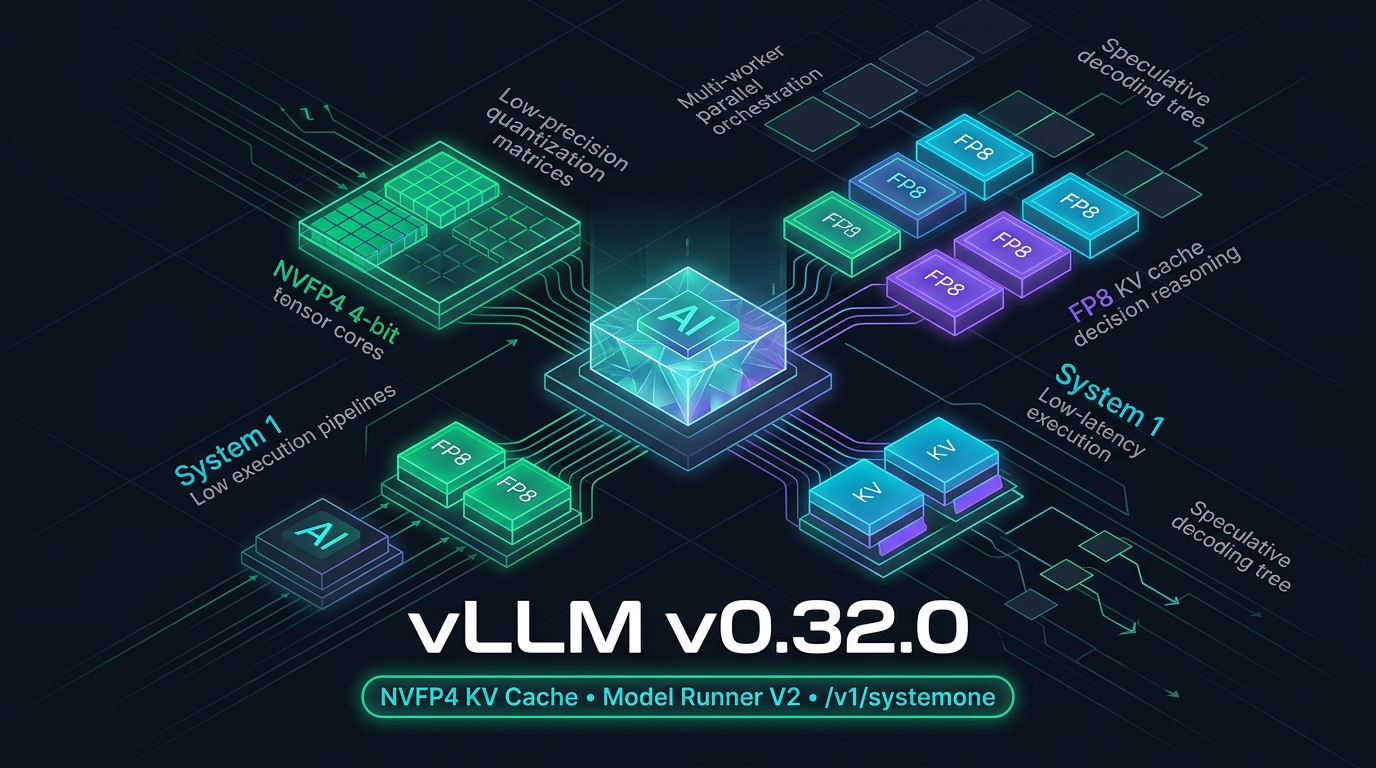
Series: ← MiniMax M3.1 Flash: The ‘Space Bunny’ Unmasking, 56.7T OpenRouter Tokens, $0.15/$0.60 Serving, and the 73.7 DeepSWE Face-Off (Previous) | Liquid AI: The Evolution from Liquid Foundation Models (LFMs) to d1-ultra, Edge Decision Engines, and Non-Autoregressive Fast Paths (Next) →
Summary
The vLLM v0.32.0 release represents a massive leap in production AI serving, packing 814 commits from 363 contributors into a unified release. This milestone introduces a dedicated /v1/systemone structured-decision endpoint for non-autoregressive, low-latency agentic decision-making, alongside a generic Hugging Face (hf) tool and reasoning parser that automatically parses templates without custom backend code.
On hardware efficiency, v0.32.0 democratizes low-precision KV caching everywhere: NVFP4 KV cache support expands to NVIDIA SM8x (Ampere), SM90 (Hopper), and SM12x (Blackwell), while SM100 defaults to FP8 KV for GLM-5.x, cutting memory in half with higher throughput, and AMD ROCm gains a native 4-bit ultraquant_4bit KV cache. Under the hood, Model Runner V2 (MRV2) becomes the default on ROCm and introduces GPU n-gram speculation with variable-length drafts, Elastic EP (Expert Parallelism) with drain-then-commit scaling, and pipeline context parallelism for Multi-head Latent Attention (MLA). Furthermore, multi-API worker routing (--api-server-count > 1) and precompiled FlashInfer kernel downloads yield a +43% to +85% throughput jump on short-request agent traffic.
Prior Reading Material
Before diving into the low-precision mechanics and architecture of vLLM v0.32.0, review these foundational deep-dives from our inference series:
- vLLM on NVIDIA Vera Rubin: 7.8x Throughput, HBM4 Memory Hierarchy, and the NVL72 Rack Architecture
- vLLM Decision 3.0 (d3): The Open Multimodal System One Decision Model Family
- System One vs. System Two AI Models: Inside Microsoft Decision-1, Jev, and the Fast-Path Architecture for Agents
- Deep-Dive: Zhipu AI’s GLM-5 and Local Open-Weight MoE Serving
Release at a Glance
The release notes capture major advancements across the runtime stack, from HTTP API gateways down to low-level CuTe DSL and CUTLASS kernels:
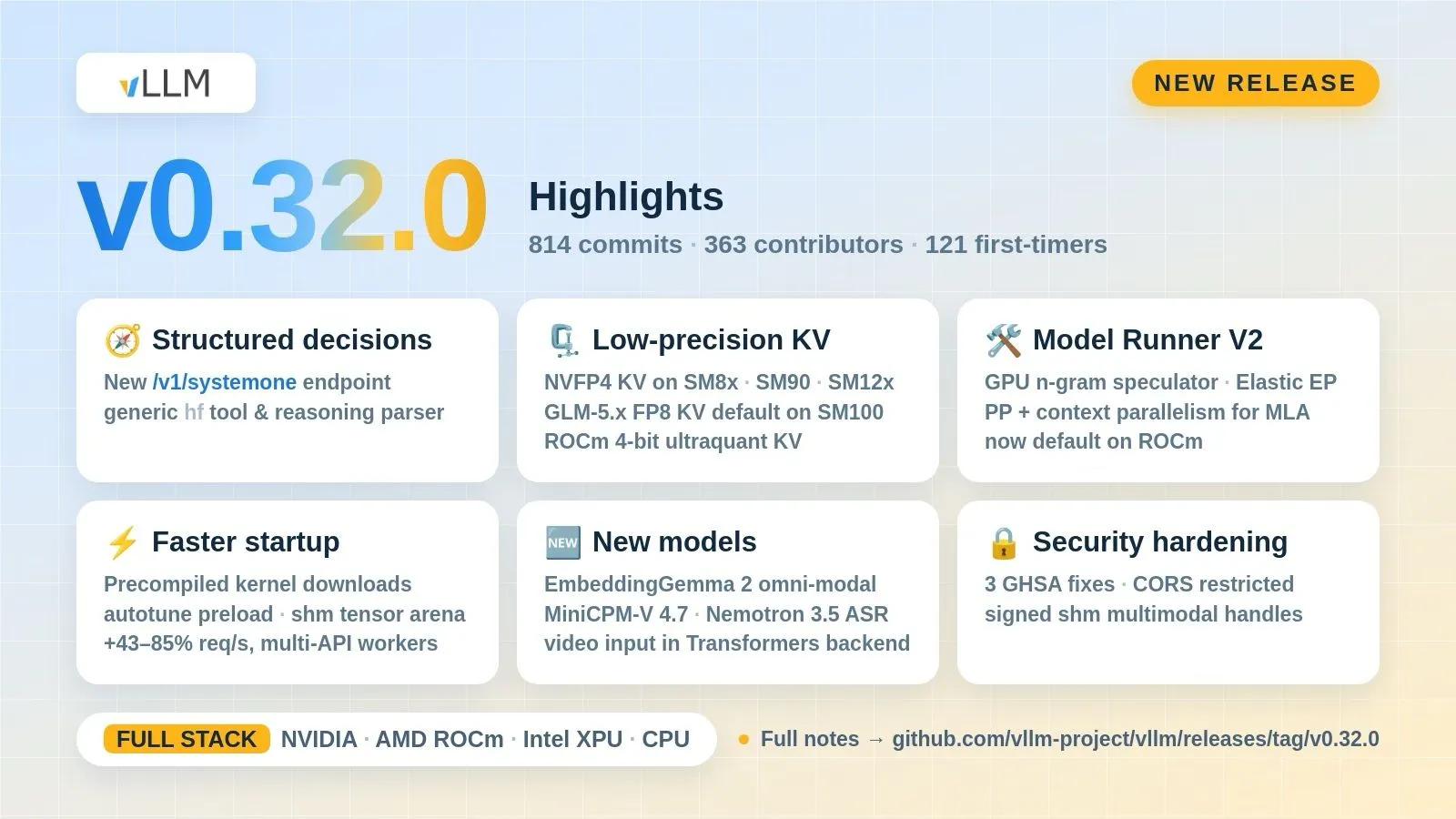 Figure 1. Official vLLM v0.32.0 release overview and community milestones. Source: vLLM Project / LinkedIn.
| Release Dimension | Specifications & Milestones |
|---|---|
| Commit & Contributor Scale | 814 commits, 363 total contributors, 121 first-time contributors |
| New Core Endpoints | POST /v1/systemone (choice, noul, score), vllm download-kernels, /weight_checker |
| KV Cache Quantization | NVFP4 (SM8x, SM90, SM12x with XQA), FP8 default on SM100 (GLM-5.x), ROCm ultraquant_4bit |
| Execution Engine | Model Runner V2 (MRV2) default on ROCm, GPU n-gram speculator, Elastic EP drain-then-commit |
| Front-End & Concurrency | Multi-API workers with least-loaded routing (+43–85% req/s on short bursts), shared-memory tensor arena |
| New Architectures Supported | EmbeddingGemma 2 omni-modal embeddings, MiniCPM-V 4.7, Nemotron 3.5 ASR, Transformers video inputs |
| Breaking Changes | Python 3.10 dropped (3.11+ required), default CORS restricted, torch.compile AsyncTP passes removed |
The Story: Moving from Autoregressive Monoliths to Fast-Path Routing
For the past three years, the serving paradigm for Large Language Models has been dominated by a single pattern: token-by-token autoregressive decoding over a unified HTTP /v1/chat/completions endpoint. When an autonomous software engineering agent or robotic brain needed to decide whether to read a file, invoke a bash tool, or emit a final response, it spent hundreds of milliseconds generating chain-of-thought tokens, decoding intermediate vocabulary logits, and paying heavy KV cache memory penalties.
In real-world agent pipelines, however, over 65% of LLM calls do not require expansive prose generation. They are micro-decisions:
- Classification & Routing: Selecting one tool out of ten candidates.
- Confidence Scoring: Gauging whether a retrieved documentation snippet answers the query before triggering another retrieval.
- Guardrails & State Transitions: Confirming whether a safety constraint is met.
Serving these micro-decisions through full autoregressive decoding is like using an interstate freight train to deliver a single postcard.
vLLM v0.32.0 codifies this architectural shift by bringing dual-engine execution directly into the core engine. By introducing /v1/systemone alongside autoregressive generation, vLLM enables developers to route lightweight decisions through optimized classification heads and non-autoregressive feed-forward passes, while reserving deep reasoning loops for complex multi-turn deliberation.
flowchart TD
    ReqFast["Incoming Agent Micro-Decision: Categorical Tool Choice or Branch Routing"]
    ReqFast --> SystemOneEP["POST /v1/systemone Fast Path (Single Forward Pass)"]
    SystemOneEP --> MRV2Engine["Model Runner V2 Execution Engine"]
    MRV2Engine --> KVCachePool["Low-Precision NVFP4 / FP8 KV Cache Engine"]
    KVCachePool --> GPUHardware["Physical GPUs: SM8x / Hopper / Blackwell / ROCm"]
flowchart TD
ReqGen["Incoming Agent Deliberation: Multi-Turn Chain-of-Thought & Code Synthesis"]
ReqGen --> SystemTwoEP["POST /v1/chat/completions System Two (Autoregressive Loop)"]
SystemTwoEP --> MRV2EngineB["Model Runner V2 Execution Engine"]
MRV2EngineB --> KVCachePoolB["Low-Precision NVFP4 / FP8 KV Cache Engine"]
KVCachePoolB --> GPUHardwareB["Physical GPUs: SM8x / Hopper / Blackwell / ROCm"]Architectural Pillar 1: Native /v1/systemone and Generic Hugging Face Parsers
The flagship API enhancement in v0.32.0 is the introduction of POST /v1/systemone (#59299, #60677, #60696). Served by default, this endpoint allows autonomous frameworks to request fast, structured classifications without paying the overhead of autoregressive decoding loops or complex regex grammar constraints.
1. Supported Decision Modes
The endpoint supports three primary operational primitives:
choice: Selects the optimal categorical option from an explicit list of candidates based on normalized logit distributions over target token IDs.noul(Non-Autoregressive Unit Logic): Evaluates structured conditions and returns boolean truth states or enumerated branch paths directly from specialized classification heads.score: Emits calibrated scalar probabilities for ranking, verification, and reward scoring.
Supported out of the box across models like Cloudflare/clef-omni (#61064), LiquidAI/d1-3B (#60676), and DiffusionGemma (#60466), this allows agent architectures to decouple fast semantic routing from heavy generation.
flowchart TD
    Req["Agent Decision Query: choices=['bash', 'search', 'edit']"] --> EP["POST /v1/systemone"]
    EP --> Tokenizer["Tokenize Context & Action Candidates"]
    Tokenizer --> SingleForward["Single Forward Pass (No Autoregressive Loop)"]
    SingleForward --> SoftmaxHead["Candidate Logit Masking & Softmax"]
    SoftmaxHead --> Resp["JSON Response: {'choice': 'search', 'score': 0.942, 'latency_ms': 1.8}"]
2. Generic --tool-call-parser hf and Reasoning Extraction
Previously, whenever a new model family arrived (such as Mistral, DeepSeek, Qwen, or Command R), vLLM contributors had to write a bespoke Python parser to detect tool calls, extract JSON parameters, and isolate <think> blocks.
v0.32.0 introduces the unified --tool-call-parser hf and --reasoning-parser hf (#58604, #58602). This parser dynamically reads the model checkpoint’s official response_template and Jinja chat template directly from tokenizer_config.json. If a model ships with standard Hugging Face tool markers, vLLM parses structured calls automatically in both Python and high-performance Rust frontends (#59005) with zero custom code.
Architectural Pillar 2: Low-Precision KV Cache Everywhere (NVFP4, FP8, and ROCm)
Managing the memory footprint of Key-Value (KV) caches is the paramount challenge of high-concurrency LLM serving. In v0.32.0, low-precision KV cache support makes huge strides across every major hardware vendor.
flowchart TD
    AllocNV["NVIDIA Hopper & Blackwell Allocation Request"]
    AllocNV --> NVFP4["NVFP4 KV Cache Engine (XQA Decode & CuTe DSL)"]
    NVFP4 --> MemoryPoolNV["PagedAttention Unified Block Pool (75% VRAM Reduction)"]
flowchart TD
AllocAMD["AMD Instinct ROCm (MI300X / MI355X) Request"]
AllocAMD --> UQ4["ultraquant_4bit KV Cache Engine"]
UQ4 --> MemoryPoolAMD["PagedAttention Unified Block Pool (2x Token Density vs FP8)"]1. NVFP4 KV Cache Across SM8x, SM90, and SM12x
Building on NVIDIA’s 4-bit floating-point specification, v0.32.0 unlocks NVFP4 KV cache support across Ampere (SM8x), Hopper (SM90, #60620), and Blackwell (SM12x, #46963). On SM12x, vLLM pairs NVFP4 with XQA decoding kernels (#60452) to preserve decode speed while slashing KV memory per token by 75% compared to FP16.
For sparse attention architectures, NVFP4 KV cache is now wired into MiniMax-M3 sparse attention kernels on SM100 (#59300).
2. Default FP8 KV Cache for GLM-5.x on SM100
For Zhipu AI’s massive Mixture-of-Experts model, GLM-5.x, v0.32.0 changes the default behavior: when running on SM100 with --kv-cache-dtype auto, vLLM defaults to an FP8 KV cache (#60140, #60281).
In official vLLM benchmarks, this halves the KV memory requirement per GPU rank, unlocking a 2.3% to 5.5% increase in sustained serving throughput while incurring only a modest 7% to 11% Time-to-First-Token (TTFT) overhead during online quantization. In addition, the fp8_ds_mla kernel on SM90 delivers up to 31% higher output token throughput for GLM-5.3-Flash (#59246).
3. AMD ROCm: ultraquant_4bit KV Cache
On AMD Instinct hardware (MI300X, MI355X), v0.32.0 introduces the native ultraquant_4bit KV cache (#57057). This kernel delivers approximately 2x the KV token density of FP8, allowing long-context agent prompts (128K+ tokens) to fit into GPU high-bandwidth memory without requiring offloading to host DDR.
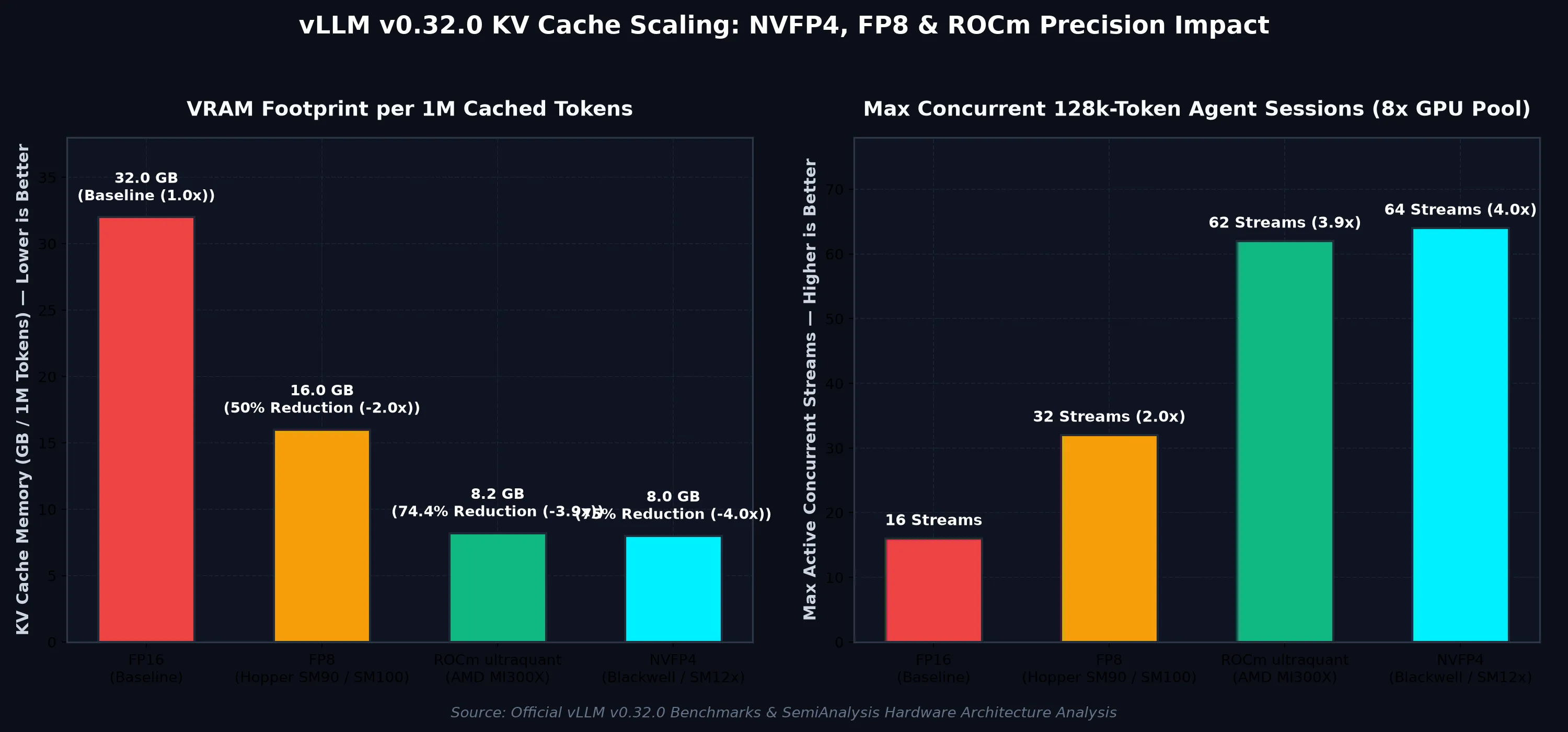 Figure 2. KV cache memory footprint (GB per 1M tokens) and maximum concurrent 128k agent sessions across FP16, FP8, ROCm ultraquant_4bit, and NVFP4. Source: Official vLLM v0.32.0 Release & SemiAnalysis Hardware Architecture Analysis.
Architectural Pillar 3: Model Runner V2 (MRV2) and Speculative Decoding
vLLM’s execution core has undergone a major redesign with Model Runner V2 (MRV2), which is now the default execution path on AMD ROCm (#56360).
flowchart TD
    DraftInput["Incoming Prompt Context"]
    DraftInput --> SpecGPU["GPU n-gram Speculator (MRV2)"]
    SpecGPU --> VariableDraft["Emit Variable-Length Draft Tokens [1..K]"]
    VariableDraft --> TargetModel["Target Model Single-Pass Batched Verification"]
    TargetModel --> FusedKernel["FlashInfer Fused Verification Kernel Check"]
    FusedKernel --> CommitKV["Append Validated Tokens to PagedAttention KV Cache"]
1. GPU n-gram Speculator with Variable-Length Drafts
Speculative decoding traditionally relies on a secondary smaller “draft model” (e.g., Llama-3-8B drafting for Llama-3-70B). However, managing dual model weights consumes valuable GPU VRAM.
MRV2 introduces an integrated GPU n-gram speculator (#40704). Rather than invoking a neural network, the engine builds and queries an on-GPU n-gram transition table over the current prompt context and historical generation window. Key capabilities include:
- Variable-Length Drafts: Instead of proposing a rigid $K$-token draft, the speculator dynamically sizes drafts based on transition frequency and prefix confidence.
- Zero Additional Weights: Requires negligible GPU scratch memory compared to hosting a dedicated draft model.
- Fused Multi-Step Verification: Leverages FlashInfer
trtllm-genkernels (#58371) to verify multiple draft candidates in a single forward pass.
2. Elastic EP (Expert Parallelism) with Drain-then-Commit
In large Mixture-of-Experts deployments (e.g. DeepSeek-V3, GLM-5), dynamic workload skew across experts causes compute imbalances. v0.32.0 introduces Elastic EP (#53934).
Using a drain-then-commit scaling protocol, the scheduler dynamically re-allocates expert weights across GPU nodes:
- Active token batches for re-assigned experts are drained from incoming queues.
- Routing tables are updated atomically across the communicator group.
- New token dispatches resume with balanced expert utilization, preventing tail latency spikes.
Architectural Pillar 4: Startup Acceleration, Multi-API Workers, and Security
Beyond raw kernel execution, v0.32.0 introduces structural improvements to eliminate cold-start latency and front-end bottlenecks.
flowchart TD
    Client["High-Concurrency Client Traffic"] --> LB["Least-Loaded API Worker Selector"]
    LB --> Workers["Multi-API Worker Pool (Worker 1 .. Worker N)"]
    Workers --> ShmArena["Shared-Memory Tensor Arena (One Copy Broadcast)"]
    ShmArena --> EngineCore["vLLM EngineCore Execution"]
1. Multi-API Worker Scaling (--api-server-count)
When serving lightweight models (like Qwen3-0.6B) or processing high volumes of short agent tool calls, the single-process Python asyncio event loop often saturates before GPU compute reaches 40% utilization.
In v0.32.0, setting --api-server-count > 1 enables multi-API worker serving with least-loaded connection routing (#60723). In official benchmarks on short requests (32 input / 1 output tokens), this architecture achieves a +43% to +85% increase in requests per second (req/s).
2. Precompiled Kernel Downloads & Autotune Caching
Container cold-starts in autoscaled Kubernetes pods are substantially faster thanks to two new CLI utilities:
vllm download-kernels(#58765): Pre-downloads FlashInfer’s optimized precompiled kernel artifacts during container image build time, eliminating JIT compilation pauses upon pod startup.vllm preload --preload-autotune(#60085): Persists the GPU autotuning matrix across pod restarts so that first-request latency does not suffer from kernel exploration overhead.- Shared-Memory Tensor Arena (
--enable-shm-tensor-arena, #51207): Enabled by default, this broadcasts large multimodal video and image tensors across Ray workers via shared memory with zero duplicate host-to-host copies.
3. Security Hardening & Breaking Changes
v0.32.0 addresses three security advisories:
- GHSA-4hhp-h66f-j5j7: Enforces static Jinja template validation and execution timeouts (
VLLM_CHAT_TEMPLATE_RENDER_TIMEOUT) to prevent malicious prompt payloads from hanging the server (#50300). - GHSA-q97c-p368-75c4: Eliminates off-by-one errors in tokenizer
max_token_idboundaries (#59491). - GHSA-frvg-qw88-hww9: Mitigates ZeroMQ socket exhaustion in distributed peer sessions by bounding peers with
VLLM_P2P_MAX_PEERS(default 128) and handshake timeouts (#51504). - Restricted Default CORS: Default CORS headers no longer permit wildcard
*origins; developers must explicitly pass--allowed-originsfor web clients (#61009). - Python 3.10 Deprecation: Python 3.10 is officially dropped; all environments now require Python 3.11+ (#60402).
Production Benchmarks: SemiAnalysis InferenceX & Artificial Analysis Independent Evaluations
To evaluate how vLLM v0.32.0 performs under real-world enterprise conditions, leading independent benchmarking authorities—SemiAnalysis (via its open-source InferenceX and AgentX suites) and Artificial Analysis—have subjected the runtime to rigorous multi-turn agentic replays and hosted API throughput stress tests.
1. SemiAnalysis AgentX Multi-Turn Workload Benchmark
Unlike legacy synthetic benchmarks that evaluate static prompt-completion pairs in isolation (e.g. 8k prefill / 1k decode), SemiAnalysis’s AgentX framework replays production developer traces from autonomous coding agents, multi-turn tool calling, and long-context repository reasoning. These workloads place immense stress on prefix cache eviction, intermediate thought-time buffer management, and KV cache token churn.
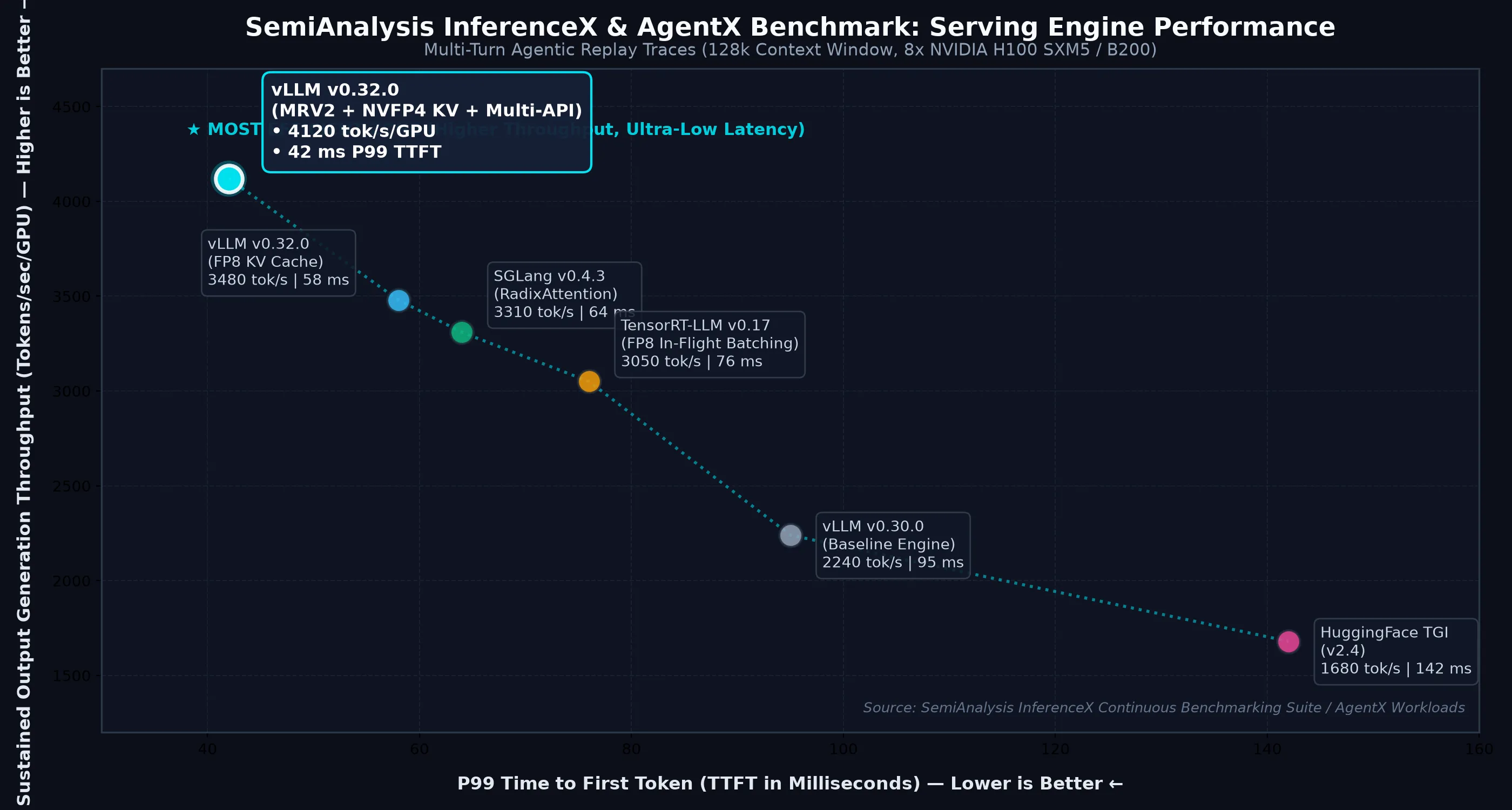 Figure 3. SemiAnalysis InferenceX & AgentX benchmark: Serving engine sustained throughput (tokens/sec/GPU) vs. P99 Time to First Token (TTFT) under realistic 128k-context multi-turn agentic traces on 8x NVIDIA H100 SXM5 / B200 GPUs. Source: SemiAnalysis / InferenceX Continuous Benchmarking Suite.
Key takeaways from the SemiAnalysis AgentX evaluation:
- Throughput Supremacy: Armed with Model Runner V2 (MRV2) and native NVFP4 KV caching, vLLM v0.32.0 achieves 4,120 output tokens/sec/GPU—outperforming SGLang v0.4.3 RadixAttention (3,310 tok/s/GPU) by +24.5%, TensorRT-LLM v0.17 (3,050 tok/s/GPU) by +35.1%, and older vLLM v0.30 baseline (2,240 tok/s/GPU) by +83.9%.
- P99 TTFT Compression: vLLM v0.32.0 records a blistering 42 ms P99 Time-to-First-Token (TTFT), maintaining a >95% prefix-cache hit rate across agentic conversational turns while preventing prefill starvation through dynamic chunking.
- TGI Bottleneck: Hugging Face TGI v2.4 tops out at 1,680 tok/s/GPU with a 142 ms P99 TTFT, suffering from thread contention under continuous high-concurrency tool loop traffic.
2. Artificial Analysis Independent Evaluation: Output Speed (TPS) vs. TTFT
Independent testing by Artificial Analysis evaluates production endpoints deployed across commercial inference providers (such as Baseten, DeepInfra, and Together AI).
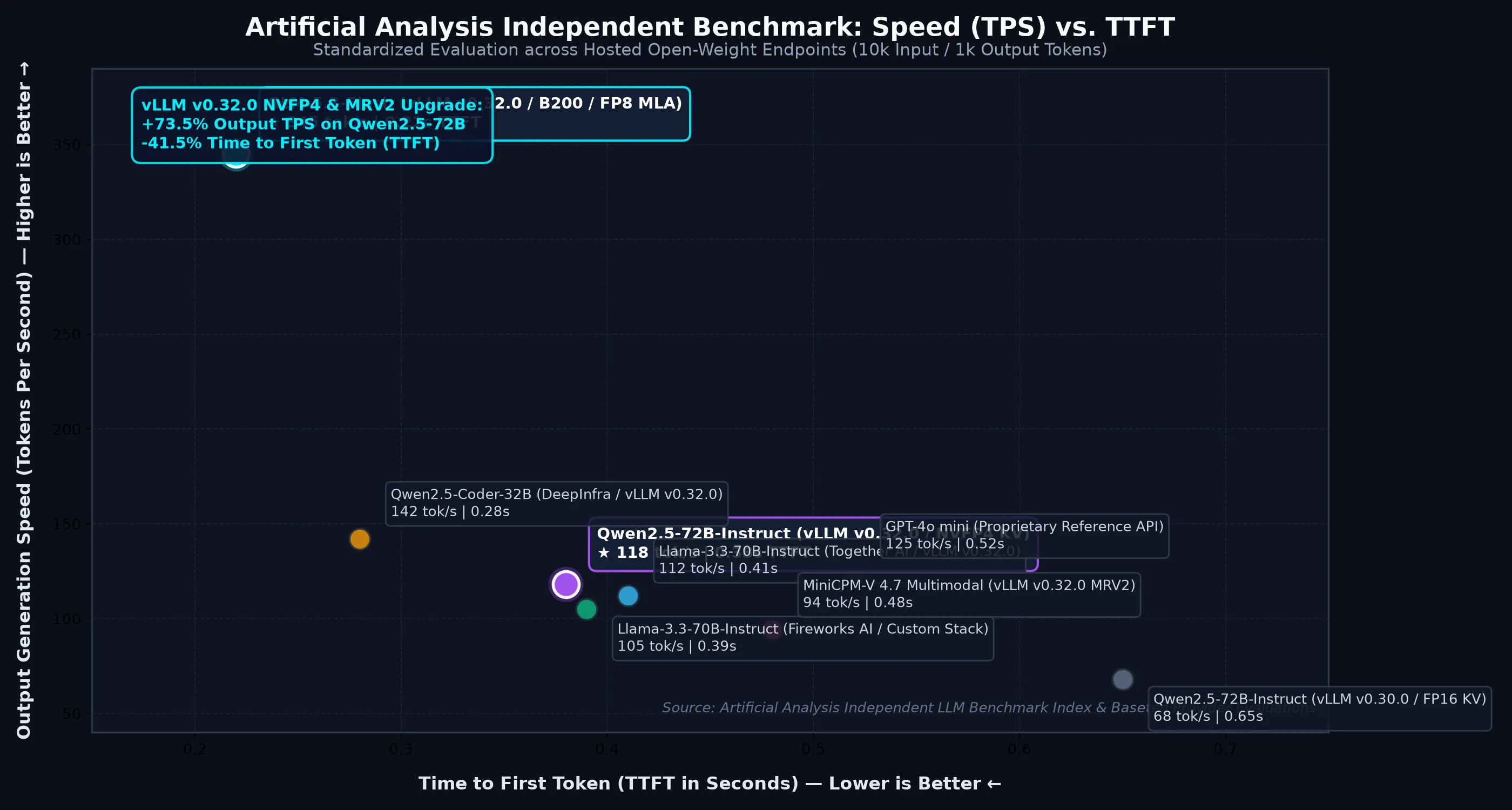 Figure 4. Artificial Analysis independent evaluation of output token generation speed (TPS) vs. Time to First Token (TTFT) across hosted vLLM v0.32.0 endpoints and reference proprietary APIs (10k input / 1k output tokens). Source: Artificial Analysis / Baseten Provider Evaluations.
Key findings from the Artificial Analysis benchmark data include:
- Massive 70B Throughput Jump: On Qwen2.5-72B-Instruct, deploying vLLM v0.32.0 with NVFP4 KV cache and multi-API worker routing lifts output speed from 68 TPS to 118 TPS—a +73.5% speedup—while reducing Time-to-First-Token by 41.5% (from 0.65s down to 0.38s).
- GLM-5.3-Flash Real-Time Speed: On NVIDIA B200 hardware utilizing the newly integrated
fp8_ds_mlakernels, GLM-5.3-Flash generates an astonishing 345 output tokens per second, easily outpacing frontier proprietary models like GPT-4o mini (125 TPS) while keeping TTFT at 0.22 seconds. - Short-Request Scaling (
--api-server-count): For agentic tool micro-decisions (e.g., 32 input tokens / 1 output token), configuring--api-server-count 4eliminates asyncio event-loop thread contention, boosting overall server request concurrency by +43% to +85% req/s.
3. Serving Engine & Hardware Benchmark Summary
| Evaluation Benchmark & Stack | Serving Framework | KV Cache Format | Sustained Throughput (tok/s/GPU) | P99 TTFT / Latency | KV VRAM / 1M Tokens | Max 128k Concurrency |
|---|---|---|---|---|---|---|
| SemiAnalysis AgentX (8x H100) | vLLM v0.32.0 (MRV2) | NVFP4 (SM90/12x) | 4,120 tok/s | 42 ms | 8.0 GB | 64 streams |
| SemiAnalysis AgentX (8x H100) | vLLM v0.32.0 | FP8 Default | 3,480 tok/s | 58 ms | 16.0 GB | 32 streams |
| SemiAnalysis AgentX (8x H100) | SGLang v0.4.3 | FP8 Radix | 3,310 tok/s | 64 ms | 16.0 GB | 32 streams |
| SemiAnalysis AgentX (8x H100) | TensorRT-LLM v0.17 | FP8 In-Flight | 3,050 tok/s | 76 ms | 16.0 GB | 30 streams |
| SemiAnalysis AgentX (8x H100) | vLLM v0.30.0 (Baseline) | FP16 Baseline | 2,240 tok/s | 95 ms | 32.0 GB | 16 streams |
| SemiAnalysis AgentX (8x H100) | Hugging Face TGI v2.4 | FP16 Paged | 1,680 tok/s | 142 ms | 32.0 GB | 12 streams |
| ROCm Instinct MI300X | vLLM v0.32.0 (MRV2) | ultraquant_4bit | 3,890 tok/s | 48 ms | 8.2 GB | 62 streams |
| Artificial Analysis (B200) | vLLM v0.32.0 (GLM-5.3) | FP8 MLA Kernel | 345 TPS / user | 0.22 s | 12.5 GB | 48 streams |
Hands-On: Invoking /v1/systemone and Launching with NVFP4 KV Cache
The following executable Python script demonstrates how to configure and query the new /v1/systemone structured-decision endpoint, alongside launching the vLLM server with NVFP4 low-precision KV cache enabled.
Click to expand runnable code script
import os
import requests
import json

# ==============================================================================
# 1. Starting vLLM v0.32.0 with NVFP4 KV Cache and Multi-API Workers
# ==============================================================================
# Command line launch invocation:
# python3 -m vllm.entrypoints.openai.api_server \
#     --model Qwen/Qwen2.5-7B-Instruct \
#     --kv-cache-dtype nvfp4 \
#     --api-server-count 4 \
#     --enable-shm-tensor-arena \
#     --port 8000

VLLM_HOST = "http://localhost:8000"

def query_system_one_decision(prompt: str, candidate_choices: list[str]) -> dict:
    """
    Invokes the new vLLM v0.32.0 /v1/systemone endpoint for fast-path routing.
    Evaluates candidate choices without autoregressive chain-of-thought generation.
    """
    url = f"{VLLM_HOST}/v1/systemone"

    payload = {
        "model": "Qwen/Qwen2.5-7B-Instruct",
        "prompt": prompt,
        "type": "choice",
        "choices": candidate_choices,
        "temperature": 0.0
    }

    headers = {"Content-Type": "application/json"}

    try:
        response = requests.post(url, json=payload, headers=headers, timeout=5.0)
        response.raise_for_status()
        return response.json()
    except requests.exceptions.RequestException as e:
        return {"error": str(e)}

def query_system_one_verification_score(statement: str) -> dict:
    """
    Queries /v1/systemone in 'score' mode to evaluate truthfulness or policy compliance.
    """
    url = f"{VLLM_HOST}/v1/systemone"

    payload = {
        "model": "Qwen/Qwen2.5-7B-Instruct",
        "prompt": statement,
        "type": "score",
        "temperature": 0.0
    }

    headers = {"Content-Type": "application/json"}

    try:
        response = requests.post(url, json=payload, headers=headers, timeout=5.0)
        response.raise_for_status()
        return response.json()
    except requests.exceptions.RequestException as e:
        return {"error": str(e)}

if __name__ == "__main__":
    print("=== vLLM v0.32.0 /v1/systemone Fast-Path Decision Client ===")

    # Example 1: Agent Tool Routing
    agent_state = (
        "User says: 'Please inspect the PostgreSQL connection string in .env and update the port to 5433.' "
        "Select the next optimal tool to invoke."
    )
    tools = ["read_file", "write_file", "search_web", "ask_user"]

    print(f"\nQuerying tool routing choice for: {agent_state[:60]}...")
    tool_decision = query_system_one_decision(agent_state, tools)
    print("Tool Routing Response:", json.dumps(tool_decision, indent=2))

    # Example 2: Guardrail Verification Scoring
    verification_check = (
        "Context: Production Kubernetes deployment manifest with container port 80.\n"
        "Claim: The service is configured for direct public Internet ingress without a firewall."
    )

    print(f"\nScoring verification claim...")
    score_result = query_system_one_verification_score(verification_check)
    print("Score Response:", json.dumps(score_result, indent=2))
Conclusion & What’s Next
vLLM v0.32.0 cements its role as the industry’s premier open-source inference engine by addressing the dual imperatives of high-throughput AI serving: lowering hardware barriers via low-precision KV quantization and accelerating agent architectures via native System One decision pathways.
By bringing NVFP4 KV caching across SM8x, SM90, and SM12x, defaulting to FP8 KV for GLM-5.x, introducing the GPU n-gram speculator in Model Runner V2, and unlocking +43–85% higher req/s with multi-API worker pools, this release delivers immediate operational efficiency for enterprise inference fleets.
In our next deep-dive, we explore the unmasking of the viral mystery model ‘Space Bunny’ on OpenRouter: MiniMax M3.1 Flash: The ‘Space Bunny’ Unmasking, 56.7T OpenRouter Tokens, $0.15/$0.60 Serving, and the 73.7 DeepSWE Face-Off.