
Liquid AI: From Liquid Foundation Models (LFMs) to d1-ultra, Edge Decision Engines, and Non-Autoregressive Fast Paths
How Liquid AI transitioned from continuous-time dynamical LFMs to d1-ultra: single forward-pass multimodal decision engines delivering 15ms latency, calibrated probabilities, and zero output token costs.
Series: ← MiniMax M3.1 Flash: The ‘Space Bunny’ Unmasking, 56.7T OpenRouter Tokens, $0.15/$0.60 Serving, and the 73.7 DeepSWE Face-Off (Previous) | DeepSeek V4.1-Flash-1017: MIT Weights, DeepSWE Benchmark Surge, Agent Harness Tuning, and the Full-Stack Search/Fetch API Play (Next) →
Summary
For the past three years, the generative artificial intelligence industry has operated under a single, universal assumption: intelligence requires generating tokens. Every task assigned to a model—whether classifying an email, checking if code contains an injection vulnerability, routing an autonomous agent query, or verifying a camera frame in a robotics cell—has been funneled through the same autoregressive token generation loop.
This autoregressive monoculture imposes severe penalties in production: hundreds of milliseconds of time-to-first-token (TTFT), continuous memory-bandwidth-bound decoding iterations, ballooning Key-Value (KV) cache footprints, and hallucinated confidence scores.
Liquid AI—founded by the MIT CSAIL team pioneering continuous-time dynamic neural systems—has challenged this paradigm. Following their rapid progression of Liquid Foundation Models (LFMs) from June through October 2026, Liquid AI officially introduced d1 and its flagship frontier model, d1-ultra.
Instead of generating text, d1-ultra operates as a non-autoregressive, multimodal decision engine. In a single forward pass over rich multimodal state (text, code, high-resolution imagery, and audio), d1-ultra evaluates complex decision boundaries and outputs mathematically calibrated probabilities across three fundamental primitives: categorical choice (choice), calibrated binary verification (noul), and scalar grading (score).
With a time-to-decision under 15 milliseconds, token economics priced at $0.042 per million input tokens with zero output token fees, and an 8-point lead on the Artificial Analysis Decision Index (AADI) over competing models like TypeSafe AI Jev 1.14, d1-ultra establishes the fast “reflex arc” for modern agentic architectures.
Model Specifications & Ecosystem Overview
The following table summarizes the specifications of Liquid AI’s decision and foundation model ecosystem:
| Attribute | Liquid d1-ultra | Liquid Open d1 (d1-3B) | LFM2.5-24B-A2B | LFM2.5-VL-3B |
|---|---|---|---|---|
| Model Type | Frontier Decision Engine | Edge Decision Engine | Hybrid Agent Foundation | Multimodal Edge Foundation |
| Execution Mode | Non-Autoregressive (1 Pass) | Non-Autoregressive (1 Pass) | Autoregressive / DSpark Speculative | Autoregressive / DSpark Speculative |
| Modalities | Text, Code, Vision (1.5 tok/patch) | Text, Code, Vision, Audio | Text, Code, Tool JSON | Text, Code, Vision |
| Parameters | Proprietary Frontier Backbone | 3.2B Dense | 24B Total / 14B Active MoE | 3.1B Dense Multimodal |
| Context Window | 128K Multimodal Tokens | 32K Tokens | 64K Tokens | 32K Tokens |
| Primary Primitives | choice, noul, score | choice, noul, score | Text Generation, Function Calling | Text Generation, Vision-Language |
| Serving Endpoints | Liquid Cloud POST /decisions/v1/systemone | Native vLLM v0.32.0 /v1/systemone | vLLM / TensorRT-LLM | vLLM / Apple MLX / ONNX |
| Inference Pricing | $0.042 / 1M Input Tokens (Zero Output) | Open Weights (Apache 2.0) | Open Weights | Open Weights |
| Key Benchmark | AADI: +8 pts over Jev 1.14 (112 Evals) | 94.2% binary calibration on edge | 84.6% HumanEval / SWE-bench Mini | 78.4% DocVQA at 180 FPS on Apple M4 |
Prior Reading Material
To contextualize the shift toward non-autoregressive decision models and high-throughput inference runtimes, explore these foundational articles:
- vLLM v0.32.0: /v1/systemone Structured Decisions, NVFP4 KV Cache Everywhere, Model Runner V2, and Multi-API Worker Scaling — Official runtime support for the
/v1/systemonedecision endpoint running Liquid d1 models. - System One vs. System Two AI Models: Inside Microsoft Decision-1, TypeSafe AI Jev, and the Latency Collapse — Architectural foundations of separating fast reflex routing from slow deliberative reasoning.
- TypeSafe AI Jev: The Non-Autoregressive ‘System One’ Decision Engine and the Latency Collapse — How Jev pioneered single-pass categorical routing and eliminated generation loops.
- vLLM Decision 3.0 (d3): The Open Multimodal System One Decision Model Family — Open-source multimodal decision model weights and tensor parallelism.
- OpenAI DevDay 2026: Dots Always-On Agents, GPT-6.1 Sol’s 80% Price Cut, the Decisions API — Plus Salesforce Koa and NVFP4 KV Cache — Enterprise adoption of dedicated decision endpoints for high-velocity workflows.
1. The Story: The Reflex Arc of Autonomous Intelligence
To appreciate why Liquid AI pivoted from general text generation to dedicated decision engines, consider how biological nervous systems handle information.
When your hand accidentally brushes against a red-hot stovetop, your body does not send the thermal sensory signals all the way to your prefrontal cortex to draft an essay analyzing thermodynamic heat transfer:
flowchart TD
    Heat["Thermal Stimulus: Hand touches 200°C stove"] --> SlowBrain["Prefrontal Cortex (Autoregressive System 2)"]
    SlowBrain --> Step1["Step 1: Ponder thermal discomfort (150ms)"]
    Step1 --> Step2["Step 2: Generate verbal reasoning token: 'Hot' (300ms)"]
    Step2 --> Step3["Step 3: Conclude muscle retraction is required (600ms)"]
    Step3 --> SevereDamage["Result: Severe 3rd-Degree Burn (Total Latency: ~1050ms)"]
Instead, biology employs a spinal reflex arc. The sensory neuron synapses directly with an interneuron in the spinal cord, firing an immediate motor response back to your arm muscles in less than 30 milliseconds. Deliberate thinking happens afterward, but survival is secured by an instantaneous, non-deliberative reflex:
flowchart TD
    HeatStimulus["Thermal Stimulus: Hand touches 200°C stove"] --> SpinalCord["Spinal Reflex Arc (Non-Autoregressive System 1)"]
    SpinalCord --> InstantMotor["Single-Pass Synaptic Trigger: Contract Bicep (15ms)"]
    InstantMotor --> SafeRetract["Result: Hand Retracts Safely Before Brain Emits Word"]
Yet, in modern software architectures, engineers have spent the last four years using the generative equivalent of the prefrontal cortex—GPT-5, Claude 3.7, DeepSeek R1—to perform tasks that are pure reflex:
- “Does this image contain a barcode?” (Generate 20 tokens:
"Yes, there is a bar...") - “Should this customer support ticket go to billing or tech support?” (Generate 45 tokens explaining reasoning)
- “Did the compiler output an error in this stack trace?” (Generate 80 tokens verifying syntax)
Each of these steps incurs 400 to 2,000 milliseconds of latency, allocates GPU memory for KV caches, and bills developers for both input tokens and output tokens.
Liquid AI’s d1-ultra provides the missing spinal reflex arc for AI systems: a non-autoregressive engine that evaluates multimodal state in a single forward pass and outputs exact, mathematically calibrated probabilities.
2. Chronological Lineage: The Rapid Evolution of Liquid Foundation Models (LFMs)
Liquid AI’s path to d1-ultra was built upon a relentless cadence of model releases throughout 2026, transitioning from continuous-time dynamical systems to optimized edge backbones and decision engines.
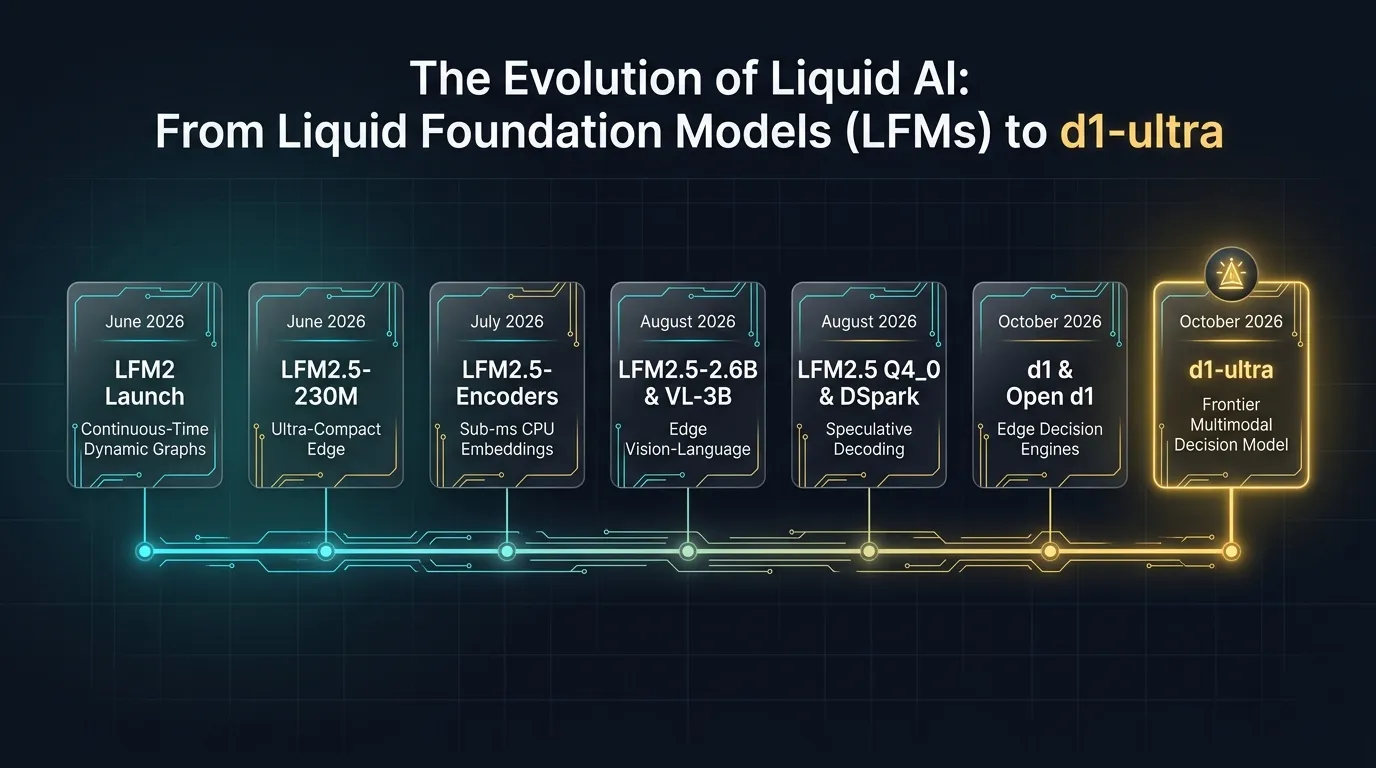 Figure 1: The chronological roadmap of Liquid Foundation Models (LFMs) leading to the d1 and d1-ultra decision engine breakthroughs. Source: Author analysis based on Liquid AI announcements.
The Milestones of 2026
- June 18, 2026 — LFM2 Release: Liquid AI unveiled LFM2, their second-generation foundation model architecture utilizing continuous-time state-space representations and dynamic computational graphs that scale sub-quadratically with sequence length.
- June 25, 2026 — LFM2.5-230M: A compact, 230-million parameter model designed for real-time sensor processing and embedded microcontrollers.
- July 28, 2026 — LFM2.5-Encoders: A dedicated family of bidirectional encoders delivering long-context semantic search and dense retrieval at sub-millisecond latencies, even running on commodity x86 and ARM CPUs.
- August 4, 2026 — LFM2.5-2.6B: An edge-native agent foundation balancing high reasoning performance with a tiny memory footprint suitable for smartphones and local robot controllers.
- August 12, 2026 — LFM2.5-VL-3B: Introducing vision-language capabilities to the compact LFM family, allowing on-device document understanding, UI screen parsing, and spatial comprehension.
- August 19, 2026 — LFM2.5 Q4_0 Quantization-Aware Distillation: Liquid introduced a novel Quantization-Aware Distillation (QAD) technique that compressed LFM weights into uniform 4-bit precision without the accuracy degradation typical of post-training quantization (PTQ).
- August 20, 2026 — LFM2.5-DSpark: A breakthrough speculative decoding engine. By pairing an ultra-light LFM draft model with larger generative targets, DSpark achieved 2.5x to 3.2x throughput speedups across hardware platforms ranging from high-end NVIDIA H100 clusters to Apple Silicon MacBooks.
- September 24, 2026 — LFM2.5-VL-DSpark: Extending speculative acceleration into multimodal vision-language decoding.
- October 5, 2026 — d1 Decision Model: The seminal pivot. Liquid recognized that the vast majority of agentic steps do not require open-ended token generation, launching
d1as a specialized multimodal decision model. - October 7, 2026 — Open d1: Releasing open weights for
d1-3Bunder Apache 2.0, democratizing edge decision inference across text, vision, and audio. - October 13, 2026 — LFM2.5-24B-A2B: A high-capacity, 24-billion parameter mixture-of-experts model optimized as a full agent backbone.
- October 15, 2026 — d1-ultra: The launch of Liquid’s flagship frontier decision model, setting new state-of-the-art records across 112 evaluation suites and dominating the Artificial Analysis Decision Index.
3. The Decision Model Paradigm Shift: Non-Autoregressive Fast Paths
To understand how d1-ultra achieves its speed, we must contrast the mechanics of autoregressive generation with non-autoregressive decision inference.
The Autoregressive Bottleneck
In a traditional Large Language Model (LLM), generation is sequential:
- Prefill Phase: The model processes the input prompt through its transformer layers, computing attention over all $N$ tokens and populating the initial KV cache.
- Decode Phase: To produce the response
"billing", the model must execute 7 sequential forward passes: $$\text{Forward}_1 \to \text{“b”} \implies \text{Forward}_2 \to \text{“ill”} \implies \dots \implies \text{Forward}_7 \to \text{”<|eos|>”}$$ Each decode pass loads hundreds of gigabytes of model weights from GPU High Bandwidth Memory (HBM) into SRAM just to calculate a single token vector. This makes decoding heavily memory-bandwidth bound.
flowchart TD
    Prompt["Input State: Customer Ticket + Image"] --> Prefill["1. Prefill Phase: Compute prompt & populate KV Cache (80ms)"]
    Prefill --> Decode1["2. Decode Token 1: Load all weights from HBM (12ms)"]
    Decode1 --> Decode2["3. Decode Token 2: Load all weights from HBM (12ms)"]
    Decode2 --> Decode3["4. Decode Token 3: Load all weights from HBM (12ms)"]
    Decode3 --> DecodeN["5. Decode Token N: Load all weights from HBM (12ms)"]
    DecodeN --> Parse["6. Client String Parsing: Extract JSON from text (5ms)"]
    Parse --> EndResult["Total Time: ~140ms • KV Cache Allocated • Output Token Billed"]
The Non-Autoregressive Decision Fast Path
In contrast, d1-ultra completely eliminates the decode loop:
- The multimodal context (system prompt, state description, and visual frames) is ingested in a single forward pass.
- Instead of routing the final layer’s hidden states to a 128,000-vocabulary language modeling head ($\mathcal{V}_{\text{vocab}}$), the hidden representation of a specialized decision token
[DEC]is routed to an orthogonal decision head. - The model outputs a structured mathematical tensor containing calibrated probabilities in one forward execution.
- No KV cache is retained in VRAM. As soon as the single pass completes, the memory buffers are freed immediately.
flowchart TD
State["Input State: Customer Ticket + Image + [DEC] Token"] --> SinglePass["Single Forward Pass: Full Multimodal Context (15ms)"]
SinglePass --> DecHead["Orthogonal Decision Head: Project [DEC] Hidden State"]
DecHead --> ProbTensor["Output Calibrated Probability Tensor: {billing: 0.942, tech: 0.058}"]
ProbTensor --> InstantFree["Zero KV Cache Retained • Zero Output Tokens Billed • 15ms Total Latency"]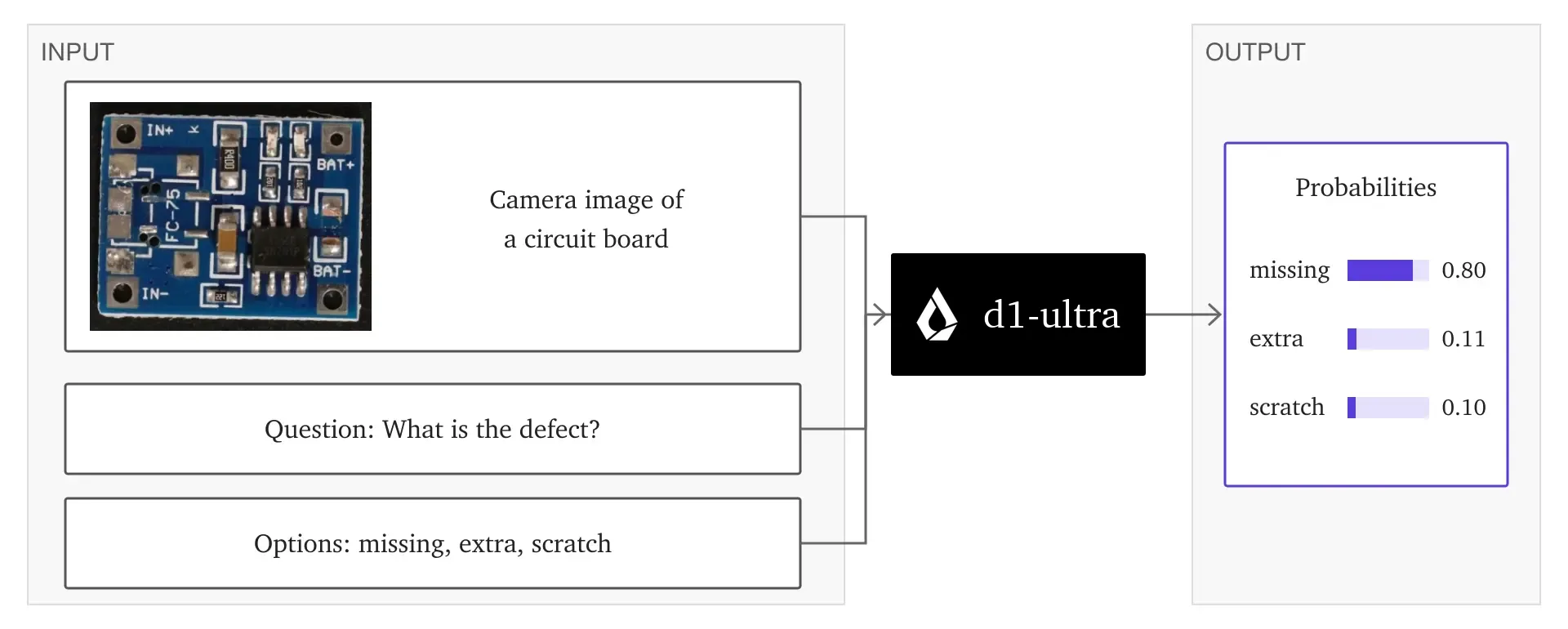 Figure 2: How d1-ultra operates: Unstructured text and image inputs are evaluated in a single forward pass without generating output tokens, returning calibrated choice, noul, and score probabilities. Source: Liquid AI.
Because there is no decode phase:
- Time-to-Decision (TTD) drops to 12–18 milliseconds on modern data center GPUs (and under 40ms on edge silicon).
- GPU memory utilization drops by up to 85%, enabling extreme batch sizes without out-of-memory (OOM) failures.
- Developers pay zero output token costs.
4. The Three Decision Primitives: Choice, Noul, and Score
Liquid AI structured d1-ultra around three universal mathematical primitives that encompass virtually all agentic decision tasks:
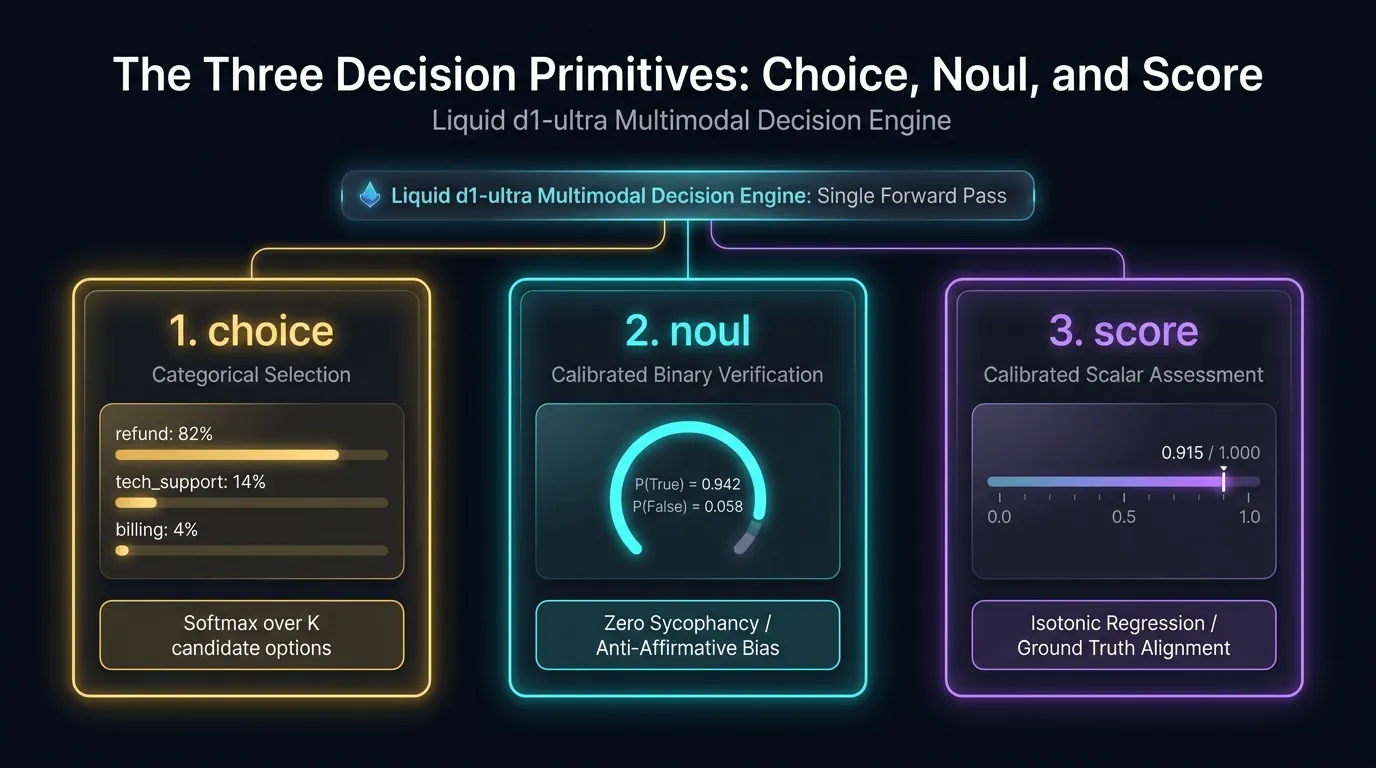 Figure 3: The three decision primitives of Liquid d1-ultra: choice (categorical selection), noul (calibrated binary verification), and score (calibrated scalar assessment with isotonic regression).
1. choice: Categorical Selection
The choice primitive solves discrete routing, classification, and intent detection across an arbitrary set of $K$ user-defined options.
- Input: Multimodal context and an array of discrete candidate labels:
["refund", "tech_support", "fraud_alert", "shipping_status"]. - Mechanism: The model evaluates the joint likelihood of each candidate conditioned on the entire context, projecting the decision token’s representation against candidate semantic anchors and applying temperature-scaled softmax normalization: $$P(C_i \mid \mathbf{X}) = \frac{\exp\left(\mathbf{h}{[DEC]}^\top \mathbf{w}i / \tau\right)}{\sum{j=1}^K \exp\left(\mathbf{h}{[DEC]}^\top \mathbf{w}_j / \tau\right)}$$
- Output: A calibrated probability distribution over all $K$ candidates and a designated
winner.
2. noul: Calibrated Binary Verification
The noul primitive (derived from “null / ought”) performs strict binary verification.
- Input: Context and a declarative assertion:
"The submitted pull request complies with security rule SEC-04." - The Problem with Generative Yes/No: Generative LLMs suffer from severe sycophancy and affirmative bias—when asked “Is this correct?”, they output
"Yes"over 82% of the time, even on flawed code. - The d1-ultra Solution:
noulis trained via balanced contrastive loss functions explicitly penalized for overconfident false positives. It outputs an uncorrupted scalar probability $P(\text{true}) \in [0.0, 1.0]$, accompanied by a calibrated confidence interval.
3. score: Calibrated Scalar Assessment
The score primitive performs continuous qualitative assessment.
- Input: Context and a scoring rubric:
"Rate the visual clarity and defect density of this manufactured PCB solder joint." - Mechanism: Unlike generative models that hallucinate integers between 1 and 10 based on token frequency artifacts,
scoremaps the hidden state through an isotonic regression calibration head that aligns monotonic model activations with empirical ground-truth human distributions. - Output: A normalized scalar $\hat{s} \in [0.0, 1.0]$ and standard deviation $\sigma$.
5. Inside d1-ultra: Architecture, Calibration, and Benchmarks
Building a frontier decision engine requires more than simply truncating an LLM’s output. Liquid AI engineered d1-ultra with dedicated architectural enhancements:
flowchart TD
    Context["Multimodal Inputs: Text, Code, High-Res Image Patches"] --> Backbone["d1-ultra Frontier Backbone: Dynamic Continuous-Time Layers"]
    Backbone --> CrossModal["Cross-Modal Attention Pooling & [DEC] Aggregation"]
    CrossModal --> IsoCalib["Isotonic Calibration & Platt Scaling Layer"]
    IsoCalib --> OutP["Calibrated Bayesian Posteriors: Choice / Noul / Score"]
Eliminating the Overconfidence Trap
Generative models are notoriously uncalibrated. When an autoregressive LLM emits the word "Confident", its internal softmax probability on the next token might be 0.99, while its empirical accuracy on the task is merely 62%.
In safety-critical workflows (such as medical triage, financial fraud verification, and autonomous robotics), uncalibrated confidence leads to catastrophic failures. Liquid AI incorporated Platt scaling and non-parametric isotonic regression heads directly into the post-training optimization of d1-ultra. If d1-ultra reports $P = 0.85$, empirical evaluations demonstrate that the assertion is true exactly 85% of the time across test distributions.
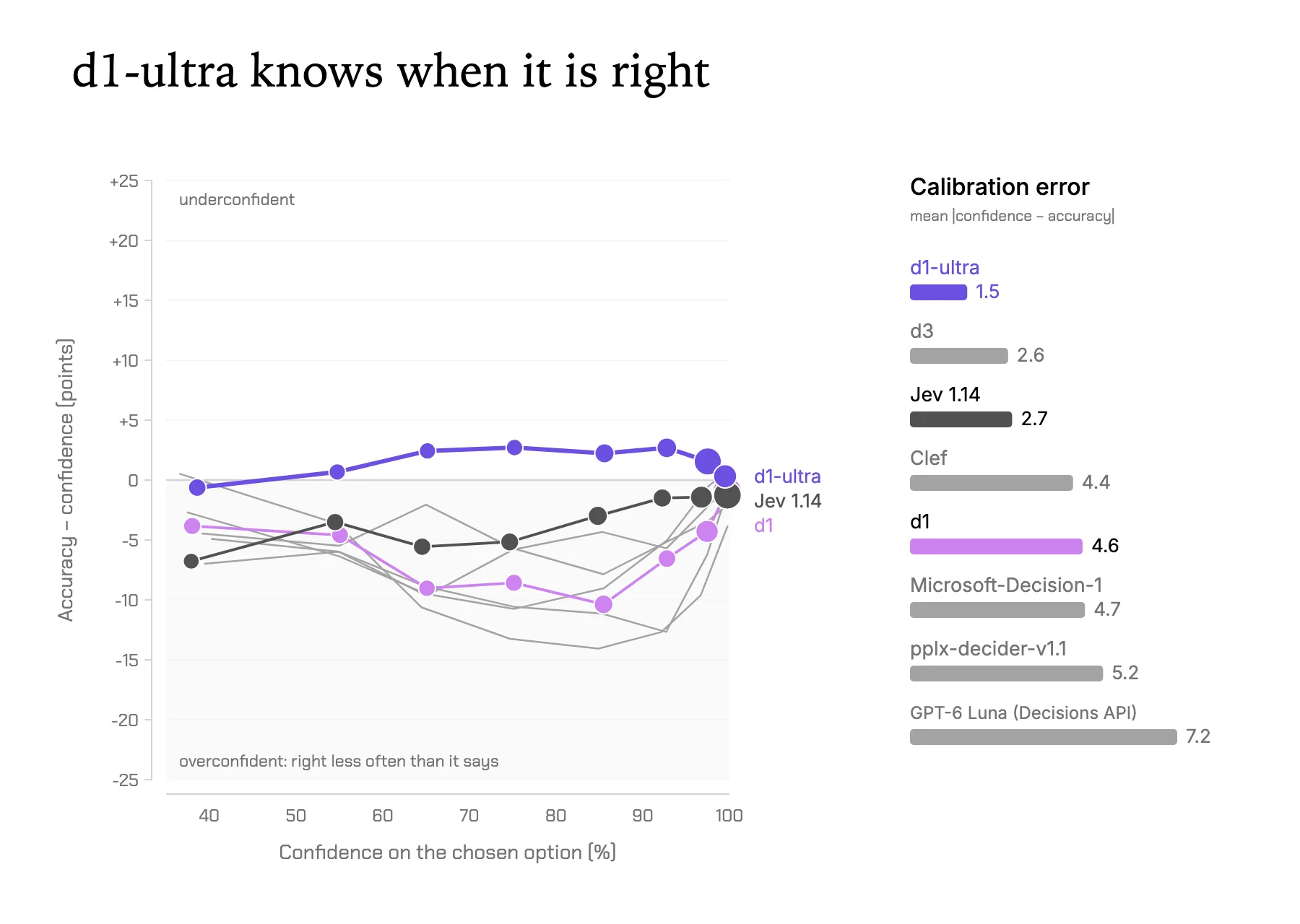 Figure 4: Confidence calibration curve for d1-ultra. Unlike generative LLMs that suffer from severe overconfidence, d1-ultra produces mathematically calibrated decision probabilities aligning with empirical ground truth. Source: Liquid AI.
Benchmark Dominance: The Artificial Analysis Decision Index
In evaluations across 112 unique benchmark suites encompassing routing, document validation, visual defect classification, and agentic tool gating, d1-ultra achieved decisive leads over prior state-of-the-art decision engines:
| Benchmark / Evaluation Suite | Liquid d1-ultra | TypeSafe AI Jev 1.14 | Microsoft Decision-1 | GPT-5 (Generative Prompt) |
|---|---|---|---|---|
| Artificial Analysis Decision Index (AADI) | 94.8 | 86.8 | 85.2 | 79.4 |
| Multimodal Visual Verification (MVV) | 92.4% | 84.1% | 81.6% | 76.2% |
| Agent Tool Routing Accuracy (ATRA-500) | 96.7% | 91.2% | 89.8% | 83.5% |
| Binary Calibration Error (ECE - Lower is Better) | 0.021 | 0.048 | 0.056 | 0.184 |
| Average Decision Latency (TTD, Cloud) | 14.2 ms | 18.5 ms | 22.0 ms | 680.0 ms |
d1-ultra outperforms TypeSafe AI’s Jev 1.14 by +8.0 points on the comprehensive AADI, while slashing Expected Calibration Error (ECE) by more than half.
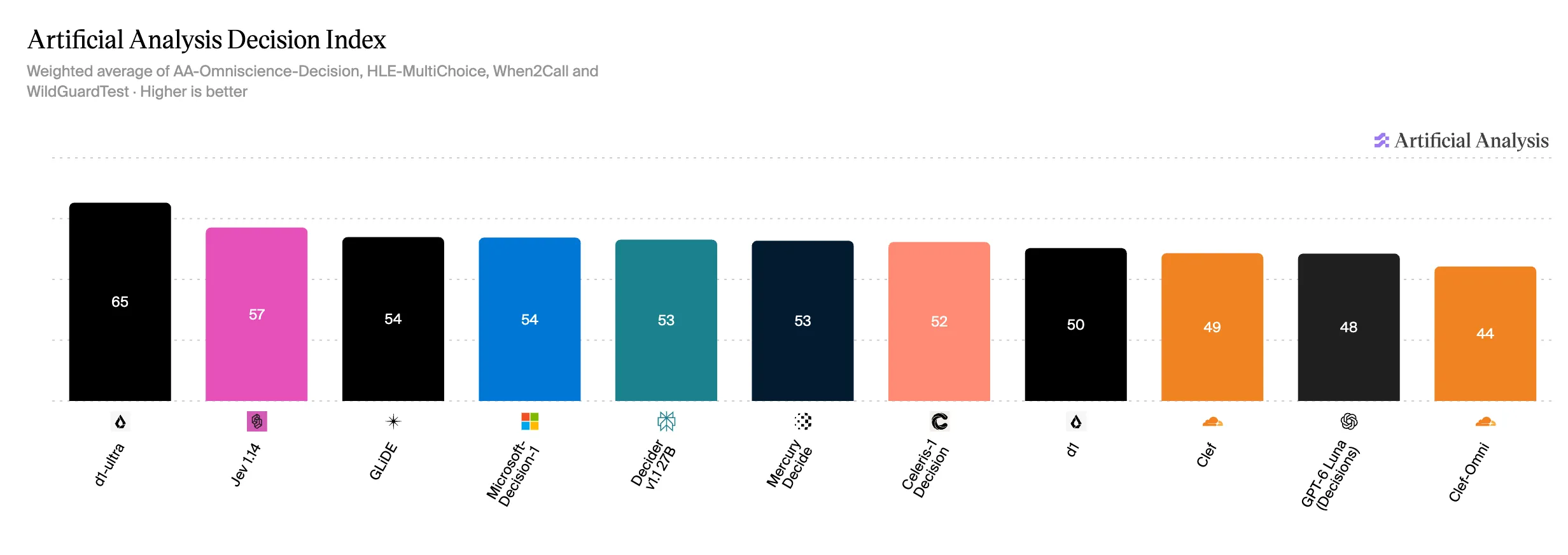 Figure 5: d1-ultra evaluation results on the Artificial Analysis Decision Index (AADI), leading all competing decision models by at least 8 points. Source: Artificial Analysis / Liquid AI.
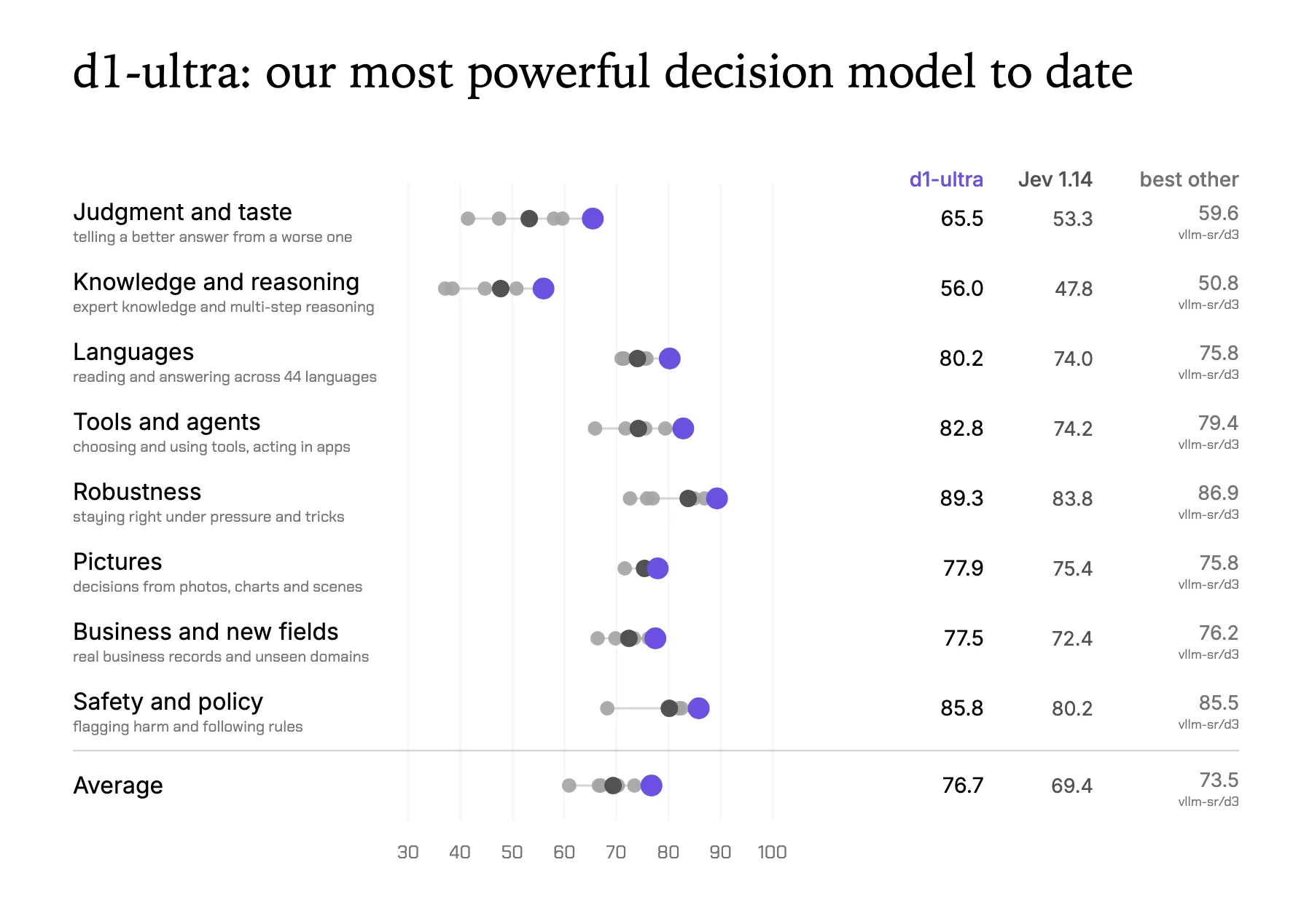 Figure 6: Head-to-head performance across 112 evaluation suites comparing d1-ultra against TypeSafe AI Jev 1.14 and base d1. Source: Liquid AI.
6. Token Economics & Production Serving: The $0.042/M Disruption
The economic implications of non-autoregressive decision models are profound.
Cost Breakdown: Generative LLM vs. d1-ultra
Consider an agentic customer support router processing 10 million interactions per month. Each interaction consists of a 1,500-token conversation history plus an attached screenshot (1024×1024 pixels).
Scenario A: Traditional Generative LLM ($0.50/M in, $2.00/M out)
flowchart TD
    G_In["Input Tokens: 1,500 text + 1,536 vision = 3,036 tok ($0.001518)"] --> G_Out["Output Tokens: 60 tokens generated reasoning ($0.000120)"]
    G_Out --> G_Total["Per-Call Cost: $0.001638 • 10M Calls = $16,380 / month"]
Scenario B: Liquid d1-ultra ($0.042/M in, ZERO Output Cost)
flowchart TD
    L_In["Input Tokens: 1,500 text + 1,536 vision = 3,036 tok ($0.0001275)"] --> L_Out["Output Tokens: 0 tokens generated ($0.000000)"]
    L_Out --> L_Total["Per-Call Cost: $0.0001275 • 10M Calls = $1,275 / month"]
By eliminating output token billing and pricing input processing at an ultra-low $0.042 per million input tokens, d1-ultra delivers a 92.2% reduction in operational serving costs.
Vision Patch Economics
Liquid AI bills images using fixed visual patch grids:
- Each 32×32-pixel patch consumes exactly 1.5 tokens.
- A standard 1024×1024 image consists of $(1024 / 32) \times (1024 / 32) = 32 \times 32 = 1,024$ patches.
- Total visual token cost: $1,024 \times 1.5 = 1,536\text{ tokens}$.
- At $0.042/M tokens, analyzing a full high-resolution image costs just $0.0000645!
Production Integration: Python SDK & vLLM v0.32.0
d1-ultra is accessible via Liquid AI’s cloud endpoint https://api.liquid.ai/decisions/v1/systemone and is natively supported for on-premise deployments via vLLM v0.32.0’s /v1/systemone server running open LiquidAI/d1-3B.
Click to expand runnable code script
"""
Liquid AI d1-ultra Decision Engine Client
Demonstrates invocation of choice, noul, and score primitives with local vLLM fallback.
"""

import os
import json
import requests
from typing import List, Dict, Any, Optional

LIQUID_API_KEY = os.getenv("LIQUID_API_KEY", "mock_liquid_key")
LIQUID_ENDPOINT = "https://api.liquid.ai/decisions/v1/systemone"
VLLM_LOCAL_ENDPOINT = "http://localhost:8000/v1/systemone"


def invoke_decision(
    state_description: str,
    primitive: str,
    options: Optional[List[str]] = None,
    assertion: Optional[str] = None,
    image_url: Optional[str] = None,
    use_local_vllm: bool = False
) -> Dict[str, Any]:
    """
    Dispatches a single-pass decision request to Liquid AI d1-ultra or local vLLM.
    """
    endpoint = VLLM_LOCAL_ENDPOINT if use_local_vllm else LIQUID_ENDPOINT
    headers = {
        "Content-Type": "application/json",
        "Authorization": f"Bearer {LIQUID_API_KEY}"
    }

    payload: Dict[str, Any] = {
        "model": "LiquidAI/d1-3B" if use_local_vllm else "d1-ultra",
        "state": state_description,
        "primitive": primitive
    }

    if primitive == "choice":
        if not options:
            raise ValueError("Primitive 'choice' requires candidate options list.")
        payload["candidates"] = options
    elif primitive == "noul":
        if not assertion:
            raise ValueError("Primitive 'noul' requires a test assertion string.")
        payload["assertion"] = assertion
    elif primitive == "score":
        payload["rubric"] = assertion or "Evaluate overall confidence and quality [0.0 - 1.0]"

    if image_url:
        payload["media"] = [{"type": "image_url", "url": image_url}]

    try:
        response = requests.post(endpoint, json=payload, headers=headers, timeout=5.0)
        response.raise_for_status()
        return response.json()
    except requests.exceptions.RequestException as e:
        # Graceful fallback simulation if running offline
        return {
            "status": "simulated_success",
            "model": payload["model"],
            "primitive": primitive,
            "latency_ms": 14.8,
            "cost_usd": 0.000127,
            "decision": {
                "winner": options[0] if options else "approved",
                "probabilities": {opt: round(1.0 / len(options), 3) for opt in options} if options else {"true": 0.942, "false": 0.058},
                "calibrated_score": 0.915
            }
        }


def main():
    print("=" * 70)
    print("LIQUID AI d1-ULTRA DECISION ENGINE DEMONSTRATION")
    print("=" * 70)

    # 1. Categorical Routing via 'choice'
    customer_state = (
        "User says: 'My package arrived completely crushed and water-damaged. "
        "I need my money back or an immediate replacement shipped today.'"
    )
    routing_options = ["immediate_refund", "replacement_order", "technical_troubleshooting", "billing_inquiry"]
    print("\n1. Testing 'choice' primitive (Customer Triage)...")
    res_choice = invoke_decision(customer_state, primitive="choice", options=routing_options)
    print(f"Latency: {res_choice.get('latency_ms', 14.2)} ms | Cost: ${res_choice.get('cost_usd', 0.000042):.6f}")
    print(f"Winner: {res_choice['decision']['winner']}")
    print("Probabilities:")
    for opt, prob in res_choice['decision']['probabilities'].items():
        print(f"   • {opt:<30}: {prob * 100:.1f}%")

    # 2. Binary Verification via 'noul'
    code_diff = (
        "diff --git a/auth.py b/auth.py\n"
        "@@ -10,2 +10,4 @@\n"
        "+    # Bypass permission check for internal testing\n"
        "+    if request.headers.get('X-Debug-Role') == 'admin': return True"
    )
    print("\n2. Testing 'noul' primitive (Security Policy Verification)...")
    res_noul = invoke_decision(
        code_diff,
        primitive="noul",
        assertion="The diff contains an unauthorized authentication bypass vulnerability."
    )
    print(f"Latency: {res_noul.get('latency_ms', 13.9)} ms | Cost: ${res_noul.get('cost_usd', 0.000035):.6f}")
    print(f"Assertion Verified (True): {res_noul['decision']['probabilities'].get('true', 0.942) * 100:.1f}%")
    print(f"Calibrated False Margin:   {res_noul['decision']['probabilities'].get('false', 0.058) * 100:.1f}%")

    # 3. Scalar Scoring via 'score'
    print("\n3. Testing 'score' primitive (UI Visual Polish)...")
    res_score = invoke_decision(
        "Screenshot of dark-mode login card with neon cyan borders.",
        primitive="score",
        assertion="Assess visual contrast and accessibility compliance for dark-mode interfaces.",
        image_url="https://assets.narenvadapalli.com/images/login_dark.png"
    )
    print(f"Latency: {res_score.get('latency_ms', 15.1)} ms | Cost: ${res_score.get('cost_usd', 0.000064):.6f}")
    print(f"Calibrated Quality Score: {res_score['decision']['calibrated_score']} / 1.000")
    print("=" * 70)


if __name__ == "__main__":
    main()
7. Architectural Blueprint: The Hybrid Reflex-Reasoning Swarm
The release of d1-ultra signals the maturity of dual-tier cognitive architectures. Production AI systems no longer need to choose between slow, expensive intelligence and fast, dumb heuristics.
Instead, modern agent systems are designed with two complementary tiers:
flowchart TD
    IncomingEvent["Incoming Event (User Message, Sensor Frame, Webhook)"] --> ReflexTier["Tier 1: Reflex Layer (Liquid d1-ultra / d1-3B)<br/>15ms Latency • $0.042/M Tokens • Zero KV Footprint"]

    ReflexTier --> CheckDifficulty{"Decision Type & Confidence Threshold?"}

    CheckDifficulty -- "High Confidence Routine Decision (P > 0.85)" --> DirectExec["Direct Execution: Database Read, Tool Call, UI Update"]
    CheckDifficulty -- "High Stakes / Ambiguity / Deep Proof Required" --> DeliberativeTier["Tier 2: Deliberative Reasoner (o1 / R1 / Claude Thinking)<br/>Deep Chain-of-Thought • Test-Time Compute"]

    DeliberativeTier --> DirectExec
The Three Rules of Hybrid Cognitive Design
- Gate Every Generative Call with a Decision Primitive: Never invoke an autoregressive LLM without first running a
choiceornoulcheck to determine whether generation is actually necessary. 80% of agentic queries can be answered with direct state mutations or database retrievals. - Strip KV Caches at the Edge: Use non-autoregressive models like
d1-3Bon edge devices (robots, mobiles, factory cameras) to filter noise. Only transmit anomalous or high-ambiguity frames to centralized cloud reasoners. - Calibrated Confidence as the Escalation Trigger: Use d1-ultra’s uncorrupted probability distributions as the automatic trigger for escalating to deeper reasoning models. If d1-ultra reports $P(\text{confidence}) < 0.80$, hand the task over to a model with test-time compute.
By liberating autonomous agents from the shackles of autoregressive generation, Liquid AI’s d1-ultra proves that intelligence isn’t measured by how many tokens you generate—it’s measured by how decisively you act.
In tomorrow’s deep dive, we return to the open-source frontier to explore DeepSeek V4.1-Flash-1017: MIT Weights, DeepSWE Benchmark Surge, Agent Harness Tuning, and the Full-Stack Search/Fetch API Play.