
Meta Muse Spark Open: Inside the 816B Multimodal Mixture-of-Experts Architecture, NVFP4 Quantization, and Open-Weights Agentic Inference
A deep architectural breakdown of Meta Muse Spark Open: 816B total parameters, 42B active per token across 256 experts, native 1M context across text, image, audio, and video, NVFP4 Blackwell serving, and DFlash/DSpark speculative decoding.
Series: ← Gemini 4 Argon for Robotics: Physical AI Reasoning, Real2Sim MuJoCo Twins, and Closed-Loop Control (Previous) | Harnessing Reasoning Models in Agentic Workflows: Integrating o1/R1, Hidden Thinking Tokens, and Cost vs. Depth Optimization (Next) →
Prior Reading Material
- Inside Meta Muse Wonder & Muse Wonder Full: Frontier Models for Personal and Professional Agents — Meta’s frontier agentic foundations, Active Memory across sessions, and long-horizon task grit.
- NVIDIA Nemotron 3.5 Super VL: 120B MoE Multimodal Architecture, 600+ TPS Agentic Inference, and Enterprise Customization — High-speed sparse MoE serving, C-RADIO vision processing, and NVFP4 Tensor Core quantization.
- vLLM on NVIDIA Vera Rubin: 7.8x Throughput, HBM4 Memory Hierarchy, and the NVL72 Inference Leap — Next-generation GPU silicon substrate, 4-bit microscaling formats, and distributed PagedAttention clusters.
- What is an Omni Model? Architectural Taxonomy Across Qwen, Gemini, and NVIDIA Cosmos — Unified multi-modal token streams bridging continuous sensor perception and digital motor policies.
Summary
In mid-October 2026, Meta open-sourced the weights for its flagship multimodal foundation model: Muse Spark Open (released across the Meta Developer Portal, official Documentation, and the Hugging Face Announcement). Weighing in at 816 billion total parameters yet activating roughly 42 billion parameters per token, Muse Spark Open represents the most capable open-weights Mixture-of-Experts (MoE) system ever released by a US frontier lab.
Unlike preceding generations that bolted separate vision encoders and speech-to-text frontends onto text-only backbones, Muse Spark Open is natively multimodal from the ground up. It unifies text, high-resolution imagery, 24 kHz raw audio waveforms, and temporal video streams into a shared 1,048,576-token (~1M) continuous context window. Engineered specifically for real-world agentic software engineering, long-horizon debugging, and visual web navigation, the model can inspect a screen recording of a flaky UI test, listen to a spoken developer voice memo, analyze multi-file git diffs, and fire structured external tool calls within a single forward inference pass.
Available immediately in both uncompressed BF16 (~1.6 TB safetensors) and hardware-calibrated NVFP4 (4-bit microscaling) checkpoints, Muse Spark Open launches with day-one support across vLLM, SGLang, llama.cpp, MLX, and Unsloth—spanning enterprise clusters of NVIDIA Blackwell B200 and AMD Instinct MI355X GPUs down to consumer Apple Silicon workstations.
Hugging Face / Official Model Card Summary
| Dimension | Technical Specification |
|---|---|
| Model Repositories | meta-models/Muse-Spark-Open-816B-A42B • meta-models/Muse-Spark-Open-816B-A42B-NVFP4 |
| Total / Active Parameters | 816B total parameters • ~42B active parameters per token |
| MoE Architecture | 62 transformer layers, 256 routed experts, top-8 active experts per token, learned residual gates |
| Attention Mechanism | Gated multi-head attention: 128 query heads, 16 key-value heads, head dimension 64, QK-norm, output gate & norm |
| Context Window | 1,048,576 tokens (1M) native sequence length at inference |
| Multimodal Perception | 1.8B parameter vision encoder (50 layers, $14 \times 14$ patches, 4096-d features, 2D RoPE) for image & video |
| Audio Processing | Continuous raw waveform tokenizer (24 kHz mono, 1,920 sample frames yielding 12.5 tokens/sec, 80 ms per token) |
| Vocabulary & Embeddings | Vocabulary size: 202,048 tokens; untied embeddings (~1.66B parameters each for input and output projection) |
| Quantization Formats | BF16 (~1.6 TB), NVFP4 (NVIDIA Blackwell), MXFP4 (AMD Instinct MI350/MI355X), INT4 GPTQ (Intel Xeon 6), Dynamic GGUF 2-bit to 8-bit (Unsloth / llama.cpp) |
| Inference Runtimes | vLLM (DSpark draft speculative decoding), SGLang (DFlash V2 speculative path), TensorRT-LLM, llama.cpp, MLX |
| License | Muse Model License (Commercial use permitted subject to Acceptable Use Policy; mandates “Built with Muse Spark Open” attribution; entities with >$20M revenue offering model-as-a-service must notify Meta and sign a separate agreement; bars military, nuclear, and under-18 misuse) |
| Official Links | Meta Developer Documentation • Build with Muse Spark Open • Hugging Face Blog |
The Story: Unifying Multimodal Reality Without the Latency Tax
Imagine an autonomous coding agent tasked with reproducing a critical frontend bug reported by a user:
flowchart TD
    A["Inbound Issue: 30-Second Video Clip of Broken Checkout + Voice Memo"] --> B["Traditional Disparate Pipeline: Run Whisper API to Transcribe Voice"]
    B --> C["Sample Video Frames -> Feed to 2D Vision Model for OCR"]
    C --> D["Stitch Transcripts & Image Descriptions into Text LLM"]
    D --> E["12-Second Cumulative Latency & Lost Temporal Alignment"]
    E --> F["Hallucinated Bug Fix Due to Separated Context"]
In standard agentic frameworks, multimodal inputs pass through an assembly line of isolated tools: audio gets transcribed by a standalone Whisper instance, video frames are chopped into separate images passed to a vision model for text captioning, and the resulting prose is dumped into an LLM context window.
By the time the LLM begins deliberating, three fatal problems occur:
- Temporal De-synchronization: The model cannot correlate the exact moment the speaker’s voice says “right here” with the mouse hover state in the video stream.
- Compound Latency: Chaining three separate API calls blows past conversational response thresholds.
- Information Bottlenecks: Audio inflection, spatial layout, and high-frequency UI transitions are irreversibly compressed into noisy text summaries.
Meta Muse Spark Open eliminates this pipeline tax entirely:
flowchart TD
    A["Simultaneous Inputs: Codebase Diff + UI Video Stream + Spoken Voice Note"] --> B["Unified Multimodal Tokenizer: 202k Text Vocab + 1.8B Vision Patches + 24kHz Audio Waveform"]
    B --> C["8,192-Dimensional Token Sequence (1M Context Window)"]
    C --> D["62-Layer MoE Backbone: 256 Experts with Top-8 Sparse Routing"]
    D --> E["Speculative Decoding: DFlash V2 / DSpark Verifying Multi-Token Chunks"]
    E --> F["Immediate Structured Action: Git Patch, Tool Execution, and Audio/Text Reply"]
Because every modality maps into the same 8,192-dimensional latent embedding space, the model perceives code syntax, audio pitch changes, and visual pixels simultaneously.
Deep Architectural Breakdown: The 816B/42B MoE Engine
The underlying architecture of Muse Spark Open synthesizes frontier Mixture-of-Experts routing with dedicated high-throughput perceptual towers:
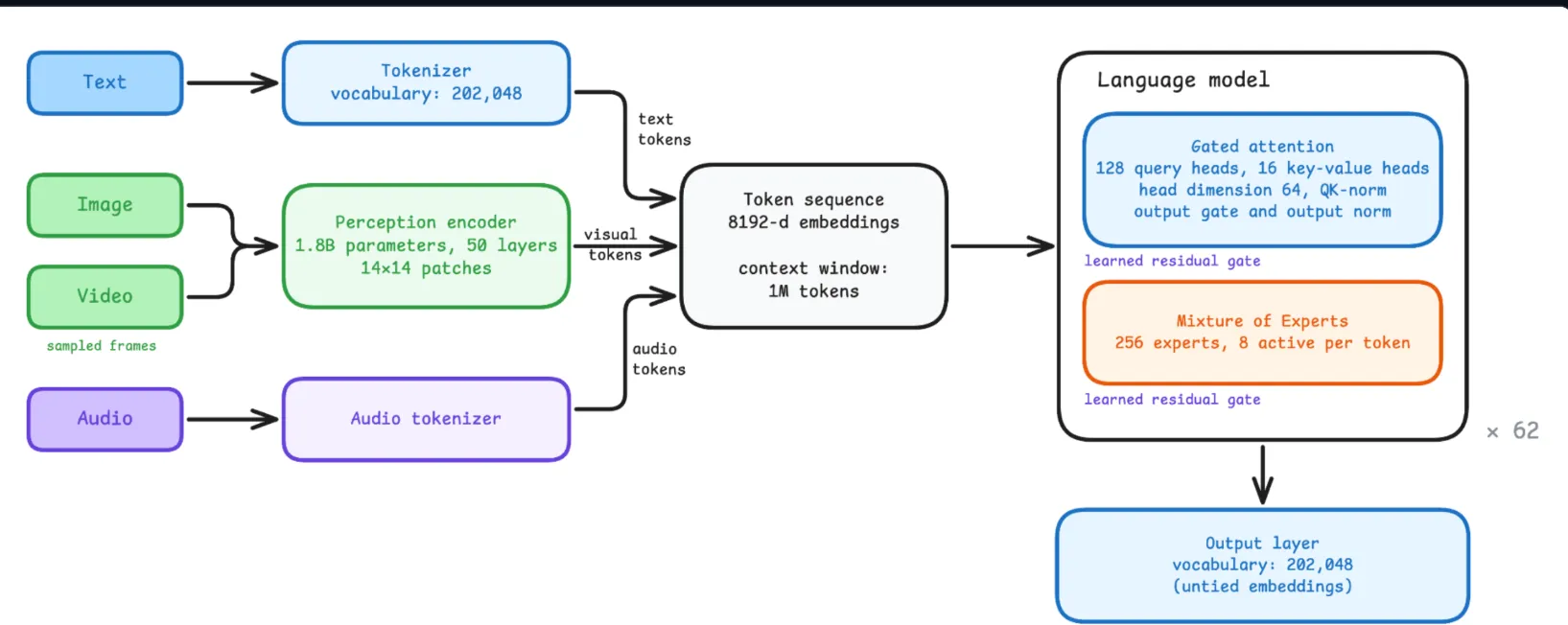 Figure 1. Full architectural pipeline of Meta Muse Spark Open: Multimodal tokenization across text (202k vocab), images/video (1.8B perception encoder, 50 layers), and audio (24 kHz waveform) feeding an 8,192-d embedding sequence into 62 MoE layers with 256 experts (8 active per token) and untied 202k output layers. Source: Meta / Hugging Face.
1. The Sparse Mixture-of-Experts Backbone
The core language model spans 62 decoder layers, each configured with:
- Hidden Dimension: 8,192 dimensions across all layers.
- Gated Multi-Head Attention: 128 query heads paired with 16 key-value heads (Grouped-Query Attention, GQA) with a per-head dimension of 64. Attention matrices incorporate explicit Query-Key Normalization (QK-norm) to stabilize training dynamics at 1M tokens, alongside gated output projections.
- Top-8 Expert Routing: Each layer contains 256 discrete feed-forward experts. For any given token, the routing gate calculates affinity logits across all 256 candidates and routes computation to strictly the top 8 experts via learned residual gates.
- Compute vs. Memory Footprint: While the entire 816B weight matrix must reside in high-bandwidth memory (VRAM), the arithmetic intensity for every generated token equals that of an agile 42B-parameter dense model. This delivers the world-knowledge density of an 800B model at the token generation latency of a lightweight model.
- Untied Input and Output Embeddings: Unlike smaller architectures that tie embedding weights to save VRAM, Muse Spark Open employs completely separated matrices for its 202,048-token vocabulary (~1.66B parameters each), preserving gradient independence between input token projection and final logits emission.
2. The 1.8B Parameter Perception Encoder (Image & Video)
Visual data is processed by a dedicated 1.8-billion parameter vision tower comprising 50 transformer layers:
- Patch Splitting: Ingests high-resolution images and video frames, dividing them into fine-grained $14 \times 14$ pixel patches.
- Feature Projection: Transforms patches into 4,096-dimensional visual features, utilizing a hybrid attention pattern: every 4th layer and the terminal 50th layer execute global dense self-attention, while intermediate layers leverage efficient local sparse attention.
- Temporal Video Alignment: Video sequences are downsampled by default to 2 frames per second (capped at 96 frames per clip). Frames are interleaved with explicit temporal timestamps (e.g.
Time: 4.5s) directly within the token sequence.
3. Continuous 24 kHz Audio Ingestion
Audio comprehension bypasses discrete semantic phoneme approximations in favor of continuous acoustic modeling:
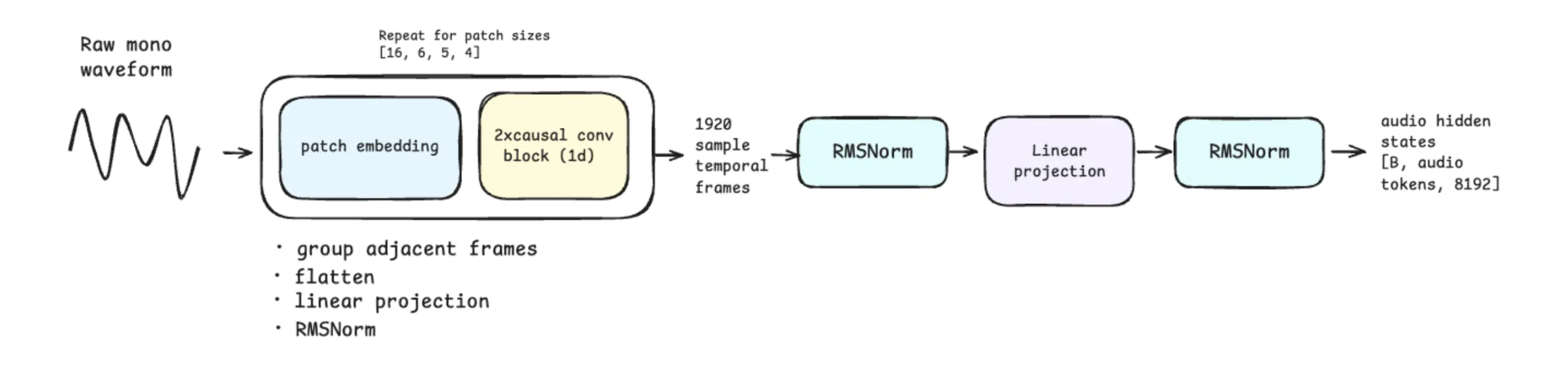 Figure 2. Audio encoding pipeline: Raw 24 kHz mono waveform segmented into 1,920-sample temporal frames, passed through 1D causal convolutions and RMSNorm projections to emit 8,192-d audio hidden states at 12.5 tokens per second. Source: Meta / Hugging Face.
- Waveform Processing: Consumes raw mono audio sampled at 24 kHz, zero-padded to multiples of 1,920 samples.
- Token Cadence: Every 1,920 audio samples yield exactly one multimodal token embedding representing an 80 ms acoustic slice (12.5 audio tokens per second). A 10-second voice note generates exactly 125 input tokens, preserving speech cadence, background acoustics, and speaker tone without text transcription errors.
Autonomous Agentic Capabilities: Browser Interaction & Coding
Meta optimized Muse Spark Open specifically for agentic execution loops: continuous planning, visual environment observation, tool execution, and error self-correction over extended horizons.
 Figure 3. Muse Spark Open operating as an autonomous browser agent: visually inspecting web pages, identifying DOM elements, executing precise search navigation, and synthesizing structured outputs in real time. Source: Hugging Face.
1. Real-World Web and Sandbox Navigation
Equipped with native visual-grounding capabilities, Muse Spark Open can interact directly with modern browser sandboxes (such as OpenEnv and Hugging Face Sandbox):
- Coordinate-Free Visual Action: Rather than relying purely on brittle HTML DOM tree parsing (which breaks across shadow DOMs and dynamic SPAs), the model visually inspects rendered viewport screenshots, identifies interactive buttons, input fields, and canvas elements, and emits high-level browser actions (
click(x, y),scroll_down,type_text). - Self-Improving Error Recovery: If an expected element fails to load or a page triggers a bot-verification modal, the model observes the visual failure, formulates an alternative navigation strategy, and recovers autonomously without developer intervention.
2. Agentic Coding & Multi-File Refactoring
On long-context developer benchmarks, Muse Spark Open sets new performance watermarks for open-weights models:
- Multi-File Context Retention: Across 100k+ token repositories, the model maintains coherence across complex cross-file dependencies, identifying stale function signatures and updating API contracts across hundreds of files in a single pass.
- Tool Calling Precision: Features dedicated system prompts for structured tool invocation, supporting multi-step chained tools, parallel API calls, and resilient JSON schema compliance even when processing complex unstructured inputs.
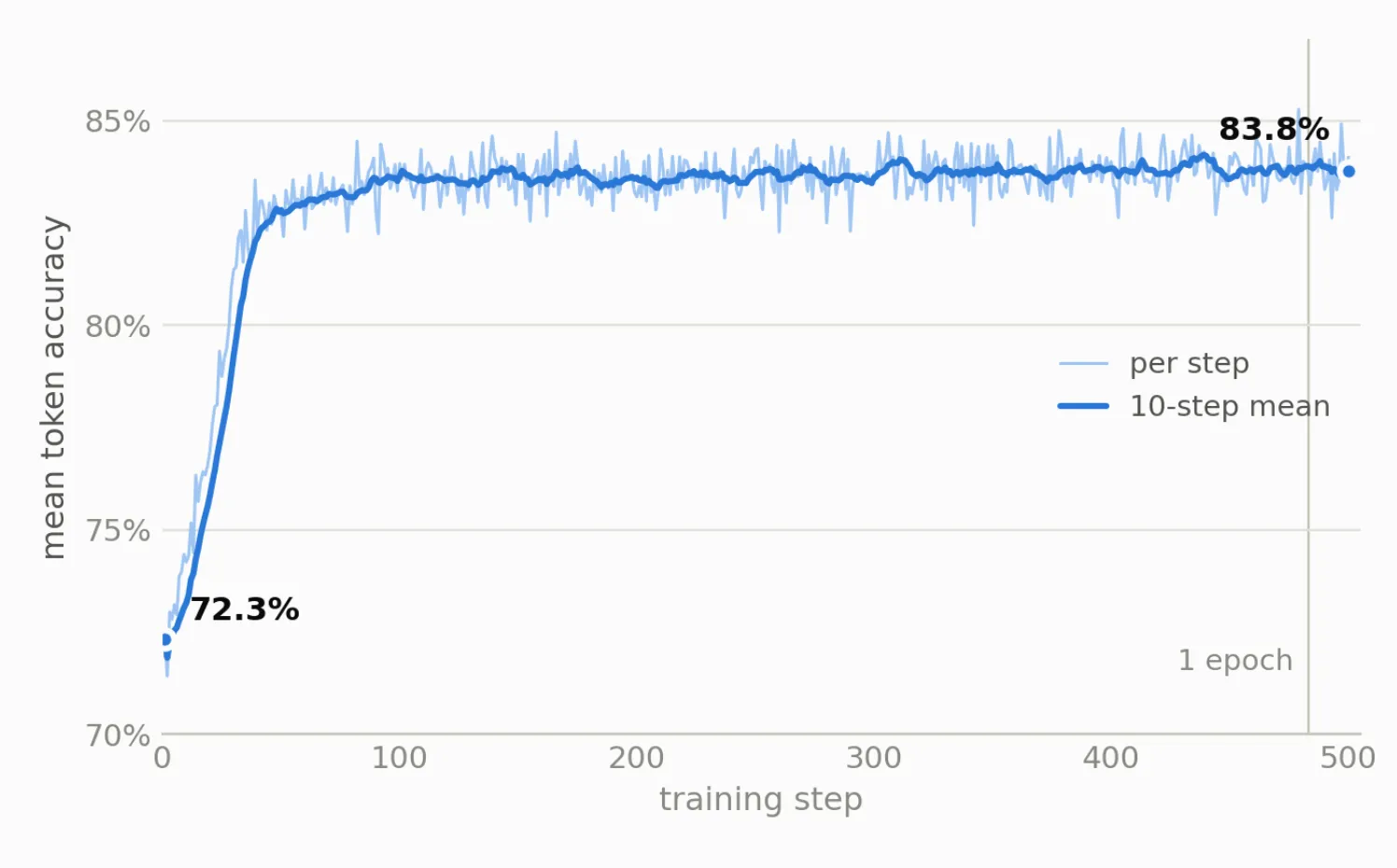 Figure 4. Mean token prediction accuracy during supervised instruction fine-tuning, rapidly converging from 72.3% to a plateau of 83.8% within a single training epoch. Source: Meta / Hugging Face.
Hardware Serving & Quantization Matrix
Deploying an 816B-parameter Mixture-of-Experts model demands thoughtful hardware provisioning. Meta and its ecosystem partners launched optimized checkpoints tailored for every deployment tier:
| Deployment Tier | Hardware Profile | Format & Precision | Framework & Parallelism |
|---|---|---|---|
| Enterprise Cloud Cluster | 4 nodes $\times$ 8 NVIDIA H200 (32 GPUs total) | Uncompressed BF16 (~1.6 TB) | Tensor Parallelism (TP=32) via Transformers / vLLM |
| Single Blackwell Node | 1 $\times$ B200 (4 GPUs) or 4 $\times$ GB300 NVL | NVFP4 (4-bit microscaling) | TensorRT-LLM & SGLang (256 experts split across 4 GPUs) |
| AMD Instinct Cluster | AMD Instinct MI350X & MI355X | MXFP4 (Quark 4-bit) | SGLang with DFlash V2 speculative decoding (3.7x TPS boost) |
| Intel Scalable Architecture | 4 $\times$ Crescent Island (160 GB) or Xeon 6 | MXFP4 / INT4 GPTQ | Compressed-tensors & offline CPU inference |
| Local Desktop Workstation | Apple Silicon Mac Studio (256 GB / 512 GB) | Dynamic GGUF (2-bit to 4-bit) | llama.cpp (18 TPS at 2-bit) & MLX dual-node tensor parallelism |
1. NVIDIA Blackwell & NVFP4 (Single Node Serving)
The reference 4-bit microscaling checkpoint (Muse-Spark-Open-816B-A42B-NVFP4) compresses model parameters into 4-bit floating point representations with negligible accuracy loss.
- Single Node Footprint: Can be served on a single 4-GPU Blackwell B200 node using TensorRT-LLM or SGLang, splitting attention 4 ways and distributing the 256 experts across the GPUs.
- Disaggregated Inference with NVIDIA Dynamo: In enterprise clusters, NVIDIA Dynamo disaggregates prefill nodes from decode workers, routing requests dynamically to workers already holding warm prefix KV caches.
2. Speculative Decoding: DFlash V2 & DSpark
To overcome memory-bandwidth bottlenecks during autoregressive generation, Muse Spark Open ships with day-one support for two open draft models:
- DFlash V2 (RadixArk & SGLang): Proposes multi-token candidate blocks in a single pass. On AMD Instinct MI355X hardware, DFlash V2 delivers 3.7x throughput acceleration for single requests and 2.9x at 16 concurrent requests (averaging 6.4 accepted tokens per step).
- DSpark (Inferact & vLLM): Co-developed by NVIDIA and the vLLM team, DSpark proposes up to 7 tokens simultaneously using a lightweight autoregressive head that accounts for token interdependencies. It maintains linear speedup across long 1M-token contexts by leveraging sliding-window attention.
3. Local Desktop Inference on Apple Silicon (MLX & llama.cpp)
For edge and privacy-conscious environments, Muse Spark Open runs locally on Apple Silicon workstations:
- Unsloth Dynamic GGUF: Compresses parameters down to 2-bit quantization, allowing the full model to fit within ~300 GB of unified system RAM. On an Apple M3/M4 Ultra Mac Studio (512 GB), an imatrix-calibrated 2-bit quant runs at 18 tokens per second via
llama.cppwith ample headroom for KV cache storage. - Apple MLX Tensor Parallelism: Splits every layer across two linked Mac Studios with M5 Ultra chips (512 GB each) or four Mac Studios with 256 GB, serving the NVFP4 checkpoint with zero cloud dependencies.
Running Muse Spark Open with vLLM
Developers can serve the Muse-Spark-Open-816B-A42B model with high-throughput PagedAttention and speculative decoding using vLLM.
Click to expand runnable code script
import os
from vllm import LLM, SamplingParams

# Configure model checkpoint and multimodal runtime settings
MODEL_ID = "meta-models/Muse-Spark-Open-816B-A42B-NVFP4"

def serve_muse_spark():
    # Initialize vLLM with tensor parallelism across 4 Blackwell GPUs
    llm = LLM(
        model=MODEL_ID,
        tensor_parallel_size=4,
        max_model_len=65536,
        trust_remote_code=True,
        enable_prefix_caching=True,
        gpu_memory_utilization=0.92,
        speculative_model="inferact/DSpark-Draft-7B",
        num_speculative_tokens=5,
    )

    # Sampling parameters tuned for agentic reasoning and tool execution
    sampling_params = SamplingParams(
        temperature=0.2,
        top_p=0.95,
        max_tokens=4096,
        stop=["<|eot_id|>", "<|tool_call_end|>"]
    )

    # Multi-modal prompt combining image screenshot and voice note
    conversation = [
        {
            "role": "user",
            "content": [
                {"type": "text", "text": "Analyze the UI checkout error shown in this screenshot and the attached user audio report. Identify the broken React component and emit a patch."},
                {"type": "image_url", "image_url": {"url": "https://example.com/assets/checkout_error.png"}},
                {"type": "audio_url", "audio_url": {"url": "https://example.com/assets/user_audio_report.wav"}}
            ]
        }
    ]

    print("🚀 Dispatched multi-modal prompt to Muse Spark Open...")
    outputs = llm.chat(messages=conversation, sampling_params=sampling_params)

    for output in outputs:
        prompt = output.prompt
        generated_text = output.outputs[0].text
        print("\n--- Model Response ---")
        print(generated_text)

if __name__ == "__main__":
    serve_muse_spark()
Conclusion & What Comes Next
Meta Muse Spark Open establishes a landmark precedent for the global AI community: a massive, 816-billion parameter multimodal Mixture-of-Experts model released with open weights. By bridging high-resolution vision, 24 kHz acoustic modeling, 1M continuous context tokens, and sub-42B active token speed, it equips developers to build frontier agentic workflows, autonomous coding swarms, and visual browser assistants without platform lock-in.
In tomorrow’s post, we shift focus to high-performance open-source serving infrastructure: vLLM v0.32.0: /v1/systemone Structured Decisions, NVFP4 KV Cache Everywhere, Model Runner V2, and Multi-API Worker Scaling.