
vLLM on NVIDIA Vera Rubin: 7.8x Throughput, HBM4 Memory Hierarchy, and the NVL72 Inference Leap
Inside vLLM's day-0 support for NVIDIA Vera Rubin NVL72: 19.16 TB/s HBM4 bandwidth, 50 PFLOPS NVFP4 Tensor Cores, CUDA 13.4 locality domains, and 7.8x throughput scaling over GB200.

Series: ← OpenAI DevDay 2026: Dots Always-On Agents, GPT-6.1 Sol’s 80% Price Cut, the Decisions API — Plus Salesforce Koa and NVFP4 KV Cache (Previous) | Inside Meta Muse Wonder & Muse Wonder Full: Frontier Models for Personal and Professional Agents (Next) →
Summary
On October 9, 2026, the vLLM project announced day-0 support for NVIDIA Vera Rubin NVL72, marking the fastest software runtime adaptation for a next-generation GPU microarchitecture in open-source AI history. While NVIDIA’s Blackwell (GB200/B200) family unlocked 4-bit microscaling formats and rack-scale NVLink domains, Rubin takes the inference engine to an unprecedented physical frontier: pairing 8 stacks of HBM4 memory delivering 19.16 TB/s of bandwidth per GPU with second-generation NVFP4 Tensor Cores capable of 50 PFLOPS of sparse compute.
In empirical production evaluations on heavy agentic Mixture-of-Experts (MoE) workloads, vLLM on Vera Rubin achieves up to 7.8x the per-GPU token throughput of the GB200 NVL72. By combining FlashInfer 0.7.0 Rubin-tuned attention and GEMM kernels with CUDA 13.4 locality domains—which pin partitioned MoE expert weights to the physically closest HBM4 channels—vLLM converts raw silicon improvements into linear serving gains for frontier models across DeepSeek, Moonshot Kimi, GLM, and MiniMax.
Official Specifications & Architectural Head-to-Head
| Architectural Dimension | NVIDIA GB200 NVL72 (Blackwell) | NVIDIA Vera Rubin NVL72 (Rubin) | Generational Multiplier |
|---|---|---|---|
| GPU Die Topology | Dual-die CoWoS-L (208B transistors) | Dual-die Advanced Packaging (336B transistors) | 1.6x |
| HBM Technology | 8 stacks HBM3e (186 GB capacity) | 8 stacks HBM4 (288 GB capacity) | 1.5x Capacity |
| Memory Bandwidth | 7.94 TB/s per GPU | 19.16 TB/s per GPU | 2.4x Bandwidth |
| Rack HBM Pool | 13.4 TB aggregate NVL72 memory | 20.7 TB aggregate NVL72 memory | 1.55x |
| Interconnect (NVLink) | NVLink 5 (1.8 TB/s bidirectional) | NVLink 6 (3.0 TB/s bidirectional) | 1.7x |
| BF16 Tensor Compute | 2.5 PFLOPS dense | 4.0 PFLOPS dense | 1.6x |
| FP8 Tensor Compute | 5.0 PFLOPS dense | 17.5 PFLOPS dense | 3.5x |
| NVFP4 Training Compute | 10.0 PFLOPS dense | 35.0 PFLOPS dense | 3.5x |
| NVFP4 Inference Compute | 10.0 PFLOPS (dense) | 50.0 PFLOPS (sparse) | 5.0x |
| Softmax SFU (FP32) | 1x baseline | 2x exponentials per SM per clock | 2.0x |
| Softmax SFU (BF16/FP16) | 1x baseline | 4x exponentials per SM per clock | 4.0x |
| Primary Software Stack | vLLM 0.6.x + CUDA 12.8 / 13.0 | vLLM + FlashInfer 0.7.0 + CUDA 13.4 | Day-0 Optimized |
Prior Reading Material
To explore how GPU silicon packaging, interconnect fabrics, and inference serving engines connect, review our prerequisite deep dives:
- OpenAI DevDay 2026: Dots Always-On Agents, GPT-6.1 Sol’s 80% Price Cut, the Decisions API — Plus Salesforce Koa and NVFP4 KV Cache — The architectural mechanics of NVFP4 block quantization and SGLang KV-cache compression on Blackwell.
- System One vs. System Two AI Models: Inside Microsoft Decision-1, TypeSafe AI Jev, and the Latency Collapse — Why fast routing and discriminative decision heads relieve cluster compute pressure.
- The Always-On Agent Showdown: Architectural, Security, and Autonomy Comparison Across Meta Muse, OpenAI Dots, Google Gemini Spark, and Perplexity Computer — Rack-level microVM sandboxing and high-density datacenter serving.
- Claude Haiku 5.5: Adaptive Thinking, Effort Scaling, and Frontier Agentic Work at Scale — Subagent swarm execution dynamics and token generation speed limits.
1. Under the Silicon Hood: What Vera Rubin Changes for Inference
In large language model inference, the bottleneck has never been raw arithmetic FLOPS alone; it is the memory-bandwidth-to-compute ratio ($B / F$) and the communication latency required to orchestrate Mixture-of-Experts (MoE) routing across clusters.
The transition from Blackwell (GB200) to Vera Rubin represents the most aggressive hardware redesign since NVIDIA introduced the Ampere A100:
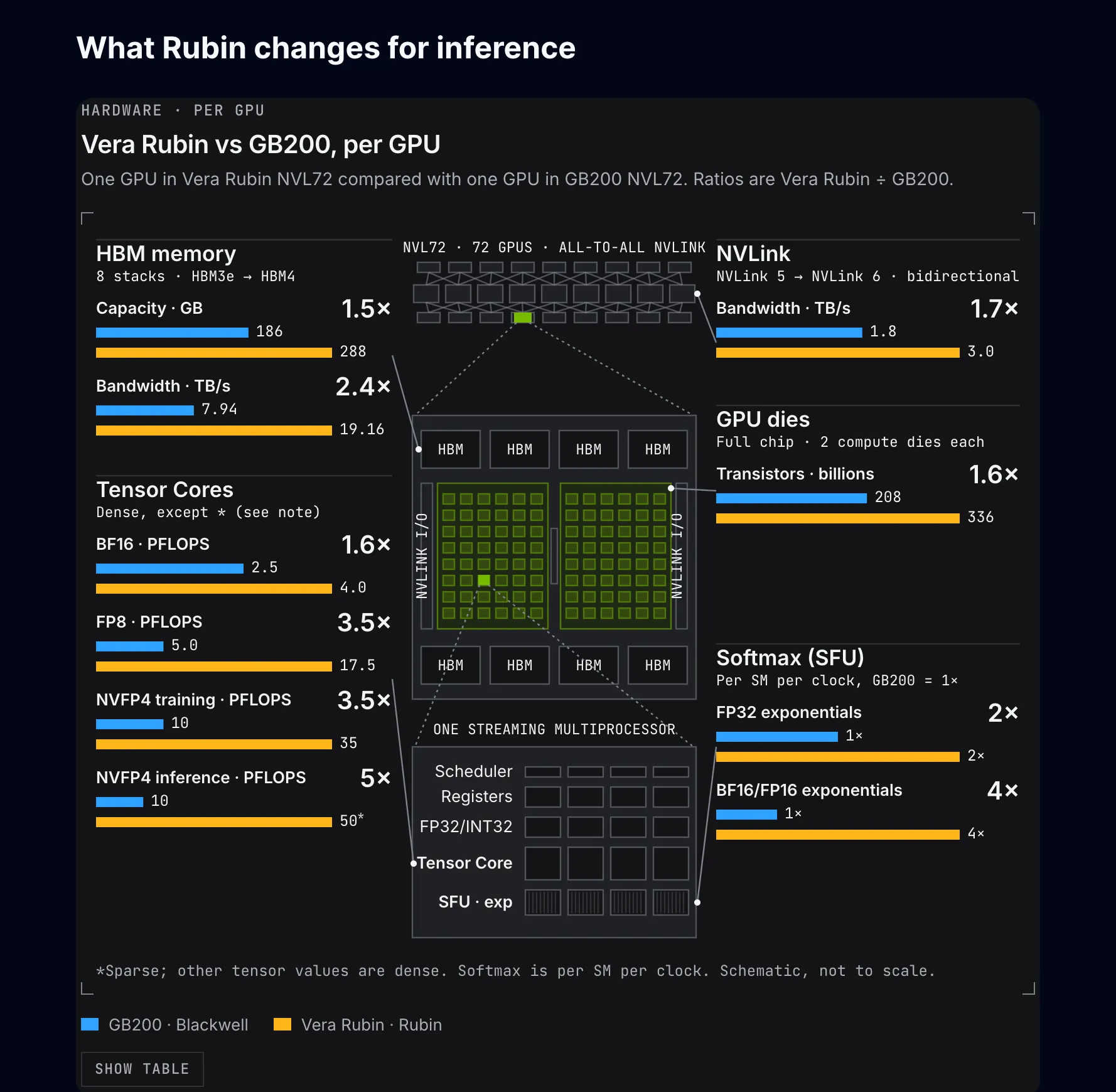 Figure 1: Architectural comparison between one GPU in Vera Rubin NVL72 and one GPU in GB200 NVL72. Data source: vLLM Engineering and SemiAnalysis.
1. The HBM4 Bandwidth Super-Highway (19.16 TB/s)
Blackwell’s 8 stacks of HBM3e topped out at 7.94 TB/s. While impressive, a 671B DeepSeek-V3 or a 1M-context agentic reasoning model running in FP8/FP4 quickly saturated those channels during the auto-regressive decode phase, leaving Tensor Cores starved for weights.
Rubin transitions directly to HBM4, widening the physical bus from 1024-bit interfaces to a customized 2048-bit base logic die with ultra-fine Through-Silicon Vias (TSVs). The result is 19.16 TB/s per GPU—a massive 2.4x leap. For memory-bound decode loops, token generation latency scales directly with this bandwidth curve.
2. NVFP4 Tensor Core Acceleration (50 PFLOPS Sparse)
While Blackwell introduced FP4 execution, Rubin refines the micro-scaling mathematical formats:
- FP8 jumps 3.5x to 17.5 PFLOPS.
- NVFP4 inference surges 5.0x to 50.0 PFLOPS per GPU when leveraging 2:4 structured sparsity.
- This allows a single NVL72 rack to deliver 3.6 ExaFLOPS of FP4 inference compute.
3. The Softmax SFU Unclogging
An often overlooked bottleneck in long-context attention kernels is the Special Function Unit (SFU). Calculating the attention matrix $A = \text{softmax}(Q K^T / \sqrt{d_k})$ requires evaluating thousands of mathematical exponentials ($\exp$). On Blackwell, dense SFUs could bottleneck attention kernels when sequence lengths approached 128k or 1M tokens.
Rubin doubles FP32 exponential throughput to 2x per SM per clock and quadruples BF16/FP16 exponential throughput to 4x. FlashAttention and FlashInfer kernels can now compute attention normalization without stalling the Tensor Core pipeline.
2. vLLM Day-0 Software Architecture: Unlocking the Hardware
Raw silicon is useless without a runtime that can exploit it. When NVIDIA taped out Rubin, the vLLM team collaborated to ensure that software was not the lagging indicator:
flowchart TD
    M["Inbound Inference Workload: DeepSeek-V3 / Kimi 1M MoE"]
    style M fill:#0f172a,stroke:#38bdf8,stroke-width:2px,color:#ffffff
flowchart TD
V["<b>vLLM Rubin Runtime Layer</b><br/>CUDA 13.4 Locality Domains + FlashInfer 0.7.0 Kernels"]
style V fill:#042f2e,stroke:#14b8a6,stroke-width:2px,color:#ffffffflowchart TD
subgraph ExecutionPlane["Vera Rubin Hardware Acceleration Pipeline"]
direction TB
L["CUDA 13.4 Locality Domains: Nearest-HBM4 Channel Expert Pinning"]
S["FlashInfer 0.7.0: 4x SFU Exponentials + Fused NVFP4 Attention GEMM"]
N["NVLink 6 All-to-All Fabric: 3.0 TB/s Bidirectional Mesh Routing"]
L --> S --> N
end
style ExecutionPlane fill:#0b0f19,stroke:#76b900,stroke-width:2px,color:#ffffff
style L fill:#1e1b4b,stroke:#818cf8,stroke-width:1.5px,color:#ffffff
style S fill:#064e3b,stroke:#10b981,stroke-width:1.5px,color:#ffffff
style N fill:#0d2b45,stroke:#00e5ff,stroke-width:1.5px,color:#ffffffflowchart TD
R["<b>Result: 7.8x Token Throughput on Agentic MoE Workloads</b>"]
style R fill:#065f46,stroke:#34d399,stroke-width:2px,color:#ffffffCUDA 13.4 Locality Domains: Eliminating NUMA Memory Stalls
In high-density dual-die packaging with 8 individual HBM4 stacks, memory access is inherently non-uniform (NUMA). If Streaming Multiprocessor #1 on Compute Die A attempts to read MoE weights residing in HBM stack #8 on Compute Die B, the request must traverse cross-die interconnects, introducing micro-latency penalties.
vLLM utilizes CUDA 13.4 locality domains to partition MoE expert weights. When deploying models with 64 or 256 routed experts (such as DeepSeek-V3 or GLM-5), vLLM statically assigns expert tensors to the locality domain immediately adjacent to the dispatching SM cluster. SMs read expert weights from their local HBM4 stack at the maximum 19.16 TB/s rate, bypassing inter-die fabric traffic.
FlashInfer 0.7.0 Rubin Kernels
Through FlashInfer 0.7.0, vLLM introduces native compute capability sm_107 targets:
- Fused NVFP4 dequantization directly inside the tensor core registers.
- Native dispatch to Rubin’s 4x BF16 SFU exponential units, slashing long-context multi-head latent attention (MLA) decode times.
- Backward compatibility: existing Blackwell
sm_100fkernels continue to execute without code rewrites, allowing immediate zero-downtime cluster migrations.
3. The NVL72 Rack Architecture: NVLink 6 and 3.0 TB/s Mesh
The true power of Vera Rubin is realized at the rack level. Individual GPUs no longer act as isolated accelerators; the entire 72-GPU rack behaves as a single unified supercomputer:
flowchart TD
R72["<b>NVL72 Unified Coherent Memory Enclave</b><br/>72 Vera Rubin GPUs • 20.7 TB Total HBM4 • NVLink 6 Copper Spine"]
style R72 fill:#0b0f19,stroke:#00e5ff,stroke-width:2px,color:#ffffffflowchart TD
subgraph AllToAll["All-to-All NVLink 6 Fabric Routing"]
direction TB
E1["GPU 0-17: Active Prompt Prefill & Early Attention Layers"]
E2["GPU 18-53: Distributed MoE Expert Tensor Execution (Locality Bound)"]
E3["GPU 54-71: Deep Speculative Token Verification & Continuous Decode"]
E1 --> E2 --> E3
end
style AllToAll fill:#0f172a,stroke:#818cf8,stroke-width:2px,color:#ffffff
style E1 fill:#042f2e,stroke:#14b8a6,stroke-width:1.5px,color:#ffffff
style E2 fill:#1e1b4b,stroke:#818cf8,stroke-width:1.5px,color:#ffffff
style E3 fill:#064e3b,stroke:#10b981,stroke-width:1.5px,color:#ffffffflowchart TD
T["<b>All-Reduce / Dispatch Latency: < 2.1 Microseconds Across All 72 GPUs</b>"]
style T fill:#065f46,stroke:#34d399,stroke-width:2px,color:#ffffffWhy NVLink 6 Matters for MoE:
When an MoE model activates 8 out of 256 experts for each token, tokens must be dynamically dispatched to the specific GPUs hosting those experts.
- On traditional PCIe or InfiniBand networks, all-to-all communication creates network bottlenecks that throttle inference.
- NVLink 5 on GB200 provided 1.8 TB/s bidirectional bandwidth.
- NVLink 6 on Vera Rubin reaches 3.0 TB/s bidirectional bandwidth per GPU—a 1.7x boost.
With NVLink 6, the communication overhead of dispatching tokens across 72 GPUs drops below 2.1 microseconds, allowing vLLM to scale tensor parallelism (TP) and pipeline parallelism (PP) across the entire rack without diminishing returns.
4. The Economics of Inference: Throughput per Megawatt
As SemiAnalysis has repeatedly highlighted, datacenter expansion has hit a hard physical ceiling: power availability. Cloud providers can no longer simply buy more GPUs; they are strictly constrained by the megawatts (MW) delivered to their facility substations.
Because revenue in AI hosting is strictly proportional to tokens generated per second:
$$\text{Revenue} \propto \frac{\text{Tokens}}{\text{Second}}$$
The metric that dictates datacenter profitability is Throughput per Megawatt:
$$\text{Efficiency} = \frac{\text{Tokens / Second}}{\text{Megawatts (MW)}}$$
The Generational Shift:
- Blackwell (GB200 NVL72): Established the baseline for 120kW rack-scale liquid cooling, delivering a dramatic leap over Hopper H100/H200.
- Vera Rubin NVL72: By quadrupling SFU exponential throughput, raising HBM4 bandwidth by 2.4x, and pushing NVFP4 compute to 50 PFLOPS, Rubin delivers up to 10x higher throughput per megawatt for reasoning models compared to Blackwell.
- Cost per Token Collapse: For frontier models running complex agentic loops with multi-step self-verification, hosting on Rubin NVL72 slashes the infrastructure cost per million tokens by approximately one-tenth.
5. What This Means for Builders
The combination of NVIDIA Vera Rubin hardware and vLLM’s day-0 software optimizations alters the landscape for AI engineers:
- Local Serving of Giant MoE Models: 600B+ parameter MoE architectures that previously required multiple clustered nodes can now be served with sub-second time-to-first-token (TTFT) on a compact Rubin enclave.
- The End of KV-Cache Truncation: With 288 GB of HBM4 per GPU and 20.7 TB across an NVL72 rack, agents can maintain millions of tokens in KV-cache without evictions or CPU offloading penalties.
- Open-Source Parity with Frontier Proprietary APIs: By enabling open runtimes like vLLM to achieve 7.8x throughput scaling on open-weight models (DeepSeek, Kimi, GLM), the cost and latency delta between proprietary frontier APIs and self-hosted infrastructure continues to narrow rapidly.
As Vera Rubin hardware rolls out to premier cloud partners like CoreWeave, Lambda, and Azure throughout 2026, the inference engine is no longer playing catch-up to foundation model architectures—it is setting the pace.