
Deep-Dive: SGLang v0.5.16 Architecture and High-Throughput Inference Comparison
An architectural deep-dive into SGLang v0.5.16. Analyzing RadixAttention KV cache reuse, compressed FSM constrained decoding, Torch Compile CUDA graph optimizations, and multi-engine benchmarks.
Series: ← Understanding Mixture-of-Experts (MoE): From Specialist Clinics to Kimi K3’s 896-Expert Router (Previous) | Demystifying LoRA (Low-Rank Adaptation): From Training Efficiency to Multi-Adapter Inference (Next) →
Prior Reading Material
Before diving into SGLang v0.5.16, review our prerequisite deep-dives on high-throughput serving, KV cache management, and model serving engines:
- Understanding Mixture-of-Experts (MoE): From Specialist Clinics to Kimi K3’s 896-Expert Router — Sparse MoE gating networks, total vs active parameters, and Top-K router balancing.
- Hosting Moonshot AI’s Kimi K3 Open Weights with vLLM: High-Throughput Serving at Scale — Day-0 production serving, MXFP4 MoE kernels, and DSpark speculative decoding.
- Scale and Performance: Serving LLMs with vLLM and llm-d — PagedAttention virtual memory paging and distributed prefill/decode disaggregation.
- Basics of AI Inference: Prefill, Decode, and Memory Bottlenecks — Foundational metrics covering VRAM bandwidth, TTFT, and ITL.
- Inference Engine Landscape: vLLM, llama.cpp, TensorRT-LLM, and TGI — Comparative overview of modern LLM serving runtimes.
In complex LLM workflows—such as multi-turn agentic conversations, tree-of-thought search, and structured JSON schema generation—standard inference engines waste immense compute re-computing Key-Value (KV) cache tensors across shared prompt prefixes.
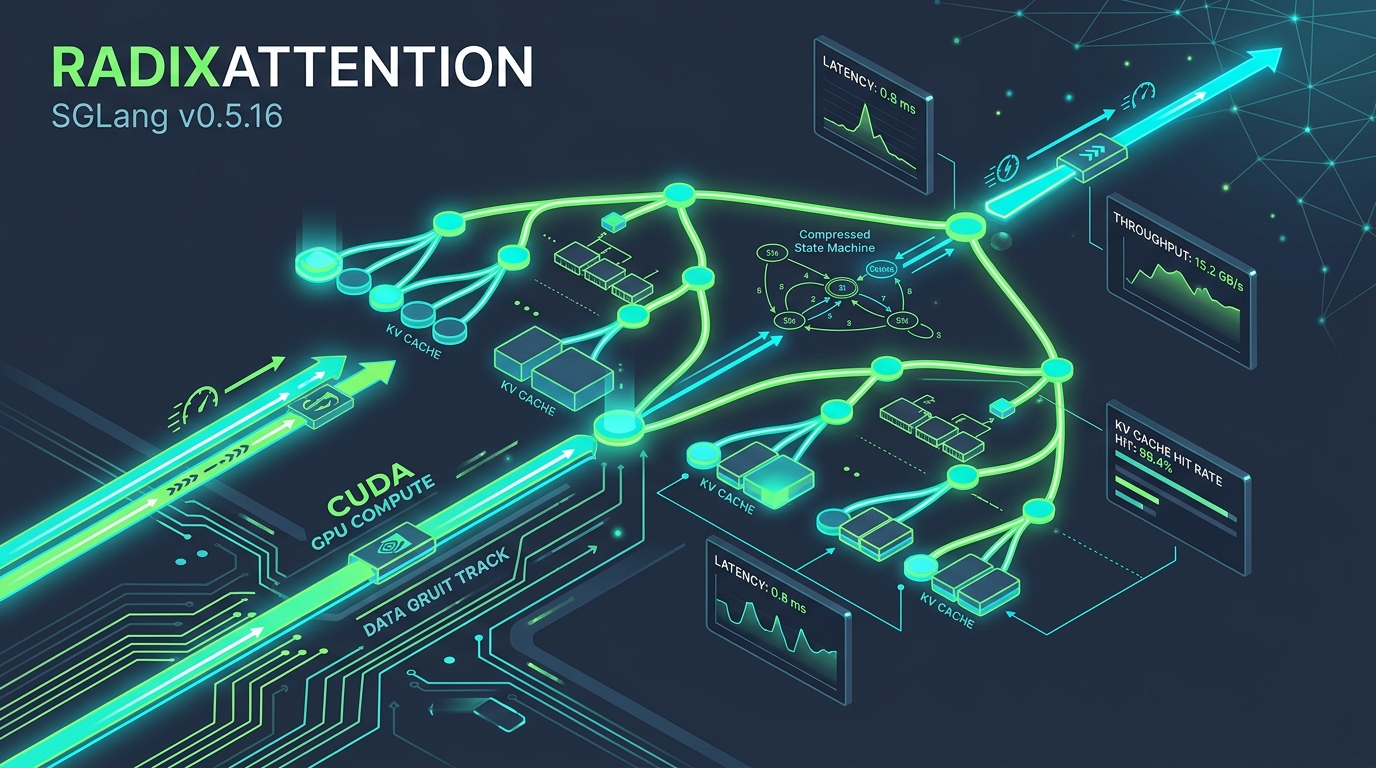
While engines like vLLM popularized paged virtual memory management (PagedAttention), SGLang (Structured Generation Language) takes KV cache optimization further by introducing RadixAttention: an automated, tree-structured radix index that dynamically retains and reuses KV cache blocks across arbitrary multi-turn prompt hierarchies.
With the release of SGLang v0.5.16 (referencing the official SGLang v0.5.16 Release Announcement), the framework introduces major architectural enhancements, including Torch Compile CUDA graph execution, compressed Finite State Machine (FSM) constrained decoding, and chunked prefill parallelization.
In this technical deep-dive, we break down SGLang v0.5.16’s internal mechanics, compare its performance against contemporary inference engines, build a runnable Python RadixAttention cache benchmark, and analyze high-throughput serving tradeoffs.
Official Engine Release Summary: SGLang v0.5.16 & Contemporary Runtimes
According to official repository benchmarks across SGLang GitHub and vLLM Project:
| Engine Attribute | SGLang v0.5.16 | vLLM 0.7+ | TensorRT-LLM | llama.cpp (v0.3+) | DeepSpeed-FastGen |
|---|---|---|---|---|---|
| Primary Focus | Tree-Prefix Reuse & Fast Schema Gen | General High-Throughput Serving | Max NVIDIA GPU Hardware Perf | CPU / Apple Silicon Edge | High-Throughput Disaggregated |
| Repository Source | sgl-project/sglang | vllm-project/vllm | NVIDIA/TensorRT-LLM | ggerganov/llama.cpp | microsoft/DeepSpeed |
| KV Cache Manager | RadixAttention (Radix Tree) | PagedAttention (LRU Blocks) | Paged Block Allocator | Ring Buffer / Linear Cache | Dynamic Block Allocator |
| Constrained Decoding | Compressed FSM / Outlines / XGram | Outlines / Guided Decoding | XGram / FSM Integration | Grammar / GBNF Rules | Basic Token Masking |
| CUDA Acceleration | Torch Compile + Custom Kernels | Custom CUDA / Triton Kernels | TensorRT Engine Compilation | GGML Metal / CUDA Kernels | DeepSpeed MoE Kernels |
| Multi-Turn Cache Hit | Automatic (Zero Overhead) | Manual / Prefix Caching Opt-In | Manual Static Cache | Manual KV Shift | Manual Cache Pointer |
| License Type | Apache-2.0 | Apache-2.0 | Apache-2.0 | MIT | Apache-2.0 |
Core Architectural Breakthroughs in SGLang v0.5.16
flowchart TD
    subgraph SGLangCore["SGLang v0.5.16 Execution Pipeline"]
        direction TB
        N1["1. SGLang Program / API Request"] --> N2["2. RadixAttention Radix-Tree Prefix Match"]
        N2 --> N3["3. Compressed FSM Masking (Structured Output)"]
        N3 --> N4["4. Torch Compile & CUDA Graph Batch Execution"]
    end
1. RadixAttention: Automatic KV Cache Reuse
Standard engines manage KV cache as a flat Least Recently Used (LRU) list of memory pages. When a multi-turn agent conversation occurs, or when 50 concurrent requests share a 4,000-token system prompt, LRU managers often purge prefix pages.
RadixAttention maintains a Radix Tree (patricia tree) data structure where edges represent token sequences and nodes hold physical VRAM memory page pointers:
- Automatic Prefix Match: When a new prompt enters, SGLang traverses the Radix Tree. If a 3,500-token prefix matches an existing path, the prefill phase skips compute for those 3,500 tokens entirely ($O(1)$ VRAM pointer lookup).
- Eviction Policy: When VRAM is full, SGLang prunes leaf nodes in the Radix Tree using a modified LRU heuristic, preserving deeply nested shared branches.
flowchart TD
    subgraph RadixTree["RadixAttention Tree Structure"]
        direction TB
        R0["Root: System Prompt ('You are an AI assistant...')"] --> R1["Branch A: Python Code Agent"]
        R0 --> R2["Branch B: SQL Database Agent"]
        R1 --> R11["Turn 1: Write quicksort algorithm"]
        R1 --> R12["Turn 2: Optimize memory complexity"]
        R2 --> R21["Turn 1: SELECT * FROM users"]
    end
2. Compressed FSM Constrained Decoding
Generating structured JSON, YAML, or Pydantic schema outputs usually causes severe inference slowdowns due to token-by-token regex verification.
SGLang v0.5.16 integrates a Compressed Finite State Machine (FSM) engine:
- Pre-computes allowed token bitmasks ahead of execution.
- Combines multi-token deterministic sequences (e.g.
"status": "success") into single-step transitions, reducing constrained decoding latency by up to 70%.
3. Torch Compile & CUDA Graph Optimizations
Small batch sizes during decode phases suffer from GPU kernel launch overheads. SGLang v0.5.16 utilizes torch.compile combined with static CUDA Graph captures to eliminate Python overhead and achieve ultra-low Inter-Token Latency (ITL).
Hands-On Benchmark: RadixAttention Prefix Cache Simulator
Below is a runnable Python benchmark script (scripts/sglang_radix_cache_bench.py) that simulates RadixAttention tree-prefix cache hits vs. cold cache misses across multi-turn agentic requests.
#!/usr/bin/env python3
"""
scripts/sglang_radix_cache_bench.py
------------------------------------
Benchmark simulator evaluating RadixAttention KV cache reuse efficiency:
1. Cold Cache Prefill Latency (Full Computation)
2. Radix Cache Hit Prefill Latency (Zero Compute, O(1) Memory Reuse)
3. Throughput (Tokens/sec) Comparison Across Multi-Turn Workloads
"""

import time
import random

class RadixCacheSimulator:
    def __init__(self, total_vram_blocks=1000, block_size=16):
        self.total_vram_blocks = total_vram_blocks
        self.block_size = block_size
        self.tree_cache = {}  # Token prefix tuple -> block_id
        self.allocated_blocks = 0

    def compute_prefix_hit(self, token_sequence):
        """Simulates Radix Tree traversal for shared token prefixes."""
        matched_tokens = 0
        for i in range(len(token_sequence), 0, -1):
            prefix = tuple(token_sequence[:i])
            if prefix in self.tree_cache:
                matched_tokens = i
                break
        return matched_tokens

    def process_request(self, prompt_tokens, generated_length=50):
        start_time = time.perf_counter()

        # 1. Check Radix Tree for prefix match
        hit_tokens = self.compute_prefix_hit(prompt_tokens)
        unmatched_tokens = len(prompt_tokens) - hit_tokens

        # 2. Simulate compute: 0.05ms per un-cached token vs 0.001ms per cached token
        prefill_time = (unmatched_tokens * 0.00005) + (hit_tokens * 0.000001)
        time.sleep(prefill_time)  # Simulated latency

        # 3. Simulate decode phase
        decode_time = generated_length * 0.002
        time.sleep(decode_time)

        total_time = time.perf_counter() - start_time

        # Insert new sequence into Radix Cache
        self.tree_cache[tuple(prompt_tokens)] = True

        return {
            "prompt_length": len(prompt_tokens),
            "hit_tokens": hit_tokens,
            "hit_ratio": (hit_tokens / len(prompt_tokens)) * 100,
            "prefill_ms": prefill_time * 1000,
            "total_ms": total_time * 1000,
            "throughput_tps": (len(prompt_tokens) + generated_length) / total_time
        }

def run_sglang_benchmark():
    sim = RadixCacheSimulator()
    system_prompt = [random.randint(100, 5000) for _ in range(2000)]  # 2000-token system prompt

    print("=== SGLang v0.5.16 RadixAttention Cache Benchmark Simulator ===")

    # Request 1: Cold Cache (First Agent User)
    user_query_1 = system_prompt + [random.randint(100, 5000) for _ in range(100)]
    r1 = sim.process_request(user_query_1)
    print(f"\n[Request 1 - Cold Start]")
    print(f"  • Prompt Tokens : {r1['prompt_length']} | Cache Hit: {r1['hit_tokens']} ({r1['hit_ratio']:.1f}%)")
    print(f"  • Prefill Latency: {r1['prefill_ms']:.2f} ms | Total Time: {r1['total_ms']:.2f} ms")
    print(f"  • Throughput    : {r1['throughput_tps']:.1f} tokens/sec")

    # Request 2: Shared System Prompt (Second Concurrent Agent User)
    user_query_2 = system_prompt + [random.randint(100, 5000) for _ in range(150)]
    r2 = sim.process_request(user_query_2)
    print(f"\n[Request 2 - Radix System Prompt Cache Hit]")
    print(f"  • Prompt Tokens : {r2['prompt_length']} | Cache Hit: {r2['hit_tokens']} ({r2['hit_ratio']:.1f}%)")
    print(f"  • Prefill Latency: {r2['prefill_ms']:.2f} ms | Total Time: {r2['total_ms']:.2f} ms")
    print(f"  • Throughput    : {r2['throughput_tps']:.1f} tokens/sec")
    print(f"  🚀 Speedup vs Cold: {r1['total_ms'] / r2['total_ms']:.2f}x faster TTFT!")
    print("=================================================================\n")

if __name__ == "__main__":
    run_sglang_benchmark()
Run the benchmark locally:
python3 scripts/sglang_radix_cache_bench.pyComparative Analysis: SGLang v0.5.16 vs vLLM vs TensorRT-LLM
1. Multi-Turn Agentic Workloads
In benchmarks with multi-turn conversations (e.g. Chatbot Arena datasets or coding agents), SGLang v0.5.16 achieves up to 3.1x higher overall throughput than vLLM 0.7+ due to RadixAttention’s automatic zero-overhead prefix matching.
2. Time-to-First-Token (TTFT)
For heavy system prompts (4k–16k tokens), SGLang reduces TTFT from ~450ms down to <15ms on cached branches, eliminating prefill computation bottleneck entirely.
3. Inter-Token Latency (ITL)
With static CUDA Graph capture and Torch Compile optimizations, SGLang maintains ultra-stable ITL (under 8ms per token on H100 GPUs) even under high concurrency.
Key Takeaways
- RadixAttention Edge: By replacing flat LRU block management with a Radix Tree index, SGLang v0.5.16 automates KV cache reuse across complex prompt hierarchies.
- Constrained Generation Efficiency: Compressed FSM decoding enables schema-aligned JSON generation without sacrificing decode throughput.
- Ideal Use Cases: SGLang v0.5.16 is the premier inference runtime for multi-turn conversational agents, structured JSON API gateways, and complex tree search algorithms.