
Inside Meta Muse Wonder & Muse Wonder Full: Frontier Models for Personal and Professional Agents
Meta introduces Muse Wonder and Muse Wonder Full: 1M context, Active Memory across weeks, and Active Focus persistence trained at the gigawatt Prometheus cluster.
Series: ← vLLM on NVIDIA Vera Rubin: 7.8x Throughput, HBM4 Memory Hierarchy, and the NVL72 Inference Leap (Previous) | NVIDIA Nemotron 3.5 Super VL: 120B MoE Multimodal Architecture, 600+ TPS Agentic Inference, and Enterprise Customization (Next) →
Prior Reading Material
- Introducing Meta Muse: Personal AI Agents, Muse Spark, and Secure VM Architecture — The foundational architecture of Meta Muse, the Muse Secure VM container runtime, and initial Muse Spark 1.3 model.
- Memory Architectures for Long-Running Agents: Vector Indexes vs. Knowledge Graphs — Overcoming naive vector RAG amnesia across multi-week horizons with episodic ledgers and graph topologies.
- Harnessing Reasoning Models in Agentic Workflows: Integrating o1/R1, Hidden Thinking Tokens, and Cost vs. Depth Optimization — Engineering dual-tier cognitive dispatch and managing test-time compute in long-running agent loops.
- Disaggregated Inference: Separating Prefill and Decode to Scale Frontier Serving — High-throughput serving topologies for million-token context windows and persistent agent workloads.
Summary
On October 14, 2026, Meta Superintelligence Labs (led by Alexandr Wang) unveiled Muse Wonder and Muse Wonder Full—Meta’s first frontier AI models engineered specifically for autonomous agentic delegation. Moving decisively beyond conversational chat, the Wonder family introduces two core architectural capabilities: Active Memory (preserving and consolidating user context across conversations spanning weeks and months) and Active Focus (reinforcement-learned persistence that tries alternative execution paths, recovers from errors, and asks for confirmation before consequential external actions).
Crucially, Wonder marks a profound strategic departure: Meta has abandoned its signature open-weights philosophy. Neither model is downloadable. Instead, base Muse Wonder is offered via the Meta Model API at $4.00 per million input tokens and within the Muse Code terminal, while flagship Muse Wonder Full is locked strictly behind Muse Code’s premium $50 and $200 monthly subscription tiers.
While early independent evaluations from Artificial Analysis largely back Meta’s claims—scoring Wonder Full at 56 on the Intelligence Index (tying Claude Sonnet 5.5 and beating Claude Fable 5.1 and GPT-6 Astra at 53)—the launch has ignited immediate industry pushback. Most notably, Abacus.AI CEO Bindu Reddy publicly challenged Meta’s benchmark claims, arguing Wonder is “nowhere near Fable or Astra level” in real-world agentic execution. In this deep dive, we unpack the architecture of Active Memory and Active Focus, examine the benchmark data, and analyze the brewing evaluation controversy.
Official Model Card & Benchmark Summary
| Architectural Dimension / Metric | Meta Muse Spark (Sept 2026 Baseline) | Meta Muse Wonder (API / Dev Base) | Meta Muse Wonder Full (Flagship / Muse Code Max) |
|---|---|---|---|
| Developer & Lab | Meta Superintelligence Labs (MSL) | Meta Superintelligence Labs (MSL) | Meta Superintelligence Labs (MSL) |
| Compute Infrastructure | Meta Grand Teton Clusters | Prometheus Datacenter (Gigawatt Scale) | Prometheus Datacenter (Gigawatt Scale) |
| Native Context Window | 128,000 tokens | 1,048,576 tokens (~1M) | 1,048,576 tokens (~1M) |
| Input Modalities | Text, Code, Images | Text, Code, Images, Audio, Video, PDF | Text, Code, Images, Audio, Video, PDF |
| Output Modality | Text / Structured JSON | Text / Code / Agent Tool Actions | Text / Code / Agent Tool Actions |
| Artificial Analysis Intelligence Index | 44 (Baseline) | 52 | 56 (Ties Claude Sonnet 5.5) |
| Long-Horizon Persistence | Single-session reactive | Active Focus & Active Memory | Active Focus Max & SWE-Marathon |
| Availability & Pricing | Deprecated / Integrated | Meta Model API ($4.00/1M input) & Muse Code | Exclusive to Muse Code Subscribers ($50 / $200/month tiers) |
| License / Weights | Hosted API / Closed | Hosted API (No Open Weights) | Hosted Subscription (No Open Weights) |
From Muse Spark to Muse Wonder: The Generational Shift
When Meta introduced Muse in September 2026, it was framed as an ambitious personal operating system: an autonomous companion running inside an isolated Linux sandbox (Muse Secure VM) tasked with coordinating calendars, drafting emails, and assembling interactive Artifacts. Under the hood, however, initial versions relied on Muse Spark 1.3—a fast, reflex-oriented model optimized for zero-shot CLI command emission and prompt injection filtering.
While Spark performed well on short, structured operations, real-world delegation exposed fundamental limitations:
- Context Fragmentation: Spark treated each conversation as an isolated turn. If a user discussed a landlord dispute on Monday, Spark could not autonomously correlate that lease clause with an eviction notice uploaded three weeks later without manual copy-pasting.
- Premature Hand-Offs (Low Grit): When a shell script failed or an API returned an unexpected 429 rate limit, Spark frequently hallucinated completions or surrendered back to the user with “I encountered an error.”
- Domain Shallow Depth: Evaluating complex real estate leases, cross-border tax forms, or refactoring multi-repo dependencies overwhelmed Spark’s 128k context buffer.
flowchart TD
    subgraph Spark["Original Muse Spark (September 2026)"]
        direction TB
        A1["User Task Prompt"] --> B1["Short-Horizon Tool Dispatch"]
        B1 --> C1["Single-Session 128k Context Buffer"]
        C1 --> D1{"Hit Unexpected Error / Schema Mismatch?"}
        D1 -- "Yes" --> E1["Surrender Task to User / Error Halt"]
        D1 -- "No" --> F1["Emit Shallow Text Output"]
    end

    style Spark fill:#0f172a,stroke:#38bdf8,stroke-width:2px,color:#ffffff;
    style A1 fill:#1e293b,stroke:#0ea5e9,stroke-width:1px,color:#ffffff;
    style B1 fill:#1e293b,stroke:#0ea5e9,stroke-width:1px,color:#ffffff;
    style C1 fill:#1e293b,stroke:#0ea5e9,stroke-width:1px,color:#ffffff;
    style D1 fill:#334155,stroke:#f59e0b,stroke-width:2px,color:#ffffff;
    style E1 fill:#450a0a,stroke:#ef4444,stroke-width:2px,color:#ffffff;
    style F1 fill:#064e3b,stroke:#10b981,stroke-width:2px,color:#ffffff;
Muse Wonder replaces this brittle single-turn pipeline with a continuous cognitive loop. Trained with massive test-time deliberation and reinforcement learning over long execution trajectories, Wonder treats delegation as an iterative journey rather than a single forward pass.
flowchart TD
    subgraph Wonder["Muse Wonder Cognitive Engine (October 2026)"]
        direction TB
        A2["Long-Horizon User Goal"] --> B2["Active Memory Recall (Cross-Thread Knowledge)"]
        B2 --> C2["1M-Token Trajectory Context & Planning"]
        C2 --> D2["Sub-Agent Task Partitioning & Tool Invocation"]
        D2 --> E2{"Execution Blocker / Sub-Process Failure?"}
        E2 -- "Yes: Active Focus Triggered" --> F2["Self-Correction Loop: Alternative Exploration"]
        F2 --> D2
        E2 -- "No: Action Confirmed" --> G2["Deterministic State Update & Memory Consolidation"]
    end

    style Wonder fill:#022c22,stroke:#10b981,stroke-width:2px,color:#ffffff;
    style A2 fill:#064e3b,stroke:#34d399,stroke-width:1px,color:#ffffff;
    style B2 fill:#064e3b,stroke:#34d399,stroke-width:1px,color:#ffffff;
    style C2 fill:#064e3b,stroke:#34d399,stroke-width:1px,color:#ffffff;
    style D2 fill:#064e3b,stroke:#34d399,stroke-width:1px,color:#ffffff;
    style E2 fill:#334155,stroke:#f59e0b,stroke-width:2px,color:#ffffff;
    style F2 fill:#1e293b,stroke:#00e5ff,stroke-width:2px,color:#ffffff;
    style G2 fill:#065f46,stroke:#059669,stroke-width:2px,color:#ffffff;
The Two Pillars of Wonder: Active Memory & Active Focus
1. Active Memory: Ending Flat Vector Amnesia
Most commercial AI assistants implement memory by executing a similarity query against a flat vector database of recent chat snippets. As detailed in our analysis of Long-Running Agent Memory Architectures, vector search is fundamentally blind to causality, negation, and temporal ordering.
Active Memory in Muse Wonder operates as a dynamic, hierarchical state store:
- Selective Context Retention: Wonder automatically extracts durable facts, user behavioral preferences, project constraints, and relational entities without requiring explicit “Remember this” prompts.
- Proactive Temporal Slicing: When presented with an ambiguous request (“Update the budget according to the email I received this morning”), Wonder traverses its episodic event ledger to identify the specific email sender, resolve currency discrepancies against past invoices, and apply updates within the relevant workspace.
- Cross-Thread Coherence: Conversations held in Muse Code (a command-line development task) seamlessly inform decisions made in the desktop Muse app (scheduling a calendar review or deploying a staging build).
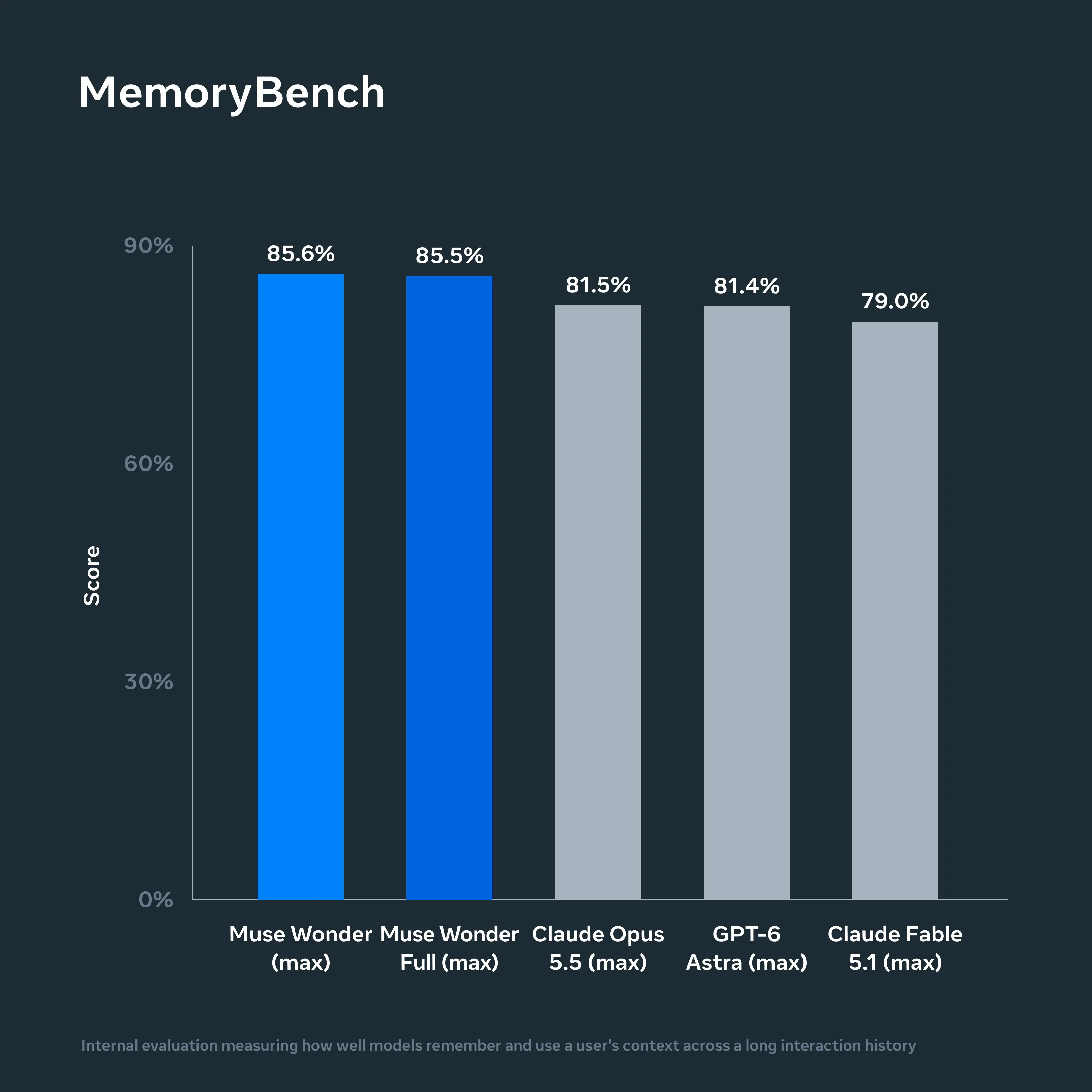 Figure 1: MemoryBench evaluation measuring how well models remember and dynamically retrieve user context across long interaction histories. Muse Wonder leads the frontier tier at 85.6%. Source: Meta AI Research.
2. Active Focus: Reinforcement-Learned Task Persistence
Where conventional LLMs give up when encountering shell errors, missing dependencies, or API schema mutations, Active Focus gives Muse Wonder deliberate operational grit.
Meta trained Active Focus using reinforcement learning over long-horizon trajectories (rewarding autonomous bug resolution and penalizing premature user interruptions):
- State Verification & Rollbacks: If a refactored SQL migration breaks a staging server, Wonder halts, inspects stderr logs, rolls back the Git commit, adjusts the column constraints, and reruns the migration.
- Autonomous Sub-Agent Spawning: For large refactoring projects, Wonder partitions requirements into independent work units, delegating exploratory searches to lightweight sub-agents while retaining the supervisor role.
- Human-in-the-Loop Safeguards: Active Focus distinguishes between safe reversible operations (editing code, testing endpoints) and consequential external actions (sending emails, committing financial transactions, modifying production DNS). On consequential steps, it automatically generates an interactive confirmation diff before execution.
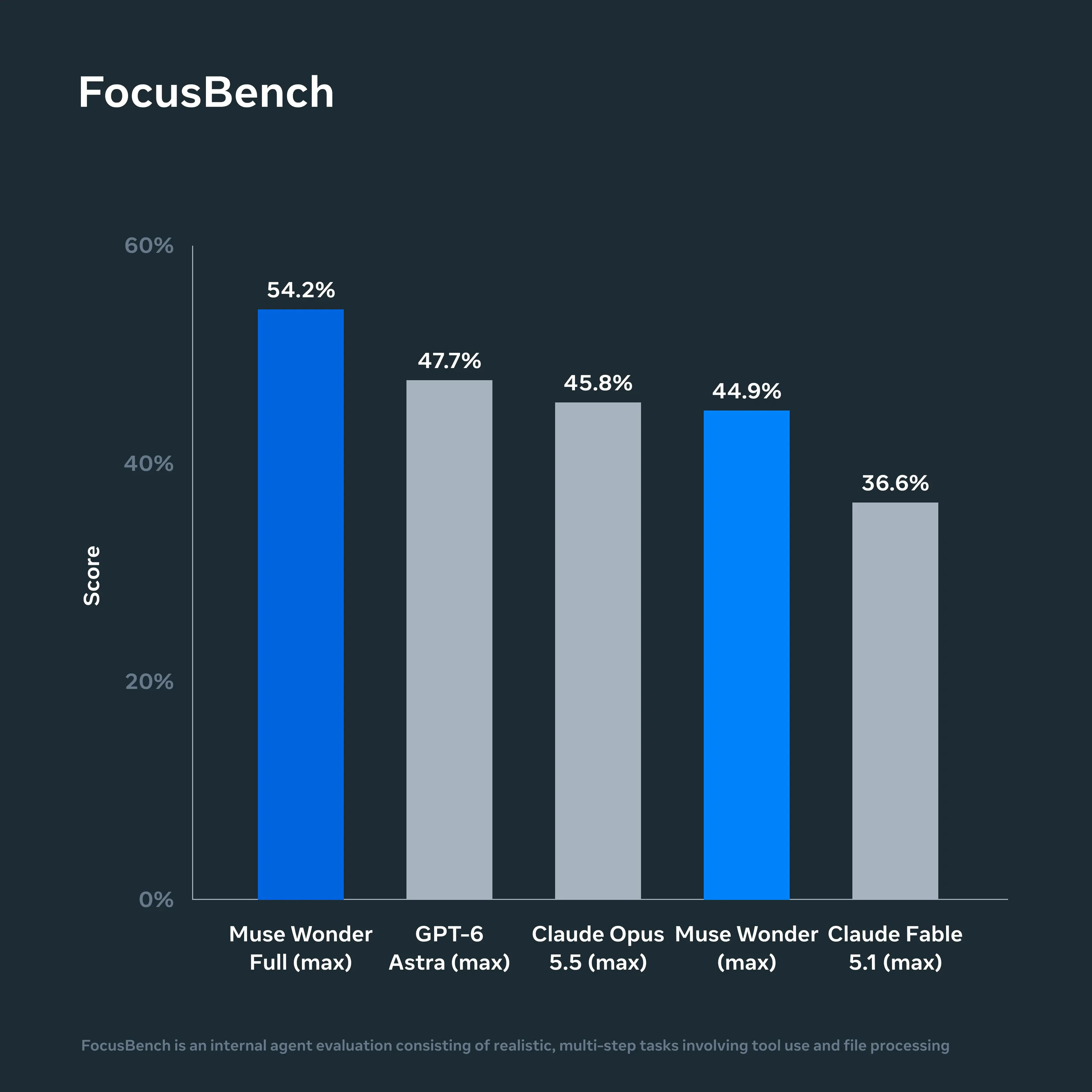 Figure 2: FocusBench evaluation tracking goal adherence over multi-step tasks involving tool usage, constraint recovery, and file processing. Muse Wonder Full achieves 54.2%, outperforming GPT-6 Astra (47.7%) and Claude Opus 5.5 (45.8%). Source: Meta AI Research.
Benchmarking the Wonder Frontier: Official Meta Research Evaluation Suite
Rather than relying purely on synthetic chat prompts, Meta Superintelligence Labs evaluated Muse Wonder and Wonder Full across a comprehensive evaluation suite spanning personal and professional agent workflows, end-to-end coding, and terminal execution.
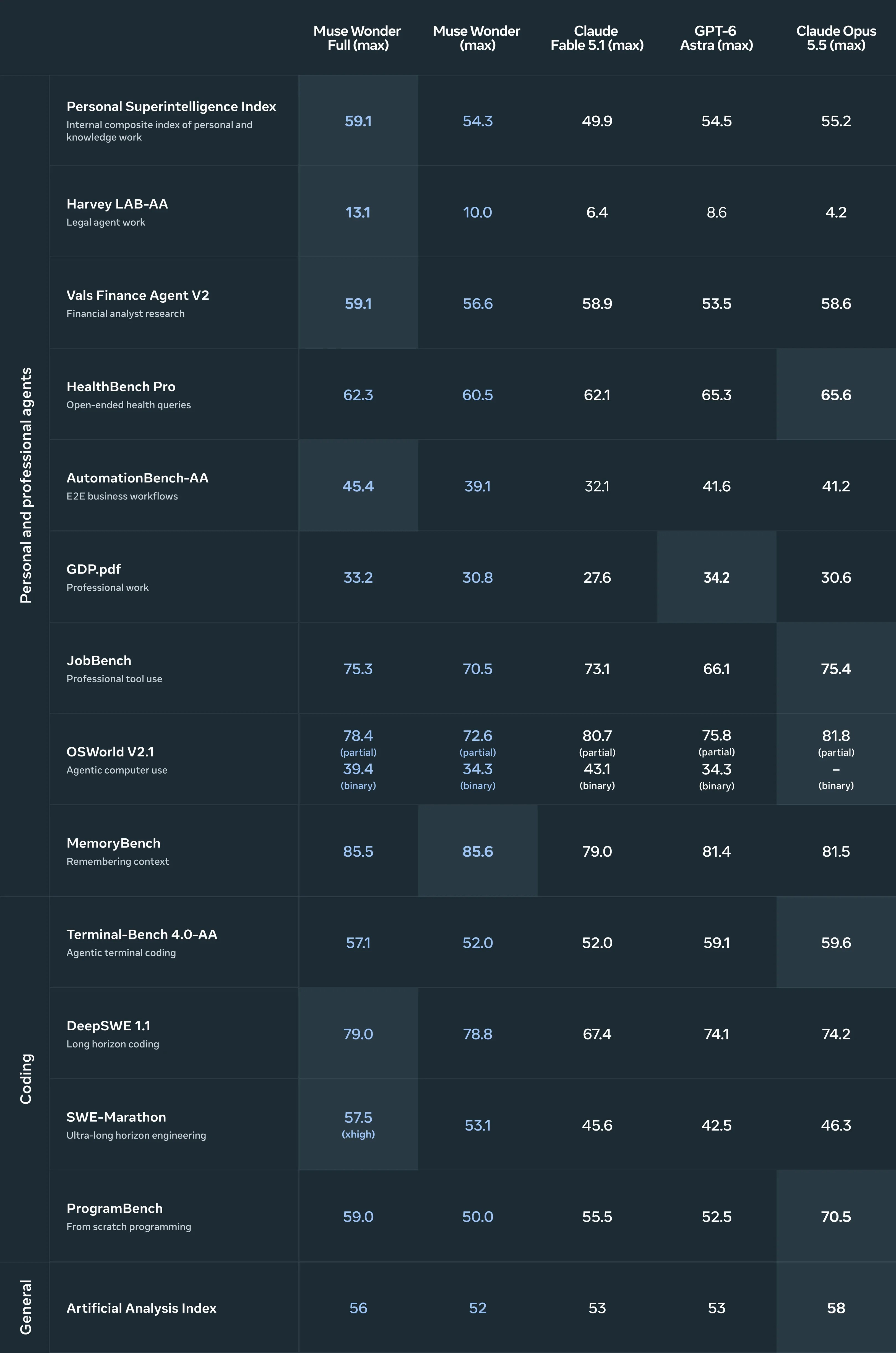 Figure 3: Comprehensive frontier model evaluation across personal agents, professional workflows, and coding benchmarks. Source: Meta AI Research.
Detailed Benchmark Comparison Across Frontier Models
The empirical data reported by Meta AI Research highlights several structural shifts across both domain-specific agents and long-horizon engineering:
| Evaluation Dimension | Benchmark / Metric | Muse Wonder Full (max) | Muse Wonder (max) | Claude Fable 5.1 (max) | GPT-6 Astra (max) | Claude Opus 5.5 (max) |
|---|---|---|---|---|---|---|
| Personal & Professional | Personal Superintelligence Index | 59.1 | 54.3 | 49.9 | 54.5 | 55.2 |
| Harvey LAB-AA (Legal Agents) | 13.1 | 10.0 | 6.4 | 8.6 | 4.2 | |
| Vals Finance Agent V2 (Financial Research) | 59.1 | 56.6 | 58.9 | 53.5 | 58.6 | |
| AutomationBench-AA (E2E Workflows) | 45.4 | 39.1 | 32.1 | 41.6 | 41.2 | |
| JobBench (Professional Tool Use) | 75.3 | 70.5 | 73.1 | 66.1 | 75.4 | |
| MemoryBench (Context Persistence) | 85.5 | 85.6 | 79.0 | 81.4 | 81.5 | |
| Coding & Terminal | SWE-Marathon (Ultra-Long Engineering) | 57.5 (xhigh) | 53.1 | 45.6 | 42.5 | 46.3 |
| DeepSWE 1.1 (Long-Horizon Coding) | 79.0 | 78.8 | 67.4 | 74.1 | 74.2 | |
| Terminal-Bench 4.0-AA (CLI Tooling) | 57.1 | 52.0 | 52.0 | 59.1 | 59.6 | |
| Overall Index | Artificial Analysis Intelligence Index | 56 | 52 | 53 | 53 | 58 |
SWE-Marathon & Harvey LAB: Where Wonder Pulls Ahead
Two specific benchmark graphs illustrate where Meta’s heavy reinforcement learning and test-time compute investment in the Prometheus cluster produce outsized real-world gains:
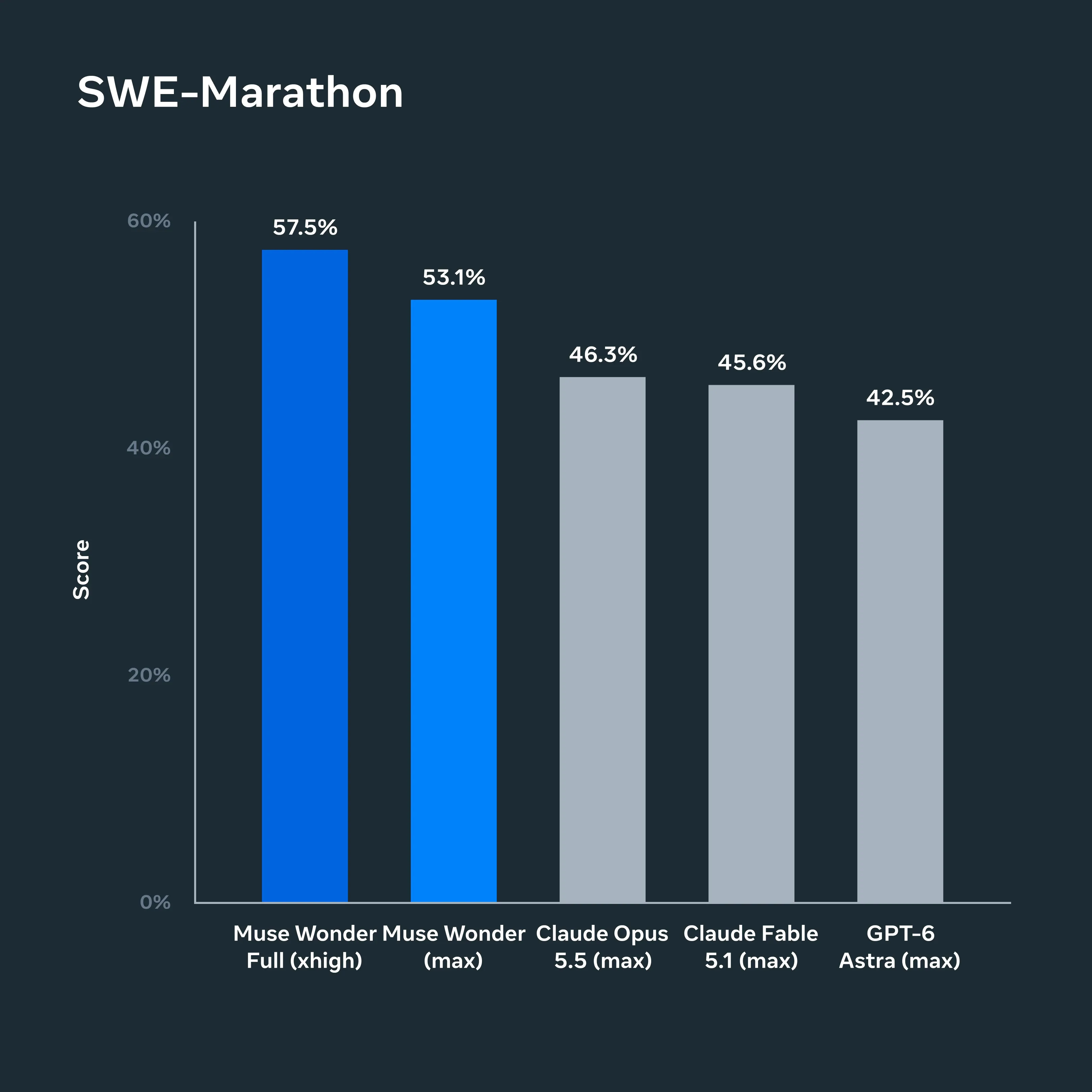 Figure 4: SWE-Marathon evaluation comparing ultra-long horizon repository engineering. Muse Wonder Full reaches 57.5% in ultra-high reasoning mode, establishing a substantial lead over Claude Opus 5.5 (46.3%) and GPT-6 Astra (42.5%). Source: Meta AI Research.
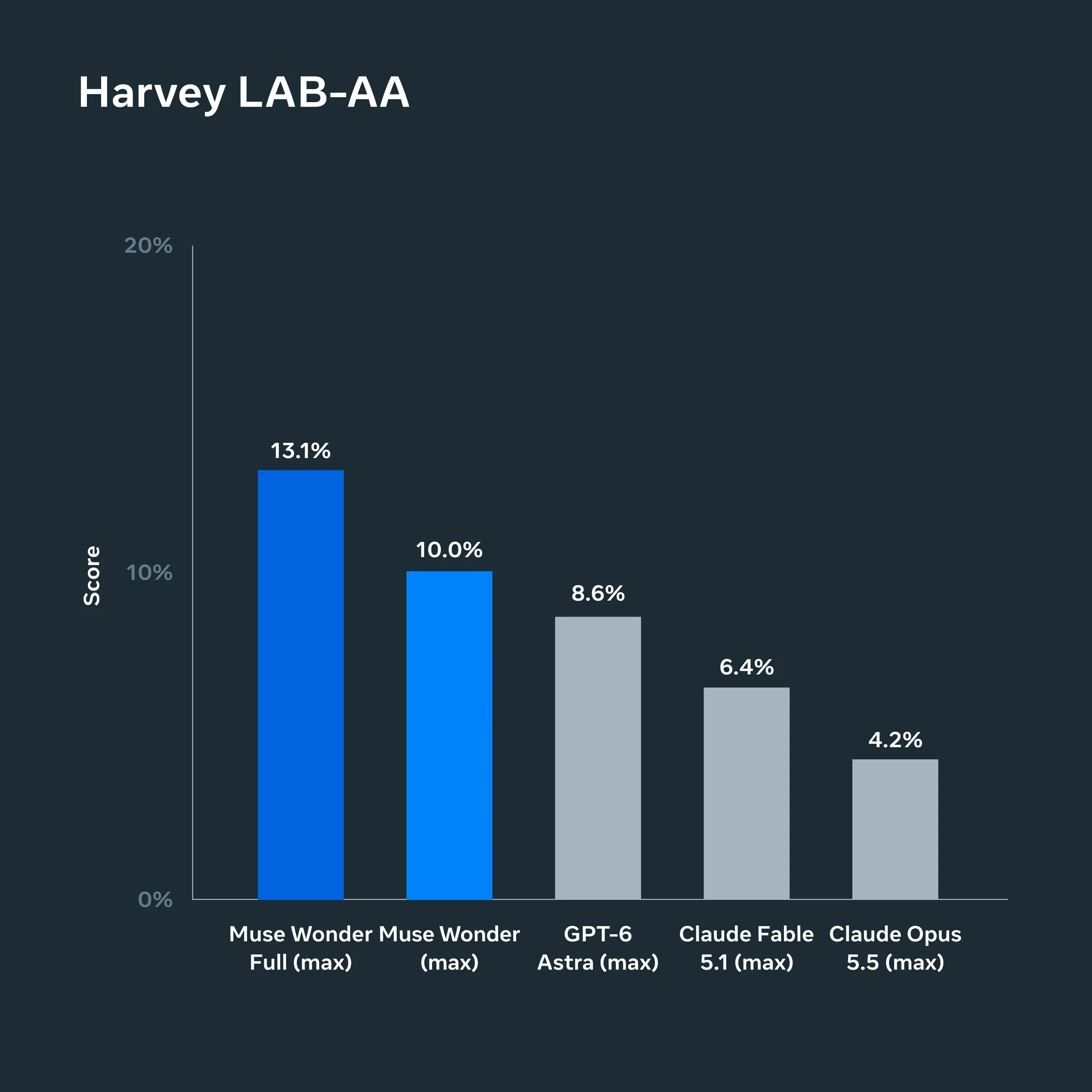 Figure 5: Harvey LAB-AA benchmark measuring complex legal synthesis, clause redlining, and lease interpretation. Muse Wonder Full achieves 13.1%, more than tripling Claude Opus 5.5 (4.2%). Source: Meta AI Research.
A key engineering takeaway from these figures is the pronounced performance delta between the base Muse Wonder model and Muse Wonder Full. In SWE-Marathon (+4.4%), Harvey LAB (+3.1%), and AutomationBench (+6.3%), Wonder Full demonstrates how sustained test-time compute scaling unlocks superior multi-step error recovery and domain-specific precision.
The Benchmark Dispute: Independent Validation vs. Industry Pushback
While Meta’s published evaluations paint a picture of decisive frontier leadership, the launch of Muse Wonder has sparked an intense debate across the AI research community. The controversy hinges on two critical friction points: the divergence between lab benchmarks and raw execution, and Meta’s historic pivot away from open-source.
flowchart TD
    subgraph Dispute["The Frontier Agent Evaluation Controversy"]
        direction TB
        MetaClaim["Meta & Artificial Analysis\n• Wonder Full: 56 Index (Ties Sonnet 5.5, Beats Astra 53)\n• SWE-Marathon: 57.5% in Ultra-High Reasoning\n• MemoryBench: 85.5% Recall Retention"]
        IndustryAudit["Abacus.AI & Community Pushback (Bindu Reddy)\n• Claims Wonder is 'nowhere near Fable or Astra level'\n• Multi-turn prompt steering brittleness in production\n• Heavy test-time prompt-caching dependencies"]
        EvalsFuture["The Emerging Consensus\n• Benchmark divergence between isolated synthetic tasks and noisy live repos\n• Closed-weights prevent independent local ablation and audit"]

        MetaClaim --> IndustryAudit
        IndustryAudit --> EvalsFuture
    end

    style Dispute fill:#0f172a,stroke:#38bdf8,stroke-width:2px,color:#ffffff;
    style MetaClaim fill:#064e3b,stroke:#10b981,stroke-width:1px,color:#ffffff;
    style IndustryAudit fill:#450a0a,stroke:#ef4444,stroke-width:1px,color:#ffffff;
    style EvalsFuture fill:#1e293b,stroke:#0ea5e9,stroke-width:1px,color:#ffffff;
1. Artificial Analysis Backing vs. Abacus.AI’s Challenge
On one side of the dispute, independent benchmarking firm Artificial Analysis largely corroborates Meta’s frontier claims. On the Artificial Analysis Intelligence Index, Muse Wonder Full posted a score of 56, placing it in a dead heat with Anthropic’s Claude 3.5 Sonnet / 5.5 and clear of Claude Fable 5.1 (53) and OpenAI’s GPT-6 Astra (53).
However, within hours of the announcement, Bindu Reddy, CEO of Abacus.AI, publicly pushed back against the numbers. Characterizing the models as “nowhere near Fable or Astra level,” Reddy asserted that practical multi-turn coding and enterprise workflow evaluations inside real-world agent runtimes reveal significant degradation compared to Meta’s published SWE-Marathon figures. Abacus.AI announced it is preparing a comprehensive counter-benchmark suite specifically comparing Muse Wonder against GPT-6 Astra and Claude Fable across messy, real-world repositories with ambiguous specifications.
The core of the dispute reflects a broader crisis in LLM benchmarking: as frontier models rely more heavily on test-time search, chain-of-thought exploration, and custom container harness environments, published numbers become hyper-sensitive to the exact scaffolding used during evaluation.
2. The Death of Open Weights at Meta
Beyond the benchmark dispute lies an even more consequential philosophical shock: Meta abandoned open weights to build Wonder.
From Llama 1 through Llama 3.3, Meta established itself as the undisputed champion of the open AI ecosystem, open-sourcing trillions of tokens worth of foundational weights. With Muse Wonder, however, that era has officially ended:
- Proprietary API Only: Base Muse Wonder is strictly available via the Meta Model API at $4.00 per million input tokens, with no downloadable weights, no local quantizations, and no self-hosted Ollama or vLLM deployment paths.
- Subscription Wall for Flagship Compute: Muse Wonder Full cannot even be accessed via a pay-per-token API; it is locked exclusively behind Meta’s Muse Code $50/month and $200/month subscription tiers, directly mirroring the commercial SaaS playbook of OpenAI and Anthropic.
By locking its highest-performing reasoning models inside hosted walled gardens, Meta has signaled that frontier test-time compute, agentic sandboxes, and multi-session user memory are too strategically and commercially valuable to give away for free.
Conclusion & What’s Next
The release of Meta Muse Wonder and Muse Wonder Full marks a critical inflection point in the competitive landscape of autonomous agents. By focusing compute resources at the Prometheus cluster on Active Memory and Active Focus, Meta is shifting the battleground away from synthetic single-prompt chat benchmarks toward sustained, real-world task execution.
For developers and enterprise engineers, Muse Wonder offers three key takeaways:
- The Million-Token Context is the Baseline: Processing extensive code repositories, complete document corpuses, and multi-day agent histories natively in memory is no longer a luxury—it is table stakes.
- Grit Outperforms Zero-Shot Accuracy: Autonomous agents in production succeed not because they are infallible on step one, but because they possess the architectural state machines and reinforcement-learned focus required to detect errors, backtrack, and adapt.
- Two-Tier Model Distribution: As seen with Muse Wonder (broad public API) and Muse Wonder Full (exclusive subscription tier), frontier providers will increasingly reserve high-test-time-compute models for specialized professional environments like Muse Code.
In our next analysis, we will explore how reasoning-driven agents integrate into existing enterprise frameworks, decomposing complex multi-agent graphs with LangGraph and optimizing cognitive dispatch between System 1 reflex models and System 2 deliberative thinkers.