
Claude Haiku 5.5: Adaptive Thinking, Effort Scaling, and Frontier Agentic Work at Scale
Anthropic releases Claude Haiku 5.5 with adaptive thinking and configurable effort scaling: delivering near-Sonnet agentic performance at $0.10/1M tokens, 240 tok/s throughput, and 1M context.

Series: ← System One vs. System Two AI Models: Inside Microsoft Decision-1, TypeSafe AI Jev, and the Latency Collapse (Previous) | Gemini at Work: Google Cloud’s Universal Coworker Agent, Dedicated Workspace Identities, and Enterprise Agency (Next) →
Summary
On October 7, 2026, Anthropic released Claude Haiku 5.5 (claude-haiku-5-5-20261007), marking the most consequential structural shift in fast-tier foundation models since the introduction of Claude 3.5 Sonnet. Historically, “small” models were stripped-down completions engines: lightning-fast and inexpensive, but brittle when asked to sustain multi-step tool use, debug code environments, or orchestrate autonomous workflows.
Haiku 5.5 dismantles that tradeoff. Built with a full 1,000,000-token context window, an unprecedented 128,000-token output capacity, and sustaining ~240 tokens per second, Haiku 5.5 is the first lightweight model equipped with adaptive thinking and granular effort scaling (low, medium, high, xhigh, max). On autonomous desktop and browser benchmarks like OSWorld 2.1, Haiku 5.5 surges from 42% accuracy at minimal cost to an astonishing 73% accuracy at maximum reasoning effort—outperforming GPT-6 Luna, demolishing Haiku 4.5 by more than 4x, and closing within spitting distance of Claude Sonnet 5.5 at a fraction of the operating budget.
Official Model Card & Specifications
| Model Parameter | Anthropic Specification |
|---|---|
| Model Name | Claude Haiku 5.5 |
| Model ID | claude-haiku-5-5-20261007 (API alias: claude-5-5-haiku-latest) |
| Context Window | 1,000,000 tokens |
| Max Output Tokens | 128,000 tokens |
| Base Pricing ($\le$100K context) | $0.10 / 1M input tokens • $0.50 / 1M output tokens |
| Extended Pricing (>100K context) | $0.50 / 1M input tokens • $2.50 / 1M output tokens |
| Prompt Caching | Write: $0.125 / 1M tokens • Read: $0.01 / 1M tokens (90% savings) |
| Output Velocity | ~240 tokens/second (median across global inference clusters) |
| Thinking Architecture | Dynamic Adaptive Thinking with configurable reasoning effort (low, med, high, xhigh, max) |
| Official Documentation | What’s New in Haiku 5.5 • Migration Guide |
Prior Reading Material
To explore how lightweight reasoning models interface with agentic scaffolding and tool ecosystems, review our prerequisite analyses:
- OpenAI DevDay 2026: Dots Always-On Agents, GPT-6.1 Sol’s 80% Price Cut, the Decisions API — Plus Salesforce Koa and NVFP4 KV Cache — The macroeconomic collapse in frontier token pricing and persistent cloud agents.
- The Always-On Agent Showdown: Architectural, Security, and Autonomy Comparison Across Meta Muse, OpenAI Dots, Google Gemini Spark, and Perplexity Computer — Comparative analysis of persistent virtualization layers and model routing.
- Model Context Protocol (MCP): Tool Integration in Claude Code — Standardized tool communication mechanisms used in Claude agent runtimes.
- Claude 3.7 Sonnet: Architecture, Benchmarks, and Systems Engineering of Anthropic’s First Hybrid Reasoning Model — The architectural origin of Anthropic’s hybrid thinking and token budgeting paradigm.
1. The Small Model Dilemma: From Fast Autocomplete to Cognitive Agility
For three years, software architects designing multi-agent systems operated under an uncomfortable compromise known as the “Model Tier Divide”:
flowchart TD
subgraph TraditionalDivide["The Legacy 2024-2025 Model Divide"]
direction TB
F["Frontier Reasoning Models: Sonnet / Opus / GPT-6<br/>High Accuracy (70-85%) • High Latency • $3.00-$15.00/1M tokens"]
D["The Cognitive Abyss: Multi-Agent Loops Unaffordable at Scale"]
S["Small Subagent Models: Haiku 4.5 / Flash / Mini<br/>Low Latency (150-250 tok/s) • Cheap ($0.25-$1.00) • Low Agentic Accuracy (15-35%)"]
F --> D --> S
end
style TraditionalDivide fill:#0b0f19,stroke:#6366f1,stroke-width:2px,color:#ffffff
style F fill:#1e1b4b,stroke:#818cf8,stroke-width:1.5px,color:#ffffff
style D fill:#18181b,stroke:#71717a,stroke-width:1px,color:#ffffff
style S fill:#0f172a,stroke:#38bdf8,stroke-width:1.5px,color:#ffffffWhenever an agent framework—such as Claude Code, AutoGen, or an enterprise coding daemon—attempted to delegate tasks to small models, the agent would reliably derail:
- Shallow Plan Formation: Small models emitted tool calls after minimal reflection, failing to anticipate environment state changes or dependency conflicts.
- Premature Termination: Faced with a non-trivial error in bash or browser DOM structures, small models routinely hallucinated task completion rather than persevering.
- Context Choke: With 128K or 200K context boundaries, large codebase ASTs and browser accessibility trees caused severe context truncation.
Claude Haiku 5.5 rewrites this calculus by importing the adaptive reasoning machinery originally developed for Anthropic’s flagship Sonnet tier directly into the lightweight distillation framework.
Rather than treating chain-of-thought as a fixed binary (either enabled or disabled), Haiku 5.5 exposes a dynamic reasoning effort dial. Developers can command the model to respond with zero extra thought tokens for microsecond classification tasks, or scale thinking effort up to max for stubborn browser debugging runs.
2. Benchmark Breakdown: OSWorld 2.1 & Artificial Analysis
The definitive validation of Haiku 5.5’s architecture lies in real-world computer-use and autonomous operating system interaction. OSWorld 2.1 measures an agent’s ability to navigate arbitrary desktop applications—managing file systems, manipulating spreadsheets, configuring developer environments, and controlling web browsers.
Below are the official benchmark findings evaluated across reasoning effort tiers, plotted against leading industry frontier and small-tier models:
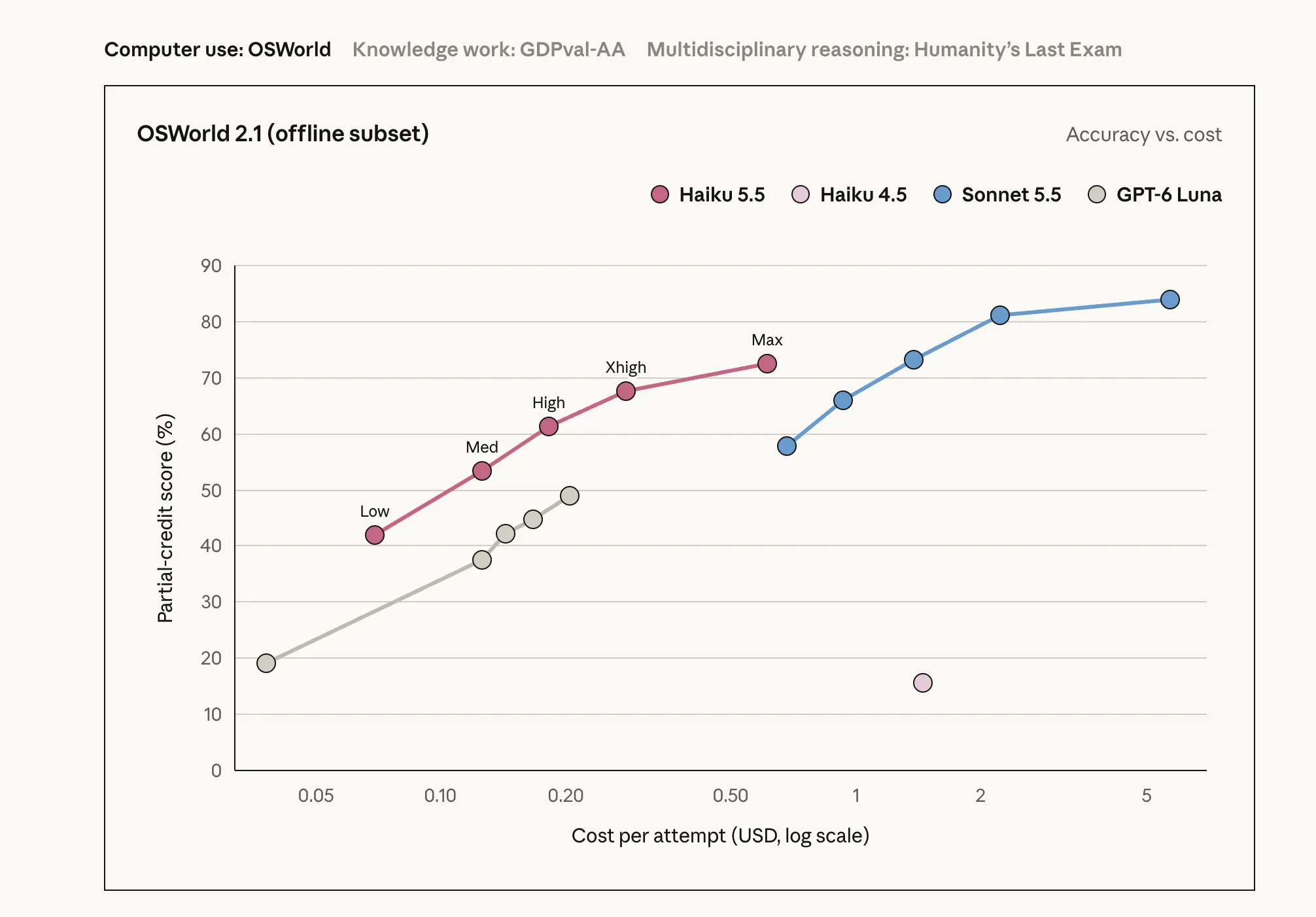 Figure 1: OSWorld 2.1 (Offline subset) benchmark comparing task completion accuracy against cost per task attempt. Data source: Official Anthropic release documentation and independent evaluations by Artificial Analysis.
Key Takeaways from the Data:
- A 4.5x Generational Leap: Haiku 4.5 topped out at a modest 16% accuracy on OSWorld while costing ~$1.50 per attempt due to repetitive retry loops and inefficient context handling. Haiku 5.5 at
Loweffort achieves 42% accuracy at a minuscule $0.07 per attempt—delivering nearly triple the accuracy at 1/20th the cost. - Effort Scaling Unlocks 73% Task Success: When set to
Maxeffort, Haiku 5.5 reaches 73% accuracy on OSWorld. This overtakes GPT-6 Luna’s maximum performance ceiling (~49% at $0.20) and closes within 11 percentage points of Sonnet 5.5’s peak (~84%), but at $0.60 per attempt compared to Sonnet’s $6.00 per attempt—a 10x cost reduction. - The Artificial Analysis Intelligence Index: On the standardized Artificial Analysis Intelligence Index, Haiku 5.5 registers an overall score of 43 (Max effort), cleanly outpacing Google’s Gemini 3.8 Flash (41) and OpenAI’s GPT-6 Luna (38), while generating tokens at ~240 tokens/second with a Time to First Token (TTFT) of just 10.18s on
Loweffort.
3. The Mechanics of Adaptive Thinking & Effort Parameters
How does Haiku 5.5 achieve frontier-grade execution without collapsing into latency bottlenecks? The secret is Anthropic’s Adaptive Thinking Engine.
In the Claude API, thinking is governed via the thinking configuration parameter:
{
  "model": "claude-haiku-5-5-20261007",
  "max_tokens": 16000,
  "thinking": {
    "type": "enabled",
    "effort": "high"
  }
}
The 5-Tier Reasoning Spectrum
Anthropic provides five granular effort presets tailored for distinct agentic architectures:
| Effort Setting | Cognitive Profile | Recommended Workload | Cost / Task Profile |
|---|---|---|---|
low | Terse internal checks; immediately proceeds to tool invocation | Live customer chat routing, JSON extraction, intent parsing | ~$0.02 - $0.07 |
medium | Balanced reflection; explores 2-3 step planning hypotheses | Simple file refactoring, test execution, database queries | ~$0.08 - $0.15 |
high | Rigorous hypothesis testing; cross-checks API documentation | Multi-file code generation, browser form workflows | ~$0.15 - $0.35 |
xhigh | Extensive verification chains; models edge cases and rollbacks | End-to-end OSWorld workflows, complex Git merge conflict resolution | ~$0.35 - $0.50 |
max | Exhaustive exploration; deep backtracking until self-verification passes | Hard algorithmic debugging, mission-critical autonomous ops | ~$0.50 - $0.65 |
flowchart TD
    subgraph AgentLoop["Haiku 5.5 Adaptive Reasoning Control Cycle"]
        direction TB
        P["User Prompt / Subagent Objective"] --> E["Effort Gate: low | med | high | xhigh | max"]
        E --> T["Adaptive Internal Scratchpad (Thinking Tokens)"]
        T --> H{"Self-Consistency Check"}
        H -- "Discrepancy Detected" --> B["Backtrack & Revise Planning State"]
        B --> T
        H -- "Verification Passed" --> A["Emit Structured Tool Call / Bash Execution"]
        A --> R["Sandbox Environment Output"]
        R --> C{"Task Complete?"}
        C -- "No / Error" --> T
        C -- "Yes" --> F["Return Verified Final Result"]
    end
    style AgentLoop fill:#0b0f19,stroke:#00e5ff,stroke-width:2px,color:#ffffff
    style E fill:#1e1b4b,stroke:#818cf8,stroke-width:1.5px,color:#ffffff
    style T fill:#0d2b45,stroke:#00e5ff,stroke-width:1.5px,color:#ffffff
    style H fill:#312e81,stroke:#a5b4fc,stroke-width:1.5px,color:#ffffff
    style A fill:#064e3b,stroke:#10b981,stroke-width:1.5px,color:#ffffff
    style F fill:#065f46,stroke:#34d399,stroke-width:2px,color:#ffffff
4. Prompt Engineering for Haiku 5.5: Critical Rules & Best Practices
Migrating from Claude 3.5 Haiku, Haiku 4.5, or Sonnet to Haiku 5.5 requires understanding Anthropic’s official prompting behavioral guidelines. Because Haiku 5.5 is aggressively optimized for fast autonomous throughput, it can exhibit specific failure modes if prompted using outdated conventions.
Rule 1: Guarding Against Premature Stopping
Distilled models possess an inherent bias toward concise resolution. When faced with large, open-ended tasks (such as crawling 50 web pages or refactoring an entire microservice repo), Haiku 5.5 may stop after completing the first three steps and proclaim success.
The Fix: Inject explicit boundary mandates into your system prompt:
“Keep working continuously until all parts of the user request are fully accomplished. Do not stop midway or ask for permission to proceed with obvious next steps. If a command or tool returns an error, diagnose the root cause, formulate an alternative solution, and retry immediately.”
Rule 2: Mandatory Verification Enforcement
Unlike Sonnet 5.5, which naturally double-checks its work before declaring victory, Haiku 5.5 benefits dramatically from programmatic verification incentives:
“When modifying code or configuration files that can be built, executed, or type-checked, you must execute a verification test before concluding your response. Never assert that code works without verifying it in the terminal.”
Rule 3: Mid-Turn User Guidance Isolation
A frequent breaking pattern in subagent harnesses is embedding user steer messages directly inside a previous tool’s tool_result content block. In Haiku 5.5, this causes severe token attribution degradation and instruction drift.
- Incorrect: Injecting
[User note: please abort this approach]inside atool_resultJSON payload. - Correct: Always close the previous tool call turn cleanly, and supply the user’s mid-turn steering message as an independent
userturn following thetool_resultblock.
Rule 4: Accommodating Tokenizer Expansion
Haiku 5.5 utilizes Anthropic’s next-generation multilingual BPE tokenizer. In practice, this tokenizer records approximately 25% to 30% more tokens across specialized codebases and technical scripts compared to Haiku 4.5. When configuring rate limits, sliding window buffers, or strict cost alerts, account for this nominal token count expansion.
5. Architectural Implications: The Tier-1 Subagent Swarm
What does Haiku 5.5 mean for modern software engineering teams?
In contemporary agent frameworks—like Anthropic’s Claude Code or autonomous dev swarms—architects no longer route every operation to a single monolithic frontier model. Instead, they structure multi-tiered hierarchical DAGs:
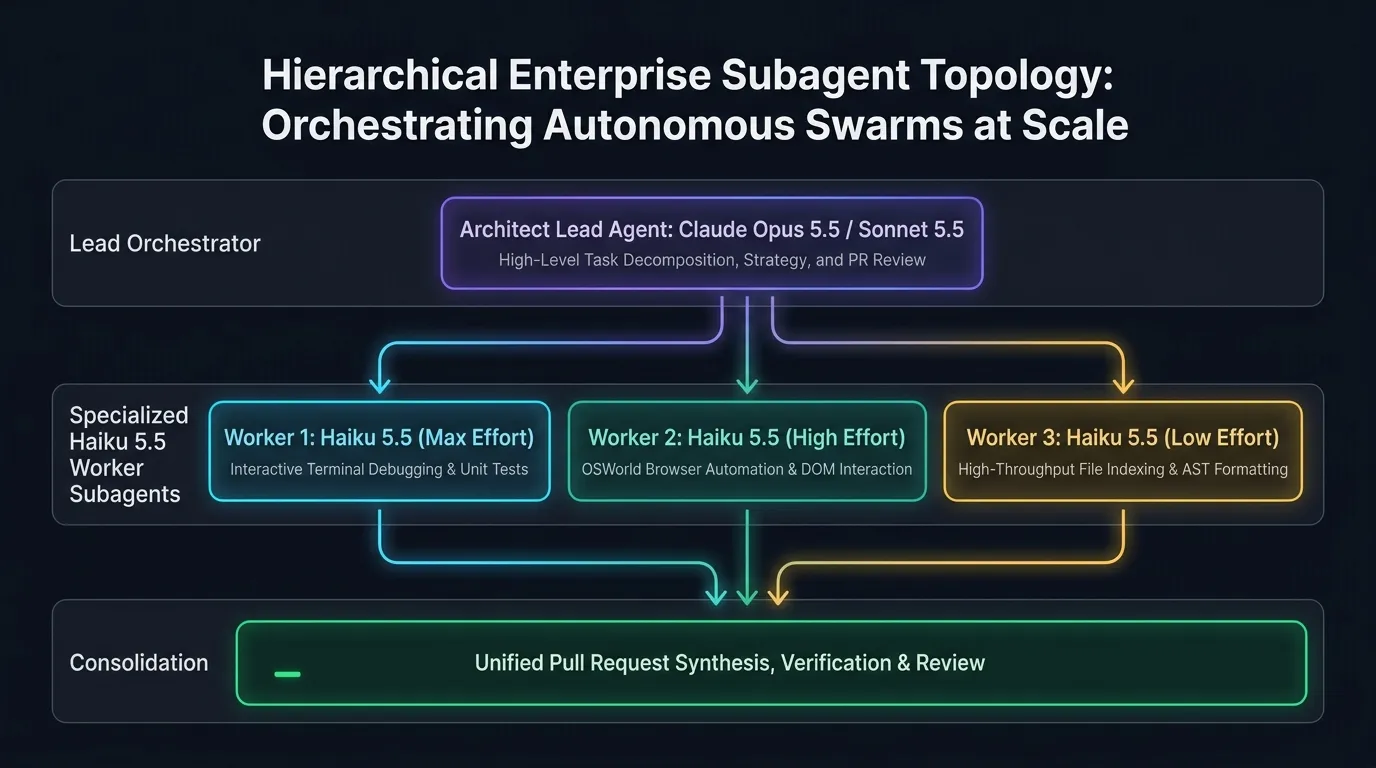 Figure 2: Hierarchical multi-agent swarm topology decoupling high-level strategic decomposition in frontier models from high-throughput execution across specialized Claude Haiku 5.5 reasoning effort profiles.
With Haiku 5.5 priced at $0.10 per million input tokens (and cached reads at $0.01 per million), running a 20-agent parallel swarm for an entire afternoon costs less than a single coffee. At 240 tokens per second, worker subagents complete repository inspections, run test suites, and resolve lint failures in seconds rather than minutes.
By coupling a 1M-token context window with dynamic reasoning effort, Anthropic has transformed the “budget model” into an industrial-grade workhorse. For agent builders, the barrier is no longer model intelligence or inference cost—it is designing architectures bold enough to harness this abundance.