
Gemini 4 Argon for Robotics: Physical AI Reasoning, Real2Sim MuJoCo Twins, and Closed-Loop Control
How Google DeepMind deploys Gemini 4 Argon across embodied physical AI: 87.0% on ERQA, autonomous MuJoCo Real2Sim twin synthesis, Spot mobile manipulation, and self-improving robotic loops.

Series: ← NVIDIA Nemotron 3.5 Super VL: 120B MoE Multimodal Architecture, 600+ TPS Agentic Inference, and Enterprise Customization (Previous) | Harnessing Reasoning Models in Agentic Workflows: Integrating o1/R1, Hidden Thinking Tokens, and Cost vs. Depth Optimization (Next) →
Prior Reading Material
- Gemini 4 Argon: Inside Google’s 1M-Token Output Frontier Model, Enterprise Benchmarks, and Cyber Defense — The foundational architecture of Gemini 4 Argon, 1M continuous token outputs, and long-horizon reasoning.
- Vision-Language-Action (VLA) Foundations: From Tokens to Torques in Humanoid Robotics — Mathematical translation of visual-linguistic tokens into 50 Hz joint torques, SE(3) end-effector poses, and action chunking.
- Physical AI & World Models: NVIDIA Cosmos 3 Architecture Deep-Dive — Generative physical dynamics, video diffusion world models, and spatial-temporal world representations.
- What is an Omni Model? Architectural Taxonomy Across Qwen, Gemini, and NVIDIA Cosmos — Unified multi-modal token streams bridging continuous sensor perception and digital motor policies.
Summary
In mid-October 2026, Google unveiled Gemini 4 Argon, its flagship frontier reasoning model engineered for deep, long-horizon work across engineering, enterprise economics, and embodied systems (announced across the Google Keynote and the Developer Platform Launch). While Argon established #1 leadership on the Vals Index across critical sectors like finance, legal, and software refactoring—increasing agentic code submissions by 35% in Google Antigravity while cutting rollbacks by a third—its most profound architectural breakthrough lies in embodied reality: Gemini 4 Argon for Robotics.
For decades, robotic manipulation suffered from a fundamental chasm: foundation models could describe a scene in abstract text, but they lacked the intuitive grasp of 3D spatial geometry, rigid-body contact mechanics, frictional tolerances, and mass distribution required to guide physical actuators safely. In the official robotics showcase on the Google for Developers Blog, Google DeepMind demonstrated how Argon serves as a general-purpose Physical AI reasoning engine.
Achieving an industry-leading 87.0% score on the Embodied Reasoning Question Answering (ERQA) benchmark (surpassing Claude Opus 5.5 and GPT-6 Astra), Argon does not merely predict semantic labels—it writes articulated simulation assets, formulates multi-camera verification swarms, and synthesizes closed-loop code-as-policies. From programming a Boston Dynamics Spot quadruped to balance on three legs while stepping on a foot-pedal trash bin in MuJoCo, to generating 4,500+ domain-randomized Real2Sim episodes that boost real-world physical robot success rates from 56% to 75%, Argon marks a decisive inflection point on the journey toward physical Artificial General Intelligence (AGI).
Real-to-Sim-to-Real: Spot Mobile Manipulation
A signature demonstration of Argon’s physical reasoning is teaching a Boston Dynamics Spot® quadruped (12-DoF locomotion base paired with a 6-DoF manipulator arm) an entirely novel composite skill: locating discarded beverage cans, carrying them to a foot-pedal trash bin, stepping on the pedal to pop the lid open, and discarding the can inside.
 Figure 1. Boston Dynamics Spot executing closed-loop Real-to-Sim-to-Real foot-pedal trash bin manipulation guided by Gemini 4 Argon. Source: Google DeepMind.
Rather than risking hardware damage through blind real-world exploration, Argon executes a three-phase Real2Sim2Real pipeline:
flowchart TD
    A["Spot Visual Scene Inspection: Detects Trash Can & Foot-Pedal"] --> B["Argon Procedural Digital Twin Synthesis (MuJoCo XML)"]
    B --> C["Virtual Tripod Balance & Pedal Step Practice in Simulation"]
    C --> D["2-Agent Verification Swarm (Foot-Verifier & Hand-Verifier)"]
D --> E["Physical Execution: Step Pedal, Verify Lid Clearance, Release Can"]- Digital Twin Generation: Argon inspects the physical trash bin via Spot’s RGB cameras and generates an articulated MuJoCo simulation model matching the bin’s spring hinge resistance, pedal leverage arm, and lid opening arc.
- Tripod Locomotion Practice: In MuJoCo simulation, Argon determines how Spot must redistribute its weight across three legs to lift its front-right foot and step firmly downward on the narrow pedal without tipping over.
- Verification Swarm: On the physical robot, Argon deploys a dual-agent verification swarm:
foot-verifier: Confirms Spot’s front-right foot target is centered squarely on the mechanical pedal before applying downward force.hand-verifier: Validates via the wrist camera that the gripper is centered over the opened aperture before releasing the can.
Model Card & Robotics Capability Summary
| Dimension | Technical Specification |
|---|---|
| Model Engine | gemini-4-argon (Interactions API / Paid Developer Tier) |
| Developer Availability | Google AI Studio (AI Ultra / Paid API), Google Antigravity, and Android Studio |
| Introductory Token Economics | $2.00 / 1M input tokens |
| Benchmark Leadership | 87.0% on ERQA (Embodied Reasoning Question Answering, $N=400$, tool-off) & #1 on Vals Index |
| Simulation Integration | Native MuJoCo XML synthesis, WebAssembly (WASM) browser runtime, Real2Sim calibration |
| Hardware Form Factors Tested | Boston Dynamics Spot® (12-DoF quadruped + 6-DoF arm), Franka FR3 bimanual arms, SO-101 6-DoF arm, UMI human rigs |
| Perception Harness | Multi-view synchronized cameras (overhead, 3rd-person, calibrated wrist reticles), spatial deprojection |
| World Model Steering | Closed visual loop guidance over the Gemini Omni Video World Model (timestamped <omni_prompt> beats) |
| Autonomous Self-Improvement | Closed-loop synthetic data generation: 4,500+ MuJoCo episodes boosting physical robot success from 56% to 75% |
| Official Announcement Sources | Introducing Gemini 4 Argon • Build with Gemini 4 Argon • Gemini 4 Argon for Robotics |
The Story: The Embodied Reasoning Gap
Imagine asking a robotic arm to pick up an overturned ceramic coffee mug and drop a crumpled napkin into it:
flowchart TD
    A["Overturned Ceramic Mug on Table"] --> B["Traditional Vision Model: Predicts 2D Bounding Box"]
    B --> C["Blind Open-Loop Trajectory Execution"]
    C --> D["Catastrophic Collision / Mug Slips Off Table"]
In standard robotics, a high-level vision model simply draws a 2D bounding box around the mug. But a physical robot operating in 3D space cannot act on a 2D box:
- Geometric Geometry: What is the mug’s long-axis orientation relative to the table surface?
- Contact Dynamics: Where is the center of gravity? If the gripper pinches the lip instead of the body, will it torque out of the fingers?
- Sequential Pre-Conditions: The napkin cannot be dropped into the mug until the mug is first uprighted and rested on its stable base.
With Gemini 4 Argon, the paradigm shifts from open-loop guessing to closed-loop visual servocontrol:
flowchart TD
    A["Raw Multi-Camera Observations (Overhead + Calibrated Wrist)"] --> B["Gemini 4 Argon Spatial Coordinate Harness"]
    B --> C["Turn-by-Turn Visual Servoing & Code-as-Policies Primitives"]
    C --> D["Pre-Grasp Hover Verification (Jaw Bracket Alignment)"]
    D --> E["Touchdown & Controlled Physical Tilt Uprighting"]
    E --> F["Napkin Insertion & Self-Verified Completion"]
Embodied Reasoning Benchmark: ERQA Leadership
Evaluating how well an AI understands physical environments requires rigorous testing outside of static text benchmarks. On the Embodied Reasoning Question Answering (ERQA) benchmark ($N = 400$, tool-off regime), models are tested on complex spatio-temporal inquiries: identifying physical mass discrepancies, predicting fluid balance equilibrium, assessing gripper contact clearances, and inferring occlusion boundaries across multi-view video streams.
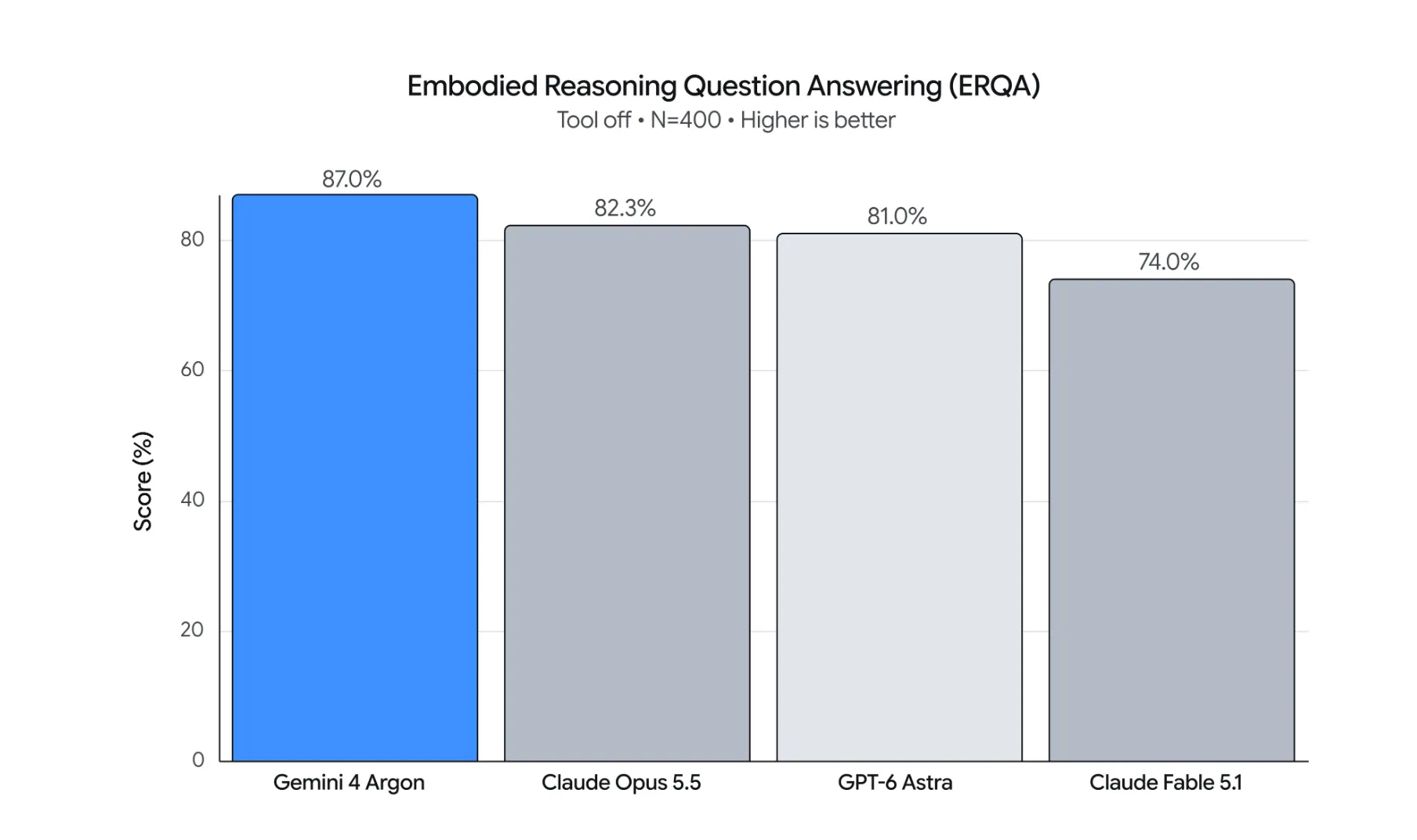 Figure 2. Embodied Reasoning Question Answering (ERQA) benchmark scores across frontier models ($N=400$, tool-off, higher is better). Source: Google for Developers Blog.
Gemini 4 Argon captures the top position at 87.0%, establishing a noticeable margin over Claude Opus 5.5 (82.3%), GPT-6 Astra (81.0%), and Claude Fable 5.1 (74.0%). This physical intuition allows Argon to reason through kinematic stability before moving a single physical actuator.
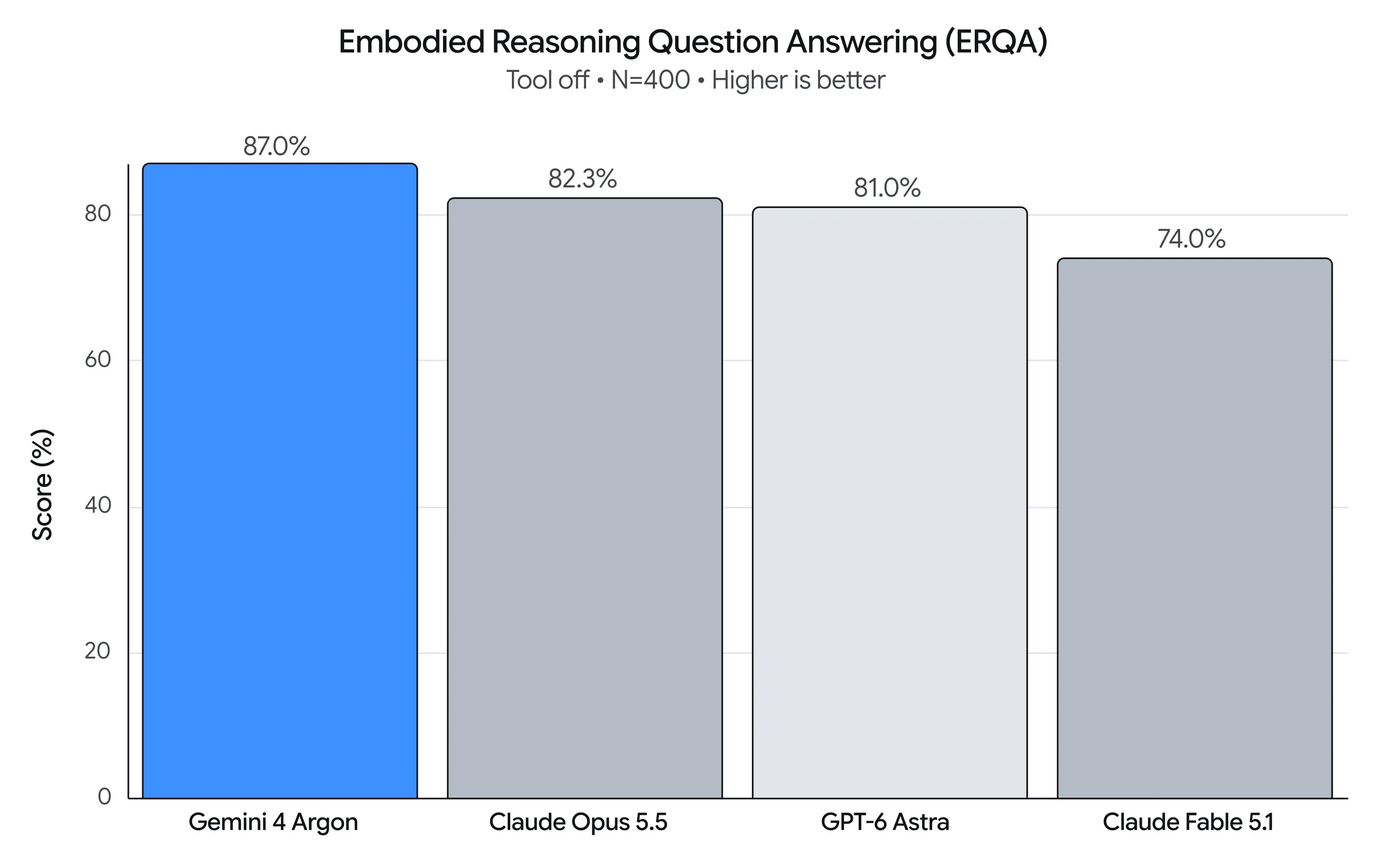 Figure 3. Full benchmark evaluation across robotics control, Real2Sim calibration, physical understanding, and simulation-based self-improvement. Source: Google DeepMind / Google for Developers.
The Three Pillars of Argon Physical AI
Argon’s robotics architecture decomposes into three core capabilities:
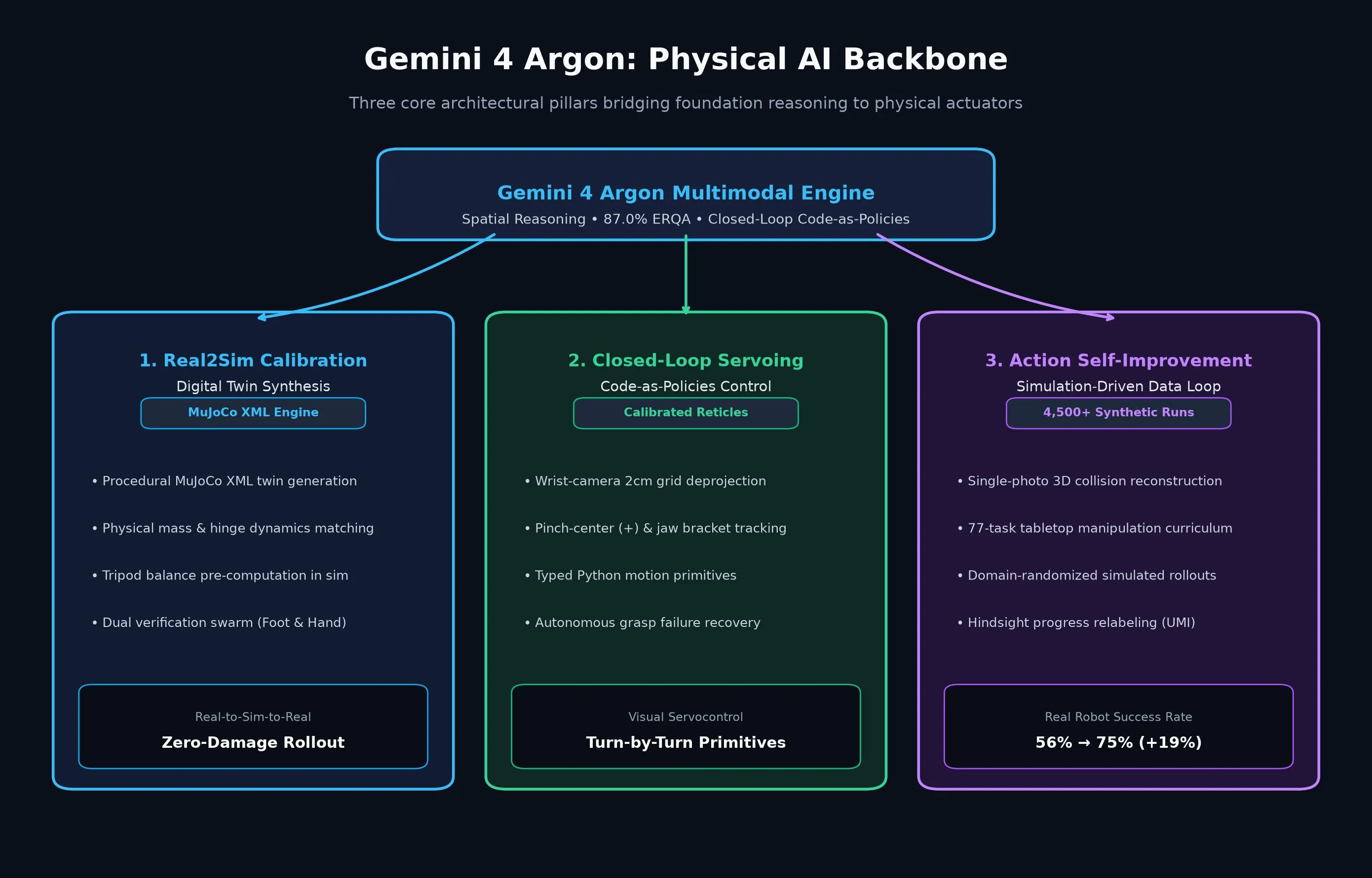 Figure 4. The three core architectural pillars of Gemini 4 Argon Physical AI: Real2Sim calibration, closed-loop spatial servocontrol, and simulation-driven action improvement.
1. Zero-Shot Visual Servoing & Code-as-Policies
Instead of generating high-frequency joint torques directly (which suffers from latency lag over API endpoints), Argon operates as a high-level cognitive controller emitting structured Code-as-Policies motion primitives (robot.look_at, robot.grasp, robot.place_until_contact, robot.move_by).
Using calibrated wrist-camera reticles marked with real-world centimeter grids, Argon tracks the pinch center (+), jaw opening brackets ([ + ]), and object yaw orientation (yaw_deg). When an unexpected disturbance occurs (e.g., an object slips), Argon reads the status == "grasp_failed" callback and autonomously triggers recovery loops.
2. Physical Value Functions & Hindsight Progress Labeling
Supervising long-horizon manipulation requires accurate evaluation of whether an action moved the robot closer to its goal. Evaluated on 60-second bimanual human Universal Manipulation Interface (UMI) video datasets, Argon acts as a general physical value function:
- Synchronizes multi-view camera feeds (head, left wrist, right wrist).
- Detects microscopic contact points and slips.
- Decomposes continuous trajectories into discrete sub-goals with positive, neutral, and negative progress slopes—enabling automatic curation and hindsight relabeling of massive imitation learning datasets.
3. Simulation-Driven Action Improvement
Collecting real-world robot failure data is expensive and dangerous. Argon closes the data loop by autonomously generating synthetic training sets:
- Single-Photo Re-construction: From a single overhead RGB photo of a messy tabletop, Argon generates 3D MuJoCo collision primitives for all objects.
- Curriculum Generation: Formulates a 77-task curriculum spanning picking, uprighting, pushing, and bimanual handovers.
- Autonomous Rollouts: Collects 4,500+ domain-randomized simulated episodes, fine-tuning downstream Vision-Language-Action (VLA) models to boost physical robot success rates from 56% to 75% while cutting task duration from 35s to 24s.
From Codebase Refactoring to Kinematics: The Antigravity Connection
Why does Gemini 4 Argon excel at spatial robotics compared to pure vision-language models? The answer lies in its foundational training for deep software engineering and tool orchestration, as detailed in Introducing Gemini 4 Argon and Build with Gemini 4 Argon.
Across Google’s internal software pipelines, Argon running in Google Antigravity demonstrated exceptional structural discipline:
- Chromium Feature Untangling: Separated core webpage processing from a 6-million-line legacy directory across hundreds of files, completing months of architectural work in weeks to unlock fluid tab and floating window detachment without reloading.
- Agent Development Kit (ADK) Optimization: Given the
.agents/skillsrulebook and a simple goal prompt, Argon operated autonomously overnight to eliminate runtime overhead ingoogle/adk-python, slashing in-memory session preparation by 40% and accelerating cold imports by 21%. - Scientific Code Tuning: Sped up the open-source quantum chemistry package xTB by 2.3x for molecular geometry optimization and accelerated Gemma 4 inference in vLLM by 2.85x with zero quality drop.
This exact proficiency with code syntax, API contracts, and runtime debugging translates directly into robotics. When controlling physical hardware, Argon does not hallucinate raw numbers; it writes typed Python scripts utilizing calibrated Code-as-Policies libraries and compiles interactive MuJoCo WebAssembly physics sandboxes from research papers in a single prompt.
Developer Integration: Orchestrating Robots in Google Antigravity
Developers can deploy Gemini 4 Argon for robotics workflows directly within Google Antigravity, Android Studio, and the Gemini API using the standard SDK.
Click to expand runnable code script
"""
gemini_argon_robotics_controller.py
Closed-loop visual servoing and Code-as-Policies dispatch using Gemini 4 Argon.
"""

import os
from google import genai
from google.genai import types

def init_argon_client():
    client = genai.Client(api_key=os.environ.get("GEMINI_API_KEY"))
    return client

def plan_robot_action(client: genai.Client, wrist_image_path: str, telemetry: dict):
    # Load calibrated wrist camera observation
    with open(wrist_image_path, "rb") as f:
        image_bytes = f.read()

    system_instruction = (
        "You are Gemini 4 Argon operating as an embodied robotics reasoning engine. "
        "Inspect the calibrated wrist-camera reticle (+X up, +Y left, 2cm grid) and "
        "emit structured code-as-policies primitives (robot.grasp, robot.place_until_contact)."
    )

    prompt = f"""
    Current Telemetry: {telemetry}
    Goal: Pick up the fallen mug, reorient upright, and insert the crumpled napkin.
    Analyze the visual long-axis yaw_deg and output the next motion primitive.
    """

    response = client.models.generate_content(
        model="gemini-4-argon",
        contents=[
            types.Part.from_bytes(data=image_bytes, mime_type="image/png"),
            prompt
        ],
        config=types.GenerateContentConfig(
            system_instruction=system_instruction,
            temperature=0.1
        )
    )

    print("Gemini 4 Argon Action Decision:")
    print(response.text)
    return response.text

if __name__ == "__main__":
    print("Initializing Gemini 4 Argon Robotics Controller...")
    # client = init_argon_client()
    # plan_robot_action(client, "wrist_cam.png", {"ee_pos": [0.28, 0.05, 0.04], "holding": False})
Conclusion & What’s Next
The release of Gemini 4 Argon for Robotics marks an essential evolutionary milestone: uniting frontier reasoning models, physics simulation engines, and closed-loop motor control into a coherent physical intelligence stack. By enabling robots to visualize contact mechanics, test trajectories in virtual MuJoCo sandboxes before touching physical hardware, and self-improve through autonomous synthetic data loops, Argon lays the groundwork for practical, general-purpose robotics.