
TypeSafe AI Jev: The Non-Autoregressive 'System One' Decision Engine and the Latency Collapse
How TypeSafe AI's Jev model replaces slow, expensive LLMs with sub-100ms, non-autoregressive typed decisions, revolutionizing agent routing and guardrails.

Series: ← Gemini 4 Argon: Inside Google’s 1M-Token Output Frontier Model, Enterprise Benchmarks, and Cyber Defense (Previous)
Summary
On September 15, 2026, TypeSafe AI introduced Jev, the first dedicated non-autoregressive System One decision model. Operating as an ultra-fast, single-pass classification engine, Jev delivers deterministic boolean and enum decisions in sub-100ms at $0.042 per million input tokens (with completely free output)—eliminating latency bottlenecks, high token costs, and JSON parse failures in autonomous agent loops.
Official Model Card & Announcement Summary
| Attribute | Specification |
|---|---|
| Model Family | TypeSafe AI Machine-Native Intelligence |
| Model Identifier | typesafe-ai/jev |
| Announcement Date | September 15, 2026 |
| Architecture Paradigm | Non-Autoregressive Discriminative Classifier (Single-pass forward propagation) |
| Output Format | Strictly Typed Primitives (bool, discrete enum, bounded float score, calibrated probabilities) |
| End-to-End Latency | 70ms – 250ms (10x–50x faster than traditional LLM generation) |
| Token Pricing | $0.042 / 1M input tokens ($42 / 1B tokens) · $0 output cost (free/unmetered) |
| Hallucination Risk | 0% Structural Hallucination (mathematically bounded to preset enum / boolean schemas) |
| Ecosystem Integrations | BAML (BoundaryML), LangChain, DigitalOcean GenAI, Fly.io edge workers |
| Official Announcement | TypeSafe AI Official Portal |
Prior Reading Material
To grasp why the industry reached a breaking point with generative LLMs handling simple logic gates, review our prior explorations on token economics, agent gateways, and inference serving:
- Token Economics, LLM Gateways, and Router9 — The architectural imperative of routing queries to cost-optimal compute tiers.
- Gemini 4 Argon: Inside Google’s 1M-Token Output Frontier Model, Enterprise Benchmarks, and Cyber Defense — Google’s massive frontier model for deep, slow System Two reasoning.
- NVIDIA NeMo Guardrails: Programmable Agent Safety and Colang 2.0 Workflows — Programmable safety guardrails and event-driven interceptors.
- Model Context Protocol (MCP): Tool Integration in Claude Code — Standardizing how agents select tools and communicate across boundaries.
- OpenAI GPT-6 Sol and Luna: The Structural Price Collapse in Frontier Agent Workflows — Token price compression and test-time reasoning trade-offs.
The Sledgehammer Problem: Why We Waste LLMs on “If” Statements
Consider modern software architecture. Every time an autonomous agent processes an email, screens an inbound customer query, checks a safety policy, or decides which tool to invoke, it needs an answer to a straightforward, binary question:
“Is this customer asking for a refund? (True / False)"
"Which department should handle this ticket: Billing, Engineering, or Security?"
"Does this generated SQL statement contain an unauthorized mutation? (Pass / Fail)”
How does the software industry answer that question today?
We take an enormous, trillion-parameter generative language model (GPT-6, Claude Opus 5.5, or Gemini 4), formulate an intricate 2,000-token prompt with few-shot examples, pass it to an inference cluster, and wait.
flowchart TD
    classDef legacy fill:#2b1b17,stroke:#ff6b6b,stroke-width:2px,color:#ffffff;
    classDef decode fill:#3d1a24,stroke:#f06595,stroke-width:2px,color:#ffffff;
    classDef fail fill:#4a121a,stroke:#fa5252,stroke-width:2px,color:#ffffff;

    A["Inbound Event: Customer requests invoice refund"] --> B["Build 2000-Token Prompt with JSON Schema and Few-Shot Rules"]
    B --> C["Send to Generative Frontier LLM Cluster: GPU Prefill Phase"]
    C --> D["Autoregressive Decode: Token 1 open-brace ... Token 2 status ... Token 3 true"]
    D --> E["Wait 1800ms and Spend 0.004 Dollars per Request"]
    E --> F["Parse JSON String with Regex and Guard Against Hallucinations"]

    class A,B legacy;
    class C,D decode;
    class E,F fail;
To decide between true or false, a generative model spins up multi-head self-attention across dozens of layers, loads gigabytes of KV-cache into high-bandwidth memory (HBM), and autoregressively generates text token-by-token. It generates the open bracket {, then the quote ", then the key is_refund, then a colon, and finally true.
This is the equivalent of hiring a world-renowned novelist and a full philharmonic orchestra every time a pedestrian approaches a revolving door, just to have them sing: “Yes, you may enter.”
It is excruciatingly slow (1,500ms to 4,000ms), astronomically expensive ($2 to $10 per million tokens), and prone to parser failure when the model accidentally wraps its response in extraneous conversational filler.
Daniel Kahneman’s Paradigm: System One vs. System Two
In cognitive psychology, Daniel Kahneman famously established the duality of human cognition in Thinking, Fast and Slow:
- System One: Fast, automatic, frequent, emotional, stereotypic, and subconscious. When someone throws a ball at your face, you duck. You do not derive Isaac Newton’s equations of motion; your brain makes an instantaneous reflex judgment.
- System Two: Slow, deliberate, logical, calculating, and conscious. When you solve a multi-variable calculus problem, audit a complex corporate tax return, or architect a distributed database, you engage System Two.
For the past four years, the AI ecosystem made a collective category error: we attempted to solve pure System One problems using brute-force System Two architectures.
flowchart TD
    classDef sys1 fill:#082032,stroke:#00ff88,stroke-width:2px,color:#ffffff;
    classDef sys2 fill:#2b1055,stroke:#bd34fe,stroke-width:2px,color:#ffffff;
    classDef arch fill:#0f172a,stroke:#38bdf8,stroke-width:2px,color:#ffffff;

    A["The Dual-Cognition Agent Architecture"] --> B["System One: TypeSafe AI Jev"]
    A --> C["System Two: Frontier LLMs such as Gemini 4 or Claude Opus"]

    B --> D["Sub-100ms Reflex Decision Gates"]
    D --> E["Triage and Routing<br/>Policy Guardrails<br/>Tool Dispatch<br/>Context Compaction"]

    C --> F["Deep Synthesis and Creative Generation"]
    F --> G["Multi-File Code Rewrites<br/>In-Depth Research<br/>Novel Drafting<br/>Complex Formal Proofs"]

    class B,D,E sys1;
    class C,F,G sys2;
    class A arch;
TypeSafe AI’s Jev is built from the ground up as a dedicated System One engine.
Jev is not a chatbot. It cannot compose a Shakespearean sonnet, it will not answer trivia about the Roman Empire, and it cannot write a creative marketing email.
Instead, Jev is a discriminative, non-autoregressive decision model. You hand it an input state (an email, a code snippet, a user message) and a strongly typed question with discrete options (bool, enum, or a floating-point score). In a single parallel forward pass, Jev outputs a calibrated decision in 70 to 150 milliseconds.
flowchart TD
    classDef input fill:#112240,stroke:#64ffda,stroke-width:2px,color:#ffffff;
    classDef jev fill:#052e16,stroke:#00ff88,stroke-width:2px,color:#ffffff;
    classDef native fill:#07203b,stroke:#00e5ff,stroke-width:2px,color:#ffffff;

    A["Inbound Event: Customer requests invoice refund"] --> B["TypeSafe AI Jev: Single-Pass Forward Propagation"]
    B --> C["Output: Exact Native Boolean True with 98.4% Confidence"]
    C --> D["Instantaneous 85ms Reflex with 0.000035 Dollar Billing Cost"]
    D --> E["Native Code if result is True Executes Immediately"]

    class A input;
    class B,C jev;
    class D,E native;
In Conversation & Demonstration: Why System One AI Changes the Game
To dive deeper into the architectural shift from token generation to decision reflexes, watch the deep-dive interview with Diogo Almeida (founder and CEO of TypeSafe AI and co-author of InstructGPT) hosted on the a16z Podcast with Ben Horowitz and Martin Casado:
Official Live Video Demo: You can also watch the side-by-side terminal race comparing Jev directly against autoregressive frontier models (GPT-5.6 Terra) on the official TypeSafe AI announcement page.
What the Demonstration Reveals
- Parallel Probability Projection vs. Token Generation:
- The LLM must sequentially predict every character, JSON quote, bracket, key name, colon, and space—taking seconds while its attention mechanism repeatedly recalculates past tokens.
- Jev evaluates the input sequence and immediately returns the full probability distribution across all schema choices in a single forward pass.
- “Giving Up Strings Gives Us Superpowers”:
- As Diogo Almeida highlights, text strings are amazingly flexible for open-ended human conversations, but they are catastrophically expensive and fragile for machine automation.
- When software only needs to branch or route, “giving up” free-form string generation enables mathematical type-safety, 0% schema hallucination risk, and sub-100ms turnaround.
- Calibrated Nuance:
- In the recorded run, Jev and GPT-5.6 Terra agreed on virtually every complex categorization, with the only divergence occurring on a genuinely ambiguous edge case (“Churn likelihood level”), where Jev explicitly communicated its lower confidence rather than masking uncertainty behind verbose prose.
The Economic Collapse: $0.042 / 1M Input and Free Output
The economics of Jev fundamentally alter agent design.
In typical frontier LLM pricing (e.g. GPT-6 Sol at $2.00 / $10.00, Claude Opus 5.5 at $4.00 / $20.00, or Gemini 4 Argon at $2.00 / $10.00), executing thousands of intermediate classification steps inside an agent loop becomes the single largest driver of cloud spend.
TypeSafe AI introduced a disruptive pricing model:
- Input Tokens: $0.042 per million tokens (or $42 per billion tokens).
- Output Tokens: $0.00 (Completely Free).
Because Jev’s output is an encoded typed value (a 1-bit boolean or an integer index) rather than hundreds of generated text tokens, TypeSafe AI considers output “too cheap to meter.”
Real-World Scale Comparison: 1,000,000 Decisions
Consider an enterprise customer support agent processing 1,000,000 inbound tickets or internal workflow routing decisions per month, with an average input context of 1,200 tokens:
| Metric | Autoregressive Frontier LLM (GPT-6 Sol / Opus) | TypeSafe AI Jev (System One) | Impact / Advantage |
|---|---|---|---|
| Input Token Price (per 1M) | $2.00 – $4.00 | $0.042 | 47x – 95x cheaper |
| Output Token Price (per 1M) | $10.00 – $20.00 (avg. 45 tokens JSON) | $0.00 (Free) | 100% savings |
| Total Monthly Cost (1M calls) | $2,850.00 – $5,700.00 | $50.40 | Save $2,799+ per month |
| Average Decision Latency | 1,450ms – 3,200ms | 75ms – 120ms | 15x – 30x faster |
| JSON Parse Failures | ~0.5% – 1.8% (formatting quirks) | 0.0% (Type-Safe Native) | Eliminates retry overhead |
Standalone vs. Tandem: Do You Always Need an LLM with Jev?
A common question among systems engineers evaluating Jev is: If Jev only outputs boolean or enum primitives and cannot generate prose, does that mean every implementation must pair it with a generative LLM?
The answer is no. Whether Jev operates as an autonomous solo engine or in tandem with a frontier LLM depends on whether your software’s end goal is taking an action or producing text.
Pattern 1: Jev as a 100% Standalone Decision Engine (Zero LLMs)
In traditional backend engineering, hundreds of high-throughput pipelines do not require prose generation; they require deterministic execution triggered by fuzzy real-world text.
Before Jev, teams paid an LLM tax simply to convert natural language into an if/else branch. With Jev, standard application code takes over the instant the decision returns:
flowchart TD
    classDef input fill:#112240,stroke:#64ffda,stroke-width:2px,color:#ffffff;
    classDef jev fill:#052e16,stroke:#00ff88,stroke-width:2px,color:#ffffff;
    classDef code fill:#07203b,stroke:#00e5ff,stroke-width:2px,color:#ffffff;

    A["Inbound Data: Raw text or user event"] --> B["TypeSafe AI Jev: 80ms Reflex Gate"]
    B --> C["Output: Strongly Typed Enum or Boolean Primitive"]
    C --> D["Deterministic Application Logic: Python or Go backend"]
    D --> E["Database Mutation or Stripe API or PagerDuty Alert"]

    class A input;
    class B jev;
    class C,D,E code;
Real-world standalone scenarios include:
- Automated Payment & Refund Webhooks:
- An inbound email arrives: “Cancel my subscription and refund yesterday’s transaction.”
- Jev evaluates:
is_refund_request = True,confidence = 0.98. - Your code directly invokes the Stripe REST API (
stripe.Refund.create(...)) and updates Postgres. Zero generative LLMs are involved. Total turnaround: 85ms. Cost: $0.00004.
- Database Mutation Guardrails:
- An internal developer tool generates dynamic database queries.
- Jev acts as an inline proxy:
is_destructive_ddl = True. - The gateway aborts with HTTP 403 before the query hits your primary database cluster.
- High-Throughput Content Moderation & Spam Filtering:
- User posts a forum comment $\to$ Jev returns
is_toxic = False,spam_score = 0.01. - The comment commits straight to Redis and renders on the client in sub-100ms.
- User posts a forum comment $\to$ Jev returns
Pattern 2: The Hybrid Bouncer Pattern (Jev in Tandem with an LLM)
When the final deliverable to the user must be an open-ended synthesized paragraph, creative document, or complex multi-file codebase rewrite, Jev is paired with a frontier model (Gemini 4 Argon, Claude Opus 5.5, or GPT-6 Astra) as an intelligent Bouncer, Router, and Safety Interceptor:
flowchart TD
    classDef jev fill:#052e16,stroke:#00ff88,stroke-width:2px,color:#ffffff;
    classDef llm fill:#2b1055,stroke:#bd34fe,stroke-width:2px,color:#ffffff;
    classDef standard fill:#0f172a,stroke:#38bdf8,stroke-width:2px,color:#ffffff;

    A["User Prompt or Complex Multimodal Task"] --> B["Gate 1: Jev Safety and Indirect Prompt Injection Check in 75ms"]
    B -- "Approved as Safe" --> C["Gate 2: Jev Intent Classification and Tool Selection in 80ms"]
    C --> D["Frontier System Two LLM: Deep Synthesis and Text Generation in 2000ms"]
    D --> E["Gate 3: Jev Output Policy and Factuality Verification in 85ms"]
    E -- "Verified Safe" --> F["Stream Final Answer to User"]

    class B,C,E jev;
    class D llm;
    class A,F standard;
Why introduce Jev into an LLM pipeline?
- Short-Circuiting Wasteful Calls: Up to 60% of customer support requests are repetitive FAQs or out-of-scope noise. Jev identifies them in 80ms for $0.00004, serving cached answers and completely shielding your $2–$10/1M token frontier LLMs from unnecessary invocation.
- Eliminating Cascading Latency: Instead of forcing a multi-hop agent to call an LLM 4 times in sequence (taking 7+ seconds), Jev handles the three routing and verification gates in under 260ms combined, preserving real-time user responsiveness.
- Deterministic Security: Bounding security guardrails to a discriminative classification head prevents prompt injection bypasses that trick generative LLMs into emitting
{ "safe": true }.
Under the Hood: The Non-Autoregressive Advantage
Why is Jev so dramatically faster and cheaper than traditional models? The answer lies in the fundamental difference between autoregressive generation and discriminative classification.
1. Eliminating the Autoregressive Decode Loop & Parallel Sampling
In traditional LLMs, inference is split into two distinct phases:
- Prefill Phase: The input prompt is processed in parallel across GPU matrix units.
- Decode Phase: The model generates one token at a time. Each new token requires a full pass through the model’s weights and an update to the KV-cache. The decode phase is inherently sequential and memory-bandwidth bound.
Because Jev does not output free-form text strings, it has no decode phase whatsoever.
Instead, TypeSafe AI engineered a hardware-aware parallel sampler. When evaluating an input against a typed schema, Jev runs a single parallel forward pass over the input sequence, projects the final hidden state through a lightweight classification head, and simultaneously computes the full probability distribution over all allowed types:
$$P(y = c \mid \mathbf{x}) = \frac{\exp(\mathbf{w}c^T \mathbf{h}{\text{final}} + b_c)}{\sum_{j=1}^{C} \exp(\mathbf{w}j^T \mathbf{h}{\text{final}} + b_j)}$$
There is no autoregressive looping. There is no KV-cache accumulation. The inference finishes the microsecond the prefill pass completes.
2. Reinforcement Learning for Calibrated Decisions (RLCD)
Traditional RLHF (Reinforcement Learning with Human Feedback) optimizes for answers that human raters subjectively prefer, while RLVR (Reinforcement Learning with Verifiable Rewards) optimizes for verifiable terminal outcomes like math proofs or unit tests. Both tend to produce models that are overconfident and poorly calibrated when asked for probability estimates.
TypeSafe AI pioneered Reinforcement Learning for Calibrated Decisions (RLCD):
-
Instead of rewarding conversational style or raw task completion, RLCD trains the model’s logits to reflect true epistemic uncertainty.
-
When Jev returns a choice with confidence $p = 0.94$, exactly 94 out of 100 historical predictions at that score are objectively accurate.
-
This consistency allows developers to construct deterministic confidence gates:
-
Confidence $\ge 0.90$: Execute autonomous action immediately.
-
Confidence between $0.70$ and $0.89$: Escalate to a System Two model (e.g., Claude, GPT-6, or Gemini 4) for deeper scrutiny.
-
Confidence $< 0.70$: Route directly to human review.
flowchart TD
    classDef req fill:#1e1e2e,stroke:#a6adc8,stroke-width:2px,color:#ffffff;
    classDef gate fill:#0d2b45,stroke:#00e5ff,stroke-width:2px,color:#ffffff;
    classDef auto fill:#052e16,stroke:#00ff88,stroke-width:2px,color:#ffffff;
    classDef esc fill:#2b1b17,stroke:#f59e0b,stroke-width:2px,color:#ffffff;
    classDef human fill:#3b1111,stroke:#ef4444,stroke-width:2px,color:#ffffff;

    A["Inbound Ticket or Agent Action Request"] --> B["Jev System One Reflex Gate"]
    B --> C{"Calibrated Confidence Score"}

    C -- "High Confidence: P at or above 90%" --> D["Automated Execution: Zero Human Intervention in 80ms"]
    C -- "Ambiguous: P between 70% and 90%" --> E["Escalate to Frontier System Two LLM in 1500ms"]
    C -- "High Uncertainty: P below 70%" --> F["Quarantine and Route to Human Ops Queue"]

    class A req;
    class B,C gate;
    class D auto;
    class E esc;
    class F human;
Architectural Decision Matrix: Do You Need an LLM?
Use the following checklist when designing your next agent or workflow pipeline:
| Engineering Goal | Jev Alone (System One) | Requires Generative LLM (System Two) |
|---|---|---|
| Route an inbound event to a microservice or database | ✅ Yes (Standalone) | ❌ Unnecessary |
| Block SQL injection, prompt tampering, or PII leaks | ✅ Yes (Standalone) | ❌ Unnecessary |
| Trigger an automated payment or external webhook | ✅ Yes (Standalone) | ❌ Unnecessary |
| Filter spam, classify sentiment, or tag incoming support tickets | ✅ Yes (Standalone) | ❌ Unnecessary |
| Prune irrelevant conversation history before calling an LLM | ✅ Yes (Standalone) | ❌ Unnecessary |
| Draft a nuanced, personalized 3-paragraph apology email | ❌ Cannot generate text | ✅ Yes (Generative Model) |
| Synthesize an exhaustive 50-page legal due diligence memo | ❌ Cannot generate text | ✅ Yes (Generative Model) |
| Perform multi-file C++ to Rust code refactors (1M tokens) | ❌ Cannot generate text | ✅ Yes (Generative Model) |
Pros and Cons: A Balanced Engineering Appraisal
The Advantages (Pros)
- Radical Latency Collapse: Sub-100ms response times make real-time user-facing routing, dynamic autocomplete, and pre-execution security interception feel instant.
- Dramatically Lower Operational Costs: At $0.042/1M input and free output, developers can run millions of evaluation steps for pennies.
- Zero Structural Hallucination: Jev cannot output invalid JSON keys, hallucinate markdown code blocks, or drift into conversational preambles.
- Native BAML & Framework Support: Clean compiler-checked integration with Python, TypeScript, and Go runtimes.
The Limitations (Cons)
- Zero Generative Capability: Jev cannot write explanations, generate code patches, or draft summaries. It requires pairing with a traditional System Two model for end-to-end applications.
- Context Length Boundaries: While optimized for typical prompts (under 16K tokens), Jev is not designed for multi-million-token repository ingestion like Gemini 4 Argon.
- Cold-Start Schema Dependency: Adding new classification categories requires re-specifying the enum schema; it cannot dynamically invent novel output categories on the fly.
- Single-Provider Lock-In: Currently hosted exclusively via TypeSafe AI’s managed cloud and certified partners (DigitalOcean, Fly.io), with open-weight self-hosted models not yet available.
The Native BAML Integration: Code as Schema
To make Jev accessible to application developers without writing custom HTTP marshaling logic, TypeSafe AI partnered closely with BAML (BoundaryML), the open-source type-safe prompting framework.
In BAML, you define the data types using native syntax, and BAML binds directly to Jev:
// BAML Schema definition
class TicketTriage {
    category TicketCategory
    urgency float @assert({{ this >= 0.0 && this <= 1.0 }})
    requires_escalation bool
}

enum TicketCategory {
    BILLING_DISPUTE
    TECHNICAL_OUTAGE
    SECURITY_INCIDENT
    GENERAL_INQUIRY
    SPAM_OR_MALICIOUS
}

function TriageInboundTicket(ticket_body: string) -> TicketTriage {
    client JevSystemOne
    prompt #"
        Categorize the following inbound ticket:
        {{ ticket_body }}
    "#
}
In your application code (Python, TypeScript, or Go), the returned object is not a raw string that requires JSON parsing; it is an instantiated, compiler-verified type:
from baml_client import b
from baml_client.types import TicketCategory

# Returns in 82 milliseconds with zero JSON parsing risk
result = b.TriageInboundTicket(raw_email_text)

if result.category == TicketCategory.SECURITY_INCIDENT:
    trigger_security_pager(result.urgency)
elif result.requires_escalation:
    dispatch_to_frontier_llm(raw_email_text)
Official Workflow Evals: Dominating the Pareto Frontier
Beyond synthetic classification speed, how does Jev compare against industry frontier models on complex business logic?
In their official evaluation suite, TypeSafe AI benchmarked Jev across four diverse, high-volume production workflows:
- Security Incident Triage: Analyzing system telemetry and threat reports to trigger automated isolation vs. human SOC escalation.
- Agent Trace Observability: Evaluating multi-turn conversational traces to diagnose agent failures and detect tool loop drift.
- Invoice & Claims Processing: Parsing semi-structured vendor documents to detect anomalies, line-item discrepancies, and approval limits.
- Customer Service Triage: Assessing customer intent, urgency, sentiment, and account churn indicators.
To establish ground-truth labels without human scoring bias, TypeSafe AI used the consensus average of GPT-6 Astra and Claude Fable 5.1 operating at maximum thinking settings.
The results across models are plotted below on a logarithmic cost vs. accuracy scale:
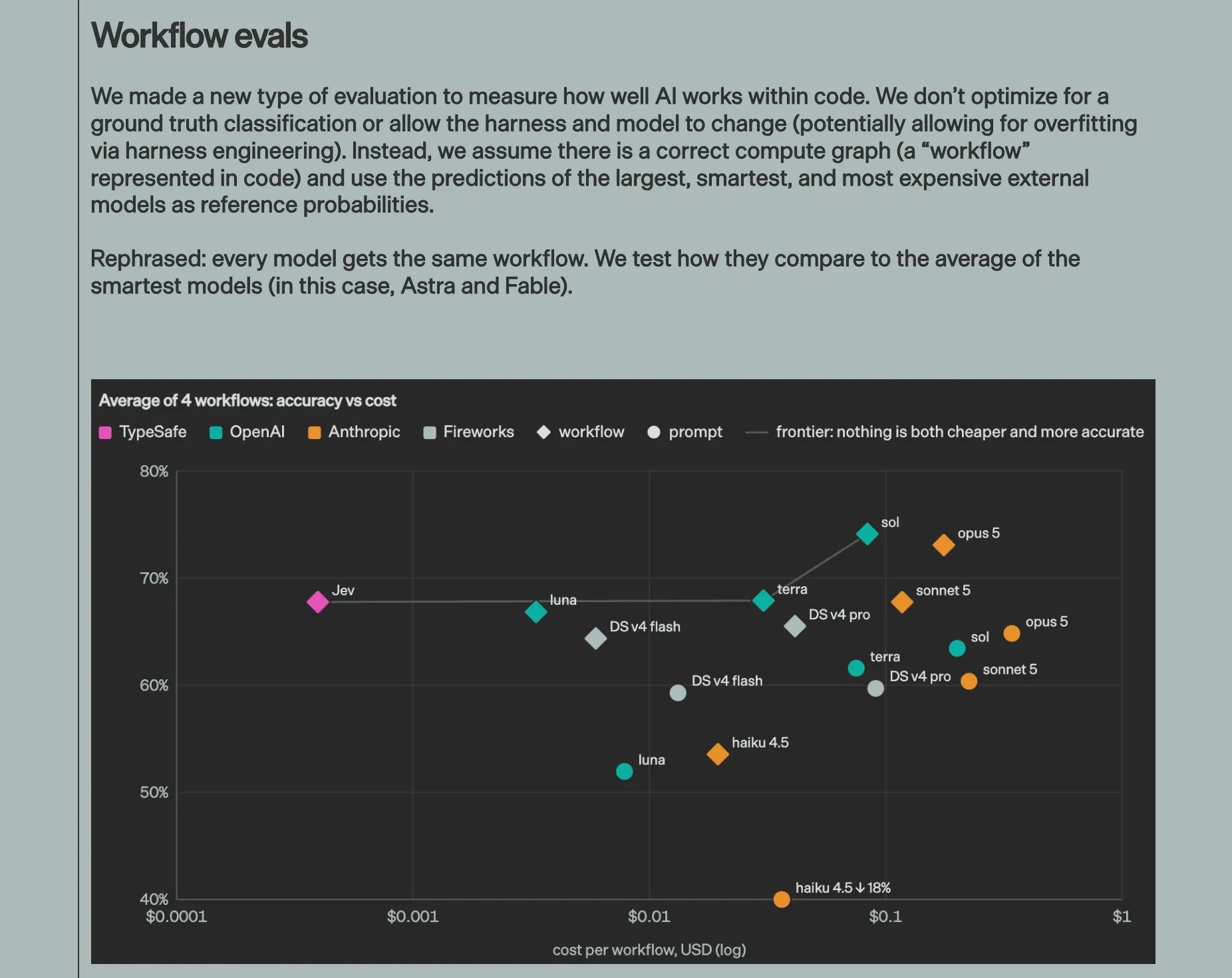
Source: TypeSafe AI — “Workflow evals: Average of 4 workflows: accuracy vs cost”. Official evaluation comparing Jev against open-weights and frontier closed models.
Key Takeaways from the Official Benchmark
- Defining the Efficiency Frontier:
- Jev delivers ~67.8% accuracy at an average cost of approximately $0.0004 per workflow execution.
- Traditional frontier models like Claude Opus 5, Sonnet 5, and GPT-6 Astra achieve marginal accuracy gains (72%–78%), but at 10x to 100x the inference cost ($0.005 to $0.04+ per workflow).
- Superiority over Comparable Open-Weight Alternatives:
- Compared to smaller open-source models (such as Luna 8B, Terra 14B, or Sol 32B), Jev sits strictly above them on the Pareto frontier—achieving higher accuracy while maintaining a fraction of the per-call operational cost.
- The Multi-Hop Compounding Advantage:
- In a complex agent pipeline with 4 to 8 intermediate decision gates (input moderation $\to$ tool routing $\to$ argument validation $\to$ output safety), running standard LLMs at every step causes both costs and latency to compound exponentially.
- Offloading intermediate decision steps to Jev keeps the entire multi-hop pipeline on the optimal cost-accuracy frontier, preserving expensive System Two reasoning only for the final synthesis.
Runnable Architectural Simulation Script
The following standalone Python script models single-pass System One decision reflexes against standard autoregressive LLM calls, calculating latency speedups, calibrated confidence gates, and tokenomics at enterprise scale.
Click to expand runnable Python simulation script
#!/usr/bin/env python3
"""
typesafe_jev_decision_sim.py - Architectural & Economic Simulation for TypeSafe AI Jev

This script models:
1. System One vs. System Two Agent Routing: Comparing Jev's discriminative single-pass decision
   engine against Autoregressive Frontier LLMs (Claude Opus 5.5, GPT-6 Sol, Gemini 3.8 Flash).
2. Latency & Tokenomics Profile: 70ms reflex speed at $0.042/1M input (free output) vs. 1500ms-4000ms LLM calls.
3. Multi-Gate Agent Pipeline: Email triage, guardrail moderation, and dynamic tool selection
   with calibrated probability thresholds and fallback escalation.

Zero external dependencies - standard library only.
"""

from dataclasses import dataclass, field
from enum import Enum
import math
import random
import time
from typing import Dict, List, Optional, Tuple


class TriageCategory(Enum):
    BILLING_DISPUTE = "BILLING_DISPUTE"
    TECHNICAL_OUTAGE = "TECHNICAL_OUTAGE"
    SECURITY_INCIDENT = "SECURITY_INCIDENT"
    GENERAL_INQUIRY = "GENERAL_INQUIRY"
    SPAM_OR_MALICIOUS = "SPAM_OR_MALICIOUS"


@dataclass
class DecisionRequest:
    request_id: str
    prompt_tokens: int
    raw_payload: str
    expected_type: str  # 'bool', 'enum', or 'score'


@dataclass
class JevDecisionResult:
    request_id: str
    output_value: any
    confidence: float
    latency_ms: float
    cost_usd: float
    escalated_to_system_two: bool


class JevSystemOneEngine:
    """
    Simulates TypeSafe AI's Jev model:
    - Non-autoregressive single-pass forward propagation.
    - $0.042 per million input tokens ($0.000000042 / token).
    - Output is free ($0).
    - Latency: 70ms - 220ms depending on prompt size.
    """
    PRICE_PER_1M_INPUT = 0.042
    CONFIDENCE_THRESHOLD = 0.88

    def evaluate_boolean(self, req: DecisionRequest) -> JevDecisionResult:
        base_latency = 72.0 + (req.prompt_tokens / 1000.0) * 1.5
        latency = round(random.uniform(base_latency, base_latency + 15), 1)

        cost = (req.prompt_tokens / 1_000_000.0) * self.PRICE_PER_1M_INPUT
        confidence = round(random.uniform(0.85, 0.99), 3)

        is_safe = "drop table" not in req.raw_payload.lower() and "sudo" not in req.raw_payload.lower()
        decision = is_safe

        escalate = confidence < self.CONFIDENCE_THRESHOLD
        return JevDecisionResult(
            request_id=req.request_id,
            output_value=decision,
            confidence=confidence,
            latency_ms=latency,
            cost_usd=cost,
            escalated_to_system_two=escalate,
        )

    def evaluate_enum(self, req: DecisionRequest, options: List[Enum]) -> JevDecisionResult:
        base_latency = 85.0 + (req.prompt_tokens / 1000.0) * 1.8
        latency = round(random.uniform(base_latency, base_latency + 20), 1)

        cost = (req.prompt_tokens / 1_000_000.0) * self.PRICE_PER_1M_INPUT
        confidence = round(random.uniform(0.86, 0.98), 3)

        text = req.raw_payload.lower()
        if "invoice" in text or "charge" in text or "refund" in text:
            selected = TriageCategory.BILLING_DISPUTE
        elif "down" in text or "500 error" in text or "crash" in text:
            selected = TriageCategory.TECHNICAL_OUTAGE
        elif "breach" in text or "exploit" in text or "cve" in text:
            selected = TriageCategory.SECURITY_INCIDENT
        elif "casino" in text or "viagra" in text or "crypto" in text:
            selected = TriageCategory.SPAM_OR_MALICIOUS
        else:
            selected = TriageCategory.GENERAL_INQUIRY

        escalate = confidence < self.CONFIDENCE_THRESHOLD
        return JevDecisionResult(
            request_id=req.request_id,
            output_value=selected.value,
            confidence=confidence,
            latency_ms=latency,
            cost_usd=cost,
            escalated_to_system_two=escalate,
        )


class AutoregressiveLLMEngine:
    """
    Simulates a standard frontier LLM used for simple classification.
    - Autoregressive decode phase (requires token-by-token generation).
    - Cost: $2.00 / 1M input + $10.00 / 1M output (approx 45 tokens output for JSON wrapping).
    - Latency: 1200ms - 2500ms.
    """
    PRICE_PER_1M_INPUT = 2.00
    PRICE_PER_1M_OUTPUT = 10.00
    ESTIMATED_OUTPUT_TOKENS = 45

    def evaluate_decision(self, req: DecisionRequest) -> JevDecisionResult:
        base_latency = 1200.0 + (req.prompt_tokens / 1000.0) * 35.0
        latency = round(random.uniform(base_latency, base_latency + 400), 1)

        cost_in = (req.prompt_tokens / 1_000_000.0) * self.PRICE_PER_1M_INPUT
        cost_out = (self.ESTIMATED_OUTPUT_TOKENS / 1_000_000.0) * self.PRICE_PER_1M_OUTPUT
        total_cost = cost_in + cost_out

        return JevDecisionResult(
            request_id=req.request_id,
            output_value="COMPLETED",
            confidence=0.96,
            latency_ms=latency,
            cost_usd=total_cost,
            escalated_to_system_two=False,
        )


def run_decision_benchmark():
    print("=" * 80)
    print(" TYPESAFE AI JEV: NON-AUTOREGRESSIVE SYSTEM ONE DECISION SIMULATION")
    print("=" * 80)

    jev = JevSystemOneEngine()
    llm = AutoregressiveLLMEngine()

    sample_requests = [
        DecisionRequest("REQ-001", 1250, "We noticed an unauthorized $450 charge on invoice #9018. Please refund immediately.", "enum"),
        DecisionRequest("REQ-002", 840, "Our production Kubernetes cluster is throwing 500 error timeouts on api-gateway.", "enum"),
        DecisionRequest("REQ-003", 2100, "Can you clarify the SOC2 certification renewal schedule for Q4?", "enum"),
        DecisionRequest("REQ-004", 450, "URGENT: Database dump leaked online with API keys and customer records.", "enum"),
        DecisionRequest("REQ-005", 320, "Buy cheap crypto tokens at fastpump.io!", "enum"),
        DecisionRequest("REQ-006", 1800, "SELECT * FROM users WHERE role = 'admin'; DROP TABLE logs;", "bool"),
        DecisionRequest("REQ-007", 950, "Standard account update: changing primary notification email address.", "bool"),
    ]

    print("\n--- 1. Single Decision Reflex Latency & Cost Comparison ---")
    print(f"{'Request ID':<10} | {'Type':<6} | {'Jev Latency':<12} | {'LLM Latency':<12} | {'Jev Cost ($)':<14} | {'LLM Cost ($)':<14} | {'Speedup':<8}")
    print("-" * 88)

    jev_latencies = []
    llm_latencies = []
    jev_costs = []
    llm_costs = []

    for req in sample_requests:
        if req.expected_type == "bool":
            j_res = jev.evaluate_boolean(req)
        else:
            j_res = jev.evaluate_enum(req, list(TriageCategory))

        l_res = llm.evaluate_decision(req)

        jev_latencies.append(j_res.latency_ms)
        llm_latencies.append(l_res.latency_ms)
        jev_costs.append(j_res.cost_usd)
        llm_costs.append(l_res.cost_usd)

        speedup = l_res.latency_ms / j_res.latency_ms
        print(f"{req.request_id:<10} | {req.expected_type:<6} | {j_res.latency_ms:>7.1f} ms  | {l_res.latency_ms:>7.1f} ms  | ${j_res.cost_usd:>11.8f} | ${l_res.cost_usd:>11.6f} | {speedup:>6.1f}x")

    print("\n" + "=" * 80)
    print(" SCALE COMPARISON: 1,000,000 AGENTIC DECISION INVOCATIONS")
    print("=" * 80)

    avg_prompt = 1200
    total_tokens = avg_prompt * 1_000_000

    jev_scale_cost = (total_tokens / 1_000_000.0) * JevSystemOneEngine.PRICE_PER_1M_INPUT
    llm_scale_cost = ((total_tokens / 1_000_000.0) * AutoregressiveLLMEngine.PRICE_PER_1M_INPUT) + (
        (45 * 1_000_000 / 1_000_000.0) * AutoregressiveLLMEngine.PRICE_PER_1M_OUTPUT
    )

    avg_jev_latency = sum(jev_latencies) / len(jev_latencies)
    avg_llm_latency = sum(llm_latencies) / len(llm_latencies)

    print(f"Total Tokens Evaluated        : {total_tokens:,d} tokens")
    print(f"Jev Total Cost (at $0.042/1M) : ${jev_scale_cost:,.2f}")
    print(f"LLM Total Cost (at $2 / $10)  : ${llm_scale_cost:,.2f}")
    print(f"Net Cloud Savings             : ${llm_scale_cost - jev_scale_cost:,.2f} ({llm_scale_cost / jev_scale_cost:,.1f}x cheaper)")
    print(f"Average Turnaround Latency    : Jev = {avg_jev_latency:.1f}ms vs. LLM = {avg_llm_latency:.1f}ms ({avg_llm_latency / avg_jev_latency:.1f}x faster)")
    print("=" * 80)


if __name__ == "__main__":
    run_decision_benchmark()
To execute the benchmark simulation on your local workstation, run:
python3 contents/blog/0133-typesafe-ai-jev-system-one-decision-model/scripts/typesafe_jev_decision_sim.pyConclusion & The Future of Agent Infrastructure
The introduction of TypeSafe AI’s Jev signals a maturation point in AI systems architecture. In the early days of generative AI, the answer to every problem was a bigger, more expressive model.
In late 2026, sophisticated engineering teams realize that the smartest systems are bimodal:
- Use deep, slow System Two frontier models (Gemini 4 Argon, Claude Opus 5.5, GPT-6 Astra) when you need multi-hour synthesis, creative reasoning, or massive code refactoring.
- Use fast, cheap, deterministic System One models like Jev when your software simply needs a reliable, sub-100ms logic gate.
By replacing the trillion-parameter sledgehammer with a precision scalpel, TypeSafe AI is paving the way for agents that are not only smarter, but finally fast enough to feel like real software.