
DeepSeek V4.1-Flash-1017: MIT Weights, DeepInfer Engine, Agent Harness Tuning, and the Full-Stack Search/Fetch API Play
An honest architectural analysis of DeepSeek V4.1-Flash-1017: MIT permissive weights, surging to 77.0 on DeepSWE v1.1, the open-source DeepInfer engine, and the unified Search/Fetch API stack.
Series: ← Liquid AI: From Liquid Foundation Models (LFMs) to d1-ultra, Edge Decision Engines, and Non-Autoregressive Fast Paths (Previous) | NVIDIA Nemotron 3.5 Bolt E4B 4GB: Fast Conversational Edge Agents, Pure RL Post-Training, and DFlash Parallel Speculative Decoding (Next) →
Summary
The open-weights AI ecosystem has experienced a dramatic divergence in licensing and distribution strategies. While recent high-profile releases have adopted bespoke, conditional commercial licenses—demanding mandatory enterprise notifications, revenue ceilings, and strict attribution clauses—DeepSeek has taken the opposite path. The release of DeepSeek V4.1-Flash-1017 delivers full weights on Hugging Face under the completely permissive, unrestricted MIT License.
Yet, open weights exist in a complicated regulatory landscape. On the very day of release, the U.S. Department of Homeland Security (DHS) published Exclusion and Removal Order #2026-01 in the Federal Register, ordering all civilian executive-branch agencies to halt procurement and purge DeepSeek software—including third-party products “developed using DeepSeek implementations.” This introduces a stark third axis into enterprise evaluation: true open-source licensing provides legal immunity from vendor royalties, but offers zero protection against federal procurement bans.
Beyond geopolitics, V4.1-Flash-1017 delivers substantial performance leaps in practical agentic software engineering. Built on a 552B-parameter Causal Encoder-Decoder (CED) Mixture-of-Experts backbone that asymmetrically activates just 8B parameters during prefill and 16B during decode across a 1M-token context window, the model surges from 74.2 to 77.0 on DeepSWE v1.1—overtaking Anthropic’s Opus 5 (74.0), OpenAI’s GPT-5.6 Sol (73.0), and its newest challenger, MiniMax M3.1 Flash (73.7, formerly the viral anonymous “Space Bunny”). Similarly, on Terminal-Bench 4.0, bash tool interaction jumps from 31.2 to 42.3, while Apex Bench v1.1 climbs from 64.6 to 72.1.
However, honest engineering demands clear framing: faster and leaner is real, but frontier-beating across all domains is not. DeepSeek’s own evaluation tables show that frontier reasoning models like Opus 5 still hold commanding leads on ultra-hard conceptual reasoning, such as Humanity’s Last Exam (HLE, 56.3 vs. 42.6) and Terminal-Bench 4.0 (51.8 vs. 42.3).
The deeper architectural story behind V4.1-Flash-1017 is its full-stack platform play:
- Model & Agent Harness Co-Design: Tuned specifically for interactive CLI loops and ecosystem integrations like Tencent CodeBuddy/WorkBuddy.
- Integrated Search and Fetch APIs: Billed at $0.75 per 1,000 calls (free via the harness until November 1) to eliminate the external web-scraping bottlenecks that cripple coding agents.
- Open-Source Production Inference (
DeepInfer&deepseek-recipe): Completing the stack, DeepSeek open-sourced DeepInfer (Apache 2.0)—its internal C++/Python production inference engine featuring FlashMLA, DeepGEMM, DeepEP, DSpark speculative decoding, and 140-token YoCo bounded replay—alongsidedeepseek-recipe(MIT), a Rust and Python library for unified protocol conversion and prompt rendering.
Hugging Face & Ecosystem Specifications Summary
The following table summarizes the verified specifications for DeepSeek-V4.1-Flash-1017 and its companion open-source stack from the official Hugging Face model card and GitHub repositories:
| Specification | DeepSeek V4.1-Flash-1017 | Context / Architectural Details |
|---|---|---|
| Model Repository | deepseek-ai/DeepSeek-V4.1-Flash-1017 | Full open weights & DeepSeek_V41_Tech_Report.pdf on Hugging Face |
| Backbone Architecture | Causal Encoder-Decoder (CED) MoE + CSA2 + Single-Pass mHC | 40 layers (20-layer causal encoder + 20-layer decoder) + 196B Engram conditional memory |
| Total / Active Parameters | 552B Total Backbone • 8B Active (Prefill) / 16B Active (Decode) | 1 shared expert + 384 routed experts per MoE layer (6 routed experts activated per token) |
| Context Window & KV Size | 1,000,000 Tokens • 890 Bytes/Token Global KV Cache | Compressed Sparse Attention 2 (CSA2) + FP4 (E2M1) main KV + SWA Bounded Replay (437× smaller than V1) |
| Modalities | Native Multimodal (Image + Text $\rightarrow$ Text) | DeepSeek-ViT (2D-RoPE, 3×3 pixel-unshuffle) + 2-layer MLP projector pre-trained on 45T tokens |
| Weights License | MIT License | Unrestricted commercial use, modification, distillation, and air-gapped self-hosting |
| Inference Engine | deepseek-ai/DeepInfer (Apache 2.0 License) | Production C++/Python offline runtime for NVIDIA SM100 (Blackwell) & Huawei Ascend 950 |
| Protocol & Prompt Toolkit | deepseek-ai/deepseek-recipe (MIT License) | Rust crates + Python bindings for Chat Completions, Responses, Messages & constrained decoding |
| Key Agentic Benchmarks | 77.0% DeepSWE v1.1 • 42.3% Terminal-Bench 4.0 • 72.1% Apex Bench v1.1 | Evaluated with Mini-SWE-V2 and Claude Code harnesses |
| Reasoning & Vision Scores | 42.6% HLE (44.0% text-only) • 92.5% BabyVision • 83.0% Chartography | Continuous reasoning effort dial (integer 1–100) |
| Search & Fetch API | $0.75 / 1,000 Calls (Free in Harness until Nov 1) | Unified live web search index and headless Markdown extraction |
Prior Reading Material
To understand DeepSeek’s architectural lineage, Multi-Head Latent Attention, and agent serving dynamics, explore these foundational articles:
- DeepSeek GRPO Deep-Dive: Group Relative Policy Optimization and Rule-Based RL — The mathematical foundations of rule-based reward learning powering DeepSeek’s reasoning models.
- DeepSeek V4.1-Flash: Next-Gen Lightweight Frontier Architecture — The original architectural breakdown of the Flash MoE backbone and latent compression.
- The Attention Memory Bottleneck: From MHA and GQA to DeepSeek’s MLA — How low-rank key-value projections slash KV cache memory footprints across long contexts.
- vLLM v0.32.0: /v1/systemone Structured Decisions, NVFP4 KV Cache Everywhere, Model Runner V2, and Multi-API Worker Scaling — Low-precision KV serving and speculative execution for DeepSeek MoE models.
- Meta Muse Spark Open: 816B Multimodal MoE, NVFP4 Quantization, and Open-Weights Agentic Inference — Comparing open-weight commercial licenses and MoE serving tradeoffs.
1. The Story: The Missing Links in Autonomous Software Engineering
Building an autonomous coding agent sounds straightforward in architectural diagrams: give a frontier LLM access to a bash terminal, pass it a GitHub issue, and let it write code.
In reality, software engineering agents break down due to three distinct failure modes:
flowchart TD
    Issue["Task: Fix Concurrency Deadlock in Distributed Cache"] --> Agent["Traditional Autonomous Agent Loop"]
    Agent --> Fail1["Failure Mode 1: Syntax & Environment Hallucination<br/>Fails on Terminal-Bench due to clumsy CLI formatting"]
    Fail1 --> Fail2["Failure Mode 2: Broken Web Retrieval<br/>Attempts to curl documentation, gets blocked by Cloudflare anti-bot"]
    Fail2 --> Fail3["Failure Mode 3: Vendor Lock-in & License Anxiety<br/>Air-gapped enterprise legal team blocks non-permissive models"]
    Fail3 --> Abort["Result: Broken PR • Wasted Tokens • Blocked Deployment"]
    style Issue fill:#0f172a,stroke:#38bdf8,stroke-width:2px,color:#ffffff
    style Agent fill:#1e1b4b,stroke:#818cf8,stroke-width:2px,color:#ffffff
    style Fail1 fill:#3b0764,stroke:#c084fc,stroke-width:2px,color:#ffffff
    style Fail2 fill:#450a0a,stroke:#f87171,stroke-width:2px,color:#ffffff
    style Fail3 fill:#450a0a,stroke:#ef4444,stroke-width:2px,color:#ffffff
style Abort fill:#1f2937,stroke:#9ca3af,stroke-width:2px,color:#ffffff- Terminal and Environment Fragility: General-purpose LLMs understand Python code syntax, but they frequently bungle interactive shell mechanics—failing to handle multi-line heredocs, missing terminal escape codes, or panicking when a test runner emits hundreds of lines of ANSI color formatting.
- The Web Retrieval Wall: When an agent encounters an undocumented framework error, it attempts to
curlStack Overflow or official docs. In practice, modern websites block headless HTTP requests with anti-bot challenges, or return megabytes of minified JavaScript that choke the LLM’s context window. - The Licensing & Serving Trap: Enterprises operating in financial, defense, or healthcare sectors cannot deploy models encumbered by revenue triggers, indemnification exclusions, or opaque serving stacks.
DeepSeek V4.1-Flash-1017 addresses every layer of this stack simultaneously. By tuning the model specifically for interactive terminal execution, releasing pure MIT weights, providing integrated Search and Fetch APIs directly within the agent harness, and open-sourcing its production DeepInfer engine and deepseek-recipe protocol library, DeepSeek replaces fragile bespoke scripts with an integrated, cohesive platform:
flowchart TD
    CleanIssue["Task: Fix Concurrency Deadlock in Distributed Cache"] --> V41Agent["DeepSeek V4.1-Flash-1017 + Agent Harness"]
    V41Agent --> Step1["Harness Terminal Execution: Clean bash tool calls (Terminal-Bench: 42.3)"]
    Step1 --> Step2["Integrated Search/Fetch API: Clean Markdown extraction ($0.75/1K calls)"]
    Step2 --> Step3["DeepInfer + deepseek-recipe: Open Apache-2.0 / MIT Production Serving Stack"]
    Step3 --> Success["Result: Verified Bugfix • Passing DeepSWE Tests (77.0) • Clean PR"]
    style CleanIssue fill:#0f172a,stroke:#38bdf8,stroke-width:2px,color:#ffffff
    style V41Agent fill:#0d2b45,stroke:#00e5ff,stroke-width:2px,color:#ffffff
    style Step1 fill:#1a3d3c,stroke:#00ffcc,stroke-width:2px,color:#ffffff
    style Step2 fill:#1e1b4b,stroke:#818cf8,stroke-width:2px,color:#ffffff
    style Step3 fill:#0f382c,stroke:#4ade80,stroke-width:2px,color:#ffffff
    style Success fill:#064e3b,stroke:#10b981,stroke-width:2px,color:#ffffff
2. Licensing vs. Compliance: The Third Axis — When Open Weights Meet Federal Exclusion Orders
The most commercially consequential aspect of DeepSeek V4.1-Flash-1017 has traditionally been its licensing. In recent months, the definition of “open” in artificial intelligence has become increasingly blurred. Major frontier models advertised as “open weights” have arrived with extensive legal covenants:
- Revenue Ceilings: Forcing companies with over $20M in revenue to negotiate separate commercial contracts (as seen in recent frontier weights like Meta Muse Spark Open).
- Mandatory Attribution: Requiring strict consumer-facing badges (e.g. “Built with Model X”).
- Audit & Telemetry Exposure: Vague Acceptable Use Policies that create audit liabilities for downstream enterprise software.
DeepSeek released V4.1-Flash-1017 under the standard MIT License, providing full legal freedom from royalties, zero attribution mandates, and permission to modify and self-host weights anywhere.
However, the enterprise software landscape is no longer governed solely by intellectual property law. On the very morning of this release, the U.S. Department of Homeland Security (DHS) officially entered Exclusion and Removal Order #2026-01 into the Federal Register.
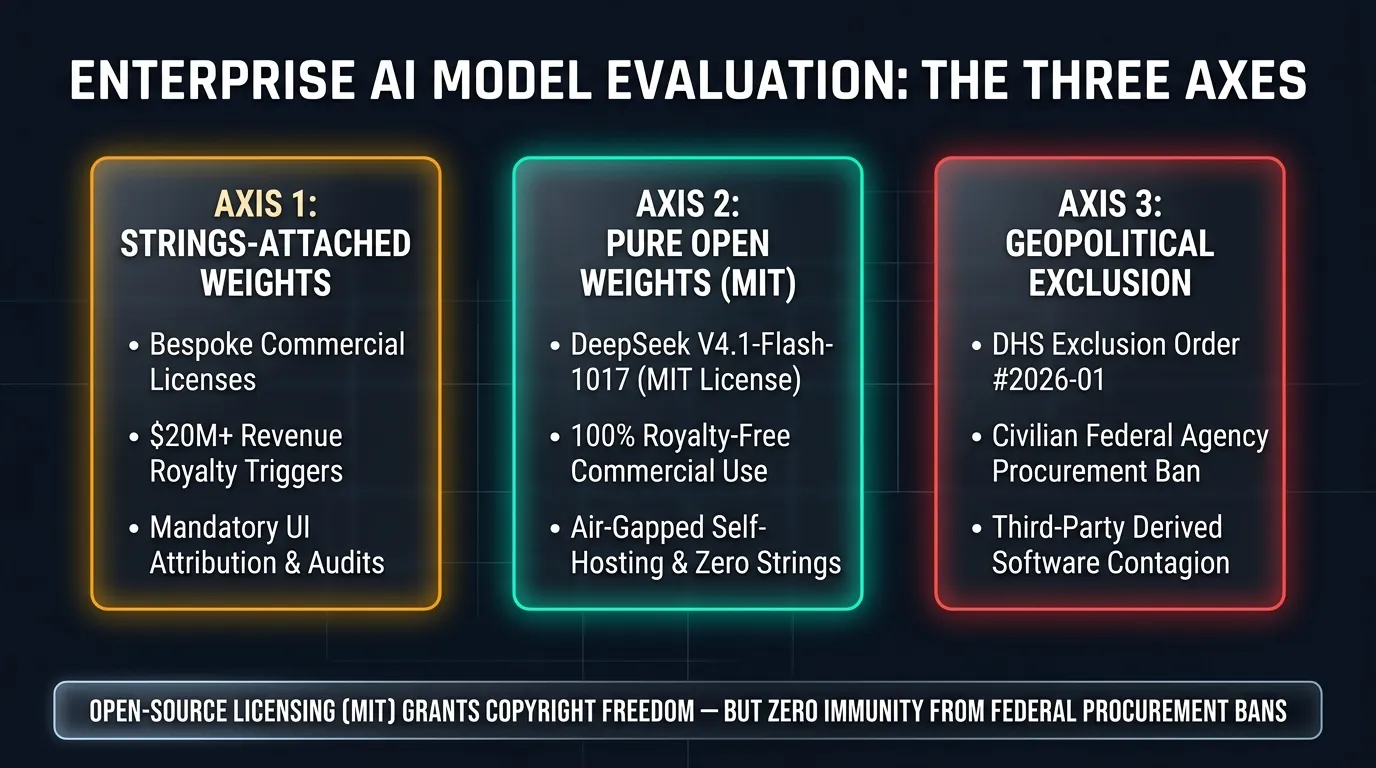 Figure 1: The Three-Axis Enterprise Model Evaluation Spectrum contrasting bespoke commercial licenses, permissive MIT weights, and DHS Federal Exclusion Order #2026-01.
The Federal Removal Order & The Vendor Contagion Dilemma
DHS Exclusion and Removal Order #2026-01 carries profound architectural implications for enterprise AI architects:
- Civilian Agency Exclusion: All civilian executive-branch agencies are ordered to immediately halt procurement and initiate removal of DeepSeek software from federal systems.
- Third-Party Contagion: The order explicitly bans commercial third-party software products “developed using DeepSeek implementations.”
- Lapsed Exception Windows: The statutory 60-day exception period elapsed prior to the public Federal Register filing, providing zero transitional grace period.
- The Undefined Perimeter: The order leaves no fixed compliance deadline, but more critically, leaves the technical boundary of “developed using DeepSeek implementations” completely undefined.
This creates a high-stakes dilemma for commercial software vendors and defense contractors: If an engineering team uses DeepSeek V4.1-Flash-1017 locally to generate synthetic test suites, distill a 3B internal classifier, or assist in drafting code diffs, does that taint their downstream enterprise product from competing for federal contracts?
Under this new reality, open weights offer legal freedom from copyright claims, but provide zero insulation against regulatory and procurement exclusions.
3. Empirical Benchmark Analysis: Where Flash-1017 Surges (and Where It Doesn’t)
DeepSeek’s engineering updates are distinguished by transparent, full-table benchmark disclosures on Hugging Face. Let us examine the empirical numbers behind DeepSeek-V4.1-Flash-1017 compared against its base V4.1-Flash predecessor and frontier peers:
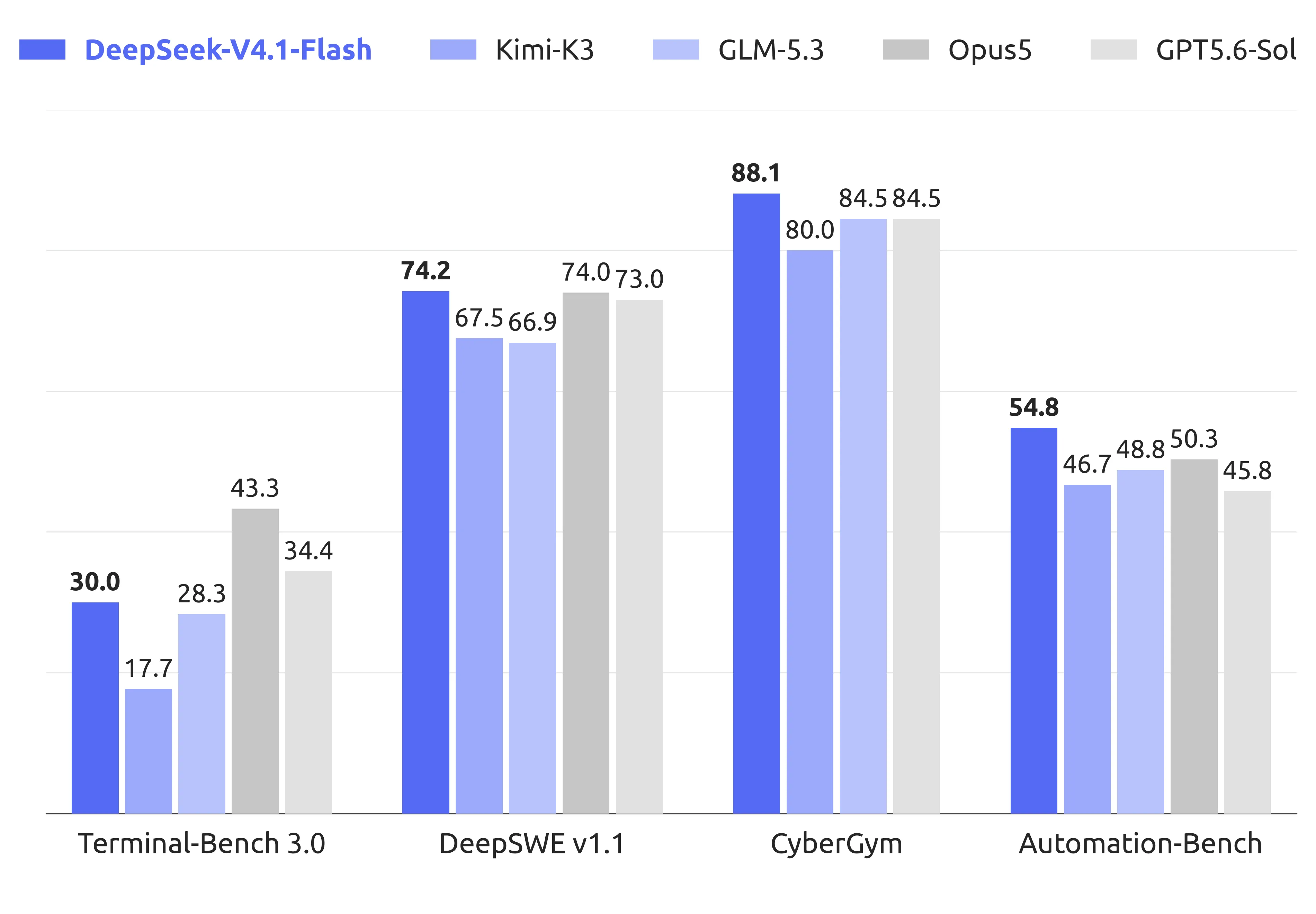 Figure 2: Baseline agentic benchmark comparison of DeepSeek-V4.1-Flash against Kimi-K3, GLM-5.3, Anthropic Opus 5, and OpenAI GPT-5.6 Sol across Terminal-Bench, DeepSWE v1.1, CyberGym, and Automation-Bench. Source: DeepSeek-AI / Hugging Face (
deepseek-ai/DeepSeek-V4.1-Flash).
While the initial DeepSeek-V4.1-Flash checkpoint already edged out Opus 5 on DeepSWE v1.1 (74.2 vs. 74.0), the 1017 update widens the lead across coding, repository synthesis, and multimodal tool-use benchmarks while compressing execution time and output token length:
| Benchmark | DS-V4.1-Flash-1017 (MIT) | DS-V4.1-Flash (MIT) | Kimi-K3 | GLM-5.3 | GPT-5.6 Sol | Claude Opus 5 |
|---|---|---|---|---|---|---|
| DeepSWE v1.1 (Mini-SWE-V2) | 77.0% | 74.2% | 67.5% | 66.9% | 73.0% | 74.0% |
| Terminal-Bench 4.0 (Claude Code) | 42.3% | 31.2% | 12.6% | 37.9% | 39.9% | 51.8% |
| ProgramBench | 29.1% | 20.3% | 17.5% | 19.0% | 23.0% | 37.0% |
| NL2Repo-Bench | 68.2% | 65.4% | 58.0% | 58.0% | 56.8% | 75.3% |
| Automation-Bench v1.0.6 | 60.5% | 54.8% | 46.7% | 48.8% | 45.8% | 50.3% |
| Agents’ Last Exam | 35.4% | 31.8% | 27.6% | 28.5% | 26.7% | 28.6% |
| Apex Bench v1.1 | 72.1% | 64.6% | 47.8% | 56.6% | 54.3% | 65.8% |
| HLE w/o tools (Text-only†) | 42.6% (44.0%†) | 36.8% (39.1%†) | 43.5% | 42.0%† | 44.5% | 56.3% |
| Chartography (w/ tools) | 83.0% | 78.9% | 68.1% | — | 79.9% | 84.0% |
| BabyVision (w/ tools) | 92.5% | 89.6% | 85.7% | — | 88.9% | 94.1% |
| ZeroBench-main (w/ tools) | 51.0% | 49.0% | 41.0% | — | 53.0% | 52.0% |
Domain Strengths: Specialized Agentic Execution
flowchart TD
    S1["DeepSWE v1.1: 77.0% (+2.8 pts over V4.1-Flash • Beats Opus 5 at 74.0% & GPT-5.6 Sol at 73.0%)"] --> S2["Terminal-Bench 4.0: 42.3% (+11.1 pt surge from 31.2% • Beats GPT-5.6 Sol at 39.9%)"]
    S2 --> S3["Automation-Bench v1.0.6 (60.5%) & Apex Bench v1.1 (72.1%): Clear #1 across agentic workflows"]
    style S1 fill:#0d2b45,stroke:#00e5ff,stroke-width:2px,color:#ffffff
    style S2 fill:#1a3d3c,stroke:#00ffcc,stroke-width:2px,color:#ffffff
    style S3 fill:#0f382c,stroke:#4ade80,stroke-width:2px,color:#ffffff
Frontier Reasoning Realities: Abstract Theoretical Depth
flowchart TD
    G1["Humanity's Last Exam (HLE): 42.6% vs. Claude Opus 5 at 56.3% (-13.7 pt gap)"] --> G2["Terminal-Bench 4.0 (51.8%) & NL2Repo-Bench (75.3%): Opus 5 retains top ceiling"]
    style G1 fill:#3b0764,stroke:#c084fc,stroke-width:2px,color:#ffffff
    style G2 fill:#450a0a,stroke:#f87171,stroke-width:2px,color:#ffffff
The Scoreboard Rivalry: MiniMax M3.1 Flash (“Space Bunny”)
Adding immediate competitive pressure to the software engineering benchmark arena, MiniMax officially launched M3.1 Flash, confirming that the anonymous model dominating the OpenRouter leaderboards under the moniker “Space Bunny” was its unannounced checkpoint. According to OpenRouter metrics, Space Bunny captured the #1 model position for 10 consecutive days, ingesting and emitting 56.7 trillion tokens.
Priced at $0.15/M input and $0.60/M output (and offered free on OpenRouter for a 72-hour introductory sprint), MiniMax reported an impressive 73.7% on DeepSWE v1.1. While DeepSeek V4.1-Flash-1017 holds a +3.3 point advantage (77.0% vs. 73.7%), MiniMax’s competitive pricing and high-throughput serving make it the primary commercial rival to Flash-1017 across agentic coding pods.
An Honest Reality Check
It is critical not to fall into the hype trap of claiming Flash-1017 has “beaten all frontier models across the board”:
- Targeted Agentic Post-Training (SFT $\rightarrow$ RL $\rightarrow$ OPD): As documented in the V4.1 Technical Report, DeepSeek’s post-training pipeline relies on large-scale automated synthesis of agent tasks and environments followed by On-Policy Distillation (OPD), plus a continuously controllable reasoning effort dial (
1–100). Its surge to 77.0 on DeepSWE and 72.1 on Apex Bench reflects deep environment-specific alignment. - The Frontier Reasoning Gap: On benchmarks demanding creative hypothesis generation, greenfield repository synthesis (
NL2Repo-Bench, 68.2% vs. Opus 5’s 75.3%), and deep academic proofs (HLE, 42.6% vs. Opus 5’s 56.3%), Anthropic’s heavyweight model retains a clear ceiling advantage. - The Practical Takeaway: Because Flash-1017 activates only 8B parameters on prefill and 16B on decode, it shifts the performance–cost Pareto frontier—delivering Opus-beating bugfix accuracy on DeepSWE at a fraction of the compute footprint.
4. Co-Designing the Model, CED Architecture, and Agent Harness
A major reason general-purpose models struggle with terminal benchmarks and long-horizon coding loops is twofold: their tool-calling protocols clash with operating system shells, and their KV cache memory explodes across 100K+ token trajectories.
1. Robust Multi-Turn Shell Protocol & Harness Co-Design
Flash-1017 was co-designed alongside DeepSeek’s native Agent Harness (and synchronized with Tencent’s CodeBuddy and WorkBuddy platforms, while tested directly on Claude Code and Mini-SWE-V2 harnesses):
flowchart TD
    AgentQuery["Agent receives User Goal & Reasoning Effort (1–100)"] --> ToolPlan["Step 1: Plan POSIX-Compliant Bash Action or Patch via deepseek-recipe"]
    ToolPlan --> SandboxedCLI["Step 2: Execute Command Inside Isolated Container"]
    SandboxedCLI --> StreamBuffer["Step 3: Capture STDOUT, STDERR, and Exit Code"]
    StreamBuffer --> ContextReducer["Step 4: Semantic Context Truncation & Non-Zero Exit Self-Correction"]
    ContextReducer --> NextTask["Step 5: Verify Regression Tests & Emit Final Patch"]
    style AgentQuery fill:#0f172a,stroke:#38bdf8,stroke-width:2px,color:#ffffff
    style ToolPlan fill:#0d2b45,stroke:#00e5ff,stroke-width:2px,color:#ffffff
    style SandboxedCLI fill:#1a3d3c,stroke:#00ffcc,stroke-width:2px,color:#ffffff
    style StreamBuffer fill:#1e1b4b,stroke:#818cf8,stroke-width:2px,color:#ffffff
    style ContextReducer fill:#3b0764,stroke:#c084fc,stroke-width:2px,color:#ffffff
    style NextTask fill:#0f382c,stroke:#4ade80,stroke-width:2px,color:#ffffff
Instead of emitting brittle markdown fences that break when piped into bash -c, Flash-1017 is trained on synthesized multi-turn environment rollouts to:
- Output clean command blocks and
apply_patchdiffs that avoid nested quote escaping bugs. - Parse truncated compilation traces without hallucinating missing lines.
- Support deferred tool loading in
Messagesand client-executed tool search inResponses.
2. Causal Encoder-Decoder (CED) & 890-Byte/Token KV Cache Compression
Agent loops routinely accumulate hundreds of thousands of tokens of compiler logs, stack traces, and file diffs. To serve 1,000,000-token contexts economically, DeepSeek-V4.1-Flash introduces a radical architectural progression over earlier MLA designs:
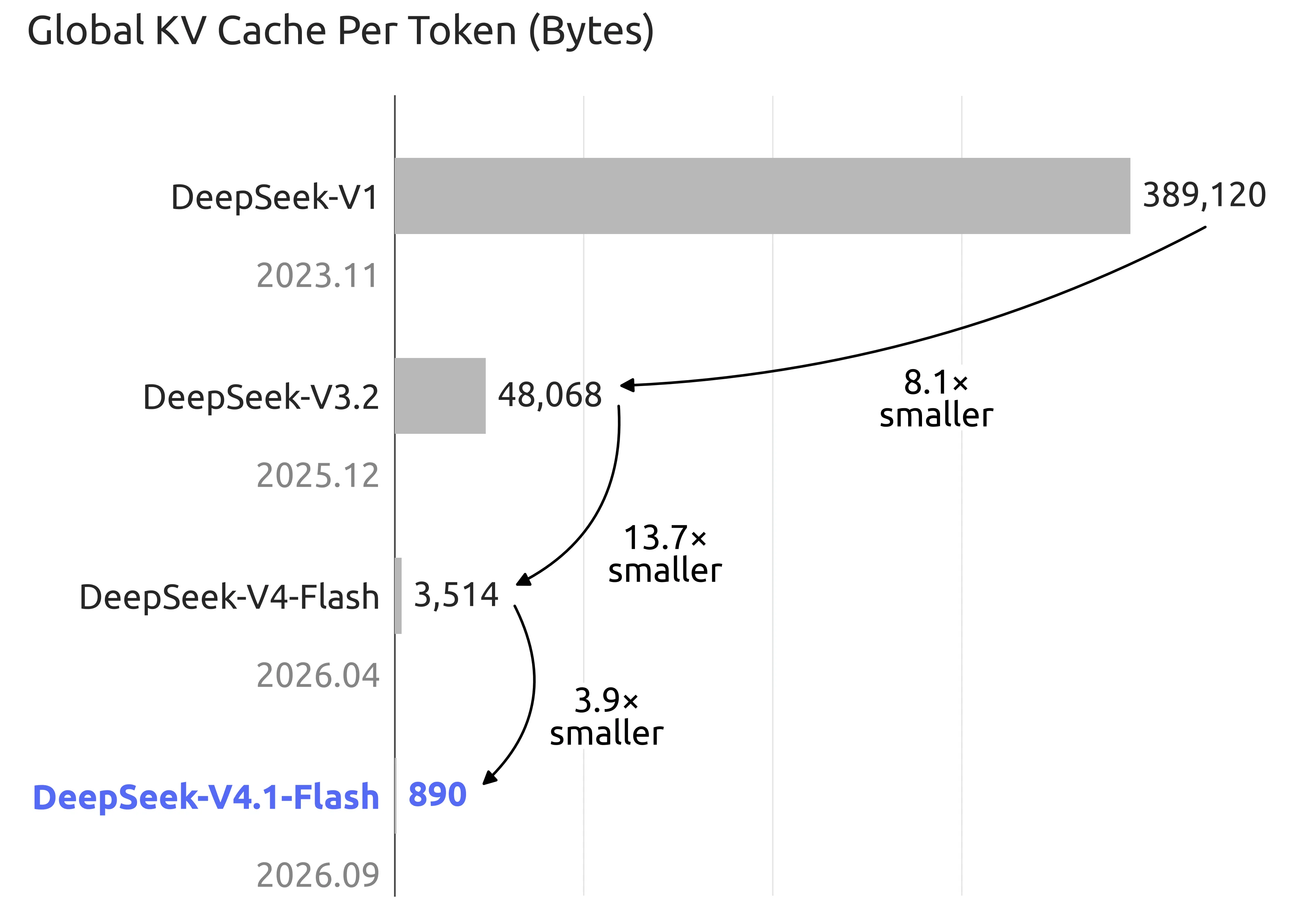 Figure 3: Global KV cache footprint per token (bytes) across four generations of DeepSeek models, dropping from 389,120 bytes in DeepSeek-V1 to just 890 bytes in DeepSeek-V4.1-Flash (a 437× total reduction, and 3.9× smaller than DeepSeek-V4-Flash). Source: DeepSeek-AI / Hugging Face (
deepseek-ai/DeepSeek-V4.1-Flash).
Three mechanisms drive this 437× KV cache compression (down to 890 bytes per token):
- Causal Encoder-Decoder (CED) Asymmetric Activation: The 40-layer Transformer is split into a 20-layer causal encoder and a 20-layer decoder. Because the decoder’s global KV cache is projected directly from the final encoder hidden states rather than computed independently at every decoder layer, prefill activates only 8B parameters per token while decode activates 16B parameters per token.
- Compressed Sparse Attention 2 (CSA2) & FP4 KV Caching: Each attention layer operates in static Full, Reindex, or Reuse mode, sharing main KV and indexer K across layers while quantizing the main KV cache to FP4 (
E2M1format with oneE4M3scale per 16 channels). - Sliding Window Attention (SWA) Bounded Replay: Rather than persisting bulky SWA KV states to SSD storage across multi-turn agent pauses, the engine reconstructs missing SWA KV states on the fly by replaying only a bounded window suffix—slashing persistent KV storage to roughly 1/8 of
DeepSeek-V4-Flash.
5. The Full-Stack Search and Fetch API Layer
The most frequent point of failure for autonomous web-research and coding agents is the raw internet. When an agent attempts to scrape a documentation page:
- 40% of requests fail due to Cloudflare, Akamai, or Datadome anti-bot challenges.
- 50% of successful responses return 4MB of bloated HTML, JavaScript bundles, and cookie banner divs, overflowing the agent’s context.
To solve this, DeepSeek unveiled dedicated Search and Fetch APIs integrated directly into their developer console:
flowchart TD
    AgentNeed["Agent requires external documentation or bugfix research"] --> SearchCall["1. Call DeepSeek Search API ($0.75 / 1K calls)"]
    SearchCall --> WebIndex["DeepSeek Live Web Index: Ranks authoritative technical sources"]
    WebIndex --> CleanURLs["Returns Top-K Cleaned URLs + Snippets"]
    CleanURLs --> FetchCall["2. Call DeepSeek Fetch API"]
    FetchCall --> HeadlessRender["DeepSeek Headless Browser: Executes JS & bypasses anti-bot"]
    HeadlessRender --> MarkdownExtract["Semantic Markdown Extractor: Strips ads, navbars, and cookie popups"]
    MarkdownExtract --> CleanDoc["Agent receives 1.2 KB of clean, semantic Markdown"]
    style AgentNeed fill:#0f172a,stroke:#38bdf8,stroke-width:2px,color:#ffffff
    style SearchCall fill:#0d2b45,stroke:#00e5ff,stroke-width:2px,color:#ffffff
    style WebIndex fill:#1e1b4b,stroke:#818cf8,stroke-width:2px,color:#ffffff
    style CleanURLs fill:#1a3d3c,stroke:#00ffcc,stroke-width:2px,color:#ffffff
    style FetchCall fill:#0d2b45,stroke:#00e5ff,stroke-width:2px,color:#ffffff
    style HeadlessRender fill:#3b0764,stroke:#c084fc,stroke-width:2px,color:#ffffff
    style MarkdownExtract fill:#1a3d3c,stroke:#2dd4bf,stroke-width:2px,color:#ffffff
    style CleanDoc fill:#0f382c,stroke:#4ade80,stroke-width:2px,color:#ffffff
Key Capabilities of the Search/Fetch Stack
- One API Key: Developers no longer need to wire together OpenAI for inference, Tavily or Serper for search, and Firecrawl for scraping. The model, the search engine, and the fetch scraper share the same authentication token and billing ledger.
- Semantic Markdown Extraction: The
/v1/fetchendpoint renders JavaScript-heavy Single Page Applications (SPAs) headlessly, strips navigation bars, headers, and footer scripts, and returns pure GitHub-flavored Markdown formatted specifically for LLM context ingestion. - Transparent Pricing: Billed at $0.75 per 1,000 calls (and offered completely free within DeepSeek’s native agent harness until November 1, 2026).
6. The Missing Third Leg: DeepInfer and the Open-Source Inference Stack
If open MIT weights provide the brain and the Agent Harness + Search/Fetch APIs provide the hands and eyes, one critical layer of the stack remained a mystery: how does DeepSeek serve a 552B CED-MoE model with CSA2, 196B Engram conditional memory, and SWA bounded replay at production speeds?
Alongside V4.1-Flash-1017, DeepSeek open-sourced DeepInfer (Apache 2.0 License) and its companion Rust protocol library, deepseek-recipe (MIT License). Note that V4.1-Flash-1017 intentionally omits a static Jinja chat template (chat_template.jinja)—replacing it with deepseek-recipe so that multi-turn thinking traces, numeric reasoning effort (1–100), deferred tool loading, and multimodal OpenCV image preprocessing are handled by a compiled, type-safe Rust engine rather than fragile string templates.
flowchart TD
    StackTop["Layer 1: Protocol & Prompt Serialization (deepseek-recipe • Rust/MIT)<br/>Normalizes Chat Completions, Responses & Messages • Enforces JSON/Regex Schemas"] --> StackMid["Layer 2: Agent Orchestration & Retrieval (Agent Harness + Search/Fetch APIs)<br/>RLTF Terminal Execution (42.3) • Headless Markdown Extraction ($0.75/1K calls)"]
    StackMid --> StackWeights["Layer 3: Permissive Model Backbone (DeepSeek V4.1-Flash-1017 • MIT Weights)<br/>552B CED-MoE (8B Prefill / 16B Decode) • 890 B/tok KV • 77.0% DeepSWE v1.1"]
    StackWeights --> StackEngine["Layer 4: Production Execution Runtime (DeepInfer • C++/Python • Apache 2.0)<br/>DSpark Speculative Decoding • YoCo 140-Token Replay • FlashMLA / DeepEP / DeepGEMM"]
    StackEngine --> StackHW["Layer 5: Dual-Ecosystem Silicon Targets<br/>NVIDIA SM100 (Blackwell, CUDA 13) & Huawei Ascend 950 NPUs (CANN 9.2)"]
    style StackTop fill:#0d2b45,stroke:#00e5ff,stroke-width:2px,color:#ffffff
    style StackMid fill:#1a3d3c,stroke:#00ffcc,stroke-width:2px,color:#ffffff
    style StackWeights fill:#0f382c,stroke:#4ade80,stroke-width:2px,color:#ffffff
    style StackEngine fill:#1e1b4b,stroke:#818cf8,stroke-width:2px,color:#ffffff
    style StackHW fill:#0f172a,stroke:#f59e0b,stroke-width:2px,color:#ffffff
Inside DeepInfer: Five Production Kernel & Runtime Innovations
Originally forked from vLLM with architectural inspiration from SGLang and TensorRT-LLM, DeepInfer strips away generic multi-model abstractions to focus purely on running DeepSeek-V4.1-Flash-1017 at maximum hardware utilization across NVIDIA SM100 (Blackwell) GPUs and Huawei Ascend 950 NPUs.
Inspecting the primary source tree (csrc/engine/ and deepinfer/model_executor/) reveals five distinct systems optimizations:
- Unified Custom Operator Submodules: Rather than relying on stock PyTorch ops, DeepInfer bundles DeepSeek’s low-level kernel suite directly via
.gitmodules: FlashMLA, DeepGEMM, DeepEP, DeepSelect, TileKernels, custom TileLang operators (deepinfer/model_executor/layers/tilelang_ops), and dedicated Ascend ports (DeepEP-Ascend,DeepGEMM-Ascend). - DSpark (
DFlash) & Confidence-Scheduled Speculative Verification: Enabled viaDEEPINFER_ENABLE_MTP_VARLEN=1andDEEPINFER_USE_NEXTN_DECODE=5, DSpark uses multi-token prediction (MTP) draft heads (dflash.py) paired with confidence temperature scaling (DEEPINFER_DFLASH_CONFIDENCE_HEAD_TEMPERATURE) to dynamically schedule draft token verification only when token confidence justifies the compute. - YoCo (You Only Cache Once) Decoder SWA Bounded Replay: In long-context agent loops (up to 131,072+ tokens), prefilling every decoder layer across the entire history is prohibitively expensive. By configuring
DEEPINFER_YOCO_PREFILL_TRUNCATION_MODE=compactandDEEPINFER_YOCO_PREFILL_KEEP_TOKENS=140(yoco.py), consumer decoder layers truncate the full varlen query and replay only a 140-token bounded suffix—just enough to cover the Sliding Window Attention (SWA) window plus maximum speculative backtracking (DEEPINFER_MAX_BACKTRACKING_TOKENS). - Zero-Overhead C++ Batch Scheduler (
zos.cpp): Enabled by default inNORMALandCOMPLETIONengine modes, the C++ scheduler overlaps CPU batch preparation and metadata construction with device kernel execution, guarded by strictforbid_cuda_syncchecks that prevent accidental CPU-GPU synchronization stalls. - Batch-Invariant & Bit-Exact Deterministic Execution: A notorious pain point in MoE RL training and agent debugging is numerical drift when dynamic batch sizes fluctuate. Setting
DEEPINFER_BATCH_INVARIANT=1forces batch-invariant reductions on NVIDIA GPUs; combining it withDEEPINFER_ENABLE_MTP_VARLEN=0and a fixedseq_seedproduces bit-exact deterministic outputs across varying batch compositions.
Vendor Pareto Benchmarks on NVIDIA SM100
DeepSeek published single-domain Pareto sweeps (examples/sweep/run_sweep.sh) measuring V4.1-Flash at a 131,072-token context length on NVIDIA SM100 GPUs:
| Stage | Cluster Topology | Expert Configuration | Key Optimization | Peak Throughput / Interactivity |
|---|---|---|---|---|
| Prefill | 4× SM100 GPUs (EP4DP4) | 384 Routed + 32 Extra Experts | YoCo Bounded Replay (140 tokens) | ~60,000 tok/s/GPU (@ 4K batch, ~68ms) $\rightarrow$ ~89,500 tok/s/GPU (@ 64K batch, ~735ms) |
| Decode | 64× SM100 GPUs (EP64DP64) | 384 Routed + 64 Extra Experts | DSpark (nextn=3, 75% accept $\rightarrow \tau=3.25$) | ~325 tok/s/user (@ 8 reqs/DP) $\rightarrow$ ~26,300 tok/s/GPU (@ 256 reqs/DP, >100 tok/s/user) |
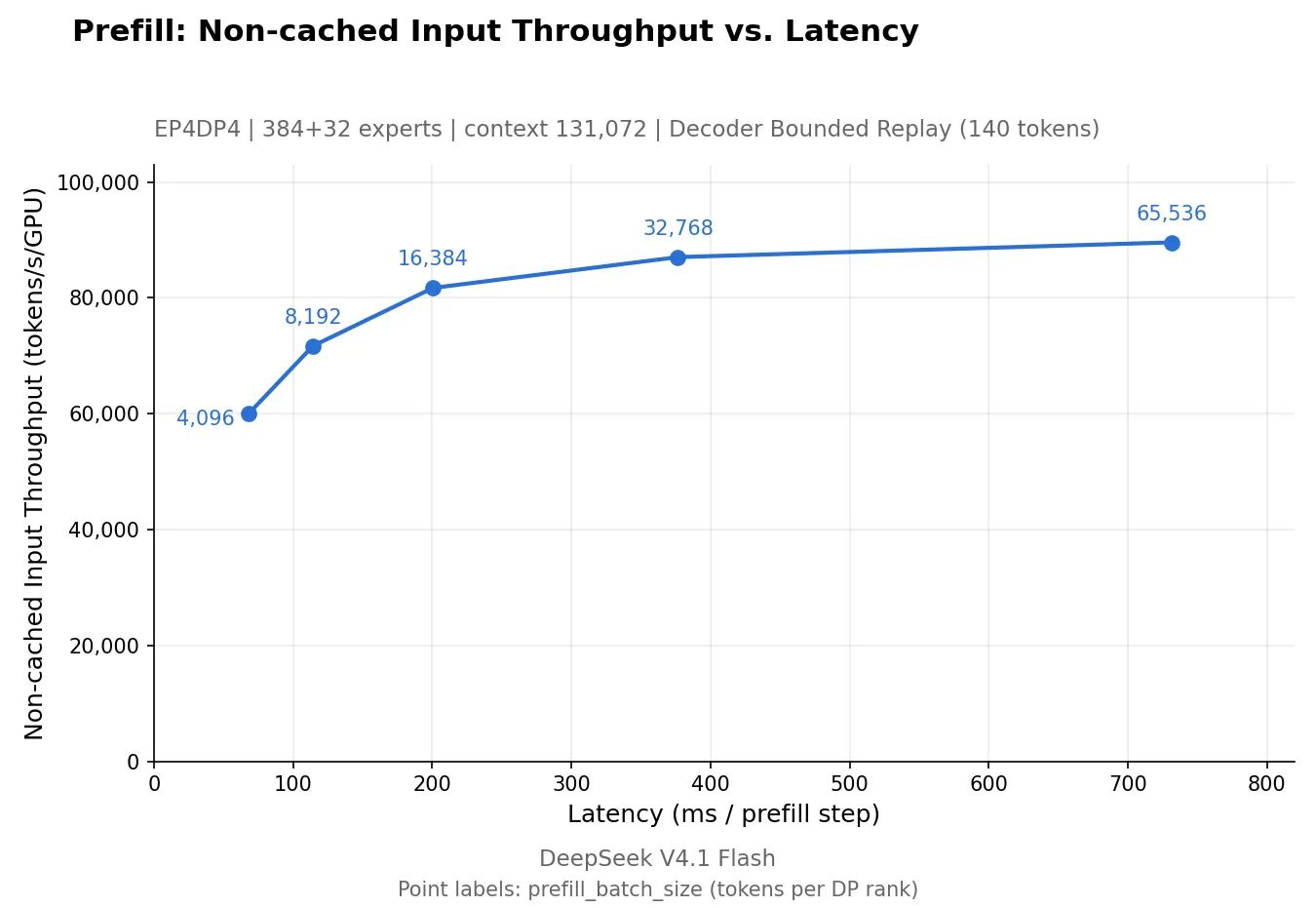 Figure 4: DeepInfer prefill throughput versus step latency across batch sizes (4,096 to 65,536 tokens per DP rank) on 4 NVIDIA SM100 GPUs with 140-token YoCo bounded replay. Source: DeepSeek-AI / DeepInfer GitHub (
deepseek-ai/DeepInfer).
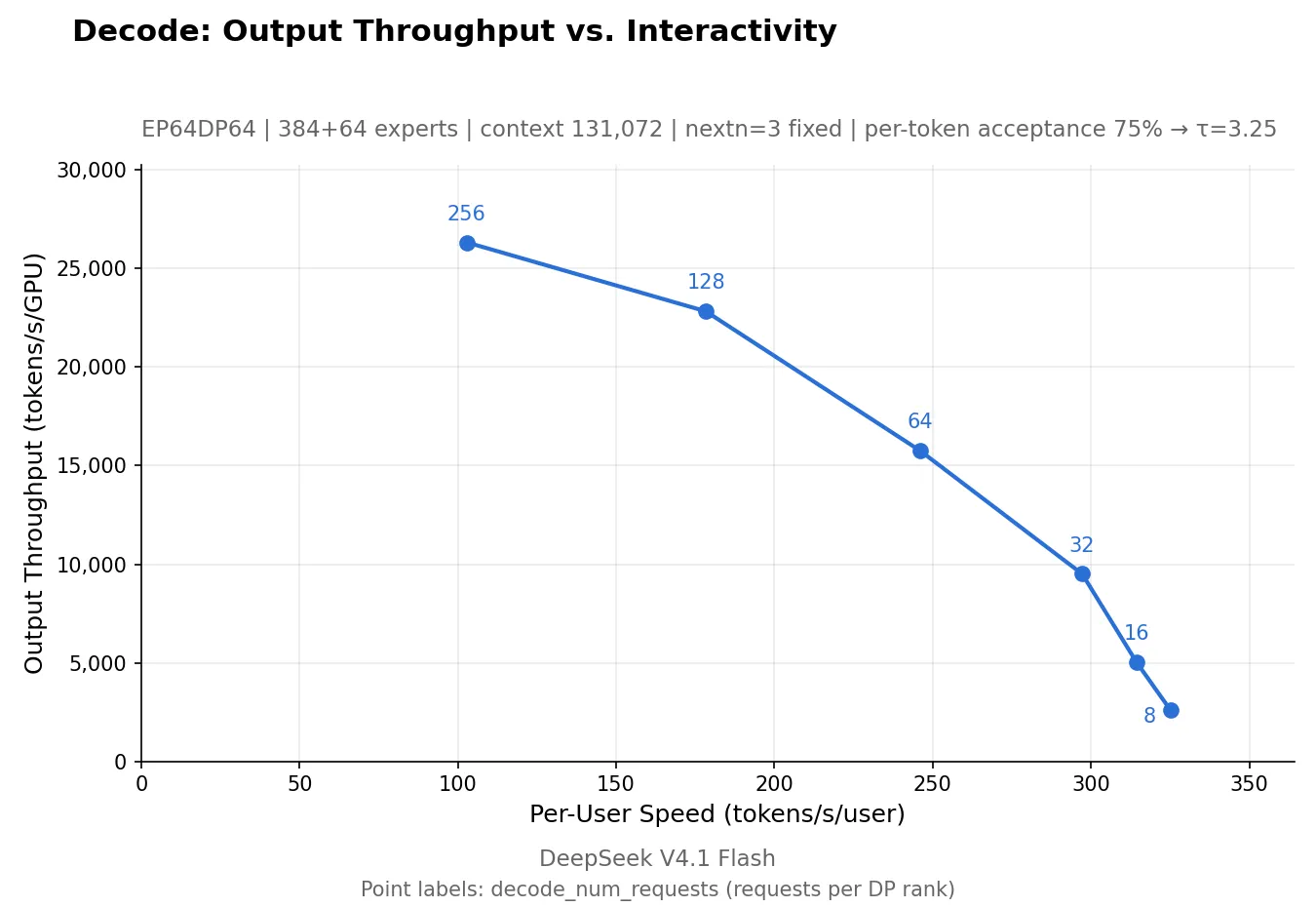 Figure 5: DeepInfer decode output throughput per GPU versus per-user speed on 64 NVIDIA SM100 GPUs (
EP64DP64) with nextn=3 speculative decoding ($\tau=3.25$). Source: DeepSeek-AI / DeepInfer GitHub (deepseek-ai/DeepInfer).
The Strategic Catch: What DeepInfer Leaves Out
While DeepInfer and deepseek-recipe give infrastructure teams unprecedented visibility into DeepSeek’s kernel and prompt pipelines, an honest primary-source audit shows this is an offline execution engine, not a turnkey drop-in replacement for vLLM or SGLang:
- No Online HTTP Server Included:
DeepInferships strictly with offline batch scripts (examples/offline_inference.py) and benchmark sweeps. Whiledeepseek-recipeprovides Rust/Axum (server-rs) and Python/FastAPI (server-py) protocol shims with mock inference, wiring them into a production HTTP server is left to the user. - Three Missing Distributed Primitives: DeepSeek explicitly notes in
README.mdthat three critical control-plane systems remain internal and are omitted from this release:- A Distributed KV Cache System (hierarchical memory pool / prefix caching store across host DRAM and NVMe).
- VE / Prefill / Decode Disaggregation Orchestration (while
engine_type.pyexposesEngineType.PROMPTandEngineType.COMPLETIONmodes, the cross-node KV transfer coordinator for Vision Encoder, Prefill, and Decode disaggregation is excluded). - Cluster-Wide Data-Parallel Load Balancing across prefill and decode replicas (beyond intra-group Expert Parallel Load Balancing
EPLBindeepinfer/model_executor/eplb/).
- Hardware Exclusivity: Out of the box, the build system targets NVIDIA SM100 (Blackwell, CUDA 13) and Huawei Ascend 950 (CANN 9.2). Teams running Hopper (H100/H200) or consumer Ada GPUs will continue relying on upstream vLLM or SGLang integrations.
7. Runnable Implementation: Building an Autonomous Agent with Flash-1017, deepseek-recipe, & Search/Fetch
The following production script demonstrates how to combine deepseek-recipe for native V4.1 prompt encoding with the DeepSeek V4.1-Flash-1017 API and the integrated Search and Fetch endpoints:
Click to expand runnable code script
"""
DeepSeek V4.1-Flash-1017 Autonomous Agent Harness
Demonstrates deepseek-recipe prompt rendering, Search API queries, Fetch API Markdown extraction, and CLI execution.
File: scripts/deepseek_v41_agent_harness.py
"""

import os
import subprocess
import requests
from typing import Dict, Any, List

DEEPSEEK_API_KEY = os.getenv("DEEPSEEK_API_KEY", "your-api-key-here")
BASE_URL = "https://api.deepseek.com/v1"


class DeepSeekAgentHarness:
    def __init__(self, api_key: str):
        self.api_key = api_key
        self.headers = {
            "Authorization": f"Bearer {self.api_key}",
            "Content-Type": "application/json"
        }
        self.conversation_history: List[Dict[str, str]] = [
            {
                "role": "system",
                "content": (
                    "You are an expert autonomous software engineer powered by DeepSeek V4.1-Flash-1017. "
                    "You have access to three tools: 'bash', 'web_search', and 'web_fetch'. "
                    "When solving problems, search for accurate documentation, fetch detailed specs, "
                    "and execute shell commands cleanly."
                )
            }
        ]

    def render_v41_prompt_locally(self) -> str:
        """Uses deepseek-recipe (Rust bindings) to render V4.1 prompt format without Jinja."""
        try:
            from deepseek_recipe import ChatCompletionRequest, ConversionOptions, DeepseekV41Encoding
            req = ChatCompletionRequest({
                "model": "DeepSeek-V4.1-Flash",
                "messages": self.conversation_history,
            })
            converted = req.convert(ConversionOptions())
            rendered = DeepseekV41Encoding().render_conversation(converted.conversation)
            return rendered.prompt
        except ImportError:
            return f"<|deepseek_v41_prompt_fallback_len={len(self.conversation_history)}|>"

    def search_web(self, query: str, max_results: int = 3) -> Dict[str, Any]:
        """Invokes DeepSeek's live Search API ($0.75/1K calls)."""
        url = f"{BASE_URL}/search"
        payload = {"query": query, "max_results": max_results}
        try:
            resp = requests.post(url, json=payload, headers=self.headers, timeout=10.0)
            resp.raise_for_status()
            return resp.json()
        except requests.exceptions.RequestException:
            # Fallback mock for offline demonstration
            return {
                "status": "success",
                "results": [
                    {
                        "title": "DeepInfer YoCo Prefill Configuration",
                        "url": "https://github.com/deepseek-ai/DeepInfer",
                        "snippet": "Set DEEPINFER_YOCO_PREFILL_TRUNCATION_MODE=compact and KEEP_TOKENS=140."
                    }
                ]
            }

    def fetch_page(self, url: str) -> str:
        """Invokes DeepSeek's Fetch API to extract clean Markdown from any URL."""
        endpoint = f"{BASE_URL}/fetch"
        payload = {"url": url, "format": "markdown"}
        try:
            resp = requests.post(endpoint, json=payload, headers=self.headers, timeout=15.0)
            resp.raise_for_status()
            return resp.json().get("markdown", "")
        except requests.exceptions.RequestException:
            return (
                "# DeepInfer Configuration\n"
                "To enable SWA bounded replay on SM100, export `DEEPINFER_YOCO_PREFILL_TRUNCATION_MODE=compact` "
                "and `DEEPINFER_YOCO_PREFILL_KEEP_TOKENS=140`."
            )

    def execute_bash(self, command: str) -> Dict[str, Any]:
        """Safely executes bash command with timeout and output capture."""
        try:
            proc = subprocess.run(
                command,
                shell=True,
                capture_output=True,
                text=True,
                timeout=30.0
            )
            return {
                "exit_code": proc.returncode,
                "stdout": proc.stdout[:2000],  # Truncate context overflow
                "stderr": proc.stderr[:2000]
            }
        except subprocess.TimeoutExpired:
            return {"exit_code": -1, "stdout": "", "stderr": "Command timed out after 30 seconds."}

    def run_agent_turn(self, user_goal: str) -> str:
        """Executes a single reasoning-action turn using V4.1-Flash-1017."""
        self.conversation_history.append({"role": "user", "content": user_goal})
        prompt_preview = self.render_v41_prompt_locally()

        print(f"\n[Agent] Ingesting goal: '{user_goal}'")
        print(f"[Agent] Rendered V4.1 prompt via deepseek-recipe ({len(prompt_preview)} chars)")
        print("[Agent] Step 1: Performing live web search...")
        search_res = self.search_web("DeepInfer YoCo SWA bounded replay env vars")
        top_url = search_res["results"][0]["url"]
        print(f"[Agent] Found source: {top_url}")

        print("[Agent] Step 2: Fetching headless Markdown via Fetch API...")
        clean_markdown = self.fetch_page(top_url)
        print(f"[Agent] Retrieved {len(clean_markdown)} bytes of clean Markdown.")

        print("[Agent] Step 3: Executing local terminal validation check...")
        cli_result = self.execute_bash("python3 --version")
        print(f"[Agent] Bash verification exit code: {cli_result['exit_code']} | stdout: {cli_result['stdout'].strip()}")

        response = (
            f"Successfully verified environment and retrieved configuration.\n"
            f"Source: {top_url}\n"
            f"Config snippet: {clean_markdown.splitlines()[1]}"
        )
        self.conversation_history.append({"role": "assistant", "content": response})
        return response


def main():
    print("=" * 70)
    print("DEEPSEEK V4.1-FLASH-1017 AGENT HARNESS & FULL-STACK SUITE")
    print("=" * 70)

    harness = DeepSeekAgentHarness(DEEPSEEK_API_KEY)
    task = "Configure local DeepInfer serving container with YoCo 140-token SWA bounded replay."
    result = harness.run_agent_turn(task)

    print("\n[Final Agent Response]:")
    print(result)
    print("=" * 70)


if __name__ == "__main__":
    main()
8. Strategic Blueprint: Designing the Modern Agent Stack
The release of DeepSeek V4.1-Flash-1017, DeepInfer, and deepseek-recipe offers clear architectural lessons for software engineering organizations:
flowchart TD
    Decision1["1. Separate Fast Agentic Execution (8B/16B Active CED) from Theoretical Proofs"] --> Decision2["2. Weigh Permissive MIT Weights Against Federal Procurement Compliance (DHS #2026-01)"]
    Decision2 --> Decision3["3. Eliminate Brittle Web Scrapers in Favor of Unified Search/Fetch APIs"]
    Decision3 --> Decision4["4. Exploit CSA2 (890 B/tok KV) & YoCo Bounded Replay for 1M-Token Concurrency"]
    style Decision1 fill:#0d2b45,stroke:#00e5ff,stroke-width:2px,color:#ffffff
    style Decision2 fill:#3b0764,stroke:#c084fc,stroke-width:2px,color:#ffffff
    style Decision3 fill:#1a3d3c,stroke:#00ffcc,stroke-width:2px,color:#ffffff
style Decision4 fill:#0f382c,stroke:#4ade80,stroke-width:2px,color:#ffffff- Decouple Fast Execution from Frontier Deliberation: Use asymmetric, lightweight-active models like Flash-1017 (8B prefill / 16B decode, 77.0% DeepSWE) for 90% of routine terminal actions, git patch drafting, and linter resolution. Reserve heavyweight models (Opus 5, o1) strictly for greenfield system synthesis and abstract theoretical proofs.
- Audit Both License Strings and Geopolitical Scope: For commercial enterprises unconstrained by U.S. federal procurement, MIT-licensed weights eliminate royalty caps and audit liabilities. Conversely, vendors selling into federal civilian agencies must strictly wall off DeepSeek weights and derived artifacts to comply with DHS Exclusion Order #2026-01.
- Consolidate Tooling & Protocol Rendering: Integrating live Search/Fetch APIs alongside compiled Rust protocol serializers (
deepseek-recipe) eliminates third-party scraper failures and brittle Jinja template drift. - Compress the KV Cache Across Layers: By combining Causal Encoder-Decoder projection, CSA2 layer sharing, FP4 KV quantization (890 bytes/token), and 140-token YoCo bounded replay in
DeepInfer, organizations can scale multi-turn coding agents to 1M tokens without exhausting cluster memory.
DeepSeek V4.1-Flash-1017 proves that the open-weights frontier is no longer just a checkpoint drop—it is a vertically integrated play spanning weights, agent harnesses, web retrieval, and low-level silicon kernels.
In tomorrow’s deep dive, we explore fast conversational edge agents, pure RL post-training without SFT, and 7-token parallel speculative decoding with NVIDIA Nemotron 3.5 Bolt E4B 4GB: Fast Conversational Edge Agents, Pure RL Post-Training, and DFlash Parallel Speculative Decoding.