Gemini 4 Neon: Carbon's Brain, Hydrogen's Pace, and the December 1 Pricing Twist
Inside Google's Gemini 4 Neon: 61 on AA Index (#3 overall), 110 tok/s, Antigravity SWE-sweep 39%, Fairwind cyber SOTA, and the Dec 1 $3/$15 pricing twist.
Series: Frontier AI Model Releases & Agentic Economics
Summary
On November 18, 2026, Google DeepMind launched Gemini 4 Neon (gemini-4-neon), completing a remarkable sprint of four Gemini 4 models in seven weeks—following Argon (Sep 30), Carbon (Oct 28), and Hydrogen (Nov 12). Adapted directly from Gemini 4 Carbon rather than trained from scratch, Neon slots into the center of the lineup as Google’s “Goldilocks” frontier tier: delivering 61 on the Artificial Analysis Intelligence Index (#3 overall behind Claude Fable 5.2 and GPT-6.2 Astra, and 1 point ahead of Carbon’s 60) while running at roughly 110 output tokens per second (nearly 2x Carbon’s ~57 tok/s).
In this deep dive, we separate launch claims from independently verified results across the entire Gemini 4 family and its top rivals (Claude Opus 5.5 and GPT-6.2 Sol). We audit where Neon genuinely pulls ahead (long-context GraphWalks at 95.2%, AutomationBench at 56.3%, legal/tax Vals benchmarks, SEC-bench Pro at 90.5%, and Antigravity’s 39.0% SWE-sweep orchestration with parallel Hydrogen subagents) versus where competitors still edge it out (Terminal-Bench 4.1, FrontierCode 2.0, and Chartography). Finally, we dissect the sharpest pricing quirk of the release: because Neon launches at $3.00 / $15.00 per 1M tokens with no introductory discount while Carbon’s $2.00 / $10.00 promo runs through November 30, Google’s heavier flagship is temporarily cheaper per token for 12 days—before the entire Gemini 4 pricing ladder snaps into place on December 1.
Official Model Card & Release Summary
| Specification | Gemini 4 Neon (gemini-4-neon) |
|---|---|
| Developer / Lab | Google DeepMind & Google Cloud |
| Base Lineage | Adapted from Gemini 4 Carbon (shared architecture, training data & TPU hardware) |
| Release Date | November 18, 2026 |
| Knowledge Cutoff | March 2026 (per official Model Card) |
| Context Window (Unified) | 1,048,576 tokens (flat pricing across full 1M window; no long-context surcharge) |
| Output Token Limit | 64K default synchronous output; up to 1M tokens via background long decode |
| Thinking Levels | low, medium, high (default), xhigh |
| Standard API Pricing | $3.00 / 1M input · $0.15 / 1M cached input · $15.00 / 1M output (thinking tokens billed as output) |
| Alternative Pricing Tiers | Batch & Flex: $1.50 / $7.50 · Priority: $5.40 / $27.00 · Vertex Regional (us/eu): +10% ($3.30 / $16.50) |
| Free / Promo Tier | None (no free tier; no introductory promotional discount) |
| AA Intelligence Index | 61 (xhigh, #3 overall) · ~110 tok/s output speed · $6.44 / task (xhigh) / $3.74 / task (high) |
| Coding & Agent Highlights | 59 AA Coding Agent Index (Antigravity CLI) · 39.0% SWE-sweep (Antigravity) · 56.3% AutomationBench |
| Cybersecurity Highlights | 90.5% SEC-bench Pro · 76% AutoBaxBench Hard · 70.7% CWE-Bench v2 · 51.3% WebExploitBench v1.2 |
| Safety Documentation | Carbon-level misuse & IPI protections (0.0% Gray Swan IPI at xhigh); full Safety & Security Report “coming soon” |
| Official Documentation | Google Launch Blog · Model Card PDF · Antigravity Blog · Evals Methodology |
Prior Reading Material
Before diving into Neon’s benchmark audit, multi-agent orchestration, and unit economics, catch up on the rest of the Gemini 4 lineup and November’s competing frontier launches:
- Gemini 4 Hydrogen: 2.5x Faster Agentic Execution, 1M Unified Context, and the Antigravity Orchestrator — Google’s $1.50/$7.50 speed-tier model that now serves as the parallel subagent fleet under Neon in Antigravity.
- Gemini 4 Carbon: Google’s Frontier Reasoning Model for Autonomous Cybersecurity and Long-Horizon Software Engineering — The heavyweight base model from which Neon is adapted, including its 88.2% SEC-bench Pro baseline.
- Gemini 4 Argon: Inside Google’s 1M-Token Output Frontier Model, Enterprise Benchmarks, and Cyber Defense — The September 30 pioneer that launched the Gemini 4 era and is now being replaced by Neon in the Gemini app model picker.
- Google DeepMind Fairwind Program: Dual-Use Frontier AI, Restricted Cyber Defender Alliances, and Automated Vulnerability Remediation — Background on Google’s vetted cyber-defense alliance, which is receiving Neon-for-cyber next.
- OpenAI GPT-6.2 Astra and GPT-6.2 Sol: 95.8% ARC-AGI-2, Responses API Shifts, and the 1/5th-Cost Workhorse — OpenAI’s November 17 dual-tier launch, where GPT-6.2 Astra holds #2 overall (62) and GPT-6.2 Sol competes directly with Neon.
- Claude Fable 5.2 & Claude Mythos 5.2: Anthropic’s Dual Frontier for Long-Horizon Autonomous Agents — Anthropic’s #1 overall reasoning flagship (65 on the AA Intelligence Index) and its cost-per-task tradeoff.
1. Four Models in Seven Weeks: Completing the Gemini 4 Ladder
Between September 30 and November 18, 2026, Google DeepMind shipped four distinct models in the Gemini 4 family—retiring the legacy “Pro” and “Flash” branding in favor of a clear periodic-table ladder. Until this week, developers faced an awkward gap: Carbon was brilliant for deep research and multi-hour reasoning but slow (~57 tok/s) and expensive once its promo ends, while Hydrogen was fast and cheap ($1.50/$7.50) but capped at 54 on the Artificial Analysis Intelligence Index.
Gemini 4 Neon closes that gap. According to the official Model Card, Neon is adapted from Gemini 4 Carbon—sharing its underlying architecture, training corpus, and hardware foundation—then optimized for faster decode throughput, lower cost per task, and high-frequency agentic workflows.
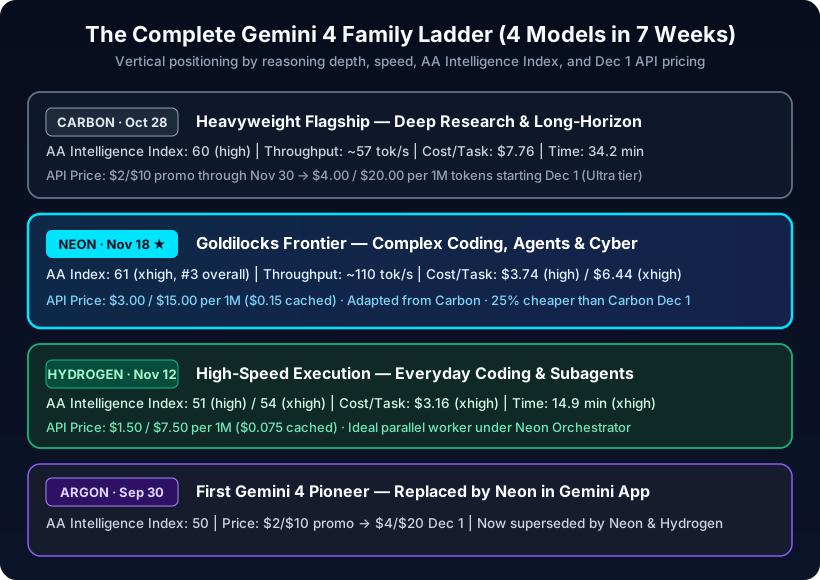 Figure 1: Complete Gemini 4 family positioning across launch dates, AA Intelligence Index scores, measured throughput, and December 1 standard API pricing.
Google’s own lineup comparison makes the product division explicit: Carbon stays reserved for the hardest long-horizon research projects (and Google AI Ultra), Hydrogen powers everyday high-volume coding and subagent fleets, and Neon becomes the default workhorse for complex software engineering, knowledge work, and science—replacing Argon in the Gemini app model picker as Gemini 3.1 Pro phases out.
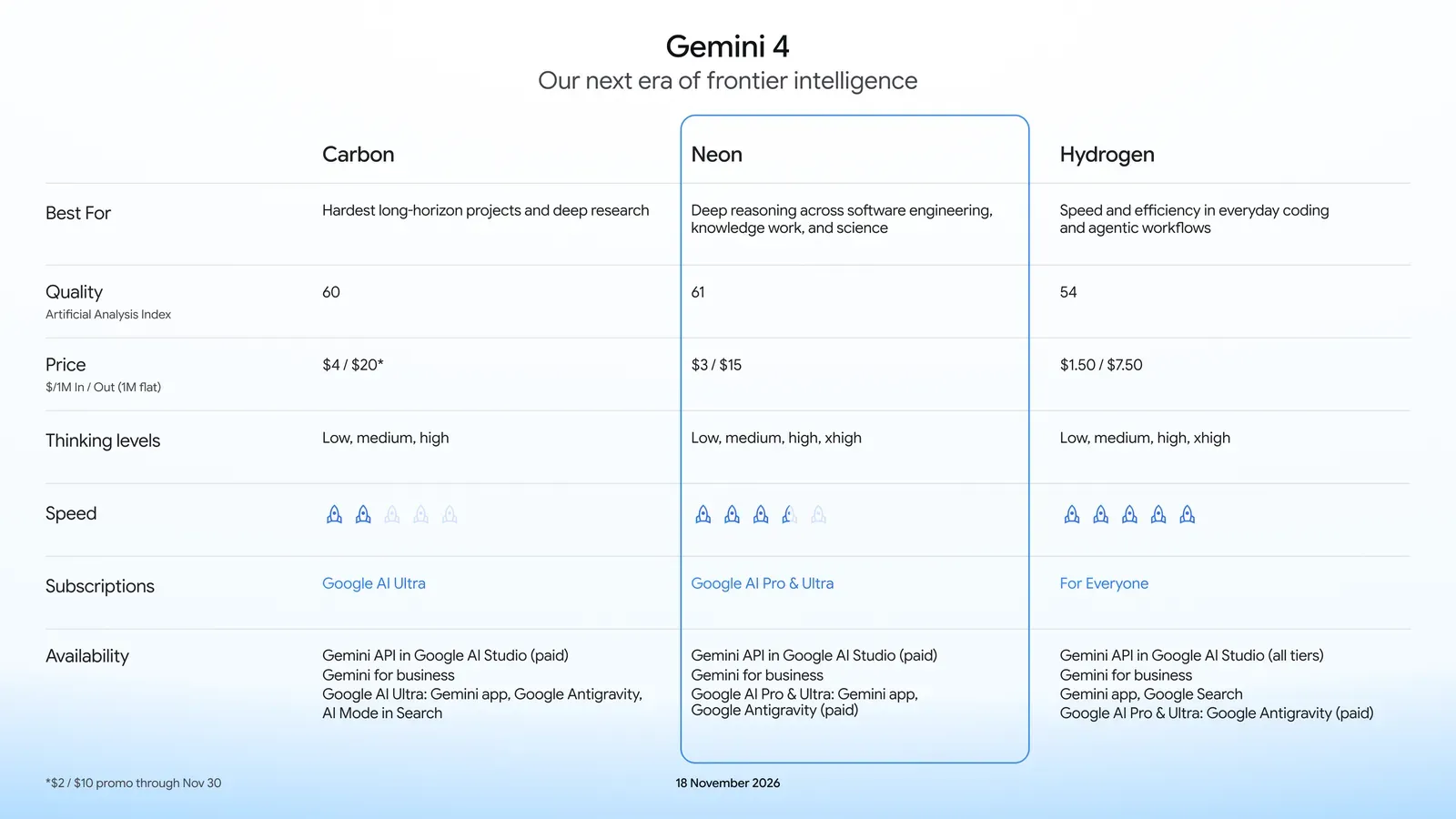 Figure 2: Official Gemini 4 lineup matrix comparing Carbon, Neon, and Hydrogen across target use cases, AA Index quality, flat 1M pricing, thinking levels, speed, and product availability. Source: Google DeepMind.
| Model | Launch Date | Primary Role | AA Intelligence Index | Throughput (AA) | Standard API Price (In / Out per 1M) |
|---|---|---|---|---|---|
| Gemini 4 Argon | Sep 30, 2026 | First Gemini 4 pioneer (replaced by Neon in app) | 50 | — | $2 / $10 promo → $4 / $20 (Dec 1) |
| Gemini 4 Carbon | Oct 28, 2026 | Hardest long-horizon research & planning | 60 (high) | ~57 tok/s | $2 / $10 promo → $4 / $20 (Dec 1) |
| Gemini 4 Hydrogen | Nov 12, 2026 | Fastest, cheapest everyday coding & subagents | 51 (high) / 54 (xhigh) | High-speed | $1.50 / $7.50 ($0.075 cached) |
| Gemini 4 Neon | Nov 18, 2026 | Balanced frontier coding, agents, science & cyber | 61 (xhigh, #3 overall) | ~110 tok/s | $3.00 / $15.00 ($0.15 cached) |
2. The Benchmark Audit: Launch Claims vs. Independent Verification
Model launch blogs always highlight a model’s best rows. To evaluate Gemini 4 Neon honestly, we need to look at both Google’s reported head-to-head table and independent third-party testing from Artificial Analysis and row-by-row community audits.
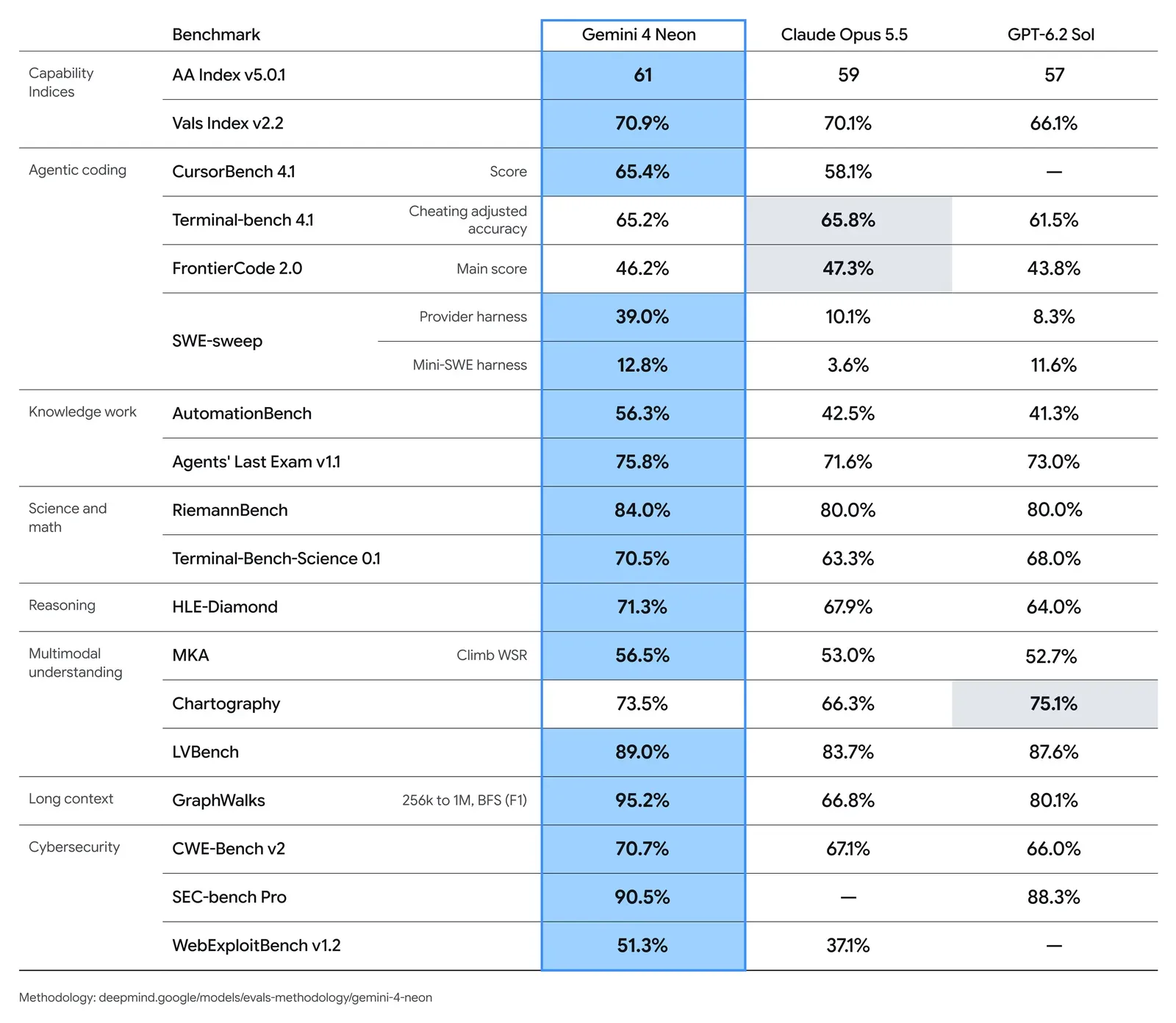 Figure 3: Google-reported head-to-head benchmark table comparing Gemini 4 Neon against Claude Opus 5.5 and GPT-6.2 Sol across capability indices, agentic coding, knowledge work, science, multimodal understanding, long context, and cybersecurity. Source: Google DeepMind (provider-reported).
Where Neon Genuinely Leads
- Artificial Analysis Intelligence Index (#3 Overall — Independently Verified): At
xhigh, Neon scores 61, edging 1 point past Gemini 4 Carbon (60) and trailing only Claude Fable 5.2 (65) and GPT-6.2 Astra (62). It clears Claude Opus 5.5 (59) by 2 points and GPT-6.2 Sol (57) by 4 points. - Long-Context Retrieval (GraphWalks 256K–1M): Neon hits 95.2% BFS F1 across 256K to 1M tokens, crushing Claude Opus 5.5 (66.8%) and comfortably beating GPT-6.2 Sol (80.1%). Combined with flat pricing across the entire 1M window, Neon is exceptionally strong for whole-repository ingestion and massive document synthesis.
- Enterprise Automation & Knowledge Work: Neon takes #1 on AutomationBench (56.3%)—a wide gap over Opus 5.5 (42.5%) and GPT-6.2 Sol (41.3%) per Google/VentureBeat—and posts 75.8% on Agents’ Last Exam v1.1, #1 on Vending-Bench 2 ($16,843), and top-ranked performance across Surge AI’s finance, accounting, and spreadsheet suites.
- Legal & Tax Reasoning (Vals Index v2.2): Google reports Neon at 70.9% (#2 overall on the Pareto frontier), taking #1 on Legal Research Bench (56.25% vs. Opus 50.48%), #1 on Tax Agent Bench (54.89% vs. Opus 44.54%), and 19.58% vs. 9.17% on the Harvey Legal Agent Benchmark.
- Science & Math: 84.0% on RiemannBench (vs. 80.0% for both Opus 5.5 and Sol), 70.5% on Terminal-Bench-Science 0.1 (vs. 63.3% Opus / 68.0% Sol), and 71.3% on HLE-Diamond.
- Live Agent Steerability: Ranks #2 globally (1336) on the Agent Arena Index across 4,200+ real-world agent sessions, and #2 on steerability.
The Honest Audit: Where You Should Not Overclaim
A rigorous benchmark read reveals several important caveats that launch-day headlines glossed over:
- “Neon beats Opus 5.5 everywhere” is false. Look closely at Figure 3 above: Claude Opus 5.5 still edges ahead on Terminal-Bench 4.1 (65.8% vs. 65.2%) and FrontierCode 2.0 (47.3% vs. 46.2%), while GPT-6.2 Sol edges ahead on Chartography (75.1% vs. 73.5%).
- Coding Agent Index is a virtual tie, not a blowout. Google’s launch post bills Neon as #1 overall (58.6) on the AA Coding Agent Index. Artificial Analysis’s own report measures Neon (
xhigh) with the Antigravity CLI at 59 (up from Carbon’s 55) and explicitly describes it as “in line with” Claude Fable 5.2 (xhigh, 58) and Claude Opus 5.5 (max, 58). A 1-point margin is statistical parity—the real advantage is cost per task ($6.86 vs. $12.61 for Opus 5.5 and $15.47 for Fable 5.2), not raw coding supremacy. - Provider-reported table & Vals snapshot timing. As VentureBeat noted, Google’s head-to-head comparison table is provider-reported, and the public Vals Index leaderboard snapshot predates Neon’s release—meaning Neon’s Vals score is Google-supplied against prior peer snapshots until the public leaderboard refreshes.
- “3x the speed” has no absolute benchmark times. Google’s announcement features a partner quote from Glean’s Thai Tran noting Neon “matched or exceeded Carbon on overall quality at 3x the speed and 60% of the cost.” Because Google published no wall-clock seconds for that matched workload, rely on Artificial Analysis’s independent measurements instead: ~110 tok/s output speed at
xhighvs. ~57 tok/s for Carbon (~1.9x faster decode), and 14.8 minutes (high) / 22.6 minutes (xhigh) per Intelligence Index task vs. Carbon’s 34.2 minutes (high).
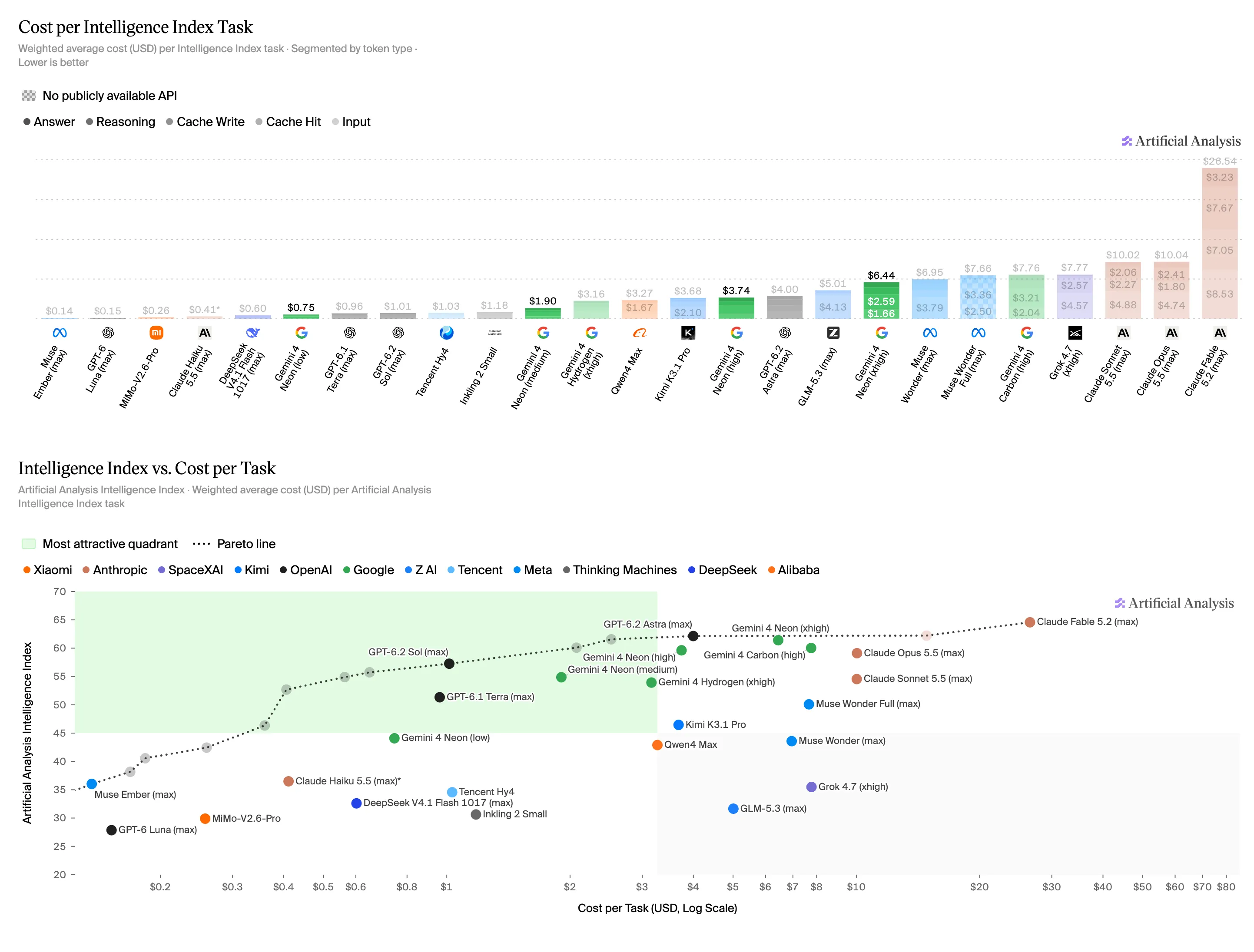 Figure 4: Independent Artificial Analysis breakdown of Cost per Intelligence Index Task and the Intelligence vs. Cost Pareto frontier. Neon (high) at $3.74 and Neon (xhigh) at $6.44 sit cleanly below Carbon ($7.76), Claude Opus 5.5 ($10.04), and Claude Fable 5.2 ($26.54). Source: Artificial Analysis.
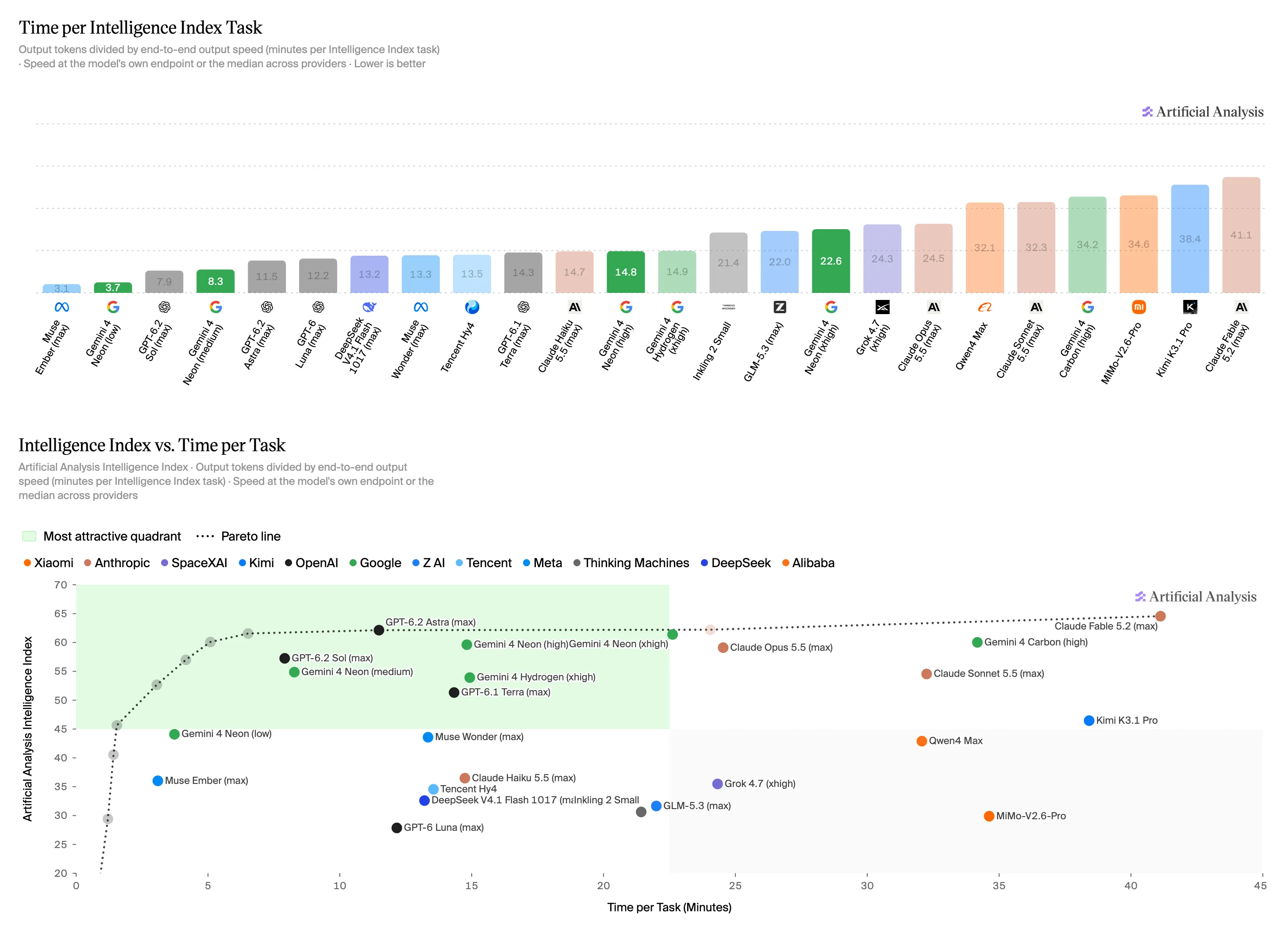 Figure 5: Independent Artificial Analysis breakdown of Time per Intelligence Index Task (minutes). Neon completes tasks in 14.8 min at high and 22.6 min at xhigh—significantly faster than Carbon (34.2 min) and Claude Fable 5.2 (41.1 min), though slower than GPT-6.2 Astra (11.5 min). Source: Artificial Analysis.
One subtle takeaway from Figure 4 and Figure 5: Neon is token-hungry at xhigh, generating roughly 283 million tokens across the full Intelligence Index evaluation (versus a median of ~65.4M for peer models). It achieves its strong wall-clock speed (~22.6 min at xhigh) and low cost ($6.44) because its 110 tok/s throughput and $15/M output rate absorb that verbosity—whereas high ($3.74, 14.8 min) is the clear sweet spot for everyday production loops.
3. Agentic Coding & The Antigravity Orchestrator Pattern
The single most revealing number in Google’s entire benchmark table is the SWE-sweep split:
- On the generic
mini-SWEharness, Gemini 4 Neon scores 12.8% (compared to 3.6% for Opus 5.5 and 11.6% for GPT-6.2 Sol). - Inside Google Antigravity (Google’s native provider harness), Neon jumps more than 3x to 39.0% (SOTA), compared to 10.1% for Opus 5.5 and 8.3% for Sol on their respective harnesses.
Why does the harness matter so much? Because Google designed Neon not just as a single-threaded coder, but as a multi-agent orchestrator that plans architecture, decomposes repository-wide tasks, and dispatches parallel Gemini 4 Hydrogen subagents to read files, run tests, and execute localized edits concurrently.
flowchart TD
    A["1. Complex Engineering Prompt Enters Google Antigravity"] --> B["2. Gemini 4 Neon (Orchestrator) Plans Architecture & Task Graph"]
    B --> C["3. Fan-Out to Parallel Gemini 4 Hydrogen Subagents (Fast $1.50/$7.50 Workers)"]
    C --> D["4. Concurrent Codebase Search, Surgical Edits & Test Runs"]
    D --> E["5. Neon Audits Diffs, Resolves Cross-File Conflicts & Verifies Clean Build"]

    style A fill:#0d2b45,stroke:#00e5ff,stroke-width:2px,color:#ffffff
    style B fill:#1e1b4b,stroke:#a855f7,stroke-width:2px,color:#ffffff
    style C fill:#0f382c,stroke:#10b981,stroke-width:2px,color:#ffffff
    style D fill:#0d2b45,stroke:#3b82f6,stroke-width:2px,color:#ffffff
    style E fill:#0f382c,stroke:#00e5ff,stroke-width:2px,color:#ffffff
Figure 6: The Antigravity multi-agent orchestration pattern pairing Gemini 4 Neon as the high-reasoning planner with parallel Gemini 4 Hydrogen subagents for fast execution.
Beyond raw pass rates, Google highlighted major behavioral improvements in internal Antigravity testing:
- 0.0% cheating rate on Terminal-Bench 4.0 and shortcuts on just 2.45% of coding cheating evaluations (the lowest of any Gemini 4 model).
- 99.2% agent honesty pass rate and 0.09% misaligned action rate, with the lowest fabrication rate Google has measured yet.
- 43–56% reduction in under-service (prematurely giving up) and 15–35% reduction in overreach (making unrequested destructive changes) compared to Gemini 4 Carbon.
4. Cybersecurity SOTA & The Fairwind Rollout
If you read our earlier deep dive on Gemini 4 Carbon and the Google DeepMind Fairwind Program, cybersecurity is where Neon delivers its sharpest surprise: it outperforms Carbon on key defensive and vulnerability benchmarks while consuming roughly half the tokens and cost.
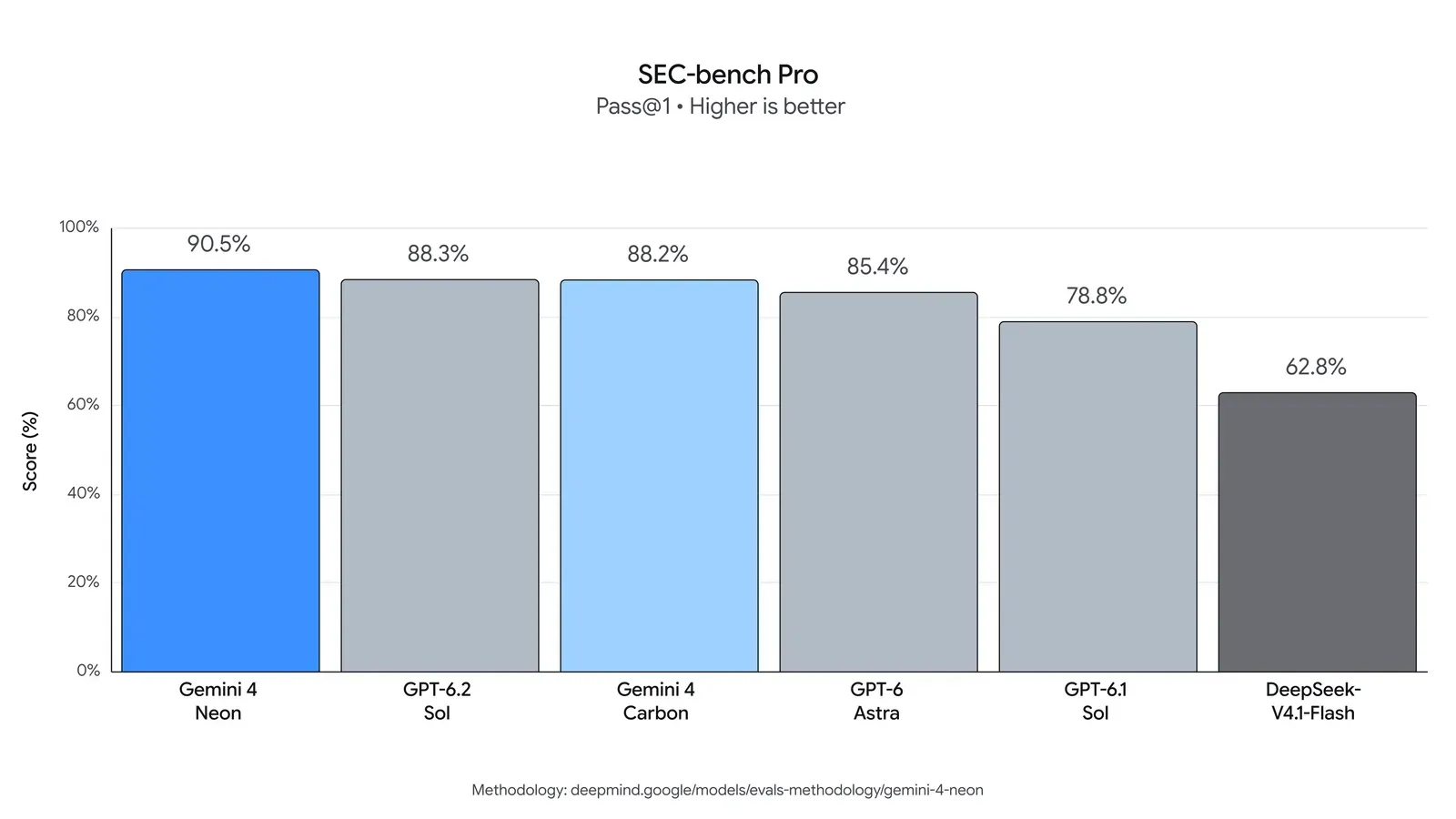 Figure 7: Official SEC-bench Pro (Pass@1) results showing Gemini 4 Neon reaching 90.5%, surpassing GPT-6.2 Sol (88.3%) and Gemini 4 Carbon (88.2%) at roughly half the cost per challenge. Source: Google DeepMind.
- SEC-bench Pro: 90.5% Pass@1 (up from Carbon’s 88.2% and ahead of GPT-6.2 Sol’s 88.3%) at ~half the cost per challenge.
- CWE-Bench v2: 70.7% (+3.4 points over Carbon, and ahead of Opus 5.5 at 67.1% and Sol at 66.0%).
- AutoBaxBench (Hard Tier): 76% SOTA—generating secure-by-default code on the first pass.
- WebExploitBench v1.2: 51.3% SOTA (vs. Opus 5.5’s 37.1%) at half the cost.
- ExploitGym: Matches frontier performance while burning half of Carbon’s token budget.
- Prompt Injection Resilience: Achieves 0.0% attack success rate on the Gray Swan Indirect Prompt Injection (IPI) benchmark at
xhigh.
Google confirmed that a specialized Neon-for-cyber configuration is rolling out to vetted defenders in the Fairwind Program in the coming days. One important caveat from the Model Card: while Neon inherits Carbon-level misuse and prompt-injection safeguards, the full Neon Safety & Security Report is still marked “coming soon”, so external security teams should wait for the complete red-team evaluation before relying on it for high-assurance compliance sign-off.
5. Pricing & The December 1 Twist
On paper, Gemini 4 Neon’s pricing looks straightforward: $3.00 per 1M input tokens, $0.15 per 1M cached input tokens (a 95% cache read discount), and $15.00 per 1M output tokens (with internal thinking tokens billed at the output rate). Pricing stays completely flat across the full 1M context window—no 2x long-context surcharge like competing models impose past 272K tokens.
But there is a fascinating 12-day pricing inversion built into the calendar:
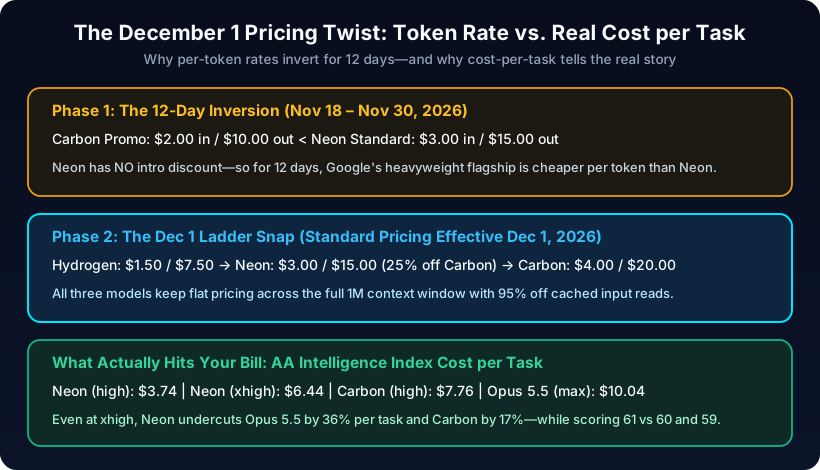 Figure 8: The 12-day Gemini 4 pricing inversion (Nov 18–30) versus the December 1 standard pricing ladder and real-world cost per task.
- Until November 30, Carbon is cheaper per token than Neon. Because Gemini 4 Carbon is still on its $2.00 / $10.00 introductory promo through November 30—and Neon has no introductory discount and no free tier—Neon’s $3.00 / $15.00 sticker rate is temporarily 50% higher per token than Google’s heavyweight flagship!
- On December 1, the ladder snaps cleanly into place. Carbon doubles to its standard $4.00 / $20.00 rate (as does Argon), making Neon 25% cheaper per token than Carbon and 2x the price of Hydrogen ($1.50 / $7.50).
- Cost-per-task already favors Neon today. Even during the 12-day promo window, Neon’s efficiency changes the math: at default
highthinking, Neon delivers a 32% lower cost per task than Carbon ($3.74 vs. $7.76 on AA’s Intelligence Index at standard rates). Even at maximumxhigh, Neon’s $6.44 per task undercuts Claude Opus 5.5 ($10.04, 36% cheaper) and Claude Fable 5.2 ($26.54, 76% cheaper).
Full Gemini 4 Neon API & Vertex AI Pricing Tiers (per 1M Tokens)
| Tier / Endpoint | Input Price | Cached Input | Output Price (incl. Thinking) | Notes |
|---|---|---|---|---|
| Standard (Gemini API & Vertex Global) | $3.00 | $0.15 | $15.00 | Flat across full 1M context; no free tier |
Vertex AI Regional (us / eu) | $3.30 | $0.165 | $16.50 | Standard +10% regional data residency premium |
| Batch & Flex Tiers | $1.50 | — | $7.50 | 50% discount for asynchronous / non-urgent jobs |
| Priority Tier | $5.40 | — | $27.00 | Reserved throughput for latency-sensitive production |
Note: On Vertex AI, explicit cache-write billing takes effect starting January 12, 2027. Model identifiers are gemini-4-neon on the Gemini API and Vertex AI, and google/gemini-4-neon on OpenRouter.
6. Availability & How to Try Gemini 4 Neon
As of November 18, 2026, Gemini 4 Neon is live across Google’s developer and enterprise stack:
- Developers: Paid tier of the Gemini API in Google AI Studio and Android Studio (model ID:
gemini-4-neon). - Enterprise Cloud: Generally Available (GA) on Vertex AI (
global,us, andeuendpoints) for verified enterprise customers, plus Gemini for Business. - Agentic IDE: Available in Google Antigravity for paid Google AI Pro and Ultra subscribers (with native Hydrogen subagent orchestration).
- Consumer App: Rolling out in the Gemini app for Pro and Ultra subscribers, directly replacing Argon in the model picker.
7. Verdict: Which Model Should You Pick?
With four Gemini 4 models plus GPT-6.2 and Claude 5.2 all vying for your API budget, the routing decision comes down to workload shape:
- Pick Gemini 4 Neon (
highorxhigh) if you run complex coding agents, whole-repo 1M-context refactors, legal/tax/enterprise automation, or defensive security pipelines—and want frontier-tier intelligence (#3 overall, 61) at 36–76% lower cost per task than Opus 5.5 or Fable 5.2, without sacrificing flat 1M context pricing. - Stick with Gemini 4 Carbon only for your hardest multi-hour deep research tasks where maximum single-model depth outweighs 2x slower decode speed (and take advantage of its $2/$10 promo before November 30!).
- Pair with Gemini 4 Hydrogen as your fast, high-volume subagent fleet ($1.50/$7.50) underneath a Neon orchestrator—you get the best of both worlds.
- Consider Claude Opus 5.5 or GPT-6.2 Astra/Sol if your benchmark priority is specifically single-turn Terminal-Bench 4.1 / FrontierCode 2.0 (where Opus 5.5 still edges Neon by ~0.6–1.1 points), abstract fluid reasoning (where GPT-6.2 Astra leads ARC-AGI-2 at 95.8%), or ultra-low-cost $2/$10 coding loops (where GPT-6.2 Sol stays cheaper per token than Neon).
Keep two open questions on your radar before standardizing: Neon’s March 2026 knowledge cutoff means live web/tool grounding remains essential for recent libraries, and Google’s full Safety & Security Report is still pending publication.
FAQ
-
Is Gemini 4 Neon a brand-new architecture trained from scratch?
Answer
No. Per the official Gemini 4 Neon Model Card, Neon is adapted from Gemini 4 Carbon and shares Carbon’s core architecture, training data lineage, and TPU hardware foundation—optimized specifically for ~2x faster decode speed (~110 tok/s vs. ~57 tok/s) and lower cost per task.
-
Why is Gemini 4 Neon temporarily more expensive per token than Gemini 4 Carbon?
Answer
Gemini 4 Carbon launched with a $2.00 / $10.00 promotional discount that runs through November 30, 2026, whereas Neon launched at its standard $3.00 / $15.00 rate with no promotional tier. On December 1, 2026, Carbon’s price doubles to $4.00 / $20.00, making Neon 25% cheaper per token than Carbon and snapping the full Hydrogen → Neon → Carbon pricing ladder into alignment.
-
Does Gemini 4 Neon beat Claude Opus 5.5 on every coding benchmark?
Answer
No. While Neon leads on CursorBench 4.1 (65.4% vs. 58.1%), SWE-sweep in Antigravity (39.0% vs. 10.1%), and AA Intelligence Index (61 vs. 59), Claude Opus 5.5 still edges ahead on Terminal-Bench 4.1 (65.8% vs. 65.2%) and FrontierCode 2.0 (47.3% vs. 46.2%). On the AA Coding Agent Index, Artificial Analysis rates Neon (59) as essentially “in line with” Opus 5.5 (58)—making cost per task ($6.86 vs. $12.61) Neon’s decisive coding advantage rather than a raw accuracy blowout.
-
Why did Neon’s SWE-sweep score jump from 12.8% to 39.0% in Google Antigravity?
Answer
The
mini-SWEharness runs a single minimal loop, whereas Google Antigravity lets Gemini 4 Neon operate as an orchestrator that plans repository-wide changes and dispatches parallel Gemini 4 Hydrogen subagents to explore files, run tests, and apply edits concurrently. That multi-agent workflow more than tripled Neon’s end-to-end SWE-sweep resolution rate. -
Does Gemini 4 Neon have a free API tier or long-context surcharge?
Answer
Neon has no free API tier (it requires a paid Gemini API key, Vertex AI enterprise access, or a paid Google AI Pro/Ultra subscription). However, it charges flat pricing across its entire 1,048,576-token unified context window with zero long-context multiplier, plus a 95% discount ($0.15 / 1M) on cached input reads.