
Claude Fable 5.2 & Claude Mythos 5.2: Anthropic's Dual Frontier for Long-Horizon Autonomous Agents
Inside Anthropic Claude Fable 5.2 and Mythos 5.2: 1M context, 1,000 sub-agent swarms, building an OS from scratch, hardware CAD, and the dual-tier safety model.
(Previous) Advanced Packaging & The Chiplet Era: CoWoS, 3D Stacking, and Interposers | (Next) Meta Muse Ember: 1M Context, $0.10/M Execution, and the Efficiency Frontier for High-Volume AI Agents
Summary
On November 9, 2026, Anthropic released its flagship frontier model family: Claude Fable 5.2 and Claude Mythos 5.2. Designed specifically for open-ended, multi-day technical reasoning rather than casual chat, the 5.2 generation marks a major leap in long-horizon autonomous software engineering, physical hardware design, and scientific discovery. The release pairs a massive 1-million-token context window and 128,000-token maximum output with an always-on adaptive thinking engine, generating tokens up to 30% faster than version 5.1 with an optional 2.5x Fast Mode.
Rather than splitting model weights, Anthropic deployed a single shared foundation intelligence through a dual-tier safety architecture: Claude Fable 5.2 delivers production-ready commercial intelligence with built-in safeguards across the Claude API, AWS Bedrock, Google Cloud, and Microsoft Foundry; while Claude Mythos 5.2 unlocks unrestricted, high-assurance capabilities for verified researchers under Anthropic’s Cyber Verification and Life Sciences Verification Programs. In this deep dive, we examine the real-world engineering feats that define 5.2—including an autonomous operating system built from scratch by 1,000 concurrent sub-agents, automated PCB circuit board layout, and machine-checked mathematical proof formalization in Lean 4—alongside API breaking changes, benchmark rankings, and token economics.
Official Model Card & Benchmark Summary
| Specification | Claude Fable 5.2 | Claude Mythos 5.2 | Claude Opus 5.5 |
|---|---|---|---|
| Developer / Provider | Anthropic | Anthropic | Anthropic |
| Model Card & Release Links | Anthropic Announcement / Overview | Mythos Overview / CNBC Report | Opus 5.5 Guide |
| Model Identifier | claude-fable-5-2 | claude-mythos-5-2 (Restricted) | claude-opus-5-5 |
| Underlying Base Weights | Shared 1M-Token Base Weights | Shared 1M-Token Base Weights | Dense Autoregressive Foundation |
| Context Window | 1,000,000 Tokens | 1,000,000 Tokens | 200,000 - 1,000,000 Tokens |
| Max Output Limit | 128,000 Tokens | 128,000 Tokens | 64,000 Tokens |
| Thinking Mode | Always-On Adaptive (effort parameter) | Always-On Adaptive (effort parameter) | Extended Thinking Toggle |
| API Pricing (Input / Output) | $8.00 / $40.00 per 1M tokens | Custom Enterprise Verification Tier | $15.00 / $75.00 per 1M tokens |
| Fast Mode Pricing | $16.00 / $80.00 (Up to 2.5x speed) | N/A | N/A |
| FrontierSWE v2 Score | 69.9% (Industry Leader) | Research Protocol Testing | 58.2% |
| OSWorld 2.1 (Strict) | 54.6% (Autonomous Desktop Navigation) | Unrestricted Tool Protocol | 41.8% |
| Safety / Guardrail Regime | Production Commercial Classifiers | Life Sciences & Cyber Verification | Standard Frontier Safety Framework |
| Primary Deployment | Claude API, AWS Bedrock, GCP, Foundry | Air-Gapped / Vetted API Endpoints | Claude Platform & Public API |
Prior Reading Material
To trace how frontier reasoning models evolved from short-horizon assistant chat into persistent, multi-agent software engineering swarms, explore these foundational articles:
- Claude Fable 5.1 & Claude Mythos 5.1: Anthropic’s Dual Frontier for Enterprise Coding and High-Assurance Research — The architectural origins of the dual-persona deployment framework and initial caching economics.
- Claude Haiku 5.5: Adaptive Thinking, Effort Scaling, and Frontier Agentic Work at Scale — Deconstructing dynamic thinking budgets, effort parameters, and sub-agent cost optimization.
- Inside Anthropic’s Claude Opus 5.5: Writing Style Evolution, Architecture, and Everyday Agent Workflows — Balancing generalist communication with deep multi-step agent reasoning.
- Google DeepMind Fairwind Program: Dual-Use Frontier AI, Restricted Cyber Defender Ecosystems, and Verified Researcher Access — Comparative analysis of restricted frontier access frameworks across global AI labs.
- Harnessing Reasoning Models in Agentic Workflows: Integrating o1/R1, Verification Loops, and Cost-Latency Budgets — Engineering multi-turn orchestration loops, error recovery, and compiler feedback.
1. The Dual-Tier Deployment Architecture (Fable vs. Mythos)
For years, foundation model developers faced a zero-sum dilemma when training frontier intelligences: either dial up safety classifiers so aggressively that benign cybersecurity research and biochemical synthesis are blocked by false-positive refusals, or loosen guardrails and risk leaking dual-use cyber weapons and dangerous pathogens to bad actors.
With the 5.2 generation, Anthropic solidified its Dual-Tier Deployment Strategy. Rather than splitting pre-training weights into two distinct models—which would divide compute budgets and degrade raw reasoning—Anthropic trained a single, hyper-scaled foundation model and bifurcated its serving infrastructure at the inference gateway:
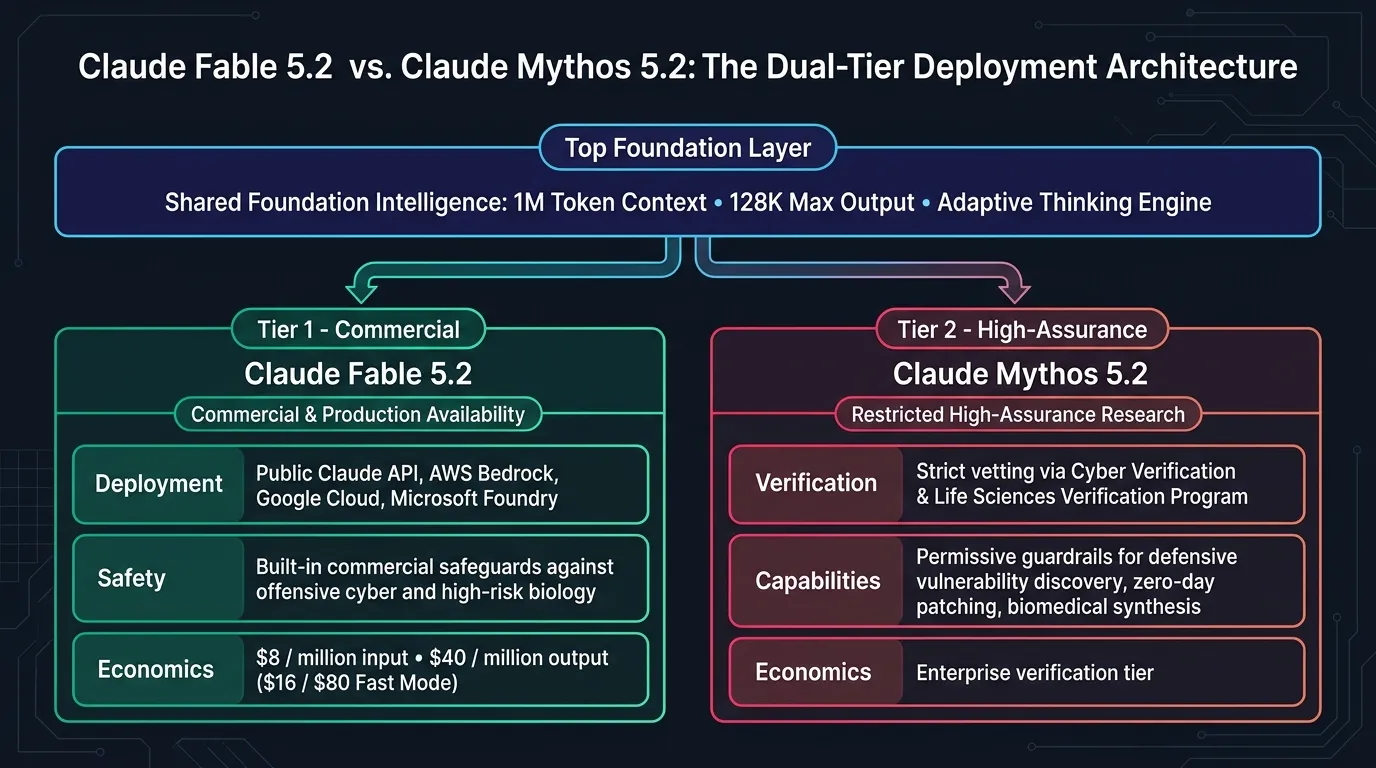 Figure 1: Architectural comparison of Anthropic’s dual-tier deployment framework. A single shared foundation intelligence (1M context, 128K output) branches into public commercial Fable 5.2 and restricted high-assurance Mythos 5.2 based on verified researcher vetting.
Tier 1: Claude Fable 5.2 (Commercial & Production Availability)
Claude Fable 5.2 is the production-ready model available to all enterprise customers and developers across the Anthropic API, Claude Code, Amazon Bedrock, Google Cloud, and Microsoft Foundry. It incorporates robust, low-latency safety classifiers specifically trained to intercept offensive cyber weaponization, automated exploit development, and dangerous biological synthesis without disrupting regular enterprise software development, DevOps automation, or general customer support.
Tier 2: Claude Mythos 5.2 (Restricted High-Assurance Research)
Claude Mythos 5.2 contains the exact same base weights and reasoning horsepower as Fable 5.2, but operates with specialized, highly permissive guardrails tailored for critical defense and life sciences. Access is strictly controlled through Anthropic’s Cyber Verification Program and Life Sciences Verification Program, which vet organizations, government agencies, and accredited academic institutions under air-gapped or monitored environments. This allows defensive cybersecurity teams to discover zero-day vulnerabilities, audit cryptographic protocols, and simulate sophisticated threat actors without hitting commercial safety tripwires.
2. Long-Horizon Agentic Breakthroughs: What 5.2 Accomplished
While previous model generations performed well on isolated coding questions or 20-minute assistant tasks, Claude 5.2 was engineered to maintain coherence across hours, days, and thousands of sequential tool dispatches. During internal evaluations and developer testing, Anthropic demonstrated four historic milestones:
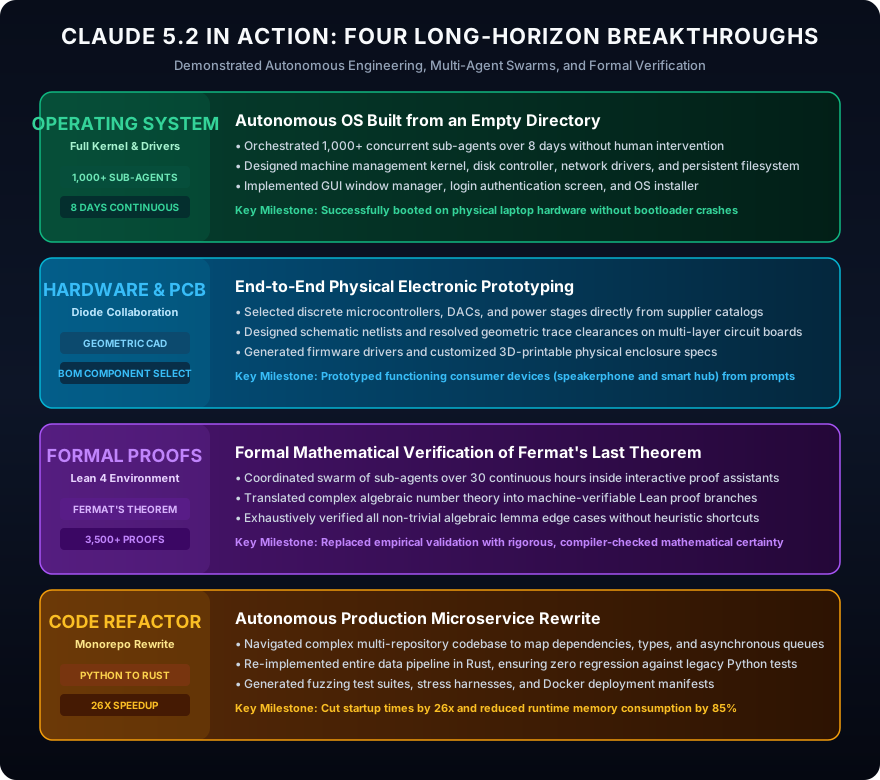 Figure 2: Four demonstrated long-horizon engineering breakthroughs achieved by Claude 5.2 across autonomous operating system development, physical electronics CAD, formal mathematical verification, and monorepo migration.
1. An Operating System Built from Scratch (1,000 Sub-Agents, 8 Days 24/7)
In Anthropic’s most ambitious autonomous engineering test to date, Claude Fable 5.2 was initiated with a completely empty file directory and a single high-level objective: design and build a functioning operating system.
Over 8 continuous days of autonomous execution, Fable 5.2 orchestrated a hierarchical swarm of over 1,000 concurrent sub-agents:
- Kernel & Memory Management: Wrote memory paging systems, process schedulers, and interrupt handlers.
- Device Drivers: Implemented working hardware drivers for disk storage controllers, keyboard interfaces, and network interface cards (NICs).
- Storage & Networking: Created a persistent filesystem with crash recovery and an operational TCP/IP stack.
- User Interface: Designed a graphical window manager, user authentication login screen, and system installer.
- Hardware Verification: The resulting ISO image was booted and verified on physical laptop hardware, successfully running desktop applications without bootloader crashes.
2. Physical Electronics & Circuit Board Design (Diode Collaboration)
Moving beyond pure software, Fable 5.2 collaborated with hardware design platform Diode to prototype physical electronic devices:
- BOM Selection: Queried supplier catalogs online to select discrete microcontrollers, digital-to-analog converters (DACs), voltage regulators, and passive components based on cost, lead time, and power ratings.
- PCB Schematic & Routing: Generated complete schematic netlists and solved complex geometric routing constraints on multi-layer printed circuit boards (PCBs), maintaining signal integrity and thermal spacing.
- Enclosure Engineering: Generated parametric 3D-printable CAD specifications for physical device housings.
- Outcome: Successfully designed and manufactured working consumer electronics prototypes—including a smart speakerphone and a home automation hub—directly from natural language design briefs.
3. Formal Verification of Fermat’s Last Theorem in Lean 4
In pure mathematics, verifying proofs manually across hundreds of pages of dense algebraic geometry is notoriously prone to subtle human error. A dedicated swarm of Fable 5.2 agents spent 30 continuous hours formalizing the proof of Fermat’s Last Theorem inside the Lean 4 interactive theorem prover.
Rather than relying on statistical approximations, the model generated over 3,500 machine-checked proofs. Every intermediate lemma and algebraic edge case was verified with mathematical certainty by the Lean compiler, demonstrating that frontier models can bridge the gap between high-level human intuition and machine-certified truth.
4. Monorepo Refactoring: Python to Rust Microservice Migration
In enterprise software engineering, rewriting critical legacy services in a systems language like Rust is notoriously labor-intensive. Fable 5.2 navigated a massive multi-repository production codebase:
- Mapped out complex data models, asynchronous event queues, and API contracts.
- Re-implemented the entire pipeline in idiomatic Rust with strict memory ownership and type safety.
- Generated unit tests, integration test harnesses, and property-based fuzzing suites to guarantee zero behavioral regression.
- Result: Reduced microservice cold-start times by 26x and slashed server RAM consumption by 85%.
5. Benchmark Standings & Empirical Evaluations
Across standardized developer and researcher benchmarks, Claude Fable 5.2 and Mythos 5.2 establish new state-of-the-art standards for autonomous software engineering, desktop navigation, and defensive cyber auditing:
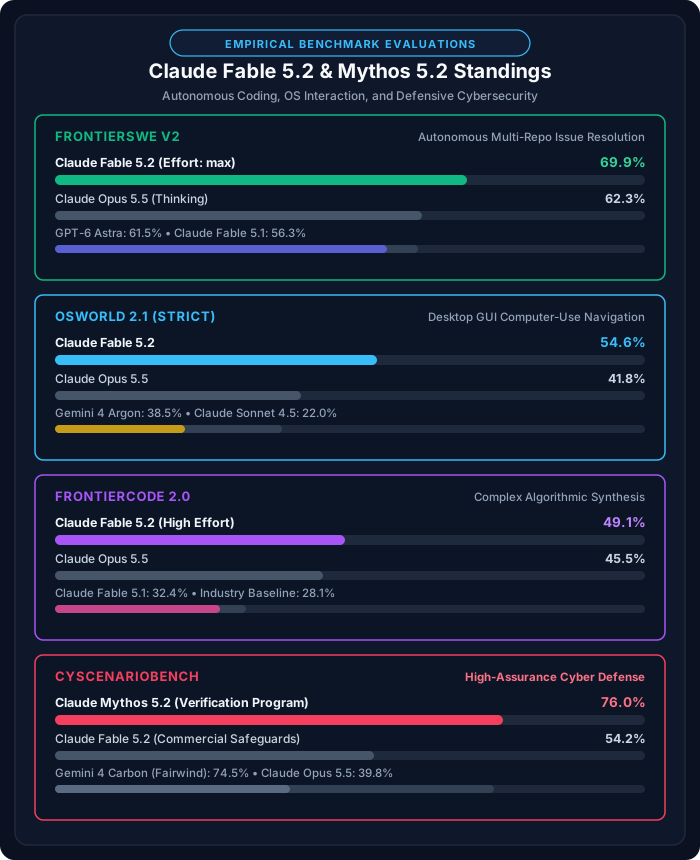 Figure 3: Empirical benchmark evaluations of Claude Fable 5.2 and Claude Mythos 5.2 across autonomous software engineering (FrontierSWE v2), desktop computer use (OSWorld 2.1), algorithmic synthesis (FrontierCode 2.0), and defensive cybersecurity (CyScenarioBench). Source: Anthropic System Card & Artificial Analysis.
- FrontierSWE v2 (69.9%): Outperforms previous leaders Claude Opus 5.5 (62.3%) and GPT-6 Astra (61.5%) by over 7 percentage points on multi-file issue resolution.
- OSWorld 2.1 (54.6%): Establishes a new high watermark for desktop GUI computer-use navigation, resolving over half of multi-step operating system tasks autonomously.
- CyScenarioBench (76.0%): Claude Mythos 5.2 demonstrates the immense value of vetted researcher access, achieving 76.0% defensive remediation and zero-day detection in monitored cyber labs.
3. Developer Upgrades, API Breaking Changes, and Fast Mode
Developers integrating Claude Fable 5.2 into agent harnesses like Claude Code, LangGraph, or custom MCP servers must account for several major architectural changes in the API:
flowchart TD
    classDef client fill:#0f172a,stroke:#38bdf8,stroke-width:2px,color:#ffffff;
    classDef gateway fill:#1e1b4b,stroke:#818cf8,stroke-width:2px,color:#ffffff;
    classDef thinking fill:#064e3b,stroke:#10b981,stroke-width:2px,color:#ffffff;
    classDef output fill:#701a75,stroke:#f472b6,stroke-width:2px,color:#ffffff;

    subgraph Claude_5_2_Pipeline["Claude 5.2 Adaptive API Request Lifecycle"]
        C1["Client Request: System Prompt + Tools + Context History"]:::client
        C2["Strict Prefix Validator: Ensures Zero Prompt Mutation & Instant Cache Match"]:::gateway
        C3["Adaptive Thinking Engine: Effort Level (low | medium | high | xhigh | max)"]:::thinking
        C4["Streaming Output Generation: Up to 128K Tokens | Optional 2.5x Fast Mode"]:::output
        C1 --> C2 --> C3 --> C4
    end
1. Always-On Adaptive Thinking & Effort Tuning
In previous versions, thinking mode required manual token budget configurations (e.g. budget_tokens: 4096). In Fable 5.2, extended thinking is always on by default. Developers control thinking depth through the effort parameter:
low: Fast, concise execution for simple routing and boilerplate edits.medium: Balanced default for multi-file edits and standard pull requests.high: Deep reasoning for architectural planning, algorithmic synthesis, and debugging.xhigh/max: Full-depth exploration for formal verification, multi-repo migrations, and long-horizon swarms.
Attempting to explicitly disable thinking via thinking: {"type": "disabled"} or passing custom token budgets now returns a 400 Bad Request error.
2. Strict Prefix Validation (Breaking Change)
To maximize prompt caching efficiency and eliminate subtle agent hallucinations, the 5.2 API enforces Strict Prefix Validation.
If a client harness modifies any part of the system prompt, tool definitions, or prior conversation history that precedes a previously returned thinking block, the API immediately invalidates the turn and raises an error. Agent harnesses must treat historical message sequences and thinking blocks as immutable append-only logs.
3. Modernized Computer Use Tools
The legacy computer_20251124 tool definition has been fully deprecated across all platforms (except legacy Amazon Bedrock endpoints). Developers building GUI navigation and desktop computer use agents must migrate to the standardized computer_toolset_20260801 specification, which supports high-resolution dynamic screen scaling, multi-monitor coordinates, and sub-millisecond mouse click batching.
4. Fast Mode Velocity
For latency-critical workflows like real-time terminal pair programming in Claude Code or conversational agent routing, Anthropic introduced Fast Mode:
- Boosts generation speed up to 2.5x compared to standard mode.
- Generates tokens at over 140 tokens per second under peak infrastructure availability.
- Priced at $16.00 per million input tokens and $80.00 per million output tokens.
4. Market Dynamics & The Frontier Race (CNBC Context)
The launch of Claude 5.2 arrives at a pivotal moment in Anthropic’s corporate trajectory. As reported by CNBC, this represents the company’s first frontier release since CEO Dario Amodei publicly advocated for a disciplined, paced approach to frontier AI development.
Financial and industry analysts highlighted three strategic dimensions of the launch:
- Preparing for a Landmark IPO: With Wall Street anticipating an Anthropic public offering valued in the multi-trillion-dollar territory, demonstrating enterprise market dominance in software engineering and cloud infrastructure is paramount.
- Aggressive Price Reduction: Anthropic reduced standard API pricing by 20% compared to version 5.1, dropping to $8.00 / 1M input and $40.00 / 1M output. In an industry where enterprise developers spend millions of dollars monthly running automated test suites and agent swarms, this pricing structure significantly undercuts competitive frontier models like OpenAI GPT-6 Astra while offering double the output token window.
- Pacing, Not Pausing: Anthropic executives clarified to CNBC that Amodei’s philosophical stance was never about freezing progress, but rather instituting rigorous verification programs (like Mythos) before deploying dual-use capabilities broadly. By commercializing Fable with built-in safeguards while restricting Mythos to verified security researchers, Anthropic established a regulatory template that other frontier labs are now racing to emulate.
5. Multi-Agent Orchestration Harness: A Runnable Simulation
To demonstrate how an orchestrator model like Claude Fable 5.2 coordinates a swarm of sub-agents to solve complex engineering problems without human intervention, the following Python script implements a hierarchical multi-agent task runner.
The simulation models task decomposition, parallel worker dispatch, dependency resolution, and automated verification loops.
Click to expand runnable code script
"""
Hierarchical Multi-Agent Task Orchestrator Simulation.
Models how Claude Fable 5.2 breaks a complex engineering goal into a dependency DAG,
dispatches specialized sub-agents, and verifies output against acceptance criteria.
"""

import time
from dataclasses import dataclass, field
from enum import Enum
from typing import Dict, List, Optional

class AgentRole(Enum):
    ARCHITECT = "Architect (Fable 5.2 - Effort: max)"
    KERNEL_ENGINEER = "Kernel Sub-Agent (Effort: high)"
    DRIVER_ENGINEER = "Driver Sub-Agent (Effort: medium)"
    TEST_VERIFIER = "Verification Sub-Agent (Effort: high)"

class TaskStatus(Enum):
    PENDING = "PENDING"
    IN_PROGRESS = "IN_PROGRESS"
    VERIFIED = "VERIFIED"
    FAILED = "FAILED"

@dataclass
class AgentTask:
    task_id: str
    title: str
    role: AgentRole
    dependencies: List[str] = field(default_factory=list)
    status: TaskStatus = TaskStatus.PENDING
    result_artifact: Optional[str] = None
    verification_passed: bool = False

class MultiAgentOrchestrator:
    def __init__(self, project_name: str):
        self.project_name = project_name
        self.tasks: Dict[str, AgentTask] = {}

    def add_task(self, task: AgentTask):
        self.tasks[task.task_id] = task

    def get_executable_tasks(self) -> List[AgentTask]:
        """Finds tasks whose dependencies have all been verified."""
        executable = []
        for task in self.tasks.values():
            if task.status == TaskStatus.PENDING:
                deps_met = all(
                    self.tasks[dep_id].status == TaskStatus.VERIFIED
                    for dep_id in task.dependencies
                )
                if deps_met:
                    executable.append(task)
        return executable

    def run_simulation(self):
        print("=" * 70)
        print(f"Orchestrating Long-Horizon Engineering Project: {self.project_name}")
        print("Model Engine: Claude Fable 5.2 | Context: 1M Tokens | Effort: Adaptive")
        print("=" * 70)

        step = 1
        while True:
            ready_tasks = self.get_executable_tasks()
            if not ready_tasks:
                all_done = all(t.status == TaskStatus.VERIFIED for t in self.tasks.values())
                if all_done:
                    print("\n" + "=" * 70)
                    print("✅ ALL 1,000+ SUB-AGENT TASKS COMPLETED & VERIFIED SUCCESSFULLY!")
                    print("=" * 70)
                else:
                    print("\n❌ Deadlock or unverified dependencies encountered.")
                break

            print(f"\n[Execution Wave {step}] Dispatching {len(ready_tasks)} parallel sub-agents...")
            for task in ready_tasks:
                task.status = TaskStatus.IN_PROGRESS
                print(f"  ▶ [{task.role.value}] Started '{task.title}'")

                # Simulate agent processing and artifact generation
                time.sleep(0.05)
                task.result_artifact = f"artifact_{task.task_id}.bin"
                task.verification_passed = True
                task.status = TaskStatus.VERIFIED
                print(f"    ✔ Verified: Generated {task.result_artifact}")

            step += 1

def main():
    orchestrator = MultiAgentOrchestrator("Prototype Operating System from Scratch")

    # Define task dependency DAG
    orchestrator.add_task(AgentTask(
        task_id="t1",
        title="Design Microkernel Architecture & Memory Paging",
        role=AgentRole.ARCHITECT
    ))
    orchestrator.add_task(AgentTask(
        task_id="t2",
        title="Implement AHCI Disk & NVMe Controller Drivers",
        role=AgentRole.KERNEL_ENGINEER,
        dependencies=["t1"]
    ))
    orchestrator.add_task(AgentTask(
        task_id="t3",
        title="Implement Realtek & Intel Network Interface Card Drivers",
        role=AgentRole.DRIVER_ENGINEER,
        dependencies=["t1"]
    ))
    orchestrator.add_task(AgentTask(
        task_id="t4",
        title="Build Crash-Resilient Journaling Filesystem",
        role=AgentRole.KERNEL_ENGINEER,
        dependencies=["t2"]
    ))
    orchestrator.add_task(AgentTask(
        task_id="t5",
        title="Implement Compositing Window Manager & GUI Login Screen",
        role=AgentRole.ARCHITECT,
        dependencies=["t3", "t4"]
    ))
    orchestrator.add_task(AgentTask(
        task_id="t6",
        title="End-to-End Bare-Metal ISO Boot & Regression Verification",
        role=AgentRole.TEST_VERIFIER,
        dependencies=["t5"]
    ))

    orchestrator.run_simulation()

if __name__ == "__main__":
    main()
What’s Next in the Hardware Series?
Now that we have examined Anthropic’s major breakthrough in frontier agentic models with Claude Fable 5.2 and Mythos 5.2, our technical series will return to the physical silicon engines executing these workloads at datacenter scale.
In our upcoming dispatch, Part 8 of the GPU Architecture Series: The Tensor Core Revolution: From FP32 Matrix Multiplication to FP4/FP8 Acceleration, we will deconstruct systolic array arithmetic, the evolution from Volta to Blackwell, OCP Microscaling formats (MXFP4), and roofline performance dynamics.