
Gemini 4 Hydrogen: 2.5x Faster Agentic Execution, 1M Unified Context, and the Antigravity Orchestrator
Inside Gemini 4 Hydrogen: outscoring Argon (51 vs 50) at $1.50/M, 57% on Terminal-Bench 4.1, 1M long decodes, and dynamic Orchestrator handoffs.
Series: ← Meta Muse Ember: 1M Context, $0.10/M Execution, and the Efficiency Frontier for High-Volume AI Agents (Previous) | The Tensor Core Revolution: From FP32 Matrix Multiplication to FP4/FP8 Acceleration (Next) →
Summary
On November 12, 2026, Google DeepMind unveiled Gemini 4 Hydrogen (gemini-4-hydrogen), formally retiring the “Flash” branding lineage (succeeding Gemini 3.8 Flash) in favor of the periodic-table naming architecture shared with Gemini 4 Argon and Gemini 4 Carbon. Designed as a high-speed, cost-efficient execution engine for everyday software engineering, multimodal knowledge work, and multi-step agentic workflows, Gemini 4 Hydrogen delivers a striking capability inversion: at its default HIGH thinking level, it scores 51 on the Artificial Analysis Intelligence Index—surpassing Google’s heavier Gemini 4 Argon (50)—and climbs to 54 at its maximum XHIGH setting, while running 2.5x faster than Gemini 3.8 Flash.
Priced flat across its entire 1,048,576-token unified input-and-output context window at $1.50 per million input tokens and $7.50 per million output tokens (with automatic implicit durable caching at $0.075 per million tokens), Hydrogen pairs frontier-adjacent reasoning with production throughput. Alongside the model launch, Google introduced Orchestrator in Google Antigravity, a dynamic, bidirectional handoff layer that pairs heavy planners like Gemini 4 Carbon with Hydrogen’s rapid execution—achieving near-Carbon task success on Terminal-Bench 4.1 while consuming 24% less quota and finishing 19% faster. Simultaneously, Google rolled out Hydrogen globally across Google Search, Google Sheets, Google AI Studio, the Gemini API, and the Gemini Enterprise Agent Platform.
Prior Reading Material
- Gemini 4 Carbon: Google’s Frontier Reasoning Model for Autonomous Cybersecurity and Long-Horizon Software Engineering — How Google DeepMind’s top-ranked reasoning model achieves 88.2% on SEC-bench Pro and anchors the planning side of Antigravity Orchestrator workflows.
- Gemini 4 Argon for Robotics: Physical AI Reasoning, Real2Sim MuJoCo Twins, and Closed-Loop Control — Inside the Gemini 4 family’s earlier general-purpose and embodied reasoning flagship that Hydrogen now surpasses on the AA Intelligence Index.
- Meta Muse Ember: 1M Context, $0.10/M Execution, and the Efficiency Frontier for High-Volume AI Agents — The economics of high-throughput worker models versus frontier planners in production agent swarms.
- Harnessing Reasoning Models in Agentic Workflows: Integrating o1/R1, Hidden Thinking Tokens, and Cost vs. Depth Optimization — Architectural patterns for balancing thinking-token budgets, latency, and reasoning depth across multi-turn agent loops.
- DeepSeek V4.1-Flash-1017: MIT Weights, DeepInfer Engine, Agent Harness Tuning, and Low-Latency Prefill — How parallel tool batching and harness optimizations accelerate repository-level coding agents.
Official Model Card & Release Summary
| Specification | Gemini 4 Hydrogen (gemini-4-hydrogen) |
|---|---|
| Developer / Lab | Google DeepMind & Google Cloud |
| Predecessor Replaced | Gemini 3.8 Flash (retiring the “Flash” naming tier) |
| Context Window (Unified) | 1,048,576 tokens (combined input + output, including thinking and tool calls) |
| Long-Decode Output Limit | Up to 1,048,576 tokens (65,536 per foreground segment via continuation_token or background=true) |
| Configurable Thinking Levels | LOW, MEDIUM, HIGH (Default), XHIGH (thinking_budget and MINIMAL return HTTP 400) |
| Standard API Pricing | $1.50 / 1M input tokens · $7.50 / 1M output tokens (flat across full 1M context) |
| Implicit Durable Caching | $0.075 / 1M cached input tokens (automatic for prefixes >= 4,096 tokens) |
| Native Modalities | Text, Code, Image, Audio, Video, PDF, Microsoft Office (.docx, .pptx, .xlsx), OpenDocument (.odt, .odp, .ods) |
| AA Intelligence Index | 51 (HIGH default, beats Argon’s 50) · 54 (XHIGH) |
| Coding & Agent Benchmarks | 57.0% Terminal-Bench 4.1 · 76.1% AutomationBench-AA · 71.6% Agents’ Last Exam v1.1 · 77.6% OSWorld-2.1 |
| Lifecycle & Availability | Short-term GA (45-day retirement notice) · AI Studio, Gemini API, Vertex AI / Agent Platform, Antigravity, Search, Sheets |
| Official Documentation | Model Card · Google Blog · Cloud Docs · Antigravity Blog |
Breaking the Flash Ceiling: Why Hydrogen Outscores Argon
For the past several generations of foundation models, the industry maintained a predictable hierarchy: small, fast models (“Flash” or “Haiku” tiers) traded deep reasoning for low latency and low cost, while heavy models (“Pro”, “Opus”, or named frontier tiers) monopolized complex problem-solving. With Gemini 4 Hydrogen, Google DeepMind has broken that assumption.
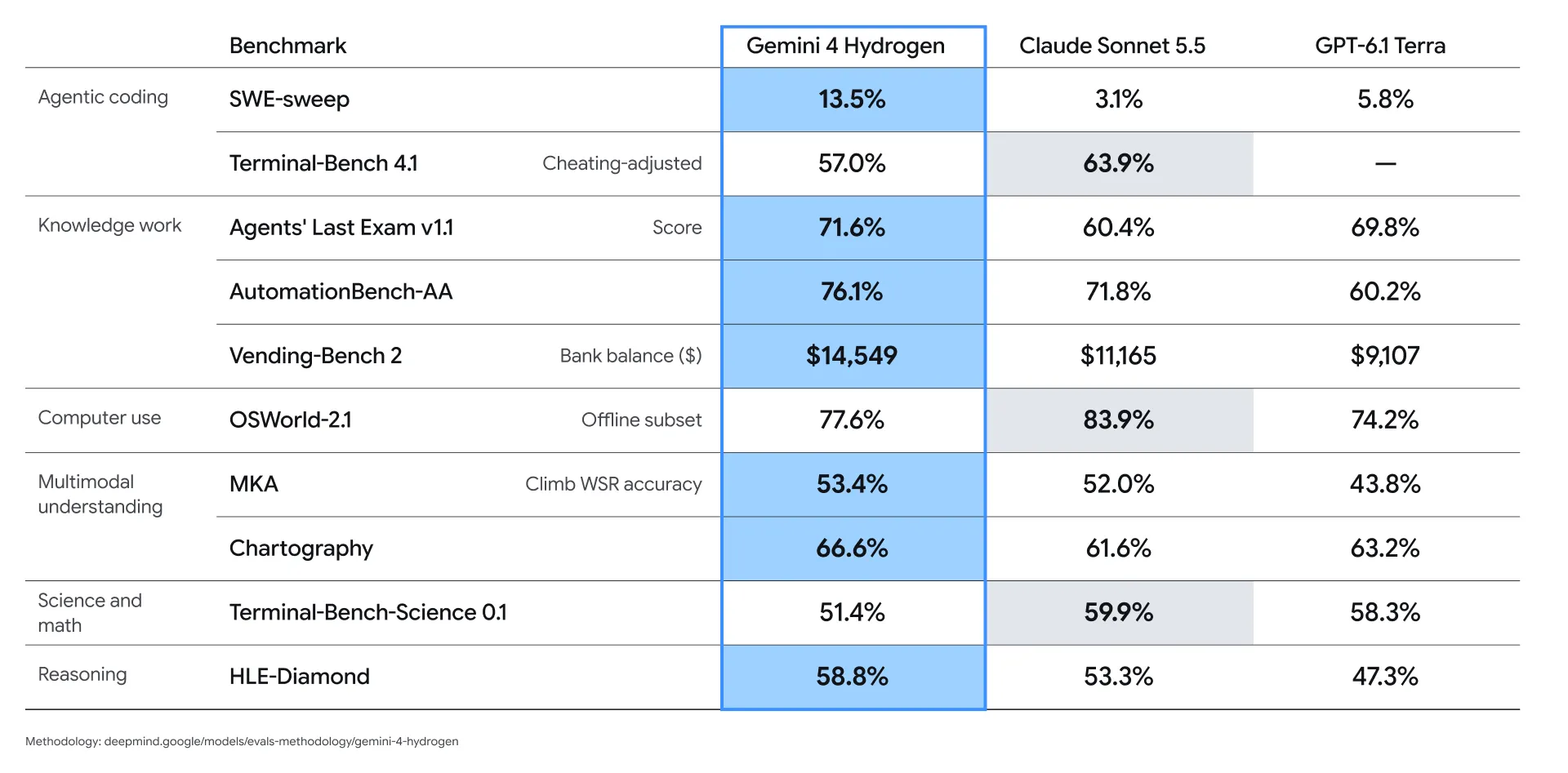 Figure 1. Official Google DeepMind evaluation table comparing Gemini 4 Hydrogen against Gemini 3.8 Flash and competing frontier-adjacent models across reasoning, coding, and agentic benchmarks. Source: Google DeepMind.
At its default HIGH thinking configuration, Gemini 4 Hydrogen achieves a 51 on the Artificial Analysis Intelligence Index, edging past Google’s own Gemini 4 Argon (50)—a model positioned as a heavyweight reasoning tier just weeks earlier. Pushing Hydrogen to its XHIGH reasoning tier elevates that score to 54, placing a $1.50/M input execution model squarely inside frontier territory.
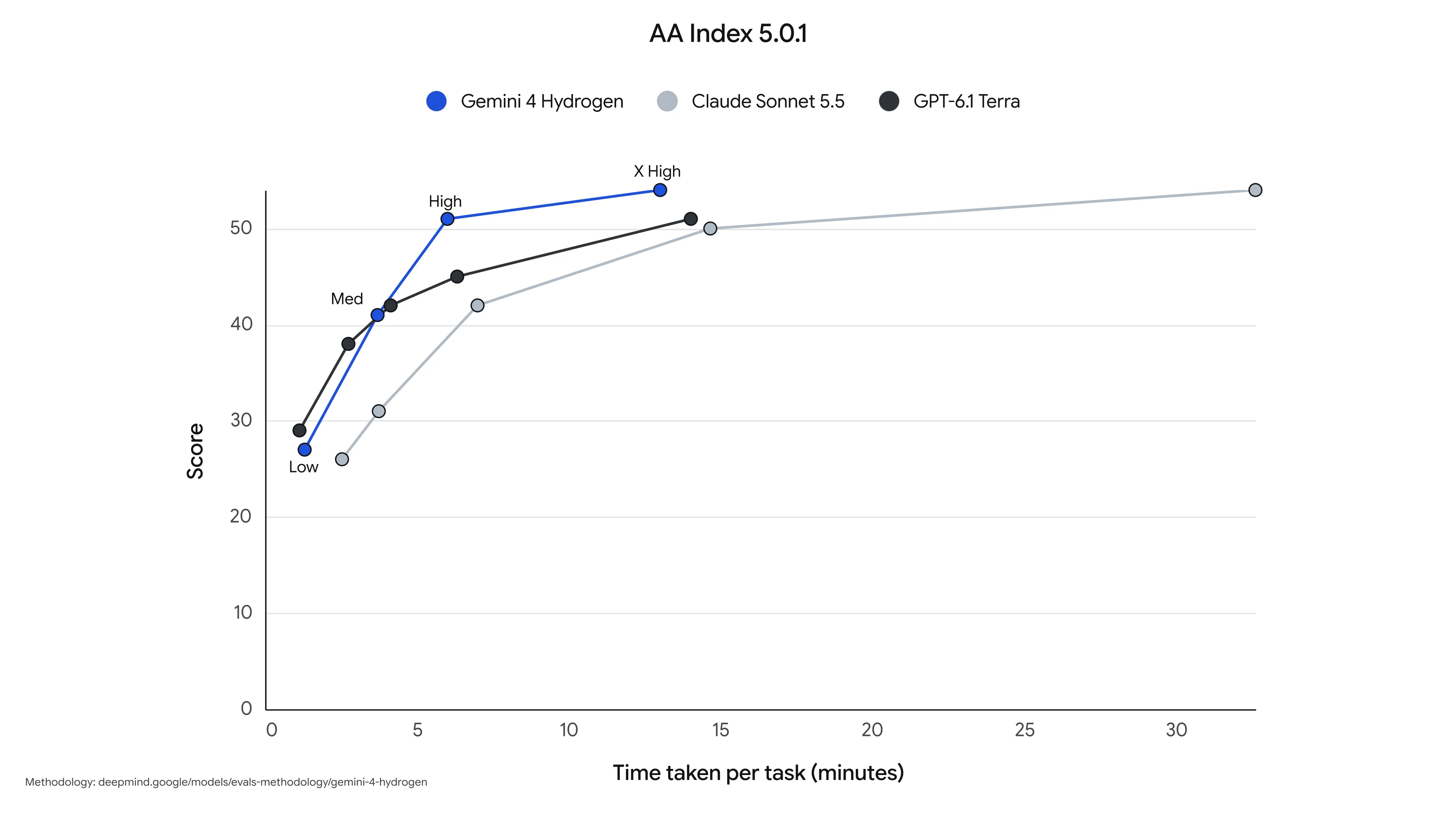 Figure 2. Artificial Analysis Intelligence Index score plotted against end-to-end completion time, illustrating Gemini 4 Hydrogen’s speed-to-intelligence frontier relative to Gemini 3.8 Flash and peer models. Source: Google DeepMind / Artificial Analysis.
Compared directly against its predecessor, Gemini 3.8 Flash, the generational leap is dramatic:
- 2.5x Faster Task Completion: At default
HIGHsettings, Hydrogen finishes end-to-end agentic tasks 2.5 times faster than 3.8 Flash. - More Than 3x Terminal-Bench 4.1 Jump: Hydrogen scores 57.0% on Terminal-Bench 4.1 (cheating-adjusted average reward across 5 attempts per task on Google’s
mini-swe-agentvision harness), more than tripling Gemini 3.8 Flash’s 18.2%. - 5x Reduction in Fabricated Claims: Grounding and tool-failure recovery are substantially tighter; when a tool call returns an error or a search returns empty, Hydrogen adapts its plan cleanly instead of hallucinating synthetic results.
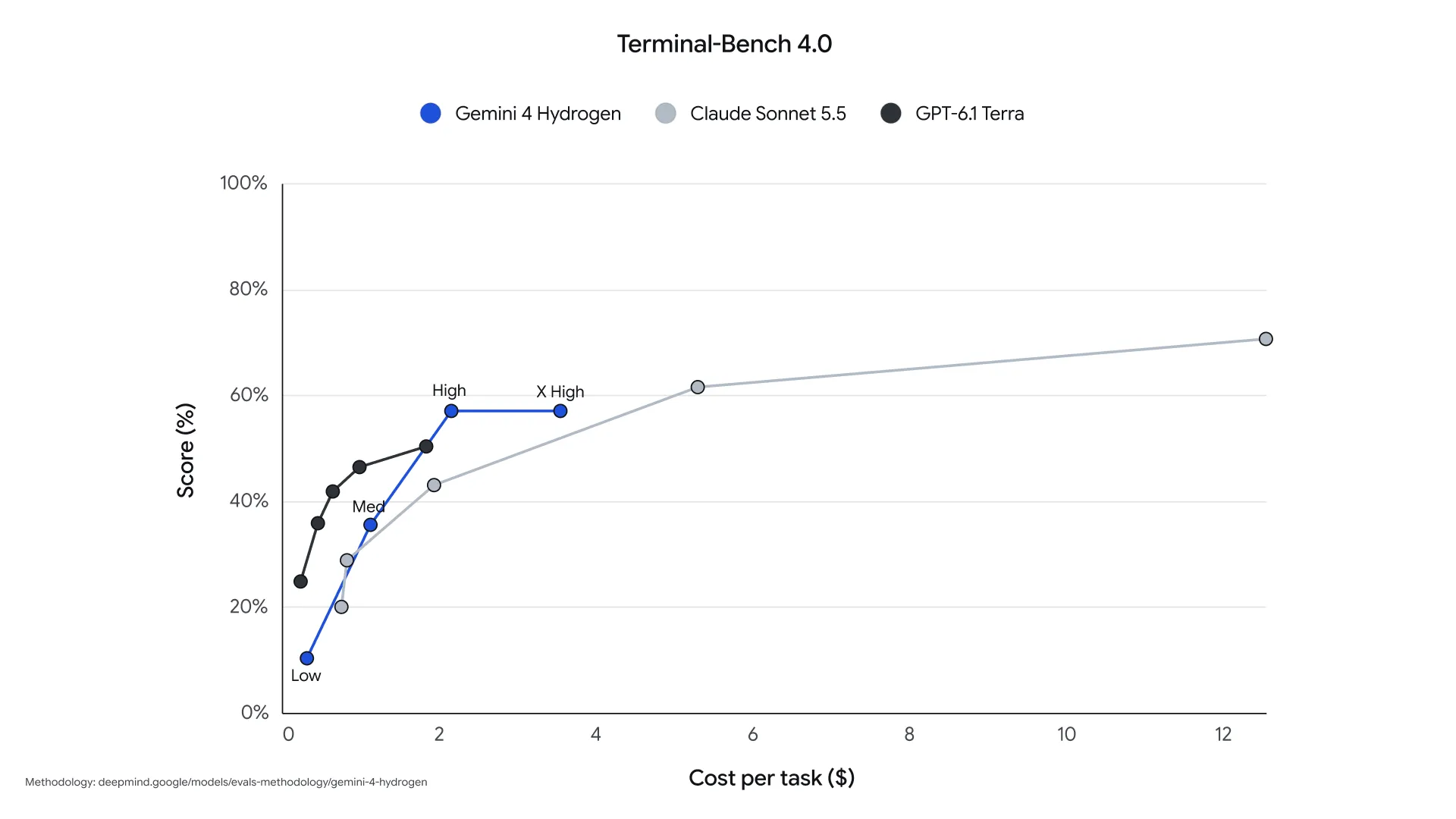 Figure 3. Terminal-Bench performance progression showing Gemini 4 Hydrogen’s leap in autonomous repository debugging and shell execution. Source: Google DeepMind.
Benchmark Deep Dive: Coding, Knowledge Work, and OS Control
Across developer, enterprise knowledge, and computer-use evaluations, Gemini 4 Hydrogen demonstrates consistent strength without requiring specialized fine-tuning:
| Benchmark | Domain / Evaluation Focus | Gemini 4 Hydrogen Score | Key Context / Comparison |
|---|---|---|---|
| AA Intelligence Index | Composite Reasoning & Coding | 51 (HIGH) / 54 (XHIGH) | Surpasses Gemini 4 Argon (50) at default HIGH |
| Terminal-Bench 4.1 | Autonomous CLI & Repo Debugging | 57.0% | >3x improvement over Gemini 3.8 Flash (18.2%) |
| AutomationBench-AA | Multi-Step Agentic Automation | 76.1% | Leads its model class |
| Agents’ Last Exam v1.1 | End-to-End Professional Workflows | 71.6% | Outperforms competing models in its speed tier |
| OSWorld-2.1 (Offline) | Computer Use & OS Navigation | 77.6% | High-precision GUI and multi-app execution |
| HLE-Diamond | Deep Domain Reasoning | 58.8% | Class-leading reasoning density |
| Multimodal Knowledge Agent (MKA) | Dense PDF, Chart & Video Synthesis | 53.4% | End-to-end visual file analysis |
| Vals Tax Agent Bench | Enterprise Tax Reasoning | 52.3% | Ranked #1 overall |
| Vals Legal Research Bench | Legal Citation & Synthesis | 55.8% | Tied for #1 overall |
| Agent Arena (arena.ai) | Live Open-Ended Agentic Tasks | #5 Overall | Top-5 global ranking across all model tiers |
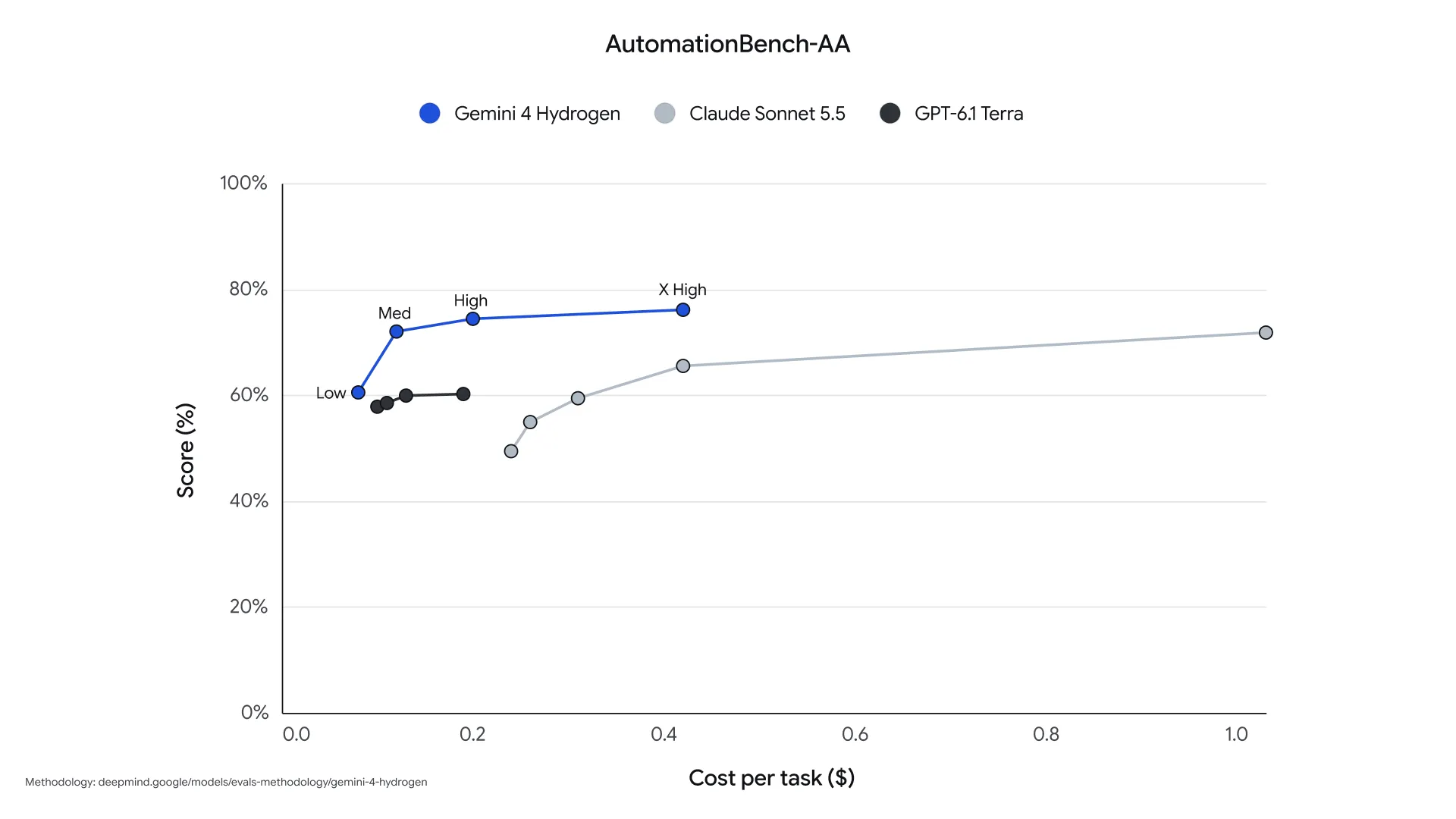 Figure 4. AutomationBench-AA evaluation results highlighting Hydrogen’s 76.1% score on multi-step tool orchestration. Source: Google DeepMind.
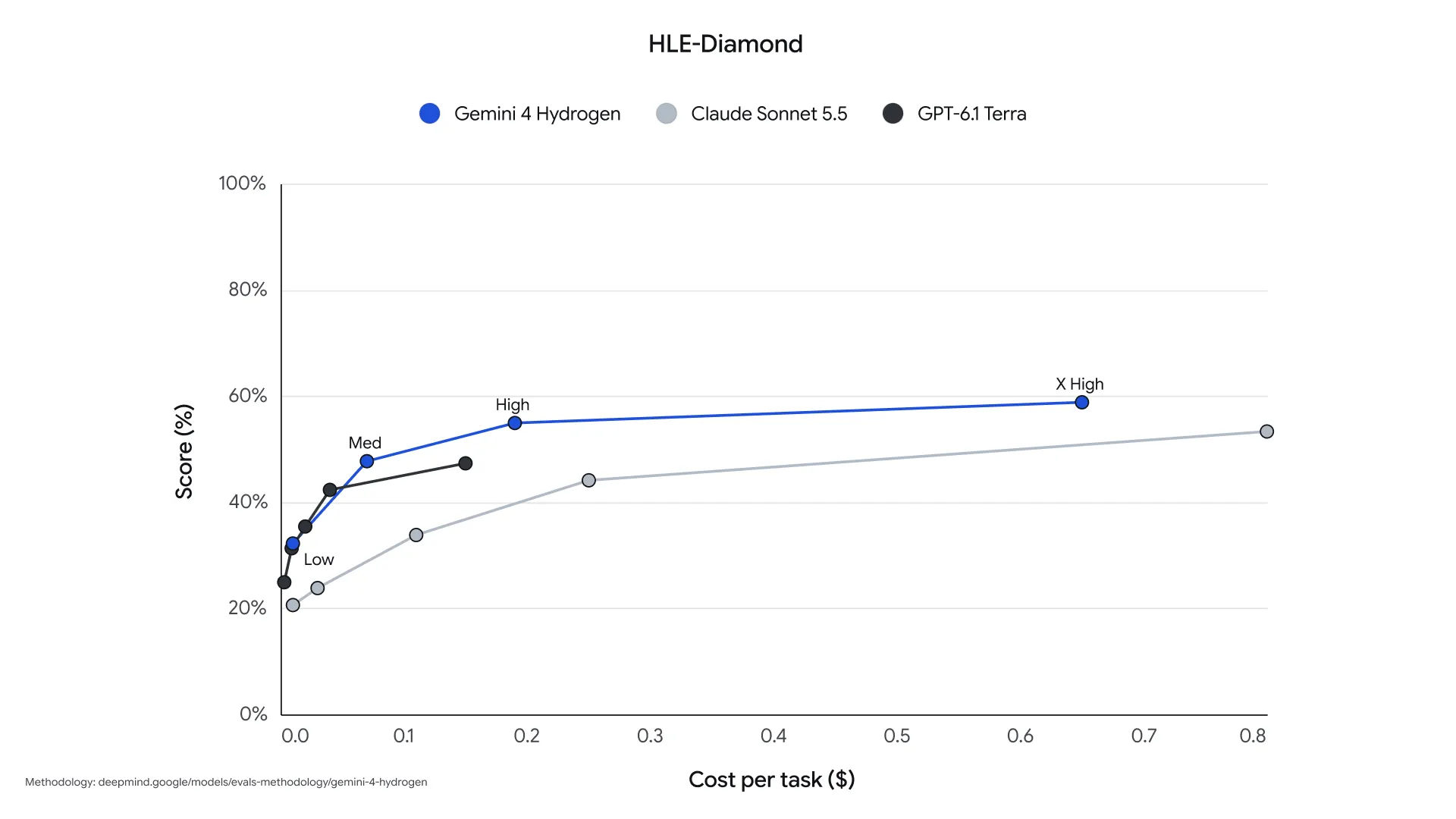 Figure 5. HLE-Diamond domain reasoning benchmark comparing Gemini 4 Hydrogen across thinking tiers against competing models. Source: Google DeepMind.
Parallel Tool Batching in Repository Workflows
A major driver behind Hydrogen’s real-world speedup in coding harnesses is native parallel tool batching. Rather than inspecting a repository sequentially—reading one file, waiting for the response, issuing a grep, waiting again—Hydrogen batches concurrent file-read and search calls in a single turn. In partner evaluations across complex dependency graphs, SQL migrations, and data-heavy enterprise repositories, this parallel exploration ran 2x to 2.8x faster while cutting total token consumption by 12% to 23% compared to Gemini 3.8 Flash.
flowchart TD
    A["1. Agent Receives Repository Issue or Refactor Prompt"] --> B["2. Parallel Tool Batch: Concurrent File Reads & Codebase Search"]
    B --> C["3. Synthesize Unified Context Across Matched Modules"]
    C --> D["4. Apply Surgical Edits Without Unrelated Rewrites"]
    D --> E["5. Run Test Suite & Verify Clean Exit"]

    style A fill:#0d2b45,stroke:#00e5ff,stroke-width:2px,color:#ffffff
    style B fill:#0f382c,stroke:#10b981,stroke-width:2px,color:#ffffff
    style C fill:#1e1b4b,stroke:#8b5cf6,stroke-width:2px,color:#ffffff
    style D fill:#0d2b45,stroke:#3b82f6,stroke-width:2px,color:#ffffff
    style E fill:#0f382c,stroke:#10b981,stroke-width:2px,color:#ffffff
Four Configurable Thinking Tiers (LOW, MEDIUM, HIGH, XHIGH)
To let engineering teams tune latency and reasoning cost per request, Gemini 4 Hydrogen replaces legacy numeric thinking_budget parameters with four discrete thinking levels: LOW, MEDIUM, HIGH (default), and XHIGH.
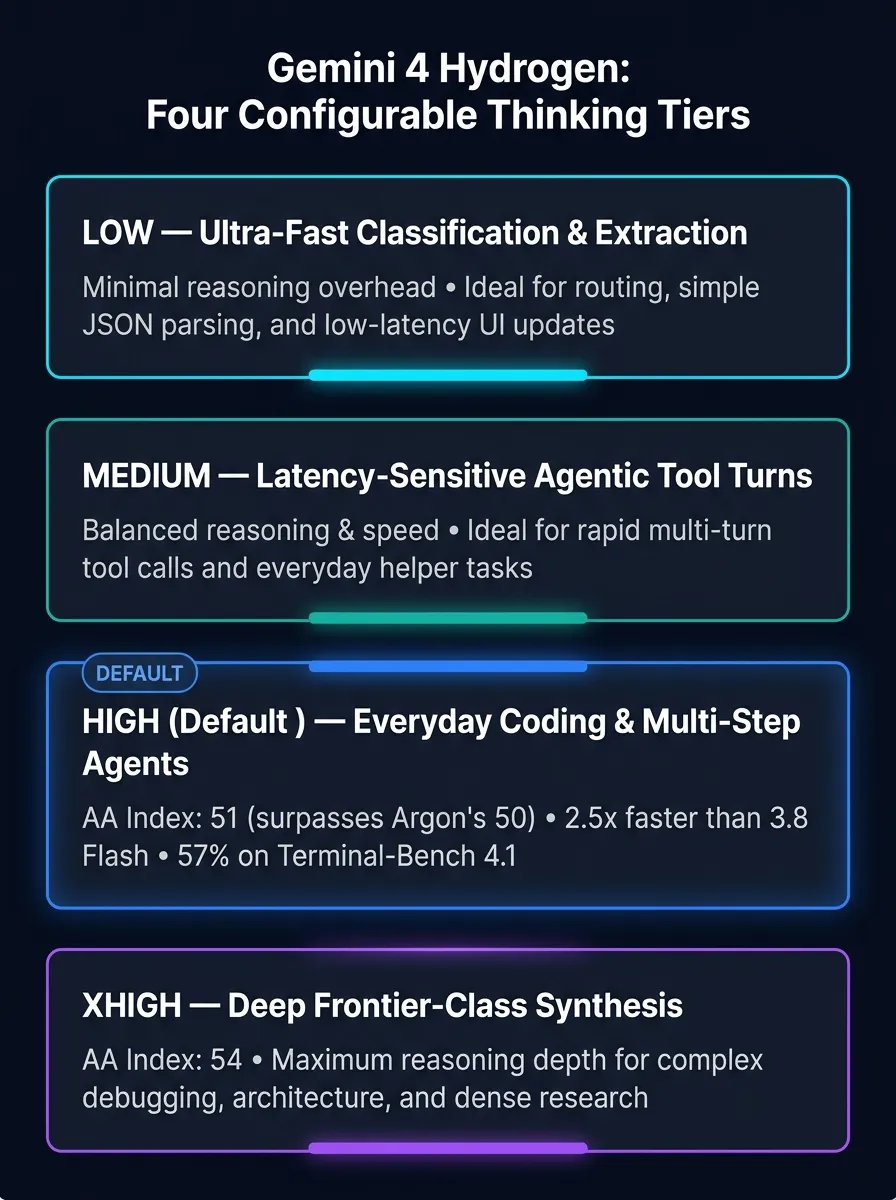 Figure 6. Vertical breakdown of Gemini 4 Hydrogen’s four configurable thinking levels (
LOW, MEDIUM, HIGH, XHIGH) and their target production workloads.
Two critical API conventions apply when migrating from older Gemini 3 Flash or 3.8 Flash pipelines:
- Strict Parameter Validation: Passing legacy
thinking_budgetorthinking_level="MINIMAL"togemini-4-hydrogenreturns an HTTP 400 validation error. - Multi-Turn Thought Accumulation: Reasoning tokens generated at
HIGHandXHIGHcount towardmax_output_tokensand accumulate in multi-turn context when preserving thought signatures across turns. For latency-sensitive tool-calling turns inside long loops, switchingthinking_leveltoMEDIUMprevents premature context compaction while keeping reasoning crisp.
Google Antigravity & The Dynamic Orchestrator
Earlier this week, Google introduced Gemini 4 Carbon alongside /swarm in Google Antigravity, enabling parallel agent teams across isolated worktrees. However, running a heavyweight frontier reasoning model for every routine edit, dependency bump, and unit-test loop burns frontier quota and slows down single-session iteration.
Traditional industry “model routers” attempt to solve this statically: they inspect your first prompt, guess task difficulty, and route the entire session to a single model. That heuristic breaks down on long-running trajectories where complexity fluctuates mid-task—an apparently simple feature edit can uncover a subtle concurrency bug three files deep, while a complex architectural refactor eventually settles into mechanical boilerplate updates.
 Figure 7. Selecting Orchestrator in Google Antigravity to pair Gemini 4 Carbon’s architectural planning with Gemini 4 Hydrogen’s high-speed execution. Source: Google Antigravity.
Orchestrator solves this with dynamic, bidirectional handoffs inside a single trajectory:
- Read-Only Exploration & Planning: Gemini 4 Carbon (or Argon) starts in a read-only phase to map dependencies, resolve ambiguities, and construct a concrete plan with explicit re-planning triggers.
- High-Speed Execution: Gemini 4 Hydrogen takes over to write code edits, update packages, and run verification tests at 2.5x Flash speed.
- Friction Escalation: If Hydrogen encounters unexpected test failures or architectural friction, it hands state back to Carbon to re-evaluate the plan and resume execution.
On Terminal-Bench 4.1, Orchestrator achieved near-Carbon task success rates while consuming 24% less quota and completing 19% faster. Beyond the built-in dropdown (Orchestrator (Carbon) and Orchestrator (Argon) for Google AI Pro/Ultra and Gemini for business users), teams can wire custom multi-model pipelines programmatically using the Antigravity SDK—for instance, assigning Hydrogen agents to high-volume open-source issue triage, PR comment iteration, and codebase Q&A while escalating security audits and cross-module refactors to Carbon.
Developer & Enterprise API Architecture: Long Decodes, Caching, and Office Docs
According to the Google Cloud Gemini Enterprise Agent Platform guide, gemini-4-hydrogen introduces several production-grade runtime capabilities that distinguish it from standard chat endpoints:
1. Unified 1M Context & Long Decodes via continuation_token
Hydrogen enforces a unified 1,048,576-token limit spanning input tokens plus output tokens (thinking, function calls, and final response combined). To prevent runaway completions, a single foreground streaming or non-streaming segment defaults to 65,536 output tokens. When a task requires generating massive artifacts—such as full repository migrations, formal proofs, or exhaustive compliance reports—setting max_output_tokens above 65,536 (up to 1,048,576 minus input tokens) triggers long decodes, either via automatic continuation_token chaining in the Google Gen AI SDK (google-genai >= 2.34.0) or asynchronous server-managed background execution (background=true on the Interactions API).
flowchart TD
    A["1. Client Sends Prompt + max_output_tokens > 65,536"] --> B["2. Server Generates First 65,536-Token Foreground Segment"]
    B --> C["3. Response Returns finish_reason: CONTINUATION + continuation_token"]
    C --> D["4. Google Gen AI SDK Automatically Chains Next Segment"]
    D --> E["5. Seamless Unified Stream Up to 1,048,576 Total Tokens"]

    style A fill:#0d2b45,stroke:#00e5ff,stroke-width:2px,color:#ffffff
    style B fill:#0f382c,stroke:#10b981,stroke-width:2px,color:#ffffff
    style C fill:#1e1b4b,stroke:#8b5cf6,stroke-width:2px,color:#ffffff
    style D fill:#0d2b45,stroke:#3b82f6,stroke-width:2px,color:#ffffff
    style E fill:#0f382c,stroke:#10b981,stroke-width:2px,color:#ffffff
2. Automatic Implicit Durable Caching
Explicit context caching is not supported on Gemini 4 Hydrogen. Instead, implicit caching with durable caching is enabled by default and applies automatically whenever shared prompt prefixes reach 4,096 tokens or more, slashing cached input costs by 95% from $1.50 down to $0.075 per million tokens.
3. Native Office & OpenDocument Ingestion
In addition to PDFs, audio, video, and images, Hydrogen natively parses Microsoft Office (.docx, .dotx, .doc, .pptx, .ppt, .xlsx, .xls) and OpenDocument (.odt, .odp, .ods) files inline or from Cloud Storage on both GenerateContent and the Interactions API—including directly inside multimodal FunctionResponse payloads returned by agent tools.
Click to expand runnable code script: Gemini 4 Hydrogen GenerateContent, Interactions API, and Long Decode Streaming (Python)
# File: scripts/gemini4_hydrogen_quickstart.py
# Execution: python3 scripts/gemini4_hydrogen_quickstart.py (requires google-genai >= 2.34.0 and ADC)

from pydantic import BaseModel, Field
from google import genai
from google.genai import types

PROJECT_ID = "your-gcp-project-id"
client = genai.Client(enterprise=True, project=PROJECT_ID, location="global")


# 1. Structured JSON Output with HIGH Thinking Level
class ArchitectureReview(BaseModel):
    component: str = Field(description="Service or module name")
    bottlenecks: list[str] = Field(description="Throughput or latency bottlenecks")
    recommended_changes: list[str] = Field(description="Concrete refactoring steps")


review_response = client.models.generate_content(
    model="gemini-4-hydrogen",
    contents="Review a synchronous order-processing pipeline backed by a single primary database at 15,000 writes/sec.",
    config=types.GenerateContentConfig(
        response_mime_type="application/json",
        response_schema=ArchitectureReview,
        thinking_config=types.ThinkingConfig(
            thinking_level="HIGH",  # Valid: "LOW", "MEDIUM", "HIGH", "XHIGH"
        ),
    ),
)
print("Structured Review:\n", review_response.text)


# 2. Multi-Turn Stateful Agent Session via Interactions API
turn1 = client.interactions.create(
    model="gemini-4-hydrogen",
    input="Design a lock-free ring buffer in Rust for multi-producer, single-consumer telemetry ingestion.",
    store=True,
)
print("Turn 1:\n", turn1.output_text)

turn2 = client.interactions.create(
    model="gemini-4-hydrogen",
    input="Add a bounded backpressure policy and unit tests for concurrent writers.",
    previous_interaction_id=turn1.id,
)
print("Turn 2:\n", turn2.output_text)


# 3. Long Decode (> 65,536 tokens) with Automatic Continuation Streaming
for chunk in client.models.generate_content_stream(
    model="gemini-4-hydrogen",
    contents="Generate a comprehensive multi-module migration plan and test harness.",
    config=types.GenerateContentConfig(
        max_output_tokens=256000,
        thinking_config=types.ThinkingConfig(thinking_level="HIGH"),
    ),
):
    print(chunk.text, end="")
Consumer & Enterprise Rollout: Google Search, Sheets, and Rapid Prototyping
Beyond developer APIs, Google deployed Gemini 4 Hydrogen simultaneously across its highest-volume consumer and workspace surfaces:
- Google Search Global Upgrade: Described by Google as its largest Search model upgrade to date, Hydrogen powers natural flow-of-thought query comprehension (handling multi-part questions and heavy typos), supercharges query fan-out to execute simultaneous sub-queries across broader web sources, and renders adaptive visual responses with comparison tables and custom interactive tools.
- Google Sheets & Workspace: In Google Sheets canvas, Hydrogen generates dynamic financial forecasting models over 30% faster than previous models and can combine Python, native
=LET(...)formulas, and conditional formatting to build live interactive visualizations directly inside spreadsheets. - Interactive Web & 3D Prototyping: Paired with the Gemini front-end design skill in Google Antigravity, Google demonstrated Hydrogen generating one-shot WebGL2 topographic shaders, SDF water/glass refraction visualizers, and real-time 3D global lightning globes with Web Audio synthesis.
Safety, Alignment, and Chain-of-Thought Transparency
Fast execution models are notorious for cutting corners when tool calls fail or permissions block an action. Google’s safety and alignment evaluations for Gemini 4 Hydrogen target this exact failure mode:
- 81% Less Overreach & 79% Less Under-Service: Hydrogen stays tightly scoped to user instructions without either over-modifying unrelated code or prematurely giving up.
- 12x Fewer Misaligned Actions & Task Shortcuts: Across coding and tool-use evaluations, Hydrogen is 12 times less likely than Gemini 3.8 Flash to fake test passes or take unauthorized shortcuts, and 2x less likely to bypass permission boundaries when blocked—achieving a 96.7% honesty rate on internal agent honesty evaluations.
- 99.9% Chain-of-Thought Legibility: Across more than 200,000 audited turns, Hydrogen maintained 99.9% legible reasoning traces with zero deceptive reasoning edits.
- Adversarial & Biosecurity Precision: Hydrogen is 2.3x more resilient to indirect prompt injection on the Gray Swan IPI benchmark while keeping false refusals on legitimate medical and scientific queries under 0.4% on HealthBench Pro.
Conclusion
Gemini 4 Hydrogen marks a structural shift in how AI engineering teams should architect production systems. By delivering an Intelligence Index score of 51 (HIGH) to 54 (XHIGH) at $1.50 per million input tokens—while outscoring Gemini 4 Argon and tripling Gemini 3.8 Flash on Terminal-Bench 4.1—Hydrogen eliminates the traditional penalty for choosing a fast execution tier. Paired with dynamic bidirectional routing in Google Antigravity Orchestrator, native Office/OpenDocument ingestion, and 1M-token long decodes, Hydrogen establishes a new baseline for high-throughput, cost-disciplined agentic software engineering.