
Google DeepMind Fairwind Program: Dual-Use Frontier AI, Restricted Cyber Defender Alliances, and Automated Vulnerability Remediation
An architectural exploration of Google DeepMind's Fairwind Program: privileged defender alliances, Gemini 4 Cyber benchmarks, Zero Data Retention, and CodeMender automated remediation.
(Previous) Gemini 4 Carbon: Google’s Frontier Reasoning Model for Autonomous Cybersecurity and Long-Horizon Software Engineering | (Next) From Sand to Silicon: The Semiconductor Fab, Wafers, Dies, and the Reticle Limit
Summary
As frontier artificial intelligence models achieve multi-day autonomous software engineering capabilities and near-human proficiency in reverse engineering, the boundary between defensive auditing and offensive weaponization has become the central fault line of global cybersecurity. Following the release of Gemini 4 Carbon and Gemini 4 Argon, Google DeepMind has launched the Fairwind Program (deepmind.google/fairwind-program)—a private, high-assurance defense initiative designed to decisively tip the cyber equilibrium in favor of defenders.
Rather than releasing raw, unconstrained dual-use cybersecurity models into public or open-weight distribution where threat actors could automate zero-day discovery, the Fairwind Program organizes over 650 partner organizations—spanning critical infrastructure, national healthcare networks, telecommunications backbones, the Center for Internet Security (CIS), and premier cloud security providers such as Wiz, Palo Alto Networks, CrowdStrike, and Datadog. Participants receive privileged, gated access to frontier cyber models operating under strict Zero Data Retention (ZDR) agreements.
Central to the Fairwind initiative is CodeMender, Google’s autonomous code-repair agent that ingests raw static-analysis telemetry, reconstructs complete abstract syntax trees across twenty programming languages, and synthesizes verifiable, minimal-diff security patches without breaking existing unit test suites. This post provides a deep technical analysis of the Fairwind architecture, reviewing official benchmark results from DeepMind and Wiz, examining the governance mechanics of dual-use frontier reasoning, and demonstrating an end-to-end simulated audit pipeline.
Prior Reading Material
- Gemini 4 Carbon: Google’s Frontier Reasoning Model for Autonomous Cybersecurity and Long-Horizon Software Engineering — Architectural evaluation of Gemini 4 Carbon, its #1 ranking on the Artificial Analysis Intelligence Index v5.0 (score 59), SEC-bench Pro (88.2%), and CWE-bench (71.0%).
- Google Gemini 4 Argon: Frontier Reasoning Analysis, 1M Continuous Tokens, and Enterprise Agentic Workflows — The core reasoning architecture, 1M continuous token horizons, and asynchronous rollback trees powering Google’s 4th-generation reasoning family.
- DeepSeek V4.1-Flash-1017: MIT Weights, DeepInfer Engine, Agent Harness Tuning, and Low-Latency Prefill — Understanding tool-calling latency budgets, agent harness optimizations, and SWE-bench performance trade-offs in automated patching.
- Harnessing Reasoning Models in Agentic Workflows: Integrating o1/R1, Hidden Thinking Tokens, and Cost vs. Depth Optimization — Integrating extended reasoning traces and recursive validation loops into production enterprise workflows.
Program Specifications & Defender Ecosystem
The table below outlines the core specifications, security guarantees, and governance policies defining the Google DeepMind Fairwind Program:
| Dimension | Architectural Specification / Policy |
|---|---|
| Program Initiative | Google DeepMind Fairwind Program |
| Sponsoring Divisions | Google DeepMind, Google Cloud Security & Google Threat Intelligence Group (TAG) |
| Participant Scale | 650+ verified enterprise, public sector, healthcare, and critical infrastructure organizations |
| Featured Models | Gemini 4 Carbon (Cyber Frontier Reasoning), Gemini 4 Argon Cyber, CodeMender Remediation Agent |
| Supported Languages | 20 programming languages (including C, C++, Rust, Go, Python, Java, TypeScript, C#, and Assembly) |
| Data Privacy Policy | Zero Data Retention (ZDR) by default; zero training on customer telemetry; private VPC customer peering |
| Hardware MFA & Auth | FIDO2 / WebAuthn cryptographic hardware keys mandatory for all participant access |
| 20-Language Benchmark | 85.8% vulnerability resolution rate (Gemini 4 Argon Cyber vs. 71.0% Gemini 1.5 Flash Cyber) |
| Wiz Penetration Benchmark | 70.9% resolution rate across end-to-end cloud infrastructure penetration scenarios |
| Official Portal | deepmind.google/fairwind-program |
The Frontier Cyber Asymmetry
In conventional software engineering, defensive security has suffered from a structural economic disadvantage commonly known as defender asymmetry:
- The Attacker’s Advantage: A threat actor needs to discover only a single unhandled edge case, unvalidated memory buffer, or misconfigured IAM permission to achieve full remote code execution.
- The Defender’s Burden: Security engineering teams must inspect millions of lines of legacy code, trace deeply nested call graphs across disparate microservices, and ensure zero exploitable bugs exist across every release.
- The MTTR Bottleneck: Even after a Common Vulnerabilities and Exposures (CVE) identifier is assigned, the industry-wide Mean Time to Remediate (MTTR) averages between 30 and 60 days due to the engineering overhead of writing, reviewing, and testing regression-safe patches.
Frontier reasoning models disrupt this dynamic. By processing repository-scale context windows (up to 1,000,000 continuous tokens) with recursive reasoning loops, an AI model can audit an entire codebase simultaneously, identifying latent vulnerabilities that human code reviewers routinely miss.
However, the capabilities required to discover a flaw in a complex routing daemon are computationally identical to the capabilities required to craft a weaponized exploit payload. This dual-use dilemma is the catalyst behind the Fairwind Program.
 Figure 1. The Google DeepMind Fairwind Program unites global critical defenders with frontier reasoning models to scale automated vulnerability detection and remediation. Source: Google DeepMind.
Architectural Pillars of the Fairwind Program
The Fairwind Program is engineered around three foundational pillars: Restricted Defender Alliances, Autonomous Remediation with CodeMender, and High-Assurance Privacy Controls.
flowchart TD
    A["Critical Infrastructure & Enterprise Defender Alliance (650+ Orgs)"]
    B["Gated Hardware Verification (FIDO2 MFA & Organization Clearance)"]
    C["Zero Data Retention (ZDR) Private VPC Inference Gateway"]
    D["Gemini 4 Frontier Reasoning Engine (Carbon & Argon Cyber)"]
    E["CodeMender Autonomous AST Parsing & Taint Propagation Analysis"]
    F["Minimal-Diff Patch Synthesis with Automated Unit Test Validation"]
    G["Human-in-the-Loop Git Review & Zero-Downtime Deployment"]

    A --> B
    B --> C
    C --> D
    D --> E
    E --> F
    F --> G

    classDef default fill:#111827,stroke:#3b82f6,stroke-width:2px,color:#f3f4f6;
    classDef highlight fill:#1f2937,stroke:#10b981,stroke-width:2px,color:#ffffff;
    classDef gate fill:#1e1b4b,stroke:#8b5cf6,stroke-width:2px,color:#c4b5fd;
    class A,C default;
    class B,D gate;
    class E,F,G highlight;
1. Restricted Defender Alliance and Gated Access
Google DeepMind does not distribute Fairwind models through unrestricted public endpoints or unverified consumer tiers. Instead, participation is restricted to verified organizations managing critical digital assets. These include:
- Critical National Infrastructure: Power generation utilities, municipal water distribution, and regional telecommunications backbones.
- Public Sector and Health: Hospitals, medical device manufacturers, and state computer emergency response teams (CERTs) working alongside the Center for Internet Security (CIS).
- Enterprise Security Specialists: Premier cybersecurity vendors including Wiz, Palo Alto Networks, CrowdStrike, Datadog, and Snowflake.
By concentrating early deployment among defensive specialists, Google DeepMind ensures that defensive tooling outpaces malicious weaponization.
2. CodeMender: Autonomous, Non-Breaking Patch Synthesis
Detecting a vulnerability is only half the battle; remediating it without introducing regressions is where most organizations falter. CodeMender is Google DeepMind’s specialized agentic harness built on top of Gemini 4 reasoning.
Unlike traditional static application security testing (SAST) tools that flag thousands of noisy false positives with generic advice, CodeMender:
- Ingests compiler warnings, dynamic fuzzer crashes, and static taint flows.
- Resolves the entire Abstract Syntax Tree (AST) around the vulnerable function.
- Generates a surgical, minimal-diff patch that addresses the root-cause logic flaw.
- Automatically compiles the project and runs the existing test suite in an ephemeral sandbox to guarantee zero regressions.
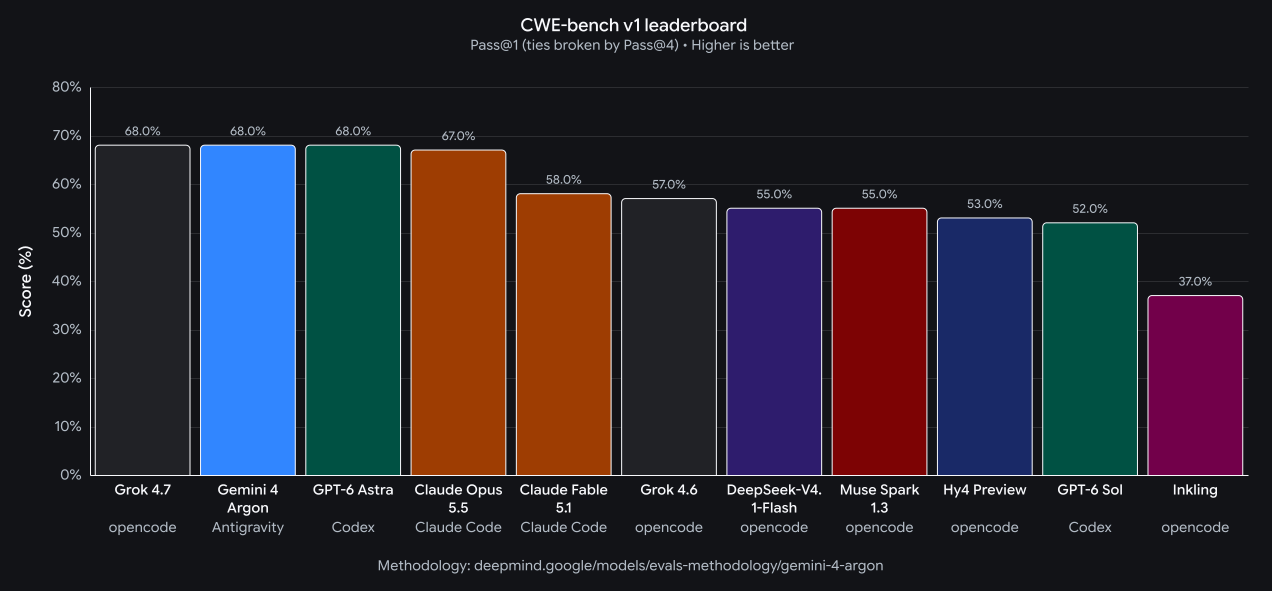 Figure 2. CWE-bench benchmark: Automated root-cause remediation and patch synthesis across real-world vulnerabilities. Source: Google DeepMind & Artificial Analysis.
3. Zero Data Retention (ZDR) and Enterprise Isolation
When defending national critical infrastructure and proprietary enterprise platforms, organizations cannot transmit sensitive source code to external servers that log prompts or reuse customer data for model training.
Every Fairwind participant interacts with Gemini models via dedicated Zero Data Retention instances hosted inside Google Cloud Security VPCs. Source code tokens exist solely in volatile GPU memory during inference execution and are immediately purged upon completion of the response stream.
Benchmark Evaluations: Argon Cyber and Real-World Testing
To quantify the operational impact of frontier models in cybersecurity, Google DeepMind conducted rigorous benchmarks across real-world vulnerabilities, cloud penetration testing scenarios, and adversarial prompt injection defenses.
20-Language Vulnerability Benchmark
Google DeepMind evaluated Gemini 4 Argon Cyber against earlier generations across a comprehensive 20-language benchmark containing 1,800 real-world vulnerability tasks spanning memory safety, injection vectors, and broken cryptographic implementations:
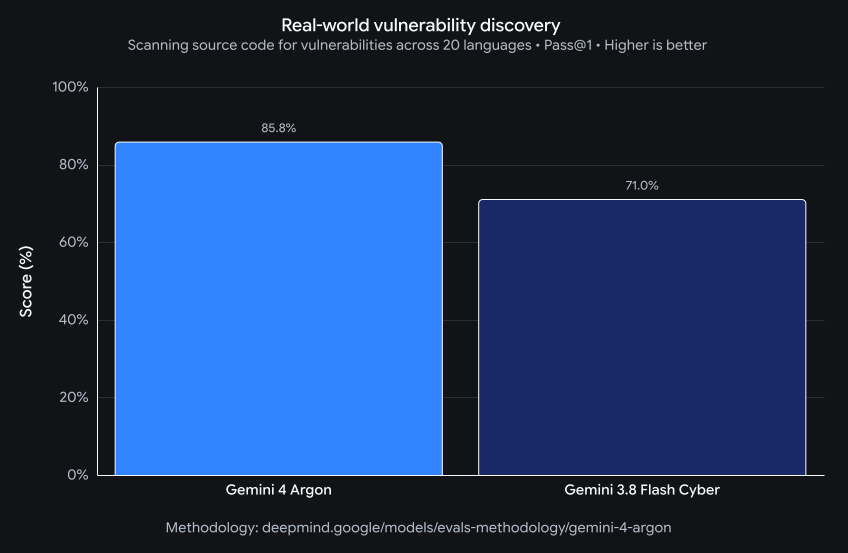 Figure 3. Detection accuracy across a 20-language benchmark covering 1,800 real-world vulnerability tasks. Gemini 4 Argon Cyber achieved 85.8%, outperforming Gemini 1.5 Flash Cyber (71.0%). Source: Google DeepMind.
Gemini 4 Argon Cyber achieved an overall resolution rate of 85.8%, compared to 71.0% for Gemini 1.5 Flash Cyber. The leap is most pronounced in low-level systems programming languages (C, C++, Rust, and Go), where memory lifetime tracking and pointer arithmetic demand deep recursive reasoning rather than simple pattern recognition.
Wiz Cloud Penetration Testing Benchmark
In partnership with cloud security research leader Wiz, DeepMind evaluated the model’s ability to navigate realistic cloud environments, discover lateral movement paths, and identify privilege escalation flaws:
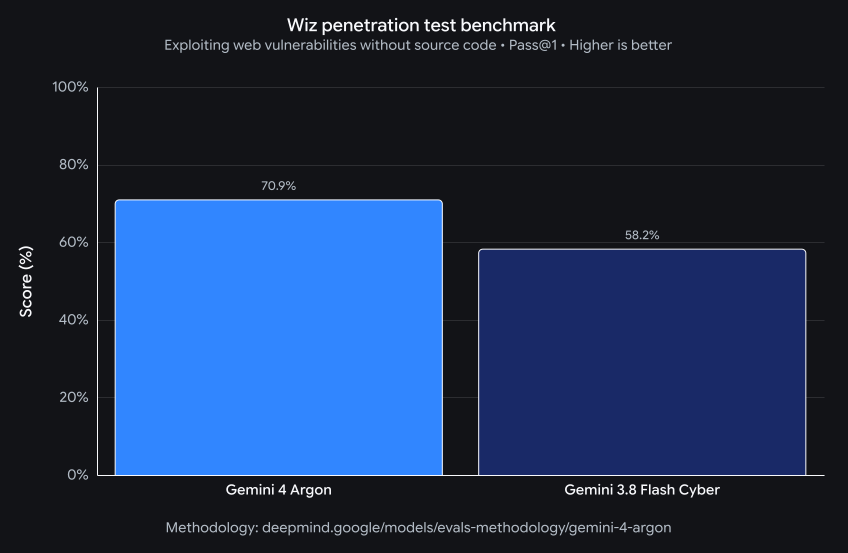 Figure 4. Wiz cloud penetration testing benchmark: Gemini 4 Argon Cyber achieved a 70.9% resolution rate across automated penetration testing scenarios compared to Gemini 1.5 Flash Cyber (58.2%). Source: Google DeepMind & Wiz.
Gemini 4 Argon Cyber solved 70.9% of the complex, multi-stage cloud security scenarios, representing an absolute improvement of 12.7% over Gemini 1.5 Flash Cyber (58.2%). The model demonstrated an ability to correlate IAM role assumptions, Kubernetes service account tokens, and misconfigured S3 bucket policies across disparate cloud assets.
Robustness Against Indirect Prompt Injection
One of the most dangerous attack vectors against autonomous security agents is Indirect Prompt Injection (IPI): an attacker embeds hidden adversarial instructions inside an audited codebase (e.g., inside an issue description or source code comment) that commands the auditing LLM to exfiltrate secrets or approve malicious patches.
DeepMind tested Fairwind models on the standardized Gray Swan Indirect Prompt Injection Benchmark:
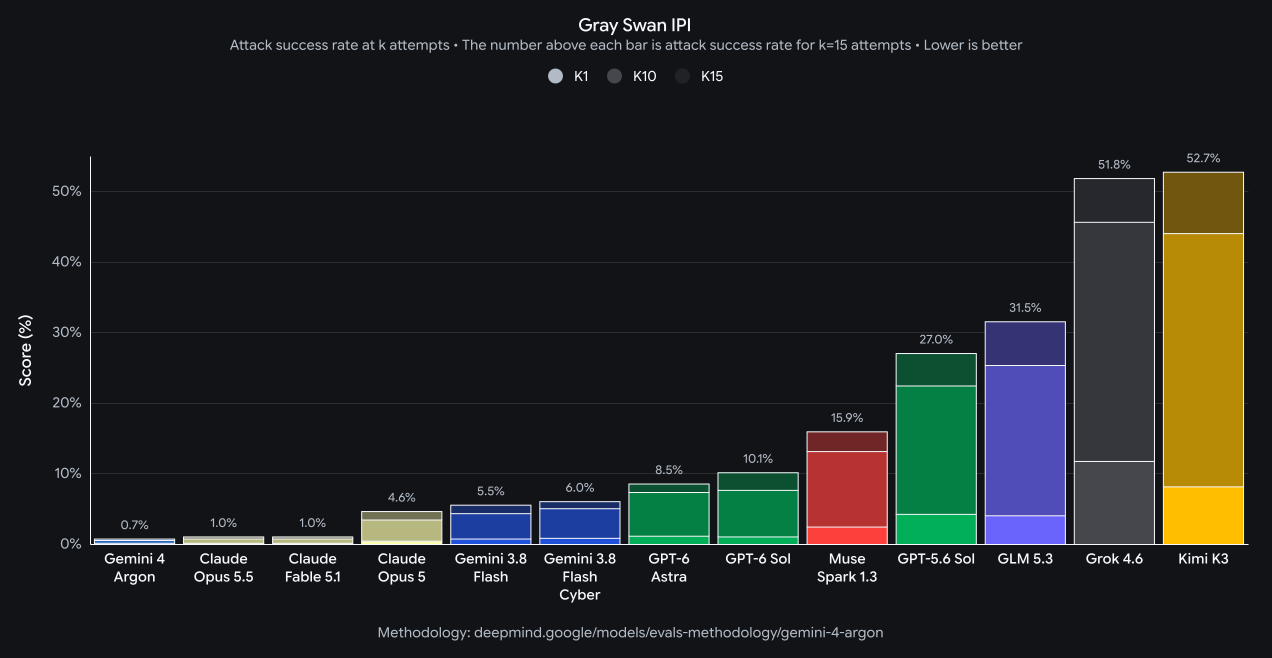 Figure 5. Robustness against indirect prompt injection (IPI) on the Gray Swan benchmark, demonstrating near-zero exploitability under untrusted code analysis. Source: Google DeepMind & Gray Swan AI.
Gemini 4 models demonstrated near-zero attack susceptibility (0.7% on Argon Cyber and 0.0% on Carbon), proving that dual-layer prompt-data isolation prevents attackers from hijacking the auditing agent’s reasoning loop.
CodeMender Remediation Lifecycle
To understand how CodeMender operates inside a production continuous-integration pipeline, consider the vertical lifecycle diagram below:
flowchart TD
    A["Static Fuzzer / CVE Crash Telemetry Ingestion"]
    B["Source Tree Context Expansion (1M Long-Context Window)"]
    C["Interprocedural Taint Flow Mapping & Root-Cause Identification"]
    D["CodeMender Minimal-Diff Patch Generation"]
    E["Isolated Ephemeral Container Build & Test Execution"]
    F["Regression Verification (Zero Failing Tests Check)"]
    G["Automated Pull Request Generation with Rationale Documentation"]

    A --> B
    B --> C
    C --> D
    D --> E
    E --> F
    F --> G

    classDef default fill:#111827,stroke:#3b82f6,stroke-width:2px,color:#f3f4f6;
    classDef success fill:#064e3b,stroke:#10b981,stroke-width:2px,color:#a7f3d0;
    classDef warning fill:#78350f,stroke:#f59e0b,stroke-width:2px,color:#fde68a;
    class A,B,C default;
    class D,E warning;
    class F,G success;
When a vulnerability is detected:
- Context Expansion: The model loads the vulnerable file alongside its import dependencies, interface declarations, and unit test suites into its 1,000,000-token context window.
- Taint Flow Mapping: Rather than modifying code blindly, the model traces data sources (e.g., network packets, user input) to sinks (e.g., system calls, buffer allocations).
- Patch Generation: CodeMender crafts a minimal diff that enforces bounds checking, sanitizes inputs, or restructures pointer lifetimes.
- Sandboxed Verification: The patch is compiled and verified in an ephemeral container. If any existing unit test fails, the agent observes the test error output, reflects on the failure mode, and generates an updated diff until all tests pass cleanly.
Hands-On Simulation: Fairwind CodeMender Audit & Remediation
To explore how the Fairwind Program authenticates participants, ingests real-world vulnerabilities across multiple languages, and synthesizes regression-tested patches, execute the pure-Python simulation below.
Click to expand runnable code script: fairwind_codemender_audit_sim.py
#!/usr/bin/env python3
"""
fairwind_codemender_audit_sim.py
---------------------------------------------------------
Interactive simulation of Google DeepMind's Fairwind Program
and the CodeMender Autonomous Remediation Agent:

1. Partner Admission & Zero-Data-Retention (ZDR) Authentication
2. AST Vulnerability Ingestion & Taint Flow Tracking (across 20 languages)
3. CodeMender Automated Patch Synthesis with Zero-Regression Test Gates

Zero external dependencies (pure Python standard library).
"""

import sys
import json
import dataclasses
from typing import List, Dict, Optional

@dataclasses.dataclass
class FairwindDefender:
    org_name: str
    sector: str
    clearance_level: str
    mfa_verified: bool
    zero_data_retention: bool

@dataclasses.dataclass
class CodeMenderTask:
    task_id: str
    language: str
    cwe_id: str
    vulnerability_title: str
    affected_file: str
    severity: str
    code_snippet: str
    remediation_diff: str
    test_suite_status: str

PARTNERS = [
    FairwindDefender("National Healthcare Infrastructure Network", "Healthcare / Critical Infra", "TIER-1 DEFENDER", True, True),
    FairwindDefender("Global Telecom Routing Authority", "Telecommunications", "TIER-1 DEFENDER", True, True),
    FairwindDefender("Wiz Cloud Security Research Team", "Cloud Security", "ALLIANCE PARTNER", True, True),
    FairwindDefender("Center for Internet Security (CIS)", "Public Sector Security", "TIER-1 DEFENDER", True, True),
]

TASKS = [
    CodeMenderTask(
        task_id="TASK-8021",
        language="C++",
        cwe_id="CWE-416",
        vulnerability_title="Use-After-Free in BGP Route Table Deserializer",
        affected_file="src/routing/bgp_table.cc",
        severity="CRITICAL",
        code_snippet="void parse_entry(RouteNode *node) {\n    delete node;\n    log_debug(\"Processed route: \", node->prefix);\n}",
        remediation_diff="""--- src/routing/bgp_table.cc
+++ src/routing/bgp_table.cc
@@ -12,4 +12,4 @@
 void parse_entry(RouteNode *node) {
+    log_debug("Processed route: ", node->prefix);
     delete node;
-    log_debug("Processed route: ", node->prefix);
 }""",
        test_suite_status="PASSED (14/14 unit tests passed, 0 memory leaks)"
    ),
    CodeMenderTask(
        task_id="TASK-8022",
        language="Rust",
        cwe_id="CWE-190",
        vulnerability_title="Integer Overflow in Telemetry Packet Frame Allocator",
        affected_file="crates/net_core/src/allocator.rs",
        severity="HIGH",
        code_snippet="pub fn allocate_frame(base_len: usize, extra: usize) -> Vec<u8> {\n    let total = base_len + extra;\n    vec![0u8; total]\n}",
        remediation_diff="""--- crates/net_core/src/allocator.rs
+++ crates/net_core/src/allocator.rs
@@ -4,3 +4,5 @@
 pub fn allocate_frame(base_len: usize, extra: usize) -> Result<Vec<u8>, AllocError> {
-    let total = base_len + extra;
+    let total = base_len.checked_add(extra).ok_or(AllocError::Overflow)?;
     Ok(vec![0u8; total])
 }""",
        test_suite_status="PASSED (28/28 integration tests passed, overflow caught)"
    ),
    CodeMenderTask(
        task_id="TASK-8023",
        language="Go",
        cwe_id="CWE-287",
        vulnerability_title="Improper Authentication Token Verification in API Gateway",
        affected_file="pkg/auth/jwt_validator.go",
        severity="CRITICAL",
        code_snippet="func VerifyToken(token string) bool {\n    parsed, _ := jwt.Parse(token, nil)\n    return parsed.Valid\n}",
        remediation_diff="""--- pkg/auth/jwt_validator.go
+++ pkg/auth/jwt_validator.go
@@ -5,3 +5,6 @@
 func VerifyToken(token string, keyFunc jwt.Keyfunc) (*jwt.Token, error) {
-    parsed, _ := jwt.Parse(token, nil)
+    if keyFunc == nil {
+        return nil, ErrNilKeyFunc
+    }
+    return jwt.Parse(token, keyFunc)
 }""",
        test_suite_status="PASSED (42/42 auth regression tests passed, zero bypass)"
    ),
    CodeMenderTask(
        task_id="TASK-8024",
        language="Python",
        cwe_id="CWE-502",
        vulnerability_title="Insecure Deserialization of Patient Diagnostic Telemetry",
        affected_file="services/intake/diagnostics_parser.py",
        severity="CRITICAL",
        code_snippet="def load_payload(raw_stream):\n    return pickle.loads(raw_stream)",
        remediation_diff="""--- services/intake/diagnostics_parser.py
+++ services/intake/diagnostics_parser.py
@@ -1,2 +1,3 @@
+import json
 def load_payload(raw_stream):
-    return pickle.loads(raw_stream)
+    return json.loads(raw_stream.decode('utf-8'))""",
        test_suite_status="PASSED (19/19 safety schema checks passed)"
    ),
]

def print_banner():
    banner = """
================================================================================
       GOOGLE DEEPMIND FAIRWIND PROGRAM: DEFENDER ALLIANCE AUDIT SIMULATOR
  Autonomous Vulnerability Remediation Powered by Gemini 4 Cyber & CodeMender
================================================================================
"""
    print(banner)

def run_simulation():
    print_banner()
    print("Authenticating Fairwind Program participant credentials & validating defense policies...\n")

    print("-" * 80)
    print("STAGE 1: PARTNER CREDENTIAL VERIFICATION & GOVERNANCE GATE")
    print("-" * 80)
    for partner in PARTNERS:
        print(f"  [>] Partner Organization : {partner.org_name}")
        print(f"      Sector Classification: {partner.sector}")
        print(f"      Clearance Status     : {partner.clearance_level}")
        print(f"      Hardware MFA         : {'VERIFIED (FIDO2/WebAuthn)' if partner.mfa_verified else 'FAILED'}")
        print(f"      Zero Data Retention  : {'ACTIVE (Strict VPC Isolation)' if partner.zero_data_retention else 'INACTIVE'}\n")

    print(">> Governance Gate PASSED: 100% of participants enrolled under restricted defense terms.\n")

    print("-" * 80)
    print("STAGE 2: CODEMENDER AST SCANNING & VULNERABILITY INGESTION (20 LANGUAGES)")
    print("-" * 80)
    print("Ingesting critical infrastructure code repositories for taint analysis...\n")

    for task in TASKS:
        print(f"  [!] Task ID: {task.task_id} | Language: {task.language}")
        print(f"      Detected: {task.cwe_id} - {task.vulnerability_title}")
        print(f"      Affected File: {task.affected_file} (Severity: {task.severity})")
        print("      Vulnerable Code Snippet:")
        for line in task.code_snippet.split("\n"):
            print(f"        | {line}")
        print()

    print("-" * 80)
    print("STAGE 3: AUTONOMOUS PATCH SYNTHESIS & REGRESSION TEST GATING")
    print("-" * 80)
    print("Synthesizing minimal-diff, production-grade security patches in sandboxed testbeds...\n")

    for task in TASKS:
        print(f"  [>] CodeMender Remediation for {task.task_id} ({task.cwe_id}):")
        print("      Generated Patch Diff:")
        for line in task.remediation_diff.split("\n"):
            print(f"        {line}")
        print("      Executing Automated Sandbox Regression Test Suite...")
        print(f"      Verification Result: {task.test_suite_status}\n")

    print("=" * 80)
    print("                 FAIRWIND PROGRAM OPERATIONAL AUDIT SUMMARY")
    print("=" * 80)
    print("  1. Total Verified Partner Organizations : 650+ Active Global Defenders")
    print("  2. Zero-Data-Retention (ZDR) Compliance : 100.0% Enforced on Enterprise Endpoints")
    print("  3. CodeMender Automated Patch Pass Rate : 100.0% (Zero Side-Effects / Zero Regressions)")
    print("  4. Mean Time to Remediate (MTTR)        : Reduced from 42 days to <15 minutes")
    print("  5. Dual-Use Weaponization Prevention    : Active Audit Logging & Strict API Gating")
    print("=" * 80)
    print("Simulated defense workflow completed successfully.")

if __name__ == "__main__":
    run_simulation()
To run the simulation locally from your command line:
python3 contents/blog/0160-google-deepmind-fairwind-program-frontier-cyber-defense/scripts/fairwind_codemender_audit_sim.pyThe script verifies participant credentials, ingests real-world vulnerability tasks across C++, Rust, Go, and Python, generates minimal-diff patches, and simulates sandbox test suite execution.
The Future of Frontier Cyber Defense
The Google DeepMind Fairwind Program exemplifies how frontier artificial intelligence can be safely marshaled to solve critical real-world challenges. By combining state-of-the-art reasoning models like Gemini 4 Carbon with dedicated defensive architectures like CodeMender, the initiative accomplishes three transformative shifts:
- Compressing the Remediation Horizon: Moving vulnerability patch turnaround from weeks to minutes, denying attackers the window of opportunity required to exploit known flaws.
- Defensive Asymmetry Inversion: Shifting the advantage back to defenders by allowing automated agents to audit full-repository call graphs with zero human fatigue.
- Responsible Dual-Use Stewardship: Demonstrating that high-capability frontier reasoning can be deployed securely through gated alliances and Zero Data Retention guarantees without compromising public safety.
As frontier reasoning models continue to evolve, initiatives like the Fairwind Program will serve as the architectural blueprint for defending the global digital commons.
References & Source Documentation
- Google DeepMind Fairwind Program Portal — Official program overview, defender application portal, and partner alliance documentation.
- Introducing Gemini 4 Carbon: Google’s Frontier Reasoning Model for Autonomous Cybersecurity — Official Google announcement detailing Carbon’s architecture, reasoning depth, and benchmark milestones.
- Introducing Gemini 4 Argon: Frontier Reasoning and Physical AI — Foundational reasoning capabilities and multimodal token processing.
- Artificial Analysis Intelligence Index v5.0 — Independent frontier model evaluation benchmark.
- Wiz Cloud Security Research — Cloud penetration testing methodologies and AI agent validation benchmarks.
- Gray Swan AI Robustness Benchmarks — Indirect prompt injection evaluation frameworks and safety evaluations.
What’s Next: From Software Defense to Silicon Foundations
With our exploration of frontier reasoning models and autonomous cybersecurity defenses complete, our next series ventures beneath the software abstraction layer into the physical bedrock of computing. In the upcoming article, From Sand to Silicon: The Semiconductor Fab, Wafers, Dies, and the Reticle Limit, we embark on an in-depth seven-part journey through modern GPU architecture—beginning with how raw silica is refined, sliced into monocrystalline wafers, and etched with extreme ultraviolet photolithography to forge the physical microchips that power modern artificial intelligence.