
DeepSeek GRPO Deep-Dive: Group Relative Policy Optimization and Rule-Based RL
How DeepSeek eliminated the critic model and revolutionized post-training reasoning with Group Relative Policy Optimization (GRPO) and rule-based reward verification.
Series: ← VectorDB Architectures for Offline RAG: ChromaDB, Qdrant, Milvus, and SQLite-vec (Previous)
Summary
The emergence of frontier reasoning models like DeepSeek-R1 and DeepSeek-V3 was driven by Group Relative Policy Optimization (GRPO). By discarding the massive neural Critic network of traditional PPO, GRPO cuts reinforcement learning memory overhead in half while aligning reasoning tokens through rule-based verifiers.
Hugging Face / Official Model Card Summary
| Specification | DeepSeek-R1 (Full) | DeepSeek-R1-Distill-Qwen (32B) | DeepSeek-V3 (Base) |
|---|---|---|---|
| Model Repository | deepseek-ai/DeepSeek-R1 | deepseek-ai/DeepSeek-R1-Distill-Qwen-32B | deepseek-ai/DeepSeek-V3 |
| Total Parameters | 671 Billion (MoE) | 32.5 Billion (Dense) | 671 Billion (MoE) |
| Active Parameters | 37 Billion per token | 32.5 Billion per token | 37 Billion per token |
| Post-Training RL | GRPO (Critic-less RL) | Supervised Fine-Tuning (SFT) | GRPO + FP8 Mixed Precision |
| Context Window | 128k Tokens | 128k Tokens | 128k Tokens |
| Reward Verification | Rule-Based (Math & Compiler) | Distilled Reasoning Traces | Rule-Based & Format Verifiers |
| License | MIT License (Fully Open) | MIT License (Fully Open) | MIT License (Fully Open) |
Prior Reading Material
Before exploring Group Relative Policy Optimization and critic-less mathematical alignment, review our foundational posts on reasoning architectures, local MoE serving, and vector retrieval:
- VectorDB Architectures for Offline RAG: ChromaDB, Qdrant, Milvus, and SQLite-vec — High-dimensional vector retrieval, HNSW graph search, and Product Quantization.
- Deep-Dive: Zhipu AI’s GLM-5 and Local Open-Weight MoE Serving — Mixture-of-Experts routing, DeepSeek-style Multi-head Latent Attention (MLA), and vLLM serving.
- Hands-On Guide: Connecting Google Antigravity & Gemini CLI to OpenClaw — Multi-agent tool execution and autonomous workspace loops.
The Story: The Classroom Without a Teacher
Imagine a graduate mathematics classroom with thirty doctoral students.
Under the traditional approach to reinforcement learning—Proximal Policy Optimization (PPO)—the university must employ a dedicated, omniscient professor (the Critic / Value Model $V_\phi$) to stand next to every single student. For every pencil stroke, the professor must estimate the expected future grade of the student: “Writing line 3 gives you an expected value of 0.74; erasing line 4 drops your value to 0.61”.
This Critic model is not lightweight. In state-of-the-art LLM post-training, the Critic must be a neural network of the exact same parameter size as the generator model. If your generator is a 671B MoE network, your Critic is another 671B MoE network!
During distributed training across thousands of GPUs, half of your compute clusters and hundreds of gigabytes of precious VRAM are occupied solely by maintaining the Critic model’s weights, optimizer states, and forward passes.
DeepSeek’s researchers asked a radical question:
What if we fire the professor entirely?
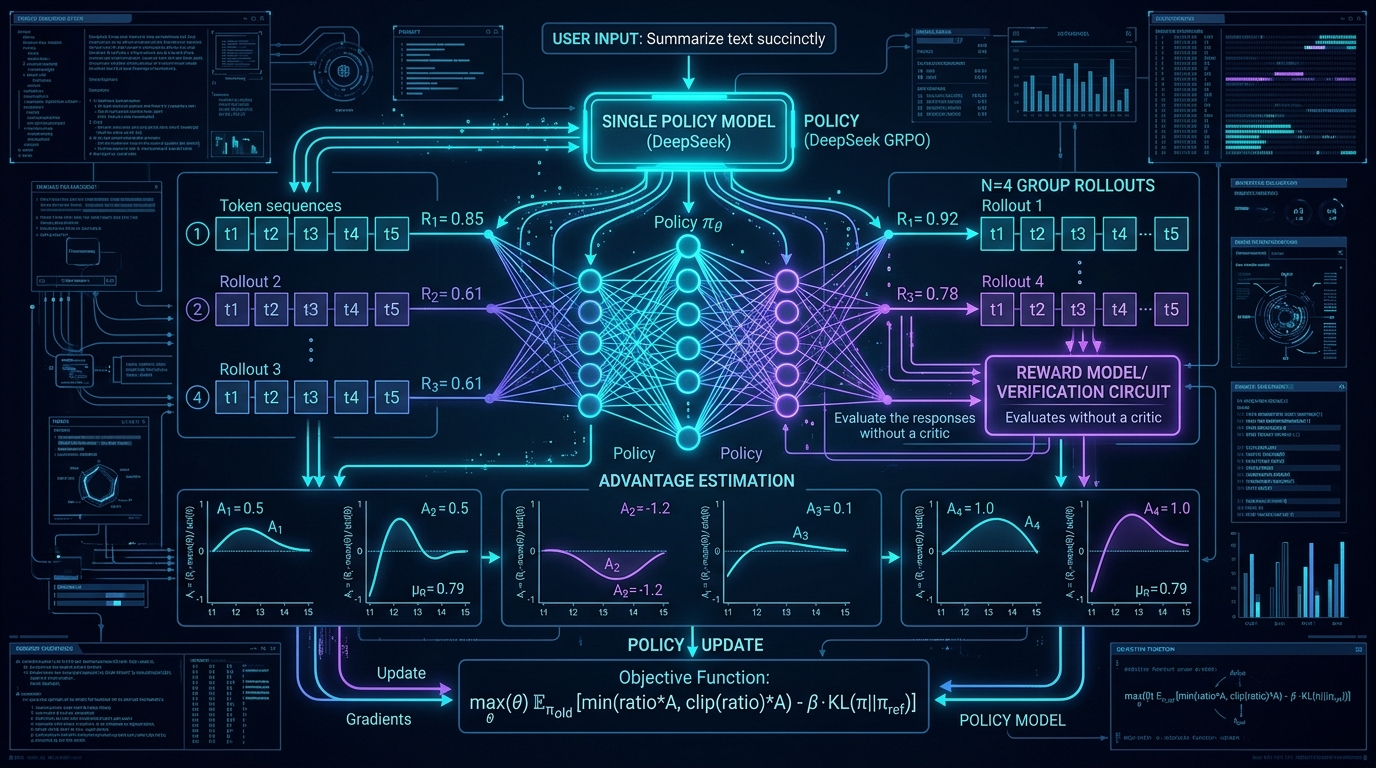
Instead of an omniscient critic guessing intermediate values, let a student tackle a hard problem four times independently, producing four distinct candidate derivations ${o_1, o_2, o_3, o_4}$.
Then, run each solution through a strict, deterministic rule:
- Did the Python compiler execute the generated code without syntax errors?
- Does the final number inside
\boxed{...}equal the ground truth answer? - Did the reasoning process use proper
<think>...</think>tags?
If three students fail and one succeeds, the successful student receives an above-average relative score, while the three failures receive below-average relative scores.
By evaluating candidates relative to their peer group rather than against an absolute learned baseline, the need for a Critic model disappears completely.
This is the core breakthrough of Group Relative Policy Optimization (GRPO).
flowchart TD
    direction TB
    style Prompt fill:#0d2b45,stroke:#00e5ff,stroke-width:2px,color:#ffffff
    style Rollout fill:#1e1b4b,stroke:#818cf8,stroke-width:2px,color:#ffffff
    style Verifier fill:#0f172a,stroke:#38bdf8,stroke-width:2px,color:#ffffff
    style Adv fill:#1a3d3c,stroke:#2dd4bf,stroke-width:2px,color:#ffffff
    style Update fill:#0f382c,stroke:#10b981,stroke-width:2px,color:#ffffff

    Prompt["User Math / Code Prompt (q)<br>'Solve differential equation dy/dx = 2xy'"] --> Rollout["Sample Group of G=4 Candidate Outputs<br>Generated autoregressively from current policy pi_theta"]
    Rollout --> Verifier["Rule-Based Verifiers (No Critic!)<br>Symbolic Math Equivalence & Compiler Execution"]
    Verifier --> Adv["Group Relative Advantage Normalization<br>A_i = (Reward_i - Mean) / (StdDev + eps)"]
    Adv --> Update["Clipped Policy Gradient Update<br>Maximize surrogate objective with KL drift constraint"]
Architectural Deep-Dive: PPO vs. GRPO
What is PPO (Proximal Policy Optimization)?
Introduced by OpenAI in 2017, Proximal Policy Optimization (PPO) has served as the default reinforcement learning algorithm behind modern LLM alignment (RLHF).
PPO uses an Actor-Critic architecture:
- The Actor ($\pi_\theta$): The language model generating token sequences (answers, code, or reasoning traces).
- The Critic ($V_\phi$): A separate, auxiliary neural network tasked with estimating the expected future reward (the “value baseline”) for any partial sequence: $$V_\phi(s_t) \approx \mathbb{E}\left[\sum_{k=0}^\infty \gamma^k r_{t+k}\right]$$
- Advantage Calculation: To determine whether an action was better or worse than average, PPO computes the Generalized Advantage Estimation (GAE): $$A_t = R_t - V_\phi(s_t)$$
The Core Problem with PPO in Frontier LLMs
While effective for standard dialogue, PPO breaks down at frontier scale:
- The Dual-Model VRAM Explosion: To accurately predict token-level values, the Critic network must match the Actor in scale and expressive capacity. For a 671-billion parameter model like DeepSeek-V3 or DeepSeek-R1, running the Critic requires allocating another 671B model in memory, consuming 50% of your cluster’s GPU memory, optimizer states, and communication bandwidth.
- Value Network Instability: In complex multi-step reasoning (math proofs or code generation), predicting the value of an intermediate step is notoriously noisy. A derivation may look brilliant for 50 steps only to fail at the very end. The Critic often overfits or provides erratic baseline values.
How GRPO Solves This
Group Relative Policy Optimization (GRPO) eliminates the Critic network $V_\phi$ entirely. Instead of training a separate multi-hundred-billion parameter model to guess baselines, GRPO generates a group of $G$ candidate outputs for the same prompt, scores each output using deterministic verifiers, and normalizes the scores against the group mean and standard deviation.
The contrast in cluster resource topologies is striking:
flowchart TD
    direction TB
    style Actor fill:#0d2b45,stroke:#00e5ff,stroke-width:2px,color:#ffffff
    style Critic fill:#3b1828,stroke:#f43f5e,stroke-width:2px,color:#ffffff
    style GRPOModel fill:#0f382c,stroke:#10b981,stroke-width:2px,color:#ffffff

    Actor["Traditional PPO Training Stack<br>Actor Policy Model: 671B Parameters"] --> Critic["Critic / Value Model: 671B Parameters<br>Consumes 50% Cluster VRAM & Network Interconnect"]

    GRPOModel["DeepSeek GRPO Training Stack<br>Actor Policy Only: 671B Parameters<br>Group Sampling eliminates Critic entirely (50% VRAM Freed)"]
Rule-Based Verifiers vs. Neural Reward Models
Standard RLHF relies on a neural Reward Model trained on human preference data. Neural reward models suffer from reward hacking—models learn to produce flattering, sycophantic text that scores high on human preference without actually being mathematically or logically sound.
GRPO replaces fuzzy neural reward models with deterministic, programmatic verifiers:
- Accuracy Rewards: Checks whether the final boxed answer strictly matches ground truth (using SymPy for algebraic equivalence or a sandboxed Python runtime for unit tests).
- Format Rewards: Enforces clean reasoning separation by penalizing responses that fail to enclose chain-of-thought derivation within
<think>and</think>tags.
Mathematical Formulations: Group Relative Advantage & Surrogate Objective
1. Group Relative Advantage Estimation
For a given prompt $q$, the policy $\pi_{\theta_{\text{old}}}$ samples a group of $G$ outputs:
$$\mathcal{O} = {o_1, o_2, \dots, o_G}$$
Each output $o_i$ receives a deterministic scalar reward $R_i \in \mathbb{R}$ from the rule verifiers. The group mean $\mu_R$ and standard deviation $\sigma_R$ are calculated across the group:
$$\mu_R = \frac{1}{G} \sum_{i=1}^{G} R_i \qquad \sigma_R = \sqrt{\frac{1}{G} \sum_{i=1}^{G} (R_i - \mu_R)^2}$$
The advantage $A_i$ for each token trajectory in candidate $o_i$ is computed via standard score normalization:
$$A_i = \frac{R_i - \mu_R}{\sigma_R + \epsilon}$$
Where $\epsilon > 0$ prevents division by zero when all candidates in the group achieve identical rewards.
2. The GRPO Clipped Surrogate Objective
The policy parameters $\theta$ are optimized by maximizing the clipped surrogate objective, regularized by an unbiased Kullback-Leibler (KL) divergence penalty against the reference model $\pi_{\text{ref}}$:
$$\mathcal{J}{\text{GRPO}}(\theta) = \mathbb{E}{q \sim P(Q), {o_i}{i=1}^G \sim \pi{\theta_{\text{old}}}(O \mid q)} \left[ \frac{1}{G} \sum_{i=1}^{G} \frac{1}{|o_i|} \sum_{t=1}^{|o_i|} \min\left( r_{i,t}(\theta) A_i, ; \text{clip}\left(r_{i,t}(\theta), 1 - \epsilon, 1 + \epsilon\right) A_i \right) - \beta , \mathbb{D}{\text{KL}}\left(\pi\theta \parallel \pi_{\text{ref}}\right) \right]$$
Where the importance sampling probability ratio at token step $t$ is:
$$r_{i,t}(\theta) = \frac{\pi_\theta(o_{i,t} \mid q, o_{i,<t})}{\pi_{\theta_{\text{old}}}(o_{i,t} \mid q, o_{i,<t})}$$
And the per-token KL divergence approximation is:
$$\mathbb{D}{\text{KL}}\left(\pi\theta \parallel \pi_{\text{ref}}\right) = \frac{\pi_{\text{ref}}(o_{i,t} \mid q, o_{i,<t})}{\pi_\theta(o_{i,t} \mid q, o_{i,<t})} - \log \frac{\pi_{\text{ref}}(o_{i,t} \mid q, o_{i,<t})}{\pi_\theta(o_{i,t} \mid q, o_{i,<t})} - 1$$
Runnable Python Simulation
The following executable Python script simulates group candidate rollouts, rule-based reward verification, group relative advantage normalization, and clipped surrogate loss calculation.
Click to expand runnable Python simulation script
#!/usr/bin/env python3
"""
DeepSeek GRPO (Group Relative Policy Optimization) Simulation
=============================================================
A zero-dependency simulation demonstrating:
1. Critic-less Reinforcement Learning: Generating a group of G=4 candidate outputs.
2. Rule-based verifiable rewards (format compliance, mathematical correctness).
3. Group Relative Advantage Normalization: (Reward - GroupMean) / (GroupStd + eps).
4. PPO-style clipped surrogate objective evaluation and KL divergence monitoring.

Author: Narendra Kumar Vadapalli (narenvadapalli.com)
Date: 2026-09-30
"""

import math
import random

def simulate_grpo_advantage_normalization():
    print("=" * 75)
    print("1. CRITIC-LESS REINFORCEMENT LEARNING VIA GROUP RELATIVE ADVANTAGE")
    print("=" * 75)

    prompt = "Solve for x: 3x + 15 = 42"
    ground_truth = 9.0

    # Simulate G=4 candidate completions sampled from policy pi_theta
    candidates = [
        {
            "id": 1,
            "text": "<think>Subtract 15: 3x = 27. Divide by 3: x = 9.</think><answer>9</answer>",
            "has_think_tags": True,
            "extracted_ans": 9.0
        },
        {
            "id": 2,
            "text": "<think>3x = 42 + 15 = 57. x = 19.</think><answer>19</answer>",
            "has_think_tags": True,
            "extracted_ans": 19.0
        },
        {
            "id": 3,
            "text": "The answer is clearly 9.",
            "has_think_tags": False,
            "extracted_ans": 9.0
        },
        {
            "id": 4,
            "text": "<think>3x = 27, therefore x = 9.</think><answer>9</answer>",
            "has_think_tags": True,
            "extracted_ans": 9.0
        }
    ]

    print(f"[*] Prompt: \"{prompt}\" (Ground Truth: {ground_truth})\n")
    print("Evaluating Rule-Based Verifiable Rewards:")
    print("  - Correct Answer Reward: +1.0")
    print("  - Strict XML Tag Formatting (<think>...</think><answer>...</answer>): +0.5\n")

    rewards = []
    for c in candidates:
        r = 0.0
        if c["extracted_ans"] == ground_truth:
            r += 1.0
        if c["has_think_tags"]:
            r += 0.5
        rewards.append(r)
        c["reward"] = r

    group_mean = sum(rewards) / len(rewards)
    variance = sum((r - group_mean) ** 2 for r in rewards) / len(rewards)
    group_std = math.sqrt(variance)
    eps = 1e-6

    print(f"{'Candidate':<10} | {'Reward':<8} | {'Advantage (A_i)':<18} | {'Policy Gradient Direction':<25}")
    print("-" * 75)

    for c in candidates:
        adv = (c["reward"] - group_mean) / (group_std + eps)
        c["advantage"] = adv
        direction = "Reinforce (+)" if adv > 0 else ("Penalize (-)" if adv < 0 else "Neutral (0)")
        print(f"Sample {c['id']:<3} | {c['reward']:<8.2f} | {adv:<18.4f} | {direction:<25}")

    print("-" * 75)
    print(f"Group Mean: {group_mean:.2f} | Group Std Dev: {group_std:.4f}")
    print("[*] Key Insight: No separate Value/Critic model (V_phi) required!")
    print("[*] Saves 50% GPU memory during RL training compared to standard PPO.\n")

def simulate_clipped_objective():
    print("=" * 75)
    print("2. GRPO CLIPPED SURROGATE OBJECTIVE & KL PENALTY")
    print("=" * 75)

    epsilon = 0.2
    beta = 0.04

    test_cases = [
        {"name": "Positive Adv, Moderate Policy Drift", "r_theta": 1.15, "A": 1.414, "kl": 0.05},
        {"name": "Positive Adv, Excessive Drift (Clipped)", "r_theta": 1.35, "A": 1.414, "kl": 0.18},
        {"name": "Negative Adv, Moderate Drift", "r_theta": 0.88, "A": -0.707, "kl": 0.04},
        {"name": "Negative Adv, Excessive Drop (Clipped)", "r_theta": 0.65, "A": -0.707, "kl": 0.22}
    ]

    print(f"{'Scenario':<38} | {'Ratio':<7} | {'Adv':<7} | {'Clipped Objective':<18}")
    print("-" * 75)
    for tc in test_cases:
        ratio = tc["r_theta"]
        adv = tc["A"]
        surr1 = ratio * adv
        surr2 = max(min(ratio, 1.0 + epsilon), 1.0 - epsilon) * adv
        clipped_obj = min(surr1, surr2) - beta * tc["kl"]
        print(f"{tc['name']:<38} | {ratio:<7.2f} | {adv:<7.3f} | {clipped_obj:<18.4f}")

    print("-" * 75 + "\n")

if __name__ == "__main__":
    simulate_grpo_advantage_normalization()
    simulate_clipped_objective()
Conclusion & Key Takeaways
DeepSeek’s introduction of Group Relative Policy Optimization fundamentally altered the economics of post-training reasoning models:
- Eliminates the Critic Network: Dispensing with a 671B Critic model frees up 50% of cluster VRAM and eliminates the synchronization overhead of updating two giant models simultaneously.
- Deterministic Verifiers Prevent Sycophancy: Replacing neural reward models with rule-based compiler and mathematical verifiers grounds model alignment in verifiable truth rather than stylistic surface patterns.
- Democratizes Frontier Alignment: With GRPO, open-source researchers can align open-weight models using standard GPU clusters without requiring industrial-scale RL infrastructure.