
NVIDIA NuRec & Dynamic 3DGS: Photorealistic Digital Twins for Robotics & AV Simulation
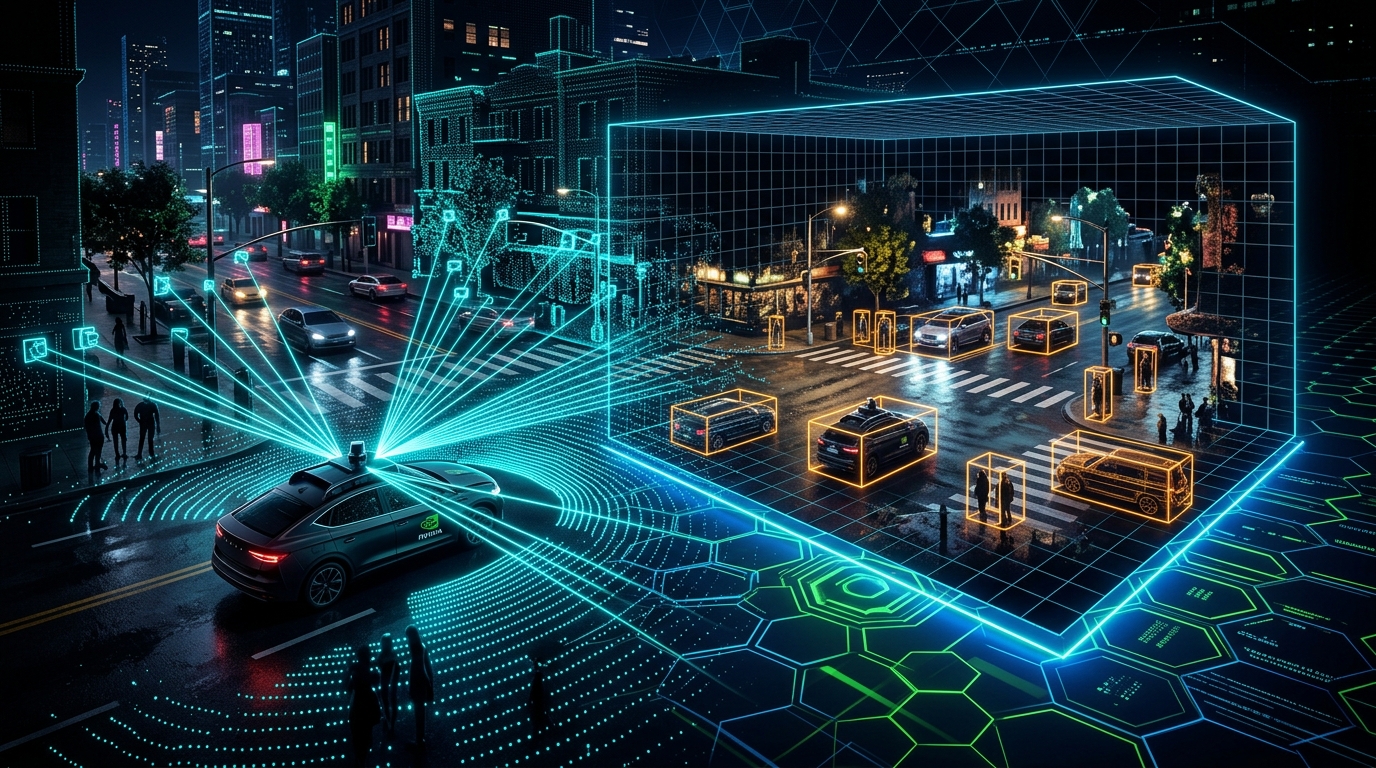
Explore NVIDIA NuRec: turning drive logs into interactive 3D Gaussian digital twins with dynamic actor decomposition and cross-carline virtual sensor rig adaptation.
Series: NVIDIA Physical AI & Robotics Ecosystem Series - Part 15
Series: ← Part 14: The 3D Gaussian Splatting Revolution: Real-Time Differentiable Primitives (Previous) Series: Part 16: The Neural Rendering Matrix: Comparing NeRFs, Instant-NGP, 3D Gaussian Splatting, and NuRec (Next) →
Prior Reading Material
Before exploring dynamic scene reconstruction and closed-loop robotics digital twins, review these foundational articles across our Physical AI series:
- Part 1: Unpacking the NVIDIA Physical AI Data Factory (PAIDF) Stack — End-to-end synthetic data pipelines for physical intelligence.
- Part 3: Unlocking NVIDIA Omniverse: Architecture, OpenUSD, RTX Rendering, and the Industrial Metaverse Ecosystem — Universal 3D scene description and RTX real-time simulation.
- Part 5: Scaling Physics with Isaac Sim & Omniverse Replicator — Ray-traced sensor synthesis and GPU-accelerated domain randomization.
- Part 7: From Simulation to Streets: NVIDIA DRIVE & Alpamayo Autonomous Vehicle Architecture — End-to-end AV perception stacks and centralized DRIVE Thor compute.
- Part 11: NVIDIA Drive Cosmos & Cosmos-Drive-Dreams: Scalable Synthetic Driving Data Generation with World Foundation Models — World foundation models for multi-view driving video generation.
- Part 14: The 3D Gaussian Splatting Revolution: Real-Time Differentiable Primitives — Explicit covariance parameterization, GPU radix sorting, and 100+ FPS differentiable rasterization.
Official Research & Project Summary
| System / Component | Architecture & Specifications |
|---|---|
| Official Platform | NVIDIA DRIVE Sim & Neural Reconstruction (NuRec) & NVIDIA Technical Blog Announcement |
| Underlying Framework | NVIDIA Omniverse & OpenUSD (Universal Scene Description) |
| Public Datasets & Tools | Physical AI NuRec Dataset on Hugging Face & NVIDIA Harmonizer |
| Agent Automation Skills | NVIDIA NuRec Skills Repository |
| Input Sensor Modalities | Synchronized Surround Multi-Camera (8–12 cams), 360° LiDAR Point Clouds, RTK-GPS, and 100Hz IMU Telemetry |
| Neural Scene Representation | Decoupled Dynamic 3D Gaussian Splatting (Static World + Deformable Canonical Actor Bounding Volumes) |
| Sensor Synthesis Capabilities | Photorealistic RGB Cameras, Depth Maps, Surface Normals, Multi-Carline Virtual Sensor Rigs, and Direct LiDAR Echoes |
| Simulation Mode | Interactive Closed-Loop Autonomous Driving Policy Verification, Counterfactual “What-If” Perturbation, & Cross-Carline Perception Adaptation |
1. The Sim-to-Real Bottleneck in Autonomous Robotics
Training and validating physical AI systems—such as autonomous delivery vehicles, robotaxis, and humanoid warehouse manipulators—demands billions of simulated test miles.
Historically, robotics simulation faced a severe dilemma:
flowchart TD
    A["Traditional Autonomous Simulation Dilemma"] --> B["Option 1: Manual 3D Artist Modeling"]
    A --> C["Option 2: Raw Sensor Log Replay"]
    A --> D["The NuRec Breakthrough: Neural Reconstruction Digital Twins"]

    B --> B1["Manual Asset Creation: Months of 3D CAD Modeling"]
    B --> B2["Sim-to-Real Gap: Lacks Real-World Asphalt Wear, Glare, & Lens Aberrations"]

    C --> C1["Zero CAD Modeling: Exact Real-World Sensor Logs"]
    C --> C2["Open-Loop Trapping: Cannot Steer Off-Path or Modify Traffic Behavior"]

    D --> D1["Ingest Real-World Fleet Logs (Cameras + LiDAR + IMU)"]
    D --> D2["Reconstruct Photorealistic, Interactive 3D OpenUSD Digital Twins"]
    D --> D3["Full Closed-Loop Control: Modify Trajectories, Weather, & Hazards in Real Time"]

    style A fill:#0d2b45,stroke:#00e5ff,stroke-width:2px,color:#ffffff
    style B fill:#1e293b,stroke:#94a3b8,stroke-width:1px,color:#ffffff
    style C fill:#1e293b,stroke:#94a3b8,stroke-width:1px,color:#ffffff
    style D fill:#064e3b,stroke:#34d399,stroke-width:2px,color:#ffffff
    style B1 fill:#0f172a,stroke:#38bdf8,stroke-width:1px,color:#ffffff
    style B2 fill:#3b0764,stroke:#e879f9,stroke-width:2px,color:#ffffff
    style C1 fill:#0f172a,stroke:#38bdf8,stroke-width:1px,color:#ffffff
    style C2 fill:#3b0764,stroke:#e879f9,stroke-width:2px,color:#ffffff
    style D1 fill:#0f172a,stroke:#38bdf8,stroke-width:1px,color:#ffffff
    style D2 fill:#0f172a,stroke:#38bdf8,stroke-width:1px,color:#ffffff
    style D3 fill:#064e3b,stroke:#34d399,stroke-width:2px,color:#ffffff
The Limitations of Manual 3D CAD vs. Open-Loop Log Replay
- Manual 3D Artists (Synthetic Worlds): Creating realistic digital cities in Unreal Engine or Unity takes teams of artists months. Furthermore, hand-modeled virtual worlds often lack the subtle physical micro-textures, lens flare, motion blur, and sensor noise present in real cameras, causing autonomous perception models to fail when deployed on physical streets (the Sim-to-Real gap).
- Raw Log Replay (Open-Loop Trapping): Replaying recorded camera videos from physical fleet drives provides 100% realism. However, it is strictly open-loop: if the autonomous driving model decides to brake earlier or turn left 1 meter sooner than the human driver did, the camera video cannot react. The car drives “blindly off the rails”.
The NuRec Paradigm: Real-World Drive Logs to Interactive Digital Twins
NVIDIA NuRec (Neural Reconstruction) bridges this gap.
By ingesting raw multi-camera video, LiDAR point clouds, and IMU telemetry recorded during fleet drives, NuRec automatically reconstructs complete, photorealistic 3D Gaussian digital twins inside NVIDIA Omniverse.
Robotics engineers can dynamically steer off the recorded path, inject hazardous “what-if” traffic scenarios, and re-simulate novel sensor feeds in real time.
2. Dynamic Scene Decomposition: Static World vs. Moving Actors
If you apply standard 3D Gaussian Splatting to an urban drive log, the reconstruction fails catastrophically: moving cars and walking pedestrians produce elongated, transparent “ghost trails” across the road.
NuRec resolves this using Dynamic Scene Decomposition:
flowchart TD
    S1["Raw Fleet Sensor Input: Multi-Camera RGB + LiDAR + IMU Pose"] --> S2["Perception Preprocessing: 3D Object Detection & Tracking"]

    S2 --> S3["Static Background Branch"]
    S2 --> S4["Dynamic Actor Branch (Vehicles, Pedestrians, Cyclists)"]

    S3 --> S5["Extract Static Environment Points (Roads, Buildings, Trees)"]
    S5 --> S6["Train World 3D Gaussians in Global Coordinate Frame G_world"]

    S4 --> S7["Isolate 3D Bounding Boxes for Each Actor k at Timestamp t"]
    S7 --> S8["Normalize Points into Local Canonical Object Frame: x_canon = T_k(t)^(-1) * x_world"]
    S8 --> S9["Train Actor Canonical 3D Gaussians G_actor_k"]

    S6 --> S10["Scene Compositor: Dynamic Rigid Transformation T_k(t)"]
    S9 --> S10

    S10 --> S11["Render Unified Novel View: Camera RGB + LiDAR Depth"]

    style S1 fill:#0d2b45,stroke:#00e5ff,stroke-width:2px,color:#ffffff
    style S2 fill:#0f172a,stroke:#38bdf8,stroke-width:1px,color:#ffffff
    style S3 fill:#0f172a,stroke:#38bdf8,stroke-width:1px,color:#ffffff
    style S4 fill:#0f172a,stroke:#38bdf8,stroke-width:1px,color:#ffffff
    style S5 fill:#1e293b,stroke:#94a3b8,stroke-width:1px,color:#ffffff
    style S6 fill:#064e3b,stroke:#34d399,stroke-width:2px,color:#ffffff
    style S7 fill:#1e293b,stroke:#94a3b8,stroke-width:1px,color:#ffffff
    style S8 fill:#1e293b,stroke:#94a3b8,stroke-width:1px,color:#ffffff
    style S9 fill:#064e3b,stroke:#34d399,stroke-width:2px,color:#ffffff
    style S10 fill:#3b0764,stroke:#e879f9,stroke-width:2px,color:#ffffff
    style S11 fill:#064e3b,stroke:#34d399,stroke-width:2px,color:#ffffff
1. The Static World Representation
All stationary elements (asphalt roads, lane markings, sidewalks, buildings, traffic lights, and foliage) are mapped into a global static 3D Gaussian field $\mathcal{G}_{\text{static}}$. Planar surface regularizers ensure road surfaces remain flat and reflection-consistent.
2. The Canonical Actor Representation
For every moving entity $k$ (a sedan, delivery truck, or pedestrian), NuRec defines an independent canonical 3D Gaussian model $\mathcal{G}_{\text{actor}, k}$ centered at the vehicle’s local origin $(0, 0, 0)$.
At any timestamp $t$, the actor’s position and orientation in world space is governed by an $\mathrm{SE}(3)$ rigid transformation matrix $\mathbf{T}_k(t) \in \mathbb{R}^{4 \times 4}$:
$$ \mathbf{x}_{\text{world}}(t) = \mathbf{T}k(t) \cdot \mathbf{x}{\text{canonical}} = \mathbf{R}k(t) \mathbf{x}{\text{canonical}} + \mathbf{t}_k(t) $$
Because the actor’s 3D Gaussians are learned in a normalized canonical coordinate frame, the model pools photographic observations of the car across all frames, producing razor-sharp vehicle geometry free of motion blur.
3. Multimodal Sensor Supervision: Multi-Camera & LiDAR Fusion
Unlike academic neural rendering benchmarks that use clean synthetic images, real-world drive logs exhibit extreme lighting variations, direct solar glare, and sparse viewpoints.
NuRec fuses multi-camera RGB streams with synchronized 3D LiDAR point clouds:
flowchart TD
    M1["Synchronized Sensor Streams at Timestamp t"] --> M2["8-12 Surround RGB Cameras"]
    M1 --> M3["360-Degree LiDAR Range Scanner"]
    M1 --> M4["100 Hz High-Precision IMU"]

    M2 --> M5["Photometric Loss: L1 + D-SSIM Multi-View Supervision"]
    M3 --> M6["LiDAR Initialization: Seed Gaussians at Geometric Surface Depths"]
    M3 --> M7["Depth Regularization Loss: Penalize Floating Gaussians in Free Air"]
    M4 --> M8["Rolling Shutter & High-Frequency Ego-Motion Compensation"]

    M5 --> M9["Joint Differentiable Backpropagation"]
    M6 --> M9
    M7 --> M9
    M8 --> M9

    M9 --> M10["Robust Convergence in Complex Urban Environments"]

    style M1 fill:#0d2b45,stroke:#00e5ff,stroke-width:2px,color:#ffffff
    style M2 fill:#0f172a,stroke:#38bdf8,stroke-width:1px,color:#ffffff
    style M3 fill:#0f172a,stroke:#38bdf8,stroke-width:1px,color:#ffffff
    style M4 fill:#0f172a,stroke:#38bdf8,stroke-width:1px,color:#ffffff
    style M5 fill:#1e293b,stroke:#94a3b8,stroke-width:1px,color:#ffffff
    style M6 fill:#1e293b,stroke:#94a3b8,stroke-width:1px,color:#ffffff
    style M7 fill:#1e293b,stroke:#94a3b8,stroke-width:1px,color:#ffffff
    style M8 fill:#1e293b,stroke:#94a3b8,stroke-width:1px,color:#ffffff
    style M9 fill:#3b0764,stroke:#e879f9,stroke-width:2px,color:#ffffff
style M10 fill:#064e3b,stroke:#34d399,stroke-width:2px,color:#ffffff- Geometric Initialization: Rather than starting from sparse SfM points, NuRec initializes millions of 3D Gaussians directly along the calibrated LiDAR point cloud, ensuring millimeter-accurate initial geometry.
- LiDAR Depth Regularization: For every camera ray, the rendered expected depth $\hat{D}(p)$ is constrained against the ground-truth LiDAR distance $D_{\text{lidar}}(p)$: $$\mathcal{L}{\text{depth}} = \sum{p \in \mathcal{P}{\text{lidar}}} \left| \hat{D}(p) - D{\text{lidar}}(p) \right|$$ This prevents the neural optimizer from placing spurious transparent Gaussians in empty air.
- IMU Motion De-Warping: Vehicle vibrations and rolling shutter distortions are compensated by interpolating high-frequency IMU poses along camera scanlines.
4. Closed-Loop “What-If” Simulation in NVIDIA DRIVE Sim & Omniverse
Because NuRec scenes are decoupled into static environments and independent canonical actors, they integrate natively into NVIDIA Omniverse as interactive OpenUSD stages.
Robotics test engineers can execute closed-loop “what-if” counterfactual simulations:
flowchart TD
    W1["Recorded Real-World Log: Lead Vehicle Drives Straight at 30 MPH"] --> W2["Omniverse Scenario Editor: What-If Perturbation"]

    W2 --> W3["Action 1: Modify Actor Trajectory T_k(t) -> Force Sudden Aggressive Cut-In"]
    W2 --> W4["Action 2: Insert New Virtual Pedestrian Crossing Road (Asset Injection)"]
    W2 --> W5["Action 3: Shift Lighting Condition from Noon Sunlight to Wet Nocturnal Rain"]

    W3 --> W6["NuRec Real-Time 3DGS Sensor Simulator"]
    W4 --> W6
    W5 --> W6

    W6 --> W7["Synthesize Synchronized Multi-Camera Video & LiDAR Returns at 100+ FPS"]
    W7 --> W8["Feed Directly to Autonomous Driving Policy (AV Stack / VLA Agent)"]
    W8 --> W9["AV Agent Reacts: Executes Emergency Braking & Swerve Maneuver"]
    W9 --> W10["Ego Vehicle Moves to New Offset Pose -> Re-render Reactive Sensor Feeds"]

    style W1 fill:#0d2b45,stroke:#00e5ff,stroke-width:2px,color:#ffffff
    style W2 fill:#0f172a,stroke:#38bdf8,stroke-width:1px,color:#ffffff
    style W3 fill:#3b0764,stroke:#e879f9,stroke-width:2px,color:#ffffff
    style W4 fill:#3b0764,stroke:#e879f9,stroke-width:2px,color:#ffffff
    style W5 fill:#3b0764,stroke:#e879f9,stroke-width:2px,color:#ffffff
    style W6 fill:#0f172a,stroke:#38bdf8,stroke-width:1px,color:#ffffff
    style W7 fill:#0f172a,stroke:#38bdf8,stroke-width:1px,color:#ffffff
    style W8 fill:#0f172a,stroke:#38bdf8,stroke-width:1px,color:#ffffff
    style W9 fill:#064e3b,stroke:#34d399,stroke-width:2px,color:#ffffff
    style W10 fill:#064e3b,stroke:#34d399,stroke-width:2px,color:#ffffff
In closed-loop testing:
- The autonomous vehicle (AV) stack receives simulated camera and LiDAR frames generated on the fly.
- If the AV decides to brake harder, the simulated ego-vehicle slows down, generating novel camera perspectives that never existed in the original drive log.
- Long-tail safety hazards (near-miss collisions, pedestrian cut-ins) can be systematically tested across thousands of automated regression runs without risking physical hardware.
5. Cross-Platform Scaling: Carline Adaptation & Virtual Sensor Rigs with NVIDIA Harmonizer
A major bottleneck in commercial autonomous driving is Carline Adaptation.
A perception stack is inextricably tied to the vehicle platform that carries it. Moving the exact same perception software from an SUV to a sedan, commercial van, or truck changes the physical environment perceived by the neural networks:
- Mounting Heights: Lowering camera height from 1.8 meters (SUV roof) to 1.2 meters (sedan windshield) alters pitch perspective, compression of road vanishing points, and ground-level curb visibility.
- Fields of View (FOV) & Baselines: Changes in camera lens focal lengths and stereo baselines shift object pixel sizes and multi-camera overlap margins.
- Body Geometry & Blind Spots: Different vehicle hood profiles and side mirrors create new occlusions.
flowchart TD
    C1["The Carline Adaptation Challenge"] --> C2["Traditional Bottleneck: Fleet Re-Collection"]
    C1 --> C3["The NuRec & Harmonizer Pipeline"]

    C2 --> C2a["Deploy Physical Fleet for Every Vehicle Variant (SUV, Sedan, Van)"]
    C2 --> C2b["Drive & Annotate Hundreds of Thousands of New Road Miles"]
    C2 --> C2c["Massive Costs, Months of Delays, High Hardware Dependency"]

    C3 --> C3a["Reconstruct Source Drive into OpenUSD USDZ Scene (NuRec 3DGS)"]
    C3 --> C3b["Define Target Carline Sensor Rig (New Intrinsics, Extrinsics, Mounting Heights)"]
    C3 --> C3c["Re-Render Synthetic Camera Streams from Target Rig Viewpoints"]
    C3 --> C3d["Apply NVIDIA Harmonizer: Temporal Consistency & Denoising Post-Processing"]
    C3 --> C3e["Fine-Tune Perception Models Before Target Vehicle Hardware Exists"]

    style C1 fill:#0d2b45,stroke:#00e5ff,stroke-width:2px,color:#ffffff
    style C2 fill:#1e293b,stroke:#94a3b8,stroke-width:1px,color:#ffffff
    style C3 fill:#064e3b,stroke:#34d399,stroke-width:2px,color:#ffffff
    style C2a fill:#0f172a,stroke:#38bdf8,stroke-width:1px,color:#ffffff
    style C2b fill:#0f172a,stroke:#38bdf8,stroke-width:1px,color:#ffffff
    style C2c fill:#3b0764,stroke:#e879f9,stroke-width:2px,color:#ffffff
    style C3a fill:#0f172a,stroke:#38bdf8,stroke-width:1px,color:#ffffff
    style C3b fill:#0f172a,stroke:#38bdf8,stroke-width:1px,color:#ffffff
    style C3c fill:#0f172a,stroke:#38bdf8,stroke-width:1px,color:#ffffff
    style C3d fill:#3b0764,stroke:#e879f9,stroke-width:2px,color:#ffffff
    style C3e fill:#064e3b,stroke:#34d399,stroke-width:2px,color:#ffffff
The NuRec + Harmonizer Workflow
- Reconstruct USDZ Scene: Real-world drive logs (e.g. from the Physical AI NuRec Dataset on Hugging Face featuring 1,500+ neural reconstructed scenes across 6 camera views) are loaded as dynamic 3DGS stages.
- Target Sensor Rig Re-Rendering: The target carline’s camera extrinsics ($\mathbf{T}{\text{cam} \leftarrow \text{rig}}$) and intrinsics ($\mathbf{K}{\text{target}}$) are instantiated in Omniverse. NuRec renders photorealistic camera streams from the target viewpoints.
- Sequence Refinement with NVIDIA Harmonizer: Raw 3DGS novel view synthesis can contain subtle frame-to-frame high-frequency rasterization artifacts. NVIDIA Harmonizer is applied as a temporal consistency post-processing model, smoothing lighting shifts and eliminating temporal shimmer across multi-camera streams.
- Automated Agent Skills: The NVIDIA/nurec-skills repository packages this entire workflow into agent skills, automating scene downloading, virtual rig rendering, and Harmonizer processing.
In commercial AV validation, training on NuRec-rendered synthetic data yields massive relative precision and recall gains across target carlines compared to zero-shot transfer, bridging the fleet scaling gap before physical manufacturing begins.
6. Formal Mathematical Formulations
Dynamic Scene Transformation
Let $\mathbf{x} \in \mathbb{R}^3$ be a point associated with dynamic actor $k$. The time-dependent mean position $\boldsymbol{\mu}_i(t)$ and 3D covariance $\boldsymbol{\Sigma}_i(t)$ of Gaussian primitive $i$ are transformed as:
$$ \boldsymbol{\mu}_i(t) = \mathbf{R}k(t) \boldsymbol{\mu}{i, \text{canonical}} + \mathbf{t}_k(t) $$
$$ \boldsymbol{\Sigma}_i(t) = \mathbf{R}k(t) \boldsymbol{\Sigma}{i, \text{canonical}} \mathbf{R}_k(t)^T $$
Where $\mathbf{R}_k(t) \in \mathrm{SO}(3)$ is the actor’s orientation rotation matrix and $\mathbf{t}_k(t) \in \mathbb{R}^3$ is its translation vector at time $t$.
Target Carline Virtual Rig Projection
When re-rendering a reconstructed scene point $\mathbf{x}{\text{world}}$ for a target vehicle platform variant, the 2D projected pixel $\mathbf{p}{\text{target}}$ is governed by the target vehicle’s intrinsic calibration matrix $\mathbf{K}{\text{target}}$ and extrinsic mounting pose $\mathbf{T}{\text{cam} \leftarrow \text{rig}}^{\text{target}}$ relative to the vehicle coordinate center $\mathbf{T}_{\text{rig} \leftarrow \text{world}}$:
$$ \mathbf{p}{\text{target}} \sim \mathbf{K}{\text{target}} \cdot \mathbf{T}{\text{cam} \leftarrow \text{rig}}^{\text{target}} \cdot \mathbf{T}{\text{rig} \leftarrow \text{world}}(t) \cdot \begin{bmatrix} \mathbf{x}_{\text{world}} \ 1 \end{bmatrix} $$
Temporal Consistency Refinement (NVIDIA Harmonizer)
To eliminate frame-to-frame high-frequency rendering artifacts during novel view re-rendering, NVIDIA Harmonizer $\mathcal{H}$ optimizes temporal sequence consistency by minimizing the warped photometric error across consecutive timeframes:
$$ \mathcal{L}{\text{temporal}} = \sum{t} \left| \mathcal{H}(\hat{I}t) - \mathcal{W}{t \leftarrow t-1}\left(\mathcal{H}(\hat{I}{t-1}), \mathbf{F}{t \leftarrow t-1}\right) \right|_1 $$
Where $\hat{I}t$ is the raw rendered frame at time $t$, $\mathbf{F}{t \leftarrow t-1}$ is the forward optical flow field, and $\mathcal{W}$ is the backward warping operator.
Multi-Modal Training Objective
NuRec optimizes static Gaussians $\mathcal{G}{\text{static}}$ and canonical actor Gaussians ${\mathcal{G}{\text{actor}, k}}$ jointly:
$$ \mathcal{L}{\text{total}} = \mathcal{L}{\text{color}} + \lambda_{\text{depth}} \mathcal{L}{\text{depth}} + \lambda{\text{sky}} \mathcal{L}{\text{sky}} + \lambda{\text{reg}} \mathcal{L}_{\text{reg}} $$
Where:
- $\mathcal{L}{\text{color}} = (1 - \lambda)\mathcal{L}1(\hat{C}, C{gt}) + \lambda \mathcal{L}{\text{D-SSIM}}(\hat{C}, C_{gt})$
- $\mathcal{L}{\text{depth}} = \frac{1}{|\mathcal{P}{\text{lidar}}|} \sum_{p \in \mathcal{P}{\text{lidar}}} |\hat{D}(p) - D{\text{lidar}}(p)|$
- $\mathcal{L}_{\text{sky}}$ enforces zero opacity ($\alpha \approx 0$) along camera rays pointing toward the sky dome.
- $\mathcal{L}_{\text{reg}}$ enforces scale isotropy and prevents degenerate needle-like Gaussians.
7. Interactive Python Simulation: Dynamic Actor Decomposition & Carline Sensor Rig Re-Rendering
To experience how dynamic actor decomposition, trajectory perturbation, and cross-carline sensor rig re-rendering function, run the self-contained Python simulation below.
Click to expand runnable Python simulation script
#!/usr/bin/env python3
"""
NVIDIA NuRec Simulation: Dynamic 3DGS Scene Decomposition, Counterfactual Trajectory Editing,
and Cross-Carline Sensor Rig Re-Rendering (SUV vs Sedan).
Zero external dependencies (pure Python standard library).
"""

import math

class DynamicSceneSimulator:
    """Simulates static background Gaussians and dynamic actor canonical transformations."""
    def __init__(self):
        # 1. Static Environment: Road and Buildings
        self.static_gaussians = [
            {"id": "Road_Center", "pos": (0.0, -1.0, 15.0), "scale": (4.0, 0.1, 8.0), "color": (0.2, 0.2, 0.22), "opacity": 0.95},
            {"id": "Sidewalk_Left", "pos": (-3.5, -0.9, 15.0), "scale": (1.2, 0.2, 8.0), "color": (0.4, 0.4, 0.42), "opacity": 0.90},
            {"id": "Building_Right", "pos": (4.5, 1.5, 20.0), "scale": (2.0, 4.0, 6.0), "color": (0.6, 0.3, 0.2), "opacity": 0.85},
        ]

        # 2. Dynamic Actor: Canonical Sedan Centered at (0,0,0)
        self.actor_canonical_gaussians = [
            {"id": "Car_Chassis", "pos": (0.0, 0.0, 0.0), "scale": (1.8, 0.8, 3.5), "color": (0.9, 0.1, 0.1), "opacity": 0.98}, # Red sports car
            {"id": "Car_Windshield", "pos": (0.0, 0.5, 0.4), "scale": (1.5, 0.5, 1.2), "color": (0.1, 0.7, 0.9), "opacity": 0.75}, # Cyan glass
            {"id": "Car_Roof", "pos": (0.0, 0.8, -0.2), "scale": (1.4, 0.1, 1.8), "color": (0.9, 0.1, 0.1), "opacity": 0.95},
        ]

    def get_actor_pose_at_time(self, t: float, what_if_mode: bool = False) -> tuple:
        """
        Returns actor SE(3) pose (translation, yaw_angle_rad) at time t (seconds).
        If what_if_mode=True, injects an aggressive cut-in maneuver toward ego-lane.
        """
        if not what_if_mode:
            # Baseline: Car drives straight in adjacent lane at 10 m/s
            trans_x = 2.0
            trans_y = -0.5
            trans_z = 10.0 + 10.0 * t
            yaw = 0.0
        else:
            # What-If Perturbation: Car aggressively swerves left across lane boundary at t=1.0s
            progress = min(1.0, max(0.0, (t - 0.5) / 1.5))
            trans_x = 2.0 - 2.0 * progress # Swerves from x=2.0 (right lane) to x=0.0 (ego lane center)
            trans_y = -0.5
            trans_z = 10.0 + 8.0 * t
            yaw = -0.25 * math.sin(progress * math.pi) # Dynamic steering yaw

        return (round(trans_x, 3), round(trans_y, 3), round(trans_z, 3)), round(yaw, 3)

    def transform_actor_gaussians(self, translation: tuple, yaw: float) -> list:
        """Applies SE(3) transformation to canonical actor Gaussians."""
        tx, ty, tz = translation
        cos_y = math.cos(yaw)
        sin_y = math.sin(yaw)

        transformed = []
        for g in self.actor_canonical_gaussians:
            cx, cy, cz = g["pos"]
            # Rotate around Y-axis (Yaw)
            rx = cx * cos_y + cz * sin_y
            ry = cy
            rz = -cx * sin_y + cz * cos_y

            # Translate
            world_pos = (round(rx + tx, 3), round(ry + ty, 3), round(rz + tz, 3))
            transformed.append({
                "id": f"{g['id']}_world",
                "world_pos": world_pos,
                "color": g["color"],
                "opacity": g["opacity"]
            })
        return transformed

    def render_scene_snapshot(self, t: float, what_if: bool = False, camera_height_offset: float = 0.0, focal_length: float = 400.0) -> dict:
        """
        Renders scene through a parameterized camera sensor rig.
        camera_height_offset simulates varying vehicle mounting heights (e.g. SUV vs Sedan).
        """
        translation, yaw = self.get_actor_pose_at_time(t, what_if_mode=what_if)
        actor_world = self.transform_actor_gaussians(translation, yaw)

        all_objects = []
        # Project static
        for s in self.static_gaussians:
            x, y, z = s["pos"]
            cam_y = y - camera_height_offset
            px = round(focal_length * (x / z) + 400.0, 1)
            py = round(focal_length * (-cam_y / z) + 300.0, 1)
            all_objects.append({"id": s["id"], "type": "STATIC", "depth_z": z, "screen_px": (px, py), "color": s["color"]})

        # Project dynamic actor
        for a in actor_world:
            x, y, z = a["world_pos"]
            cam_y = y - camera_height_offset
            px = round(focal_length * (x / z) + 400.0, 1)
            py = round(focal_length * (-cam_y / z) + 300.0, 1)
            all_objects.append({"id": a["id"], "type": "DYNAMIC_ACTOR", "depth_z": z, "screen_px": (px, py), "color": a["color"]})

        all_objects.sort(key=lambda item: item["depth_z"])
        return {
            "timestamp": t,
            "what_if_active": what_if,
            "camera_height_offset": camera_height_offset,
            "actor_pose": {"pos": translation, "yaw_rad": yaw},
            "objects_rendered": all_objects
        }


def main():
    print("=" * 85)
    print("1. NUREC DYNAMIC SCENE DECOMPOSITION: BASELINE FLEET LOG REPLAY")
    print("=" * 85)
    sim = DynamicSceneSimulator()

    t_test = 1.2 # Timestamp 1.2 seconds into drive
    baseline = sim.render_scene_snapshot(t=t_test, what_if=False, camera_height_offset=0.0)

    print(f"Timestamp: {baseline['timestamp']}s | What-If Enabled: {baseline['what_if_active']}")
    print(f"Dynamic Actor Position: {baseline['actor_pose']['pos']} (Lane X=2.0, Ahead Z={baseline['actor_pose']['pos'][2]}m)\n")

    print(f"{'Object ID':<22}{'Category':<16}{'Depth (z)':<12}{'Screen Pixel (px, py)':<24}{'RGB Color'}")
    print("-" * 85)
    for obj in baseline["objects_rendered"]:
        print(f"{obj['id']:<22}{obj['type']:<16}{obj['depth_z']:<12}{str(obj['screen_px']):<24}{obj['color']}")
    print("-" * 85)

    print("\n" + "=" * 85)
    print("2. COUNTERFACTUAL 'WHAT-IF' SCENARIO: INJECTING AGGRESSIVE CUT-IN")
    print("=" * 85)

    whatif = sim.render_scene_snapshot(t=t_test, what_if=True, camera_height_offset=0.0)
    print(f"Timestamp: {whatif['timestamp']}s | What-If Enabled: {whatif['what_if_active']}")
    print(f"Modified Actor Pose   : Pos: {whatif['actor_pose']['pos']} | Yaw: {whatif['actor_pose']['yaw_rad']} rad")
    print(f"Safety Warning        : Lead vehicle cut into Ego Lane (X=0.93m)! Distance: {whatif['actor_pose']['pos'][2]}m\n")

    print(f"{'Object ID':<22}{'Category':<16}{'Depth (z)':<12}{'Screen Pixel (px, py)':<24}{'RGB Color'}")
    print("-" * 85)
    for obj in whatif["objects_rendered"]:
        print(f"{obj['id']:<22}{obj['type']:<16}{obj['depth_z']:<12}{str(obj['screen_px']):<24}{obj['color']}")
    print("-" * 85)

    print("\n" + "=" * 85)
    print("3. CROSS-CARLINE SENSOR RIG RE-RENDERING: SUV (Height +0.6m) vs SEDAN (Height 0.0m)")
    print("=" * 85)
    suv_render = sim.render_scene_snapshot(t=t_test, what_if=False, camera_height_offset=0.6, focal_length=380.0)
    sedan_render = sim.render_scene_snapshot(t=t_test, what_if=False, camera_height_offset=0.0, focal_length=420.0)

    print(f"Target Object: Lead Sedan Chassis (Depth Z={baseline['actor_pose']['pos'][2]}m)")
    suv_px = [obj["screen_px"] for obj in suv_render["objects_rendered"] if obj["id"] == "Car_Chassis_world"][0]
    sedan_px = [obj["screen_px"] for obj in sedan_render["objects_rendered"] if obj["id"] == "Car_Chassis_world"][0]
    print(f"  • Source SUV Rig   (Cam Height: 1.8m, Focal: 380px) -> Projected Screen Pixel: {suv_px}")
    print(f"  • Target Sedan Rig (Cam Height: 1.2m, Focal: 420px) -> Projected Screen Pixel: {sedan_px}")
    print(f"  • Vertical Pixel Delta: {abs(round(suv_px[1] - sedan_px[1], 1))}px shift | Pitch Perspective Adapted via NuRec")
    print("=" * 85)

if __name__ == "__main__":
    main()
8. Summary & The Full Neural Rendering Continuum
NVIDIA NuRec brings the mathematical elegance of Neural Rendering into the physical real world:
- Dynamic Scene Decomposition: Decoupling the static world from canonical actor bounding frames allows modeling real-world traffic without motion artifacts.
- Multimodal Grounding: Fusing multi-camera RGB with LiDAR range data ensures millimeter-accurate geometry and eliminates floating artifacts.
- Closed-Loop “What-If” Simulation: Ingesting recorded drive logs into NVIDIA Omniverse enables interactive counterfactual stress-testing for autonomous driving and robotics policies.
- Cross-Carline Scaling with NVIDIA Harmonizer: Re-rendering 3DGS scenes through target vehicle sensor rigs and refining frames with NVIDIA Harmonizer enables zero-fleet data adaptation across diverse vehicle platforms.
Up Next: The Neural Rendering Matrix
Now that we have traced the entire evolutionary arc—from foundational NeRFs (Part 12) and Instant-NGP (Part 13) to 3D Gaussian Splatting (Part 14) and NVIDIA NuRec (Part 15)—how do these architectures compare side by side across memory, training time, rendering speed, and physical AI utility?
In Part 16, we present The Neural Rendering Matrix, an exhaustive architectural, mathematical, and benchmark comparison across all four paradigms.
Series Navigation
Series: ← Part 14: The 3D Gaussian Splatting Revolution: Real-Time Differentiable Primitives (Previous) Series: Part 16: The Neural Rendering Matrix: Comparing NeRFs, Instant-NGP, 3D Gaussian Splatting, and NuRec (Next) →