
Claude Fable 5.1 & Claude Mythos 5.1: Anthropic's Dual Frontier for Enterprise Coding and High-Assurance Research
Explore Anthropic Claude Fable 5.1 and Mythos 5.1: SWE-bench Pro leadership (81.2%), 75% prompt cache discounts, and dual-persona safety architecture.
Series: AI/ML Basics & Frontier Model Architectures - Part 14
Series: ← OpenAI GPT-6 Astra: Frontier Agentic Intelligence, ARC-AGI-3, and Critical Risk Thresholds (Previous)
Prior Reading Material
Before exploring Claude Fable 5.1 and Mythos 5.1’s dual-persona architecture and caching economics, review these foundational articles across our Anthropic and model architecture guides:
- Anthropic’s Mid-2026 Wave: Claude Sonnet 5, Claude Science, and Fable 5 Redeployment — The initial rollout of Anthropic’s specialized frontier lineup.
- Anthropic’s Claude Model Family: Specs, Pros, Cons, and Use Cases — Architectural trade-offs across Haiku, Sonnet, Opus, and Fable.
- Claude Code Custom Skills: Design Methodology and Workspace Personas — Designing modular skill harnesses for autonomous coding agents.
- Part 1: The Landscape of Agentic AI — Multi-turn loops, tool dispatch, and agentic error recovery.
- OpenAI GPT-6 Astra: Frontier Agentic Intelligence, ARC-AGI-3, and Critical Risk Thresholds — Contemporary frontier release deep-dive and competitive landscape.
Official Model Card & Benchmark Summary
| System / Specification | Anthropic Claude Fable 5.1 | Claude Mythos 5.1 (Project Glasswing) | OpenAI GPT-6 Astra |
|---|---|---|---|
| Developer / Provider | Anthropic | Anthropic | OpenAI |
| Model Card Link | Anthropic Release Announcement | Restricted Access (US/UK AISI) | OpenAI System Card |
| Architecture Foundation | Shared 1M-Token Base Weights | Shared 1M-Token Base Weights | Dense Autoregressive + Provider Adapter |
| Context Window | 1,000,000 Tokens | 1,000,000 Tokens | 1,000,000+ Tokens |
| Max Output Limit | 128,000 Tokens | 128,000 Tokens | 64,000 Tokens |
| API Pricing (In / Out) | $10.00 / $50.00 per 1M | Custom Enterprise Agreement | $10.00 / $50.00 per 1M |
| Prompt Cache Read | $0.25 / 1M (75% discount) | Included in Infrastructure Tier | $5.00 / 1M (50% discount) |
| SWE-bench Pro (Verified) | 81.2% (Frontier SOTA) | Classified Research Protocol | 79.8% |
| Terminal-Bench-Science | 52.6% (2.1x over Fable 5) | Uncapped Evaluation Protocol | 48.9% |
| ARC-AGI-3 (Harnessed) | 88.4% | N/A | 99.9% (Automated Solver Paradigm) |
| ExploitBench Score | Restricted Refusal Layer | Defensive Audit Mode | 100.0% (Autonomous Vulnerability Exploit) |
| Safety / Alignment Regime | Enterprise Frontier Safeguards (EFS) | Air-Gapped Glasswing Red Teaming | Preparedness Framework (Critical Threshold) |
1. The Dual-Persona Paradigm: One Foundation, Two Operating Regimes
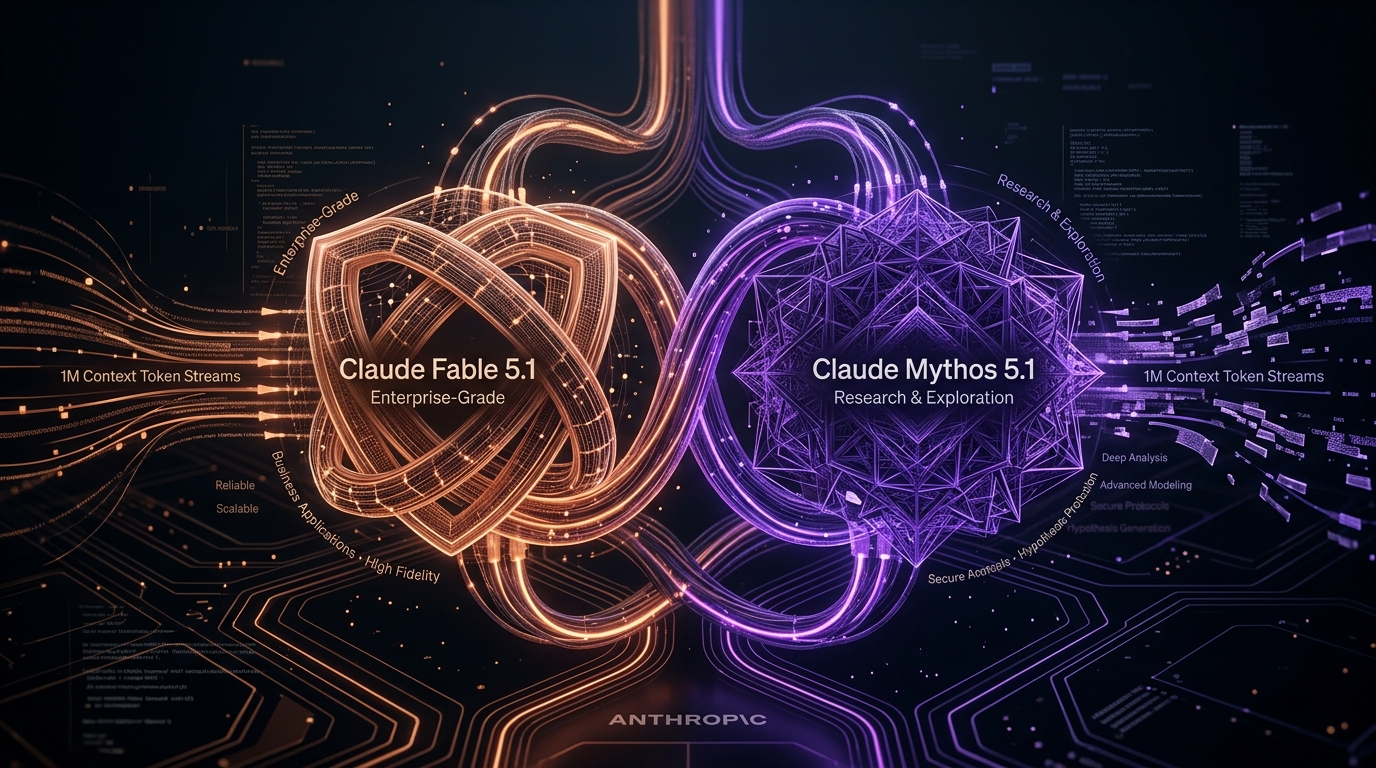
In September 2026, Anthropic released Claude Fable 5.1 and Claude Mythos 5.1, introducing a novel deployment architecture for frontier AI.
Rather than maintaining completely separate foundation models for commercial enterprise developers versus sensitive high-assurance scientific research, Anthropic trained a single, hyper-capable foundation intelligence and split its deployment into two distinct operating regimes:
flowchart TD
    A["Single Shared Foundation Intelligence: Claude 5.1 Base Weights"] --> B["Claude Fable 5.1 (Production Enterprise Persona)"]
    B --> B1["Production-Grade Safety Classifier Layer"]
    B1 --> B2["95% False-Positive Reduction on Benign Cyber/Bio Code"]
    B2 --> B3["Public Availability: Claude Platform, AWS Bedrock, GitHub Copilot"]

    style A fill:#0d2b45,stroke:#00e5ff,stroke-width:2px,color:#ffffff
    style B fill:#064e3b,stroke:#34d399,stroke-width:2px,color:#ffffff
    style B1 fill:#0f172a,stroke:#38bdf8,stroke-width:1px,color:#ffffff
    style B2 fill:#0f172a,stroke:#38bdf8,stroke-width:1px,color:#ffffff
    style B3 fill:#0f172a,stroke:#38bdf8,stroke-width:1px,color:#ffffff
flowchart TD
A["Single Shared Foundation Intelligence: Claude 5.1 Base Weights"] --> C["Claude Mythos 5.1 (Project Glasswing Research Persona)"]
C --> C1["Unrestricted Scientific & Defensive Probing Mode"]
C1 --> C2["Strict Vetting: Project Glasswing Trusted Partner Program"]
C2 --> C3["Target Use: Zero-Day Discovery & Biodefense Vulnerability Analysis"]
style A fill:#0d2b45,stroke:#00e5ff,stroke-width:2px,color:#ffffff
style C fill:#3b0764,stroke:#e879f9,stroke-width:2px,color:#ffffff
style C1 fill:#0f172a,stroke:#38bdf8,stroke-width:1px,color:#ffffff
style C2 fill:#0f172a,stroke:#38bdf8,stroke-width:1px,color:#ffffff
style C3 fill:#0f172a,stroke:#38bdf8,stroke-width:1px,color:#ffffffThe Mental Model: The Enterprise Diplomat vs. The Vault Cryptographer
- The Enterprise Diplomat (Claude Fable 5.1): Operates within Fortune 500 codebases, orchestrates complex refactors, and builds production services while maintaining rock-solid alignment boundaries and zero-data-retention compliance.
- The Vault Cryptographer (Claude Mythos 5.1): Operates inside secure, air-gapped research enclaves. Unshackled by conservative output refusal heuristics, it dives deep into binary disassembly, synthetic biological structures, and cryptographic protocols to discover critical vulnerabilities before adversaries do.
2. Setting the Engineering High-Water Mark: SWE-bench Pro & Science Benchmarks
Software engineering capability is the primary proving ground for autonomous coding agents.
On the rigorous SWE-bench Pro benchmark—evaluating an agent’s ability to resolve complex, multi-file GitHub issues from scratch—Claude Fable 5.1 established an industry-leading score of 81.2%.
flowchart TD
    W1["SWE-bench Pro Issue: Complex Repository Race Condition"] --> W2["Claude Fable 5.1 Multi-File Context Ingestion (1M Window)"]

    W2 --> W3["Step 1: Automated Root-Cause Trace Across 45 Source Files"]
    W3 --> W4["Step 2: Synthesize Reproducible Pytest Unit Failure"]

    W4 --> W5["Step 3: Generate Multi-Module Hardened Code Patch"]
    W5 --> W6["Step 4: Execute Test Suite in Sandbox Environment"]

    W6 --> W7{"Did All Unit & Regression Tests Pass?"}

    W7 -- "Test Failed" --> W8["Refine Patch: Self-Correction Loop via Execution Stacktrace"]
    W8 --> W5

    W7 -- "100% Tests Pass" --> W9["Emit Verified Pull Request Diff (81.2% SWE-bench Pro Score)"]

    style W1 fill:#0d2b45,stroke:#00e5ff,stroke-width:2px,color:#ffffff
    style W2 fill:#0f172a,stroke:#38bdf8,stroke-width:1px,color:#ffffff
    style W3 fill:#1e293b,stroke:#94a3b8,stroke-width:1px,color:#ffffff
    style W4 fill:#3b0764,stroke:#e879f9,stroke-width:2px,color:#ffffff
    style W5 fill:#1e293b,stroke:#94a3b8,stroke-width:1px,color:#ffffff
    style W6 fill:#0f172a,stroke:#38bdf8,stroke-width:1px,color:#ffffff
    style W7 fill:#0f172a,stroke:#38bdf8,stroke-width:1px,color:#ffffff
    style W8 fill:#3b0764,stroke:#e879f9,stroke-width:2px,color:#ffffff
    style W9 fill:#064e3b,stroke:#34d399,stroke-width:2px,color:#ffffff
Scientific Rigor: Terminal-Bench-Science
Beyond software engineering, Fable 5.1 doubled performance on Terminal-Bench-Science, leaping from 25.1% on Fable 5 to 52.6%. The model can autonomously navigate complex bash terminals, execute molecular dynamic simulations (GROMACS, LAMMPS), parse chemical SDF structures, and interpret high-energy physics data logs without human intervention.
3. The 75% Prompt Caching Cost Collapse
A long-standing obstacle in deploying long-running coding agents has been Token Economics. When an agent runs for 50 turns across a 200,000-token repository, re-reading the entire codebase on every turn rapidly accumulates thousands of dollars in API bills.
Anthropic introduced a 75% price reduction for prompt cache reads:
flowchart TD
    T1["Turn 1: Initial Repository Ingestion (200,000 Tokens)"] --> T2["Write to Prompt Cache: $10.00 / 1M ($2.00 Base Cost)"]
    T2 --> T3["Turns 2 through 50: Autonomous Tool Loops (49 Subsequent Turns)"]
    T3 --> T4["Legacy Caching at $1.00 / 1M: 49 x $0.20 = $9.80"]
    T4 --> T6["Legacy Workflow Total Cost: $11.80"]

    style T1 fill:#0d2b45,stroke:#00e5ff,stroke-width:2px,color:#ffffff
    style T2 fill:#0f172a,stroke:#38bdf8,stroke-width:1px,color:#ffffff
    style T3 fill:#1e293b,stroke:#94a3b8,stroke-width:1px,color:#ffffff
    style T4 fill:#3b0764,stroke:#e879f9,stroke-width:1px,color:#ffffff
    style T6 fill:#1e293b,stroke:#94a3b8,stroke-width:1px,color:#ffffff
flowchart TD
T1["Turn 1: Initial Repository Ingestion (200,000 Tokens)"] --> T2["Write to Prompt Cache: $10.00 / 1M ($2.00 Base Cost)"]
T2 --> T3["Turns 2 through 50: Autonomous Tool Loops (49 Subsequent Turns)"]
T3 --> T5["Fable 5.1 Caching at $0.25 / 1M: 49 x $0.05 = $2.45"]
T5 --> T7["Fable 5.1 Workflow Total Cost: $4.45 (62% Real-World Cost Savings)"]
style T1 fill:#0d2b45,stroke:#00e5ff,stroke-width:2px,color:#ffffff
style T2 fill:#0f172a,stroke:#38bdf8,stroke-width:1px,color:#ffffff
style T3 fill:#1e293b,stroke:#94a3b8,stroke-width:1px,color:#ffffff
style T5 fill:#064e3b,stroke:#34d399,stroke-width:2px,color:#ffffff
style T7 fill:#064e3b,stroke:#34d399,stroke-width:2px,color:#ffffffBy dropping cache read pricing to just $0.25 per million tokens, long-horizon autonomous tasks that previously cost $50–$100 now execute for under $15, making 24/7 background agent workflows economically viable for enterprise development teams.
4. Enterprise Frontier Safeguards (EFS) & False Positive Elimination
A common grievance among developers using previous safety-tuned models was over-refusal—the model refusing to parse benign SQL migrations or debug networking scripts because they contained words like drop, attack, or inject.
Fable 5.1 resolves this through:
- Context-Aware Safety Classifiers: 95% reduction in false-positive refusals on legitimate cybersecurity auditing and biomedical data.
- Enterprise Frontier Safeguards (EFS): Allows enterprise customers to host model caches within their private VPC infrastructure with cryptographically enforced Zero Data Retention (ZDR).
5. Frontier Comparison: Fable 5.1 & Mythos 5.1 vs. OpenAI GPT-6 Astra & Industry
| Capability / Benchmark | Anthropic Claude Fable 5.1 | Anthropic Claude Mythos 5.1 | OpenAI GPT-6 Astra | Anthropic Claude Sonnet 5 | Google Gemini 3 Pro |
|---|---|---|---|---|---|
| Release Date | Sep 1, 2026 | Sep 1, 2026 | Sep 3, 2026 | Mid 2026 | Mid 2026 |
| Target Audience | Enterprise Engineers | National Labs / AISI | Autonomous Agent Labs | General Developers | Multimodal Enterprise |
| SWE-bench Pro (Verified) | 81.2% | Classified / Uncapped | 79.8% | 72.4% | 72.0% |
| Terminal-Bench-Science | 52.6% | High-Assurance Audit | 48.9% | 24.5% | 31.0% |
| ARC-AGI-3 (Harnessed) | 88.4% | Frontier Evaluation | 99.9% | 52.0% | 61.2% |
| ExploitBench Score | Production Guarded | Defensive Audit Mode | 100.0% (Autonomous) | Defensive Refusal | Guarded |
| Artificial Analysis Composite | 66 | Restricted Benchmark | 66 | 54 | 55 |
| Context Window | 1,000,000 tokens | 1,000,000 tokens | 1,000,000+ tokens | 500,000 tokens | 2,000,000 tokens |
| Max Output Limit | 128,000 tokens | 128,000 tokens | 64,000 tokens | 32,000 tokens | 64,000 tokens |
| Cache Read Price (1M) | $0.25 (75% off) | Infrastructure Tier | $5.00 (50% off) | $1.00 | $0.875 |
| Input / Output Base Price | $10.00 / $50.00 | Enterprise Agreement | $10.00 / $50.00 | $3.00 / $15.00 | $3.50 / $10.50 |
| Safety Architecture | Dual-Persona EFS | Air-Gapped Glasswing | Critical Risk Preparedness | Standard RLHF | SynthID & Vertex Safety |
Architectural Divergence: Dual-Persona Routing vs. Provider Adapter Harnesses
The frontier landscape of September 2026 reveals two divergent philosophical approaches to frontier agency:
- Anthropic’s Dual-Persona Alignment (Fable 5.1 & Mythos 5.1): Anthropic maintains a single foundation model but bifurcates deployment into distinct behavioral heads. Fable 5.1 focuses on eliminating false-positive refusals on benign enterprise workflows, while Mythos 5.1 provides zero-refusal defensive reasoning exclusively within Project Glasswing’s air-gapped enclaves. Economically, Anthropic attacks long-horizon agent loops through aggressive prompt cache discounting ($0.25/1M tokens), enabling 100-turn coding sessions without linear token accumulation.
- OpenAI’s External Harness & Adapter Paradigm (GPT-6 Astra): OpenAI anchors Astra’s intelligence in a standalone persistent execution loop powered by a Provider Adapter architecture. Astra prioritizes universal automated problem-solving (scoring 99.9% on ARC-AGI-3 and 100% on ExploitBench) managed under formal Critical Risk threshold controls, while trading off higher cache read overhead ($5.00/1M tokens).
While Astra excels in generalized solver autonomy and mathematical induction, Fable 5.1 sets the frontier benchmark for production enterprise software engineering (81.2% SWE-bench Pro) and large-scale repository refactoring with its 128,000-token continuous output window.
6. Formal Mathematical Formulations
Prompt Cache Amortization Economics
Let $N_{\text{prefix}}$ be the cached repository prefix length in tokens, $T$ be the number of agent turns, $C_{\text{write}}$ be the cache write cost per token, and $C_{\text{read}}$ be the cache read cost per token.
The total cost $\mathcal{C}_{\text{agent}}$ across $T$ turns is modeled as:
$$ \mathcal{C}{\text{agent}} = N{\text{prefix}} \cdot C_{\text{write}} + \sum_{t=1}^{T-1} \left( N_{\text{prefix}} \cdot C_{\text{read}} + N_{\text{turn}, t} \cdot C_{\text{write}} + M_{\text{out}, t} \cdot C_{\text{output}} \right) $$
Under Fable 5.1’s $75%$ cache read reduction ($C_{\text{read}} = 0.25 \times 10^{-6}$ vs. $1.00 \times 10^{-6}$), the asymptotic cost savings factor $\mathcal{S}_{\infty}$ for long-horizon agent workflows ($T \gg 1$) approaches:
$$ \mathcal{S}{\infty} = \lim{T \to \infty} \frac{\mathcal{C}{\text{legacy}}(T) - \mathcal{C}{\text{fable}}(T)}{\mathcal{C}{\text{legacy}}(T)} \approx \frac{C{\text{read}}^{\text{legacy}} - C_{\text{read}}^{\text{fable}}}{C_{\text{read}}^{\text{legacy}}} = \frac{1.00 - 0.25}{1.00} = 75% $$
7. Interactive Python Simulation: Dual-Persona Routing & Caching Economics
To experience how Claude Fable 5.1 and Mythos 5.1 handle dual-persona access routing and calculate real-world prompt caching savings across multi-turn agent tasks, run the self-contained Python simulation below.
Click to expand runnable Python simulation script
#!/usr/bin/env python3
"""
Anthropic Claude Fable 5.1 & Mythos 5.1 Simulation:
Dual-Persona Access Routing, Token Caching Economics, and SWE-bench Multi-File Patching.
Zero external dependencies (pure Python standard library).
"""

class ClaudeDualPersonaSystem:
    """Simulates Anthropic's Dual-Persona deployment architecture and caching cost models."""
    def __init__(self):
        # Pricing per 1M tokens in USD
        self.pricing = {
            "input_base": 10.00,
            "output_base": 50.00,
            "cache_read_legacy": 1.00,
            "cache_read_fable51": 0.25, # 75% reduction
        }

    def route_request(self, task_description: str, has_glasswing_clearance: bool = False) -> dict:
        """Determines whether to route to Claude Fable 5.1 or Claude Mythos 5.1."""
        is_sensitive_research = any(term in task_description.lower() for term in ["zero-day", "exploit", "pathogen", "decompilation"])

        if is_sensitive_research:
            if has_glasswing_clearance:
                persona = "Claude Mythos 5.1 (Project Glasswing Research Persona)"
                mode = "High-Assurance Defensive Audit (Unrestricted Scientific Reasoning)"
            else:
                persona = "Claude Fable 5.1 (Enterprise Persona)"
                mode = "Refusal Filter Applied: Route to Enterprise Defensive Alignment"
        else:
            persona = "Claude Fable 5.1 (Enterprise Persona)"
            mode = "Standard Enterprise Execution (SWE-bench Pro Engine Active)"

        return {"persona": persona, "operating_mode": mode}

    def calculate_caching_economics(self, repo_tokens: int, turns: int, avg_turn_tokens: int, avg_output_tokens: int) -> dict:
        """Calculates exact cost savings from Fable 5.1's 75% cache discount."""
        # Initial write cost
        initial_write = (repo_tokens / 1_000_000) * self.pricing["input_base"]

        # Turn inputs & outputs
        turn_inputs = (turns * avg_turn_tokens / 1_000_000) * self.pricing["input_base"]
        turn_outputs = (turns * avg_output_tokens / 1_000_000) * self.pricing["output_base"]

        # Cache reads over subsequent turns
        subsequent_turns = max(0, turns - 1)
        legacy_cache_reads = subsequent_turns * (repo_tokens / 1_000_000) * self.pricing["cache_read_legacy"]
        fable51_cache_reads = subsequent_turns * (repo_tokens / 1_000_000) * self.pricing["cache_read_fable51"]

        total_legacy = initial_write + legacy_cache_reads + turn_inputs + turn_outputs
        total_fable51 = initial_write + fable51_cache_reads + turn_inputs + turn_outputs

        savings = total_legacy - total_fable51
        savings_pct = (savings / total_legacy) * 100

        return {
            "total_legacy_usd": round(total_legacy, 2),
            "total_fable51_usd": round(total_fable51, 2),
            "net_savings_usd": round(savings, 2),
            "savings_percentage": round(savings_pct, 1),
        }


def main():
    print("=" * 85)
    print("ANTHROPIC CLAUDE FABLE 5.1 & MYTHOS 5.1: DUAL-PERSONA & CACHING SIMULATION")
    print("=" * 85)
    system = ClaudeDualPersonaSystem()

    # 1. Dual-Persona Routing Simulation
    test_tasks = [
        ("Refactor Django authentication middleware to support WebAuthn Passkeys", False),
        ("Analyze unstripped Linux kernel module for zero-day memory corruption vulnerabilities", False),
        ("Analyze unstripped Linux kernel module for zero-day memory corruption vulnerabilities", True),
    ]

    print("\n1. DUAL-PERSONA ACCESS ROUTING MATRIX:")
    print("-" * 85)
    for task, clearance in test_tasks:
        result = system.route_request(task, has_glasswing_clearance=clearance)
        print(f"Task: \"{task[:55]}...\"")
        print(f"  • Glasswing Clearance : {clearance}")
        print(f"  • Dispatched Persona  : {result['persona']}")
        print(f"  • Operating Mode      : {result['operating_mode']}\n")

    print("=" * 85)
    print("2. LONG-HORIZON AGENT TOKEN CACHING ECONOMICS (SWE-bench Pro Workflow):")
    print("-" * 85)

    # Repository context: 250,000 tokens | 30 agent turns
    repo_size = 250_000
    num_turns = 30
    turn_in = 2_000
    turn_out = 1_500

    econ = system.calculate_caching_economics(repo_size, num_turns, turn_in, turn_out)

    print(f"Repository Ingestion Size     : {repo_size:,} Tokens (1M Max Context)")
    print(f"Autonomous Agent Iterations   : {num_turns} Multi-Turn Interaction Cycles")
    print(f"Legacy Prompt Caching Total   : ${econ['total_legacy_usd']:.2f} USD")
    print(f"Fable 5.1 75% Discount Total  : ${econ['total_fable51_usd']:.2f} USD")
    print(f"Net Enterprise Cost Savings   : ${econ['net_savings_usd']:.2f} USD ({econ['savings_percentage']}% Reduction)")
    print("=" * 85)


if __name__ == "__main__":
    main()
8. Summary & Looking Ahead
Anthropic Claude Fable 5.1 and Mythos 5.1 establish a new milestone for production AI agents:
- Software Engineering Leadership: Leading SWE-bench Pro at 81.2%, Fable 5.1 turns complex, multi-file code refactoring into a reliable background operation.
- Economic Viability: A 75% prompt cache read discount ($0.25/M) lowers the barrier for persistent 1M-token context workflows.
- Dual-Persona Alignment: By cleanly bifurcating commercial enterprise workflows (Fable 5.1) from restricted scientific and security research (Mythos 5.1), Anthropic delivers maximum capability without compromising safety.
Series Navigation
Series: ← OpenAI GPT-6 Astra: Frontier Agentic Intelligence, ARC-AGI-3, and Critical Risk Thresholds (Previous)