
Part 5: Scaling Physics with Isaac Sim & Omniverse Replicator: GPU Dynamics, Synthetic Sensors, and Domain Randomization
An in-depth engineering guide to NVIDIA Isaac Sim and Omniverse Replicator: GPU-accelerated PhysX 5 dynamics, synthetic sensor pipelines, and automated domain randomization.
Series: ← Part 4: Demystifying OpenUSD: Architecture, Composition Arcs, usdview, and Simulation Assets (Previous)
Prior Reading Material
Before exploring Isaac Sim and Omniverse Replicator, inspect these prerequisite deep-dives across our blog:
- Part 1: Unpacking the NVIDIA Physical AI Data Factory (PAIDF) Stack — Overview of NVIDIA’s 3-Computer Architecture, Digital Twin Flywheel, and Sim-to-Real data pipelines.
- Part 2: Inside NVIDIA Cosmos: World Foundation Models for Physical Commonsense & Video Trajectories — Mixture-of-Transformers (MoT), continuous latent tokenizers, and physics-conditioned trajectory generation.
- Part 3: Unlocking NVIDIA Omniverse: Architecture, OpenUSD, RTX Rendering, and the Industrial Metaverse Ecosystem — OpenUSD scene graphs, Nucleus live-sync collaboration, and real-time RTX ray tracing.
- Part 4: Demystifying OpenUSD: Architecture, Composition Arcs, usdview, and Simulation Assets — OpenUSD scene graphs, LIVRPS composition arcs, usdview, and SimReady physical assets.
1. Introduction: The Sim-to-Real Challenge in Robotics
Training autonomous robots in the physical world is constrained by physical reality: real robot arms wear out, real sensors suffer from noise, and collecting edge-case failure trajectories (such as collisions or slippery grips) can destroy expensive hardware.
To overcome this, developers use physics simulation. However, traditional CPU-bound robotics simulators suffer from two severe bottlenecks:
- Low Throughput: Simulating physics on the CPU limits execution to roughly real-time speeds ($1\times$), making it impossible to collect the billions of training samples modern deep reinforcement learning algorithms require.
- The Reality Gap (Sim-to-Real Gap): A policy trained in an idealized, noiseless simulation fails immediately when deployed onto a physical robot due to discrepancies in lighting, friction coefficients, sensor latency, and camera lens distortions.
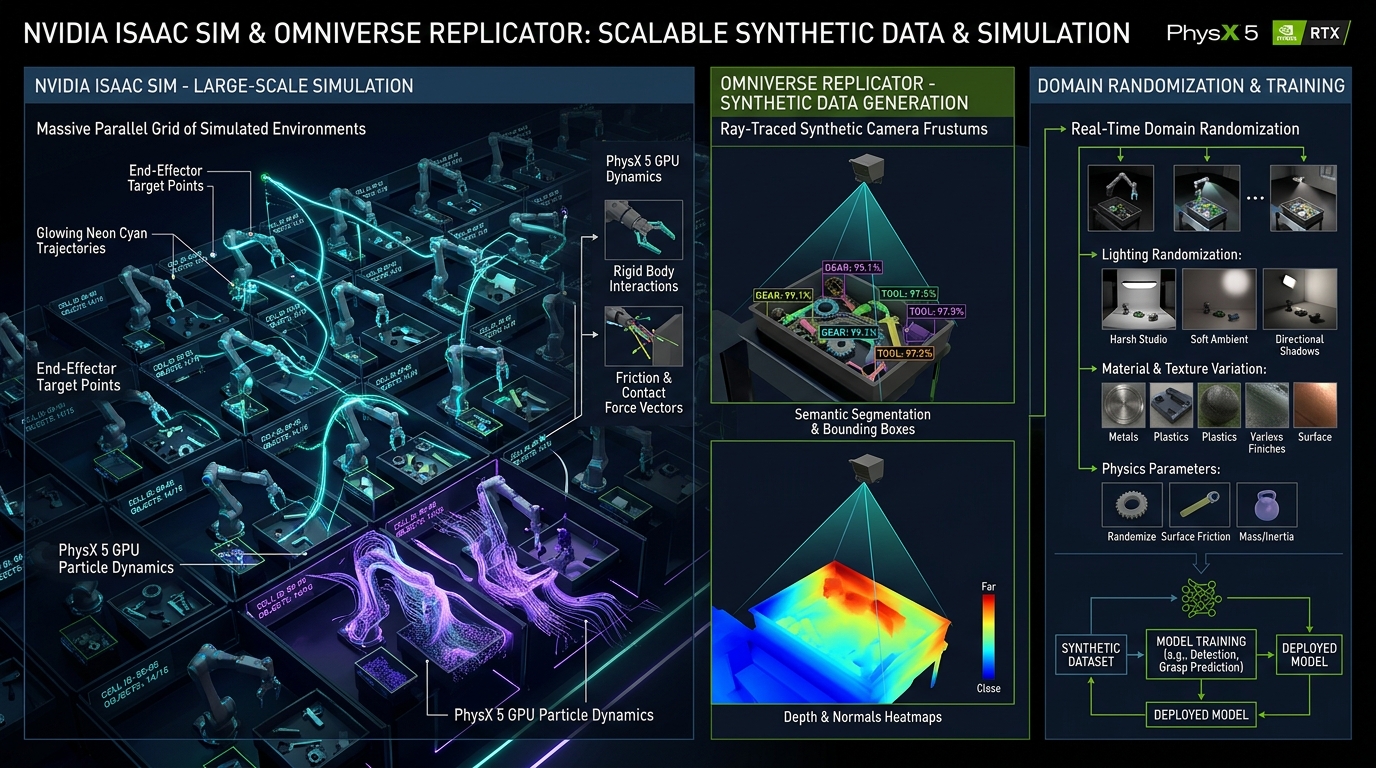
To solve both bottlenecks, NVIDIA developed Isaac Sim (powered by Omniverse and GPU-accelerated PhysX 5) and Omniverse Replicator: a high-throughput synthetic data generation and simulation platform capable of simulating thousands of robot environments in parallel on a single GPU while closing the Sim-to-Real gap through Domain Randomization (DR).
Official Framework & Tooling Summary
| Component | Technical Role & Official Developer Link |
|---|---|
| Robotics Simulator | NVIDIA Isaac Sim (Built on OpenUSD & Omniverse Kit) |
| Synthetic Data Engine | NVIDIA Omniverse Replicator |
| GPU Physics Engine | NVIDIA PhysX 5 (GPU rigid bodies, deformables, cloth, fluids) |
| Reinforcement Learning | Isaac Lab / Isaac Gym (Massively parallel GPU-vectorized RL environments) |
| Robotics Sim2Real Research | NVIDIA Sim2Real Developer Deep-Dives & GPU-Accelerated TriFinger Dexterous Transfer |
| Autonomous Vehicle Sim2Real | Sim2Real-AD: VLM-Guided RL for Real-World Autonomous Driving (Zero-shot physical vehicle deployment) |
| ROS Integration | Isaac ROS & ROS 2 Bridge (Zero-copy NITROS transport) |
| Containerized Deployment | NGC Isaac Sim Container (nvcr.io/nvidia/isaac-sim:...) |
2. Intuitive Mental Model: The Massively Parallel Wind Tunnel
To understand how Isaac Sim and Replicator achieve industrial scale, consider the Automotive Crash Test & Wind Tunnel Metaphor.
If an automaker had to build and physically crash 100,000 real cars to optimize an airbag sensor algorithm, the cost and timeline would be prohibitive. Instead, aerodynamicists and safety engineers use high-performance computational fluid dynamics (CFD) and virtual wind tunnels.
Isaac Sim operates as a Massively Parallel GPU Wind Tunnel for robots. Instead of running a single robot arm in a virtual room, PhysX 5 vectorizes the physical equations across thousands of GPU CUDA cores simultaneously:
- Vectorized Environments (Isaac Lab): 4,096 identical robotic arms operate in parallel on a single NVIDIA RTX GPU, accumulating 4,096 seconds of physical trajectory data in just 1 elapsed second of real wall-clock time ($4096\times$ speedup).
- Automated Weather & Lighting Shifts (Omniverse Replicator): While the robots train, Replicator dynamically varies surface textures, light angles, camera noise, and friction parameters on every single frame.
When the robot policy finally transfers from the virtual wind tunnel to a real physical warehouse, the physical world simply looks like just another variation it has already mastered thousands of times before.
flowchart TD
    A["OpenUSD Robot CAD & Scene Model<br/>Mass, Inertia Tensors, Articulation Limits"] --> B["PhysX 5 GPU Vectorized Dynamics<br/>4,096 Parallel Environments on Single GPU"]
    B --> C["Omniverse Replicator Pipeline<br/>Domain Randomization Triggers"]
    C --> D["Parameter Perturbations<br/>Friction: μ ∈ [0.1, 1.5], Mass, Lighting, Camera Noise"]
    C --> E["Ray-Traced Synthetic Sensor Frustums<br/>RGB, Depth, LiDAR, Point Clouds, 3D Bounding Boxes"]
    D --> F["Vectorized Tensor Buffer in VRAM<br/>Zero-copy GPU direct memory transfer"]
    E --> F
    F --> G["Policy Training Loop (PPO / VLA Fine-Tuning)<br/>Millions of experiences collected per hour"]
    G --> H["Zero-Shot Sim-to-Real Hardware Deployment"]

    style A fill:#0d2b45,stroke:#00e5ff,stroke-width:2px,color:#ffffff
    style B fill:#0d2b45,stroke:#00e5ff,stroke-width:2px,color:#ffffff
    style C fill:#1e293b,stroke:#38bdf8,stroke-width:2px,color:#ffffff
    style D fill:#1e293b,stroke:#38bdf8,stroke-width:2px,color:#ffffff
    style E fill:#1e293b,stroke:#38bdf8,stroke-width:2px,color:#ffffff
    style F fill:#0f172a,stroke:#a855f7,stroke-width:2px,color:#ffffff
    style G fill:#0f172a,stroke:#a855f7,stroke-width:2px,color:#ffffff
    style H fill:#0f2b1d,stroke:#10b981,stroke-width:2px,color:#ffffff
3. Sensor Synthesis Modalities in Omniverse Replicator
Omniverse Replicator turns graphics computation into pixel-accurate synthetic ground truth, rendering multiple sensor modalities simultaneously without manual data annotation:
| Sensor Modality | Underlying RTX Generation Method | Ground-Truth Output |
|---|---|---|
| RGB Camera Frustum | RTX real-time path tracing with physical camera optics (ISO, focal length, aperture) | Photorealistic color frames with motion blur and depth of field |
| Depth & Surface Normals | Exact geometric ray intersection distance buffers | Metric depth maps ($Z$ in meters) and 3D surface unit normal vectors ($n \in \mathbb{R}^3$) |
| 3D Bounding Boxes | Oriented 3D bounding cuboids mapped from USD prim bounds | Exact 6-DoF bounding box coordinates ($x, y, z, w, h, d, \theta$) |
| Instance & Semantic Segmentation | USD Prim identifier mapping per pixel | Pixel-level semantic labels and instance IDs with zero human labeling error |
| Synthetic LiDAR / Radar | RTX ray-casting acceleration structure (BVH) | Dense 3D point clouds ($[x, y, z, \text{intensity}]$) with configurable beam patterns |
4. The Sim-to-Real Continuum: From System Identification to Domain Randomization
In robotic reinforcement learning and physical AI, bridging the Sim-to-Real Gap requires addressing two distinct sources of error:
- Visual Domain Gap: Discrepancies between synthetic rasterization and real-world camera artifacts (sensor noise, lens flares, ambient reflections, rolling shutter distortions).
- Physical / Dynamics Gap: Unmodeled physical phenomena (cable drag, motor thermal degradation, non-linear gearbox backlash, uncalibrated friction variations, and communication latency).
As documented in NVIDIA Developer Sim2Real Research, the physical AI ecosystem employs three complementary transfer methodologies:
| Sim-to-Real Methodology | Primary Mechanism | Best Suited For | Real-World Limitation |
|---|---|---|---|
| System Identification (SysID) | Precisely measuring physical hardware dynamics (moment of inertia, joint damping, motor torque constants) and coding them into simulation. | High-precision industrial robotics with rigid kinematics in static environments. | Extremely labor-intensive; cannot model non-linear dynamic wear or environmental shifts. |
| Domain Randomization (DR) | Deliberately perturbing simulator physics and optics across wide distributions $P(\Xi)$ so real-world parameters become an in-distribution interpolation. | Generalist humanoid locomotion, bin-picking, and dexterous manipulation. | Overly wide randomization can yield conservative, sub-optimal policies. |
| Domain Adaptation & Sim2Real GANs | Using neural translation networks (CycleGAN, contrastive feature alignment) to map real sensor observations into the simulation domain (or vice-versa). | Optical camera perception and semantic segmentation pipelines. | High computational overhead; susceptible to hallucinated visual features. |
Case Study 1: High-Throughput Sim2Real on TriFinger Dexterous Manipulation
In landmark NVIDIA research (Transferring Dexterous Manipulation from GPU Simulation to Remote TriFinger Hardware), researchers trained a dexterous cube-manipulation policy in Isaac Gym across thousands of parallel environments collecting over 100,000 samples per second on a single GPU.
By applying comprehensive domain randomization across both environment dynamics (friction, mass, joint damping) and proprioceptive observation noise (delay buffers, encoder jitter), the policy transferred directly to physical robotic hands in a zero-shot fashion, winning 1st place in the Real Robot Challenge.
Case Study 2: Autonomous Driving Sim2Real (Sim2Real-AD)
The principles of Sim2Real extend far beyond stationary robotic arms and humanoids to safety-critical Autonomous Vehicles (AVs). In recent landmark research (Sim2Real-AD: A Modular Sim-to-Real Framework for Deploying VLM-Guided Reinforcement Learning in Real-World Autonomous Driving), researchers demonstrated how simulation-trained reinforcement learning policies transfer zero-shot onto full-scale physical vehicles (Ford E-Transit).
Sim2Real for autonomous driving decomposes the transfer challenge into modular architectural bridges:
- Geometric Observation Bridge (GOB): Transforms monocular front-view camera streams into simulator-compatible Bird’s-Eye-View (BEV) representations, insulating the driving policy from photorealistic domain shifts.
- Physics-Aware Action Mapping (PAM): Translates normalized simulation throttle/steering actions into platform-agnostic longitudinal and lateral physical vehicle dynamics (accounting for tire slip, vehicle inertia, and actuator lag).
- Two-Phase Progressive Training (TPT): Decouples observation-space domain randomization from action-space control stabilization, achieving over 90% car-following and 80% obstacle avoidance success rates on physical streets without a single real-world training crash.
flowchart TD
    A["Simulation Stage: Isaac Sim / Isaac Lab (PhysX 5)"] --> B["Massive GPU Parallelism<br/>100,000+ Transition Samples / Second"]
    B --> C["Sim2Real Perturbation Engine"]
    C --> C1["Physical Dynamics Randomization<br/>Mass m ~ N(m0, σ²), Friction μ ~ U(0.1, 1.5), Motor Damping"]
    C --> C2["Perceptual & Sensor Noise Injection<br/>Camera Latency (10-50ms), Jitter, Motion Blur"]
    C1 --> D["Vectorized Policy Optimization (PPO / VLA / VLM-RL)"]
    C2 --> D
    D --> E["Zero-Shot Sim-to-Real Hardware Deployment"]
    E --> E1["Robotics: Physical TriFinger & Humanoids"]
    E --> E2["Autonomous Vehicles: Full-Scale Drive by Wire"]

    style A fill:#0d2b45,stroke:#00e5ff,stroke-width:2px,color:#ffffff
    style B fill:#0d2b45,stroke:#00e5ff,stroke-width:2px,color:#ffffff
    style C fill:#1e293b,stroke:#38bdf8,stroke-width:2px,color:#ffffff
    style C1 fill:#1e293b,stroke:#38bdf8,stroke-width:2px,color:#ffffff
    style C2 fill:#1e293b,stroke:#38bdf8,stroke-width:2px,color:#ffffff
    style D fill:#0f172a,stroke:#a855f7,stroke-width:2px,color:#ffffff
    style E fill:#0f2b1d,stroke:#10b981,stroke-width:2px,color:#ffffff
    style E1 fill:#0f2b1d,stroke:#10b981,stroke-width:2px,color:#ffffff
    style E2 fill:#0f2b1d,stroke:#10b981,stroke-width:2px,color:#ffffff
5. Engineering Deep-Dive: Domain Randomization Mathematics & PhysX 5 Dynamics
5.1 Domain Randomization Objective Formulation
To guarantee robust Sim-to-Real policy transfer, Omniverse Replicator samples physical and visual environmental parameters from a domain parameter distribution $P(\Xi)$. The policy parameters $\theta$ are optimized to maximize the expected task reward under all environmental perturbations:
$$J(\theta) = \mathbb{E}{\xi \sim P(\Xi)} \left[ \mathbb{E}{\tau \sim \pi_\theta(\mathcal{M}(\xi))} \left[ \sum_{t=0}^{T} \gamma^t R(s_t, a_t; \xi) \right] \right]$$
Where:
- $\xi \in \Xi$ is the domain randomization parameter vector composed of physical friction ($\mu \sim \mathcal{U}(\mu_{\min}, \mu_{\max})$), payload mass ($m \sim \mathcal{N}(m_0, \sigma_m^2)$), and camera noise ($\eta \sim \mathcal{N}(0, \Sigma_{\mathrm{cam}})$).
- $\mathcal{M}(\xi)$ represents the randomized Markov Decision Process (MDP) instantiated by PhysX 5.
- $\tau = (s_0, a_0, s_1, a_1, \dots)$ is the trajectory rollout generated under policy $\pi_\theta$.
- $R(s_t, a_t; \xi)$ is the task reward function evaluated under context $\xi$.
5.2 PhysX 5 Vectorized Rigid Body Dynamics
PhysX 5 solves multi-body robotic articulation dynamics using maximal-coordinate Featherstone-style equations computed directly on GPU CUDA cores:
$$\mathbf{M}(q) \ddot{q} + \mathbf{C}(q, \dot{q}) \dot{q} + \mathbf{g}(q) = \mathbf{\tau} + \mathbf{J}_c(q)^T \mathbf{f}_c$$
Where:
- $\mathbf{M}(q) \in \mathbb{R}^{n \times n}$ is the generalized mass/inertia matrix.
- $\mathbf{C}(q, \dot{q}) \in \mathbb{R}^{n \times n}$ represents Coriolis and centrifugal acceleration terms.
- $\mathbf{g}(q) \in \mathbb{R}^n$ is the gravitational torque vector.
- $\mathbf{\tau} \in \mathbb{R}^n$ is the control torque vector applied by the robot actuators.
- $\mathbf{J}_c^T \mathbf{f}_c$ represents contact forces mapped through the contact Jacobian $\mathbf{J}_c$.
6. Interactive Python Simulation: Isaac Sim Vectorized Domain Randomizer
The following self-contained, zero-dependency Python script demonstrates:
- Simulating a vectorized fleet of 1,000 parallel robotic environments.
- Injecting automated Domain Randomization (friction, mass, lighting variations).
- Measuring policy reward distribution shifts across Sim vs. Real environments.
Click to expand runnable Python simulation script
#!/usr/bin/env python3
"""
NVIDIA Isaac Sim & Omniverse Replicator Simulation
Demonstrates:
1. Vectorized parallel robot environments.
2. Domain Randomization (DR) parameter sampling.
3. Sim-to-Real policy transfer reward distributions.
"""

import random
import math

class IsaacVectorizedEnvSim:
    """Simulates parallel GPU environments in Isaac Sim / Isaac Lab."""
    def __init__(self, num_envs=1000):
        self.num_envs = num_envs
        self.envs = []
        for env_id in range(num_envs):
            # Base environmental parameters
            self.envs.append({
                "id": env_id,
                "friction_mu": 0.5,
                "payload_mass_kg": 2.0,
                "light_intensity_lux": 1000,
                "camera_noise_std": 0.01,
                "target_position": [0.5, 0.2, 0.0]
            })

    def apply_domain_randomization(self):
        """Randomizes physical and visual parameters using Omniverse Replicator logic."""
        for env in self.envs:
            # Physical Domain Randomization
            env["friction_mu"] = random.uniform(0.1, 1.5)
            env["payload_mass_kg"] = random.gauss(2.0, 0.4)
            # Visual Domain Randomization
            env["light_intensity_lux"] = random.uniform(300, 3000)
            env["camera_noise_std"] = random.uniform(0.005, 0.05)

    def evaluate_policy_step(self, policy_gain=2.5):
        """Executes one control step across all parallel environments."""
        rewards = []
        for env in self.envs:
            # Physics calculation: error under randomized dynamics
            mass_factor = env["payload_mass_kg"] / 2.0
            friction_factor = env["friction_mu"]

            # Position tracking error
            tracking_error = (0.05 * mass_factor) / friction_factor + random.gauss(0, env["camera_noise_std"])
            reward = max(0.0, 10.0 - (policy_gain * abs(tracking_error)))
            rewards.append(reward)

        return rewards

def main():
    print("=" * 70)
    print("🤖 NVIDIA Isaac Sim & Omniverse Replicator Simulation")
    print("=" * 70)

    num_envs = 1000
    print(f"\n🚀 Instantiating {num_envs} GPU-Vectorized Robot Environments...")
    sim = IsaacVectorizedEnvSim(num_envs=num_envs)

    # 1. Baseline Evaluation (No Domain Randomization)
    base_rewards = sim.evaluate_policy_step()
    avg_base = sum(base_rewards) / len(base_rewards)
    print(f"📊 Baseline Mean Reward (Ideal Sim): {avg_base:.2f} / 10.00")

    # 2. Apply Omniverse Replicator Domain Randomization
    print("\n🎲 Triggering Omniverse Replicator Domain Randomization (DR):")
    sim.apply_domain_randomization()
    sample_env = sim.envs[0]
    print(f"  Sample Env #0: Friction μ = {sample_env['friction_mu']:.2f} | Mass = {sample_env['payload_mass_kg']:.2f} kg | Light = {sample_env['light_intensity_lux']:.0f} lux")

    # 3. Randomized Evaluation
    dr_rewards = sim.evaluate_policy_step()
    avg_dr = sum(dr_rewards) / len(dr_rewards)
    variance_dr = sum((r - avg_dr)**2 for r in dr_rewards) / len(dr_rewards)

    print(f"\n📈 Post-Randomization Mean Reward: {avg_dr:.2f} / 10.00 (Variance: {variance_dr:.4f})")
    print(f"🛡️ Robustness Coverage: Policy successfully evaluated across {num_envs} diverse environments simultaneously.")

    print("\n✅ Isaac Sim & Replicator pipeline executed successfully.")
    print("=" * 70)

if __name__ == "__main__":
    main()
7. Summary & Architectural Takeaways
NVIDIA Isaac Sim and Omniverse Replicator transform robotics training from physical hardware bottlenecks into GPU-accelerated computing:
- Massive GPU Parallelism: By executing PhysX 5 dynamics directly inside GPU memory, Isaac Sim simulates thousands of robot environments in parallel, speeding up reinforcement learning data collection by thousands of times.
- Automated Ground-Truth Annotation: Omniverse Replicator generates photorealistic RGB frames, metric depth maps, 3D bounding boxes, and point clouds simultaneously with zero manual labeling overhead.
- Closing the Sim-to-Real Gap: Comprehensive Domain Randomization across friction, mass, sensor noise, and lighting ensures that policies generalize seamlessly to real-world hardware.
In Part 6 of our series, we will dissect Project GR00T, exploring how generalist humanoid foundation models tokenize multimodal sensory inputs and use diffusion policy heads to predict complex 6-DoF robot actions.