Gemini at Work: Google Cloud's Universal Coworker Agent, Dedicated Workspace Identities, and Enterprise Agency
Inside Google Cloud's Gemini at Work 2026: persistent coworker agents with dedicated @agents email addresses, calendar and Drive storage, Model Context Protocol tooling, and multi-model routing across Gemini and Claude.

Series: ← Claude Haiku 5.5: Adaptive Thinking, Effort Scaling, and Frontier Agentic Work at Scale (Previous) | OpenAI DevDay 2026: Dots Always-On Agents, GPT-6.1 Sol’s 80% Price Cut, the Decisions API — Plus Salesforce Koa and NVFP4 KV Cache (Next) →
Summary
On October 8, 2026, at the Gemini at Work 2026 executive summit, Google Cloud unveiled the Gemini agent—a “universal agent for work” engineered to handle complex, asynchronous, multi-day enterprise initiatives. While the prior generation of workplace assistants functioned as conversational add-ons embedded in sidebars, the Gemini agent operates as an authentic digital coworker.
Crucially, Google resolved the fundamental enterprise governance obstacle of agent agency: identity and accountability. Every deployed coworker agent receives its own first-class Google Workspace corporate identity—complete with a dedicated @agents.company.com email address, shared calendar, Drive directory, and corporate directory listing. Running persistently in the cloud, coworker agents autonomously plan work, invoke tools, interface across business systems (Salesforce, ServiceNow, Jira, Snowflake, BigQuery), and orchestrate seamlessly across both Google’s native Gemini models and Anthropic’s Claude family. When broadly released, the capability will be included natively within Gemini Enterprise at no additional charge for existing subscribers.
Official Announcement & Model Specifications
| Platform Attribute | Enterprise Specification |
|---|---|
| Announcement Event | Google Cloud Gemini at Work Summit (October 8, 2026) |
| Product Tier | Built natively into Google Cloud Gemini Enterprise |
| Core Architecture | Universal Asynchronous Agent runtime with persistent cloud daemons |
| Workspace Identity | Dedicated corporate email (name@agents.company.com), Google Calendar, Drive, Directory listing |
| Cross-Platform Reach | Google Workspace (Gmail, Docs, Sheets, Slides, Drive, Chat, Meet), Microsoft 365, Slack |
| System Integrations | Salesforce, ServiceNow, Jira, Snowflake, BigQuery, and Model Context Protocol (MCP) servers |
| Multi-Model Orchestration | Dynamic execution across Google Gemini (Gemini 4 Argon, Gemini 3.8) and Anthropic Claude models |
| Enterprise Governance | Dedicated agent-attributed audit trails, real-time spend limits, containerized execution sandboxes |
| Availability & Pricing | Private preview for select customers (Oct 8, 2026); included at no extra cost in Gemini Enterprise |
Prior Reading Material
To trace how Google’s enterprise agent strategy intersects with broader autonomous agent architectures and protocols, review our prerequisite deep dives:
- Google Gemini Spark: Always-On Workspace Intelligence, AP2 Protocols, and Cloud VM Isolation — Google’s background daemons, MCP routing, and FIDO cryptographic payment mandates.
- Gemini 4 Argon: Inside Google’s 1M-Token Output Frontier Model, Enterprise Benchmarks, and Cyber Defense — Google’s million-token reasoning engine powering complex enterprise synthesis.
- Model Context Protocol (MCP): Tool Integration in Claude Code — Standardized tool communication protocol underpinning modern multi-agent enterprise stacks.
- The Always-On Agent Showdown: Architectural, Security, and Autonomy Comparison Across Meta Muse, OpenAI Dots, Google Gemini Spark, and Perplexity Computer — Comprehensive head-to-head evaluation of the leading 2026 always-on agent architectures.
- OpenAI DevDay 2026: Dots Always-On Agents, GPT-6.1 Sol’s 80% Price Cut, the Decisions API — Plus Salesforce Koa and NVFP4 KV Cache — OpenAI’s competing platform play with cloud-computer Dots.
1. The Enterprise Identity Paradox: Why Chatbots Needed Email Addresses
For years, enterprise IT and security compliance officers held an insurmountable objection to autonomous AI agents: the identity attribution vacuum.
When an employee interacted with a conversational AI sidebar, any action taken by that tool—such as modifying a shared spreadsheet, triggering a pull request, or dispatching an API webhook—was either executed using the human employee’s personal OAuth token or routed through a generic service account. This created two fatal enterprise failure modes:
- The Overprivileged Puppet: If an agent borrowed the human’s broad credentials, a single prompt injection vulnerability could compromise every file and email the human had access to.
- The Forensic Void: When an automated process inadvertently corrupted a database record or sent an incorrect vendor quote, the audit log attributed the event to the human employee, rendering compliance tracking impossible.
Google Cloud’s Gemini agent cuts through this dilemma by granting coworker agents first-class corporate citizenship.
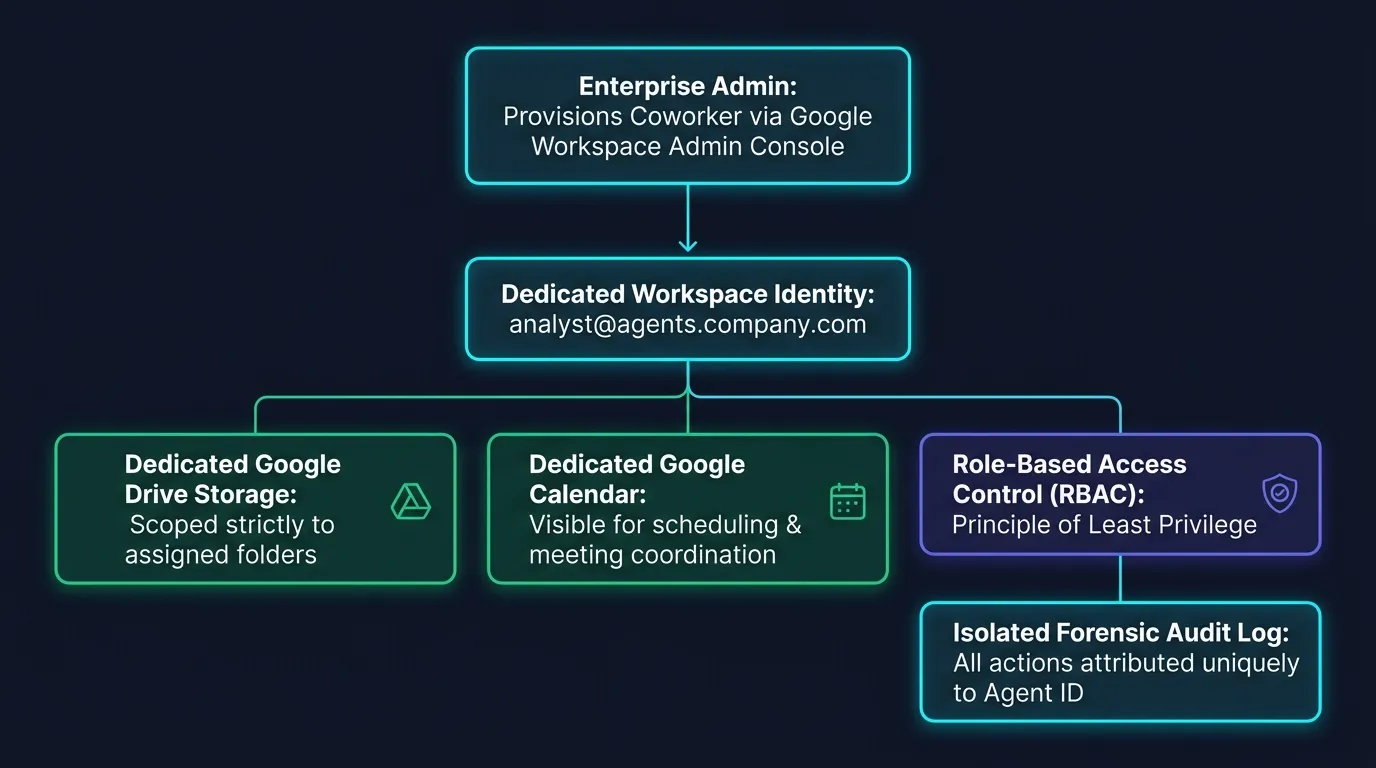 Figure: The Coworker Agent Identity Paradigm. Enterprise administrators provision AI coworkers with first-class Google Workspace corporate identities (
@agents.company.com), establishing strict RBAC boundaries, scoped drive allocations, and dedicated forensic audit trails.
By provisioning the coworker agent with an explicit @agents.company.com email address, organizations can manage, permission, monitor, and revoke AI coworkers using the identical security policies, single sign-on (SSO) boundaries, and Mobile Device Management (MDM) infrastructure already governing human employees.
2. Architecture of the Gemini Universal Agent
Under the hood, the Gemini agent operates as a multi-stage autonomous control loop designed for long-running, multi-day objectives:
flowchart TD
    subgraph ExecutionEngine["Gemini Agent Execution Lifecycle"]
        direction TB
        Delegation["Manager assigns objective: via Email, Google Chat @mention, or Web Portal"] --> Decompose["Asynchronous Objective Decomposition & Milestone Planning"]
        Decompose --> ToolDispatch["Enterprise Connector & MCP Mesh Execution"]
        ToolDispatch --> Systems["Business Systems: Salesforce, ServiceNow, Jira, BigQuery, Snowflake"]
        Systems --> StateLoop{"Milestone Complete?"}
        StateLoop -- "Continuous Progress" --> PersistentCloud["Cloud Daemon: Executes while human device is closed"]
        PersistentCloud --> ToolDispatch
        StateLoop -- "Action Required / Verification" --> Deliverables["Delivers finished work: Google Docs, Inboxes, or GitHub PRs"]
        Deliverables --> Review["Human Colleague Reviews & Signs Off"]
    end
    style ExecutionEngine fill:#0f172a,stroke:#00e5ff,stroke-width:2px,color:#ffffff
    style Delegation fill:#1e293b,stroke:#38bdf8,stroke-width:1px,color:#ffffff
    style Decompose fill:#0d2b45,stroke:#00e5ff,stroke-width:1px,color:#ffffff
    style ToolDispatch fill:#1e1b4b,stroke:#818cf8,stroke-width:1px,color:#ffffff
    style Systems fill:#0f382c,stroke:#10b981,stroke-width:1px,color:#ffffff
    style PersistentCloud fill:#0f2027,stroke:#64748b,stroke-width:1px,color:#ffffff
    style Deliverables fill:#00e5ff,stroke:#ffffff,stroke-width:2px,color:#000000
    style Review fill:#3b1e2b,stroke:#f43f5e,stroke-width:1px,color:#ffffff
The Three Core Architectural Pillars:
- Persistent Cloud Execution: Unlike browser-tied extensions that freeze the moment a laptop lid shuts, coworker agents run on Google Cloud infrastructure. A task requiring forty-eight hours of data gathering across global inventory databases and cross-referencing against internal legal briefs proceeds uninterrupted in the cloud.
- Cross-Platform Operating Radius: While deeply native to Google Workspace (Gmail, Docs, Sheets, Slides, Drive, Google Chat, Meet), the agent extends directly into third-party ecosystems. It can read messages in Microsoft 365 Outlook, coordinate tasks across Slack channels, and update records in Jira.
- Model Heterogeneity (Gemini + Claude): In a major validation of open ecosystem engineering, Google Cloud designed the Gemini agent to orchestrate tasks across multiple foundation models. While default routing utilizes Google’s Gemini 4 Argon and Gemini 3.8 Flash, enterprise customers can configure execution sub-tasks to route directly to Anthropic’s Claude model family hosted on Google Cloud Vertex AI.
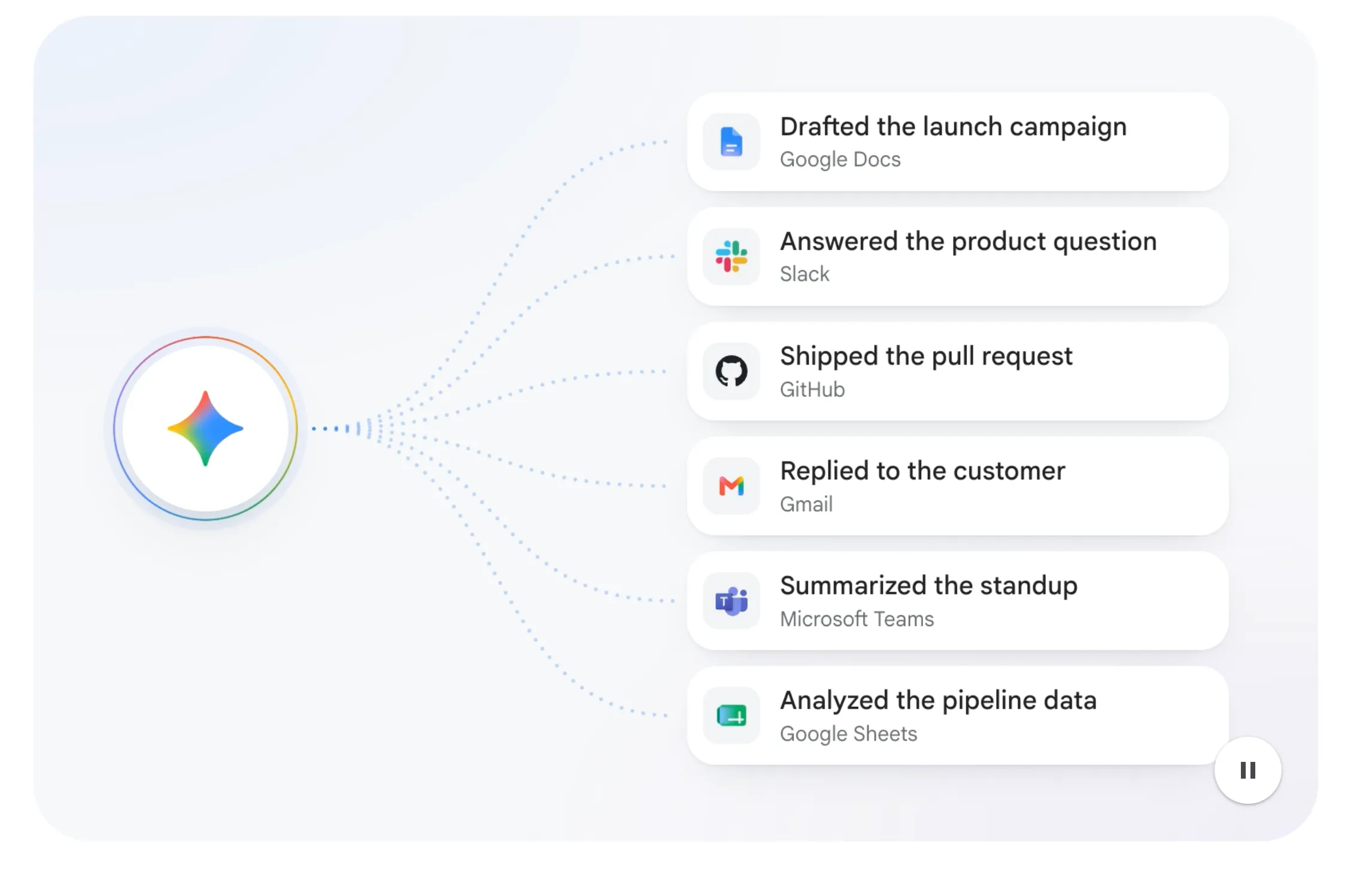 Figure 1: Official concept demonstration of the Gemini coworker agent autonomously orchestrating work across Google Docs, Slack, GitHub, Gmail, Microsoft Teams, and Google Sheets. Image credit: Google Cloud.
3. The Enterprise-Agent Race: Three Contrasting Paradigms
The release of the Gemini agent on October 8 completes a historic trifecta of autonomous agent platform moves in the autumn of 2026:
flowchart TD
    subgraph EnterpriseRace["The Enterprise-Agent Race: Three Strategic Moves"]
        direction TB
        MetaMove["1. Meta Muse (September 2026): The Personal Mobile Concierge"]
        OAIMove["2. OpenAI Dots (September/October 2026): The Cloud Computer Coworker"]
        GoogleMove["3. Google Gemini Agent (October 2026): The Universal Workspace Coworker"]
        MetaMove --> OAIMove --> GoogleMove
    end
    style EnterpriseRace fill:#0f172a,stroke:#00e5ff,stroke-width:2px,color:#ffffff
    style MetaMove fill:#1e1b4b,stroke:#a855f7,stroke-width:1px,color:#ffffff
    style OAIMove fill:#0d2b45,stroke:#00e5ff,stroke-width:1px,color:#ffffff
    style GoogleMove fill:#0f382c,stroke:#10b981,stroke-width:1px,color:#ffffff
How the Three Rivals Line Up:
- Meta — Muse: Positioned as the personal consumer agent. It shops, plans vacations, monitors deals, handles personal correspondence, and executes payments via Stripe Link inside secure microVMs monitored by host-side eBPF kernel filters.
- OpenAI — Dots: Positioned as always-on digital specialists. Each Dot is allocated a sandboxed cloud computer running headless Chromium and GPT-6 Astra, operating between conversations to investigate software bugs, author pull requests, and monitor Slack channels.
- Google Cloud — Gemini Agent: Positioned as the universal enterprise employee. Rather than requiring a dedicated virtual desktop, it integrates into the software fabric where enterprise work already happens. By giving each agent its own email address and Google Workspace account, it solves enterprise directory listing, permission scoping, and forensic audit logging.
4. Enterprise Governance, Security & Packaging
Google Cloud architected the Gemini agent to address the strict regulatory demands of Fortune 500 enterprises:
flowchart TD
    subgraph SecurityStack["Enterprise Governance & Safeguards"]
        direction TB
        Tenant["Isolated Tenant Boundary: Customer data never used for foundation training"] --> Scopes["Granular IAM Permissions: Principle of least privilege per agent identity"]
        Scopes --> Caps["Real-Time Spend & Compute Caps: Prevents runaway autonomous token loops"]
        Caps --> Sandboxing["Containerized MicroVM Sandboxes: Ephemeral execution environments"]
        Sandboxing --> AuditStream["Immutable Cloud Audit Logs: Complete cryptographic event history"]
    end
    style SecurityStack fill:#0f172a,stroke:#00e5ff,stroke-width:2px,color:#ffffff
    style Tenant fill:#1e293b,stroke:#38bdf8,stroke-width:1px,color:#ffffff
    style Scopes fill:#0d2b45,stroke:#00e5ff,stroke-width:1px,color:#ffffff
    style Caps fill:#1e1b4b,stroke:#818cf8,stroke-width:1px,color:#ffffff
    style Sandboxing fill:#0f382c,stroke:#10b981,stroke-width:1px,color:#ffffff
    style AuditStream fill:#00e5ff,stroke:#ffffff,stroke-width:2px,color:#000000
Key Security Controls:
- Real-Time Financial and Token Caps: Administrators can establish hard token spend and API execution quotas per coworker agent, eliminating the risk of runaway recursive execution loops.
- Scoped Directory Permissions: An agent created to assist the procurement team can be restricted strictly to procurement Drive folders and vendor email correspondence, with zero technical capability to query HR or engineering files.
- Zero Extra Charge in Gemini Enterprise: Demonstrating the aggressive commoditization of agentic software harnesses, Google Cloud announced that the Gemini agent runtime will be bundled directly into existing Gemini Enterprise subscriptions at no additional cost upon general availability.
5. Summary & What to Watch
The introduction of Google Cloud’s Gemini agent signals that the era of experimentation in enterprise AI has closed. The battle has migrated from raw benchmark metrics to organizational integration:
- Identity-First Agency: Assigning AI agents their own email addresses, calendars, and organizational IDs establishes the blueprint for future enterprise compliance.
- Multi-Model Neutrality: Google’s native support for Anthropic Claude alongside Gemini models marks a pragmatic recognition that enterprise customers demand multi-model flexibility.
- The Bundle Wins: By bundling the agent directly into Gemini Enterprise, Google is exerting immense pricing pressure on standalone agent startups.
What to Monitor:
- Private Preview Feedback: How effectively early enterprise pilot customers manage the onboarding, training, and permissioning of coworker agents.
- Cross-Ecosystem Friction: How seamlessly coworker agents operate inside rival Microsoft 365 environments in production.
- The Autonomous Evolution: How the interplay between Google’s Gemini agent and protocols like FIDO AP2 transforms automated enterprise procurement throughout 2027.
6. References & External Links
- Reuters — Google Cloud Introduces Gemini Agent for Work as AI Race Heats Up (Oct 8, 2026)
- Google Cloud — Gemini Enterprise Official Overview
- Official Google Blog — Introducing the Gemini Universal Agent for Work
- Decrypt — Google Cloud Launches Coworker Agents with Dedicated Workspace Accounts
- VentureBeat — Google Cloud Unveils Gemini Agent Built Into Gemini Enterprise