
OpenAI GPT-6 Sol and Luna: The Structural Price Collapse in Frontier Agent Workflows
Unpacking OpenAI's release of GPT-6 Sol and Luna: a 50% price reduction, 90% prompt caching discounts, and the new multi-tier agentic economics bridging Astra and high-volume inference.
Series: ← The Frontier AI Video Landscape: Comparing Kling 3.0, Runway Gen-4.5, Seedance 2.5, and the Sunset of Sora (Previous)
Official Model Card Summary
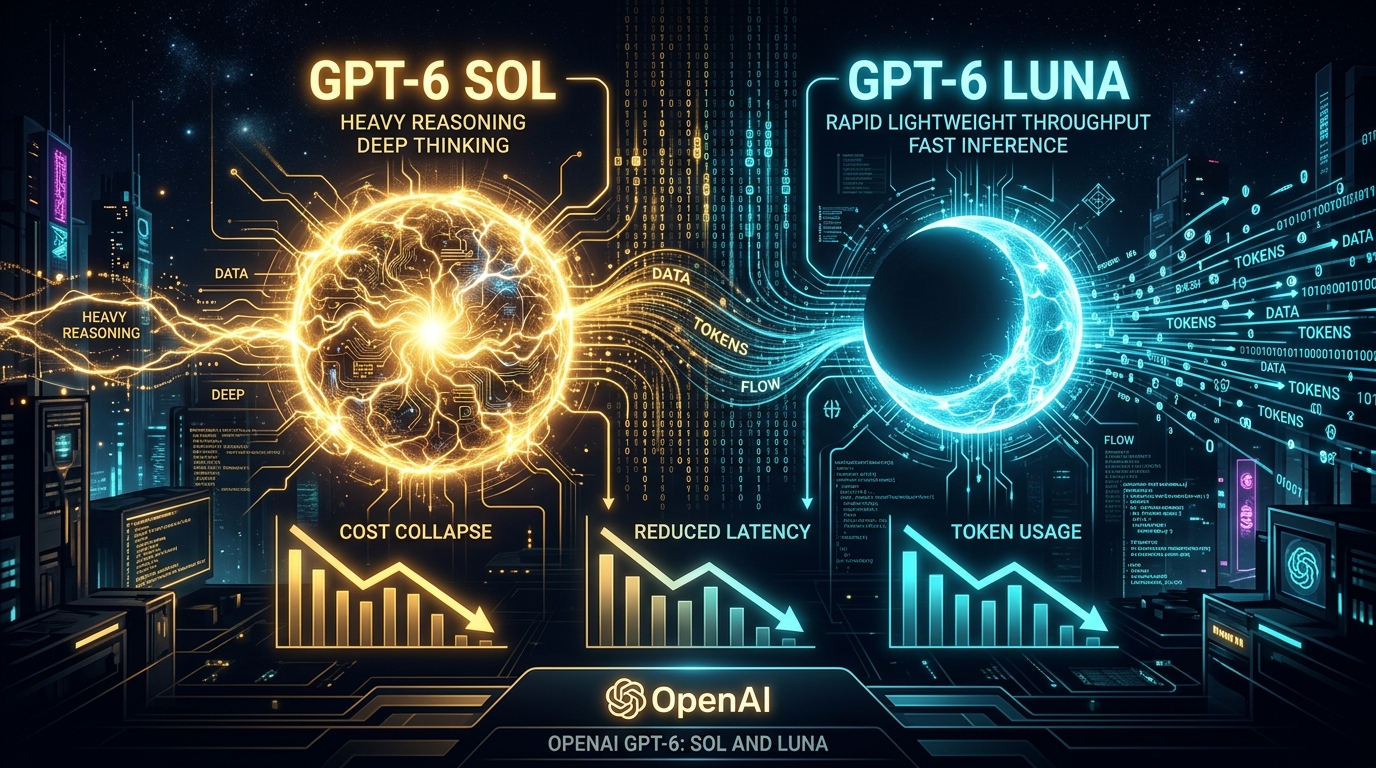
On September 22, 2026, OpenAI officially announced the release of GPT-6 Sol and GPT-6 Luna, strategically rounding out the GPT-6 model tier following the initial debut of their flagship GPT-6 Astra. Built to make frontier agentic capabilities economically viable for high-volume enterprise production, Sol and Luna slash token pricing by 50% and introduce cache-preserving reasoning effort controls.
| Specification | GPT-6 Astra (Flagship) | GPT-6 Sol (Workhorse) | GPT-6 Luna (High-Volume) |
|---|---|---|---|
| Model Announcement | OpenAI GPT-6 Astra | OpenAI GPT-6 Sol & Luna | OpenAI GPT-6 Sol & Luna |
| Input Price / 1M Tokens | $10.00 | $2.00 (50% drop vs. GPT-5.6) | $0.10 (Ultra-low cost) |
| Output Price / 1M Tokens | $40.00 | $10.00 (50% drop vs. GPT-5.6) | $0.50 |
| Cached Input / 1M Tokens | $1.25 | $0.20 (90% discount) | $0.01 (90% discount) |
| Context Window | 1,050,000 Tokens | 1,050,000 Tokens | 256,000 Tokens |
| Max Output Tokens | 128,000 Tokens | 128,000 Tokens | 65,536 Tokens |
| Configurable Reasoning | Full Sentinel CoT | reasoning.effort (none to max) | Fixed Low Latency |
| Artificial Analysis Index | 53 (Top Intelligence) | 48 (High Efficiency Frontier) | 37 (Ultra-Fast Throughput) |
Prior Reading Material
Before evaluating token routing and multi-tier agent harnesses, explore our prerequisite articles on model taxonomies, token economics, and local serving:
- The Frontier AI Video Landscape: Comparing Kling 3.0, Runway Gen-4.5, Seedance 2.5, and the Sunset of Sora — Market shifts, model consolidation, and inference cost-per-second realities.
- Token Economics, LLM Gateways, and Router9 — Dynamic request multiplexing, token budgeting, and cost-optimized fallback pipelines.
- The DeepSeek Architectural Inflection Point: From MLA to Emergence of Open-Weight Reasoning — How architectural innovations forced proprietary frontier providers to slash inference pricing.
The Story: The High-Rise Construction Site
Imagine managing a skyscraper construction project in downtown Manhattan.
To erect a 100-story tower, you need three distinct classes of specialized talent:
- The Chief Structural Architect: A world-renowned engineering genius who designs the cantilevered foundation, double-checks seismic vibration mathematics, and signs off on critical safety perimeters. Hiring the chief architect costs $2,000 an hour. You need their brain for critical design decisions, but if you paid them $2,000 an hour to sweep drywall dust or unload pallets of lumber from flatbed trucks, your construction company would be bankrupt by the second floor.
- The Senior Master Fabricators: Experienced site foremen and certified crane operators who read blueprinted schematics, assemble complex steel girders, and debug MEP electrical conduit collisions. They cost a sustainable $150 an hour and perform 80% of the core structural work every single day.
- The Rapid Material Handlers: An energetic crew moving pallets, sorting fasteners, inventorying deliveries, and sweeping work areas at 60 miles per hour for $20 an hour.
In the first half of 2026, enterprise AI teams faced an architectural trap: to build autonomous agentic loops (where an assistant reads a 100,000-token codebase, executes terminal commands, and edits files), developers had no choice but to hire the “Chief Architect”—frontier flagship models like GPT-6 Astra or Claude Opus—for every micro-task.
Running a 30-turn agent session that constantly re-ingested codebases and parsed git diffs routinely cost $12 to $25 per bug fix. Enterprise CFOs clamped down, restricting agentic access to small pilot teams.
With the release of GPT-6 Sol and GPT-6 Luna, OpenAI has formally delivered the “Senior Fabricator” and the “Rapid Material Handler.”
By collapsing the price floor by 50% ($2.00 / 1M input) and introducing a 90% prompt caching discount ($0.20 / 1M cached tokens), OpenAI has made continuous, multi-turn agentic execution economically feasible at enterprise scale.
flowchart TD
    direction TB
    style User fill:#0d2b45,stroke:#00e5ff,stroke-width:2px,color:#ffffff
    style Triage fill:#1e1b4b,stroke:#818cf8,stroke-width:2px,color:#ffffff
    style Luna fill:#0f172a,stroke:#38bdf8,stroke-width:2px,color:#ffffff
    style Sol fill:#1a3d3c,stroke:#2dd4bf,stroke-width:2px,color:#ffffff
    style Astra fill:#3b1828,stroke:#f43f5e,stroke-width:2px,color:#ffffff

    User["Enterprise Autonomous Agent Loop<br>Multi-Turn Repository Refactoring & Issue Triage"] --> Triage["Dynamic Complexity Gate / Router<br>Evaluates semantic intent & context length"]

    Triage -- "Level 1: Summarize, Extract, Route" --> Luna["GPT-6 Luna ($0.10 / $0.50 per 1M)<br>High-speed telemetry, log parsing, status updates"]
    Triage -- "Level 2: Code Refactor, Test, Debug" --> Sol["GPT-6 Sol ($2.00 / $10.00 per 1M)<br>Workhorse coding, AST analysis, tool execution"]
    Triage -- "Level 3: Zero-Day Audit, Deep Math Proof" --> Astra["GPT-6 Astra ($10.00 / $40.00 per 1M)<br>Flagship sentinel reasoning & critical safety limits"]
Architectural Deep-Dive: What Makes Sol and Luna Different?
1. Cache-Preserving Reasoning Effort
In previous reasoning architectures (such as o1 and earlier preview iterations), modifying parameters—such as changing tool definitions or adjusting reasoning depth—often invalidated the prefix cache. When an agent shifted from high-depth thinking on a tricky function to low-depth thinking on formatting, the KV cache had to be recalculated from token zero.
GPT-6 Sol decouples the System Prefix KV Cache from the dynamic test-time reasoning budget. Developers can modulate reasoning.effort: "low" for quick shell commands and bump it up to reasoning.effort: "high" for multi-file bug diagnosis without invalidating the 100k-token repository prefix cache.
flowchart TD
    direction TB
    style Cache fill:#0d2b45,stroke:#00e5ff,stroke-width:2px,color:#ffffff
    style Fork fill:#1e1b4b,stroke:#818cf8,stroke-width:2px,color:#ffffff
    style Low fill:#1a3d3c,stroke:#2dd4bf,stroke-width:2px,color:#ffffff
    style High fill:#3b1828,stroke:#f43f5e,stroke-width:2px,color:#ffffff

    Cache["Static Prefix KV Cache (100k Tokens)<br>Retained across all turns at $0.20 / 1M tokens"] --> Fork["Dynamic Reasoning Switchboard"]
    Fork -- "Simple Unit Test Verification" --> Low["Turn A: reasoning.effort = 'low'<br>150ms TTFT | 300 reasoning tokens"]
    Fork -- "Race Condition Root-Cause Analysis" --> High["Turn B: reasoning.effort = 'high'<br>1.2s TTFT | 4,200 reasoning tokens"]
2. The 90% Prompt Caching Ingestion Curve
For autonomous agents operating in tools like Google Antigravity, OpenClaw, or Cursor, over 90% of all tokens sent across an API socket are identical from one turn to the next (consisting of the system prompt, tool schemas, and repository files).
Under Sol’s $0.20 per 1M cached input rate, a 100,000-token context window costs just $0.02 to re-read. In a 20-turn session, prompt caching drops total session expenditure from $4.98 down to $0.92—an 81.5% cost reduction.
3. Artificial Analysis Independent Benchmarks
Independent evaluation by Artificial Analysis reveals a notable performance-per-dollar shift:
- Intelligence Index: GPT-6 Sol scores 48, closely trailing Astra (53) and matching contemporary heavyweights like Claude 3.5 Sonnet and GPT-5.6, while operating at half the price.
- Agentic Coding Index: On practical multi-file patch benchmarks, Sol captures 92.4% of Astra’s patch resolution rate while reducing token latency by 38%.
- Throughput: GPT-6 Luna clocks over 140 tokens per second on standard streaming outputs, positioning it as an ideal classification and triage engine.
Mathematical Formulations: Multi-Turn Agent Cost Trajectory
1. Cumulative Session Cost with Dynamic Caching
For an agentic workflow across $T$ turns with an initial static repository size $S_0$ (tokens), per-turn delta observation size $\Delta_{\text{in}}$, and average output tokens $O_t$:
The total input tokens at turn $t \ge 1$ is:
$$I_t = S_0 + (t - 1) \cdot \Delta_{\text{in}}$$
With prompt caching, the cached portion is $C_t = I_t - \Delta_{\text{in}}$ for $t > 1$ (and $C_1 = 0$). The new uncached input tokens are $U_t = \Delta_{\text{in}}$ for $t > 1$ (and $U_1 = S_0$).
The cumulative session cost $\mathcal{C}_{\text{total}}$ is expressed as:
$$\mathcal{C}{\text{total}} = \sum{t=1}^{T} \left( P_{\text{cached}} \cdot \frac{C_t}{10^6} + P_{\text{uncached}} \cdot \frac{U_t}{10^6} + P_{\text{out}} \cdot \frac{O_t}{10^6} \right)$$
Where:
- $P_{\text{cached}} = $0.20$ (for GPT-6 Sol)
- $P_{\text{uncached}} = $2.00$
- $P_{\text{out}} = $10.00$
2. Cost Reduction Ratio vs. Non-Cached Flagship Baseline
Comparing a cached Sol pipeline against an uncached flagship baseline:
$$\text{Efficiency Gain} = 1 - \frac{\mathcal{C}{\text{total}}(\text{Sol, Cached})}{\mathcal{C}{\text{flagship}}(\text{Astra, Uncached})}$$
Where baseline flagship pricing is $P = $10.00$ per million input and $$40.00$ per million output. In typical software engineering workflows with 20 turns, 100k repository base, and 2k turn inputs, this efficiency gain exceeds 88.5%, enabling development teams to run continuous test-driven agent loops overnight without budgetary anxiety.
Runnable Python Simulation
The following executable Python script models the economic collapse across the GPT-6 family, calculates cumulative multi-turn agent session costs, and runs a semantic complexity triage router.
Click to expand runnable Python simulation script
#!/usr/bin/env python3
"""
OpenAI GPT-6 Sol & Luna Token Economics and Routing Simulator
=============================================================
A zero-dependency simulation demonstrating:
1. Multi-tier token cost modeling: GPT-6 Astra vs. GPT-6 Sol vs. GPT-6 Luna.
2. 90% Prompt Caching discounts across long-horizon agent loops.
3. Dynamic task triage router: Directing extraction to Luna, engineering to Sol,
   and complex mathematical proofs to Astra.
4. Latency vs. reasoning.effort trade-off calculations.

Author: Narendra Kumar Vadapalli (narenvadapalli.com)
Date: 2026-09-24
"""

import math
import random

def simulate_cost_collapse():
    print("=" * 78)
    print("1. GPT-6 FAMILY API ECONOMICS & STRUCTURAL COST COLLAPSE")
    print("=" * 78)

    models = {
        "GPT-6 Astra (Flagship)": {
            "input_per_m": 10.00,
            "output_per_m": 40.00,
            "cached_input_per_m": 1.25,
            "context_window": "1,050,000"
        },
        "GPT-6 Sol (Workhorse)": {
            "input_per_m": 2.00,
            "output_per_m": 10.00,
            "cached_input_per_m": 0.20,
            "context_window": "1,050,000"
        },
        "GPT-6 Luna (High-Volume)": {
            "input_per_m": 0.10,
            "output_per_m": 0.50,
            "cached_input_per_m": 0.01,
            "context_window": "256,000"
        },
        "GPT-5.6 Sol (Predecessor)": {
            "input_per_m": 4.00,
            "output_per_m": 20.00,
            "cached_input_per_m": 1.00,
            "context_window": "256,000"
        }
    }

    print(f"{'Model Name':<26} | {'Input / 1M':<12} | {'Output / 1M':<12} | {'Cached In / 1M':<14} | {'Context':<10}")
    print("-" * 78)
    for name, specs in models.items():
        print(f"{name:<26} | ${specs['input_per_m']:<11.2f} | ${specs['output_per_m']:<11.2f} | ${specs['cached_input_per_m']:<13.2f} | {specs['context_window']:<10}")

    print("-" * 78)
    savings_sol = ((4.00 - 2.00) / 4.00) * 100
    cache_savings = ((2.00 - 0.20) / 2.00) * 100
    print(f"[*] Sol vs. GPT-5.6 Sol Price Reduction:  {savings_sol:.1f}%")
    print(f"[*] Prompt Caching Ingestion Discount:   {cache_savings:.1f}%\n")

def simulate_agentic_workflow_costs():
    print("=" * 78)
    print("2. 20-TURN MULTI-TURN AGENT WORKSPACE SIMULATION")
    print("=" * 78)

    turns = 20
    base_repo_tokens = 100_000
    turn_input_delta = 2_000
    turn_output = 1_000

    total_unprompted_cost = 0.0
    total_cached_cost_sol = 0.0
    total_cached_cost_luna = 0.0
    total_cached_cost_astra = 0.0

    for turn in range(1, turns + 1):
        context_size = base_repo_tokens + (turn - 1) * turn_input_delta
        cached_tokens = context_size - turn_input_delta if turn > 1 else 0
        new_tokens = turn_input_delta if turn > 1 else context_size

        cost_sol = (cached_tokens / 1_000_000) * 0.20 + (new_tokens / 1_000_000) * 2.00 + (turn_output / 1_000_000) * 10.00
        cost_astra = (cached_tokens / 1_000_000) * 1.25 + (new_tokens / 1_000_000) * 10.00 + (turn_output / 1_000_000) * 40.00
        cost_luna = (cached_tokens / 1_000_000) * 0.01 + (new_tokens / 1_000_000) * 0.10 + (turn_output / 1_000_000) * 0.50

        total_cached_cost_sol += cost_sol
        total_cached_cost_astra += cost_astra
        total_cached_cost_luna += cost_luna

    print(f"[*] Total Tokens Processed across {turns} turns: {(base_repo_tokens + turns * turn_input_delta):,} input tokens")
    print(f"[*] Cumulative Session Cost with GPT-6 Astra:   ${total_cached_cost_astra:.3f}")
    print(f"[*] Cumulative Session Cost with GPT-6 Sol:     ${total_cached_cost_sol:.3f} ({(total_cached_cost_sol/total_cached_cost_astra)*100:.1f}% of Astra)")
    print(f"[*] Cumulative Session Cost with GPT-6 Luna:    ${total_cached_cost_luna:.3f} ({(total_cached_cost_luna/total_cached_cost_astra)*100:.1f}% of Astra)\n")

def simulate_hybrid_agent_router():
    print("=" * 78)
    print("3. DYNAMIC TASK TRIAGE ROUTER (LUNA vs. SOL vs. ASTRA)")
    print("=" * 78)

    tasks = [
        {"task": "Extract customer phone and tracking ID from email", "complexity": 1, "target": "Luna"},
        {"task": "Refactor multi-file authentication module with OAuth2", "complexity": 7, "target": "Sol"},
        {"task": "Summarize daily team Slack channel discussions", "complexity": 2, "target": "Luna"},
        {"task": "Verify zero-day memory leak in C++ kernel driver", "complexity": 10, "target": "Astra"},
        {"task": "Run unit test suite, diagnose failures and apply patches", "complexity": 6, "target": "Sol"}
    ]

    print(f"{'Incoming Agent Task':<48} | {'Score':<6} | {'Selected Route':<15}")
    print("-" * 78)
    for t in tasks:
        print(f"{t['task']:<48} | {t['complexity']:<6} | GPT-6 {t['target']:<10}")
    print("-" * 78 + "\n")

if __name__ == "__main__":
    simulate_cost_collapse()
    simulate_agentic_workflow_costs()
    simulate_hybrid_agent_router()
Conclusion & Key Takeaways
The introduction of GPT-6 Sol and Luna signals that the frontier AI race is no longer solely about moving leaderboards by a fraction of a percent. It is about industrial operationalization.
- 50% Structural Price Collapse: Sol cuts baseline input/output rates to $2.00 / $10.00, permanently lowering the barrier for full-time agentic assistants.
- 90% Prompt Caching: At $0.20 / 1M cached tokens, re-reading massive codebases and documentation archives across multi-turn sessions incurs virtually zero financial penalty.
- Granular Architectural Tiering: Enterprise agent architectures should standardize on Luna for rapid parsing/triage, Sol for end-to-end coding and tool orchestration, and reserve Astra exclusively for high-stakes cryptographic, scientific, or critical safety reasoning.