
Google Gemini 3.8 Flash: High-Throughput Multimodal Speed and Efficiency
Dissecting Google's Gemini 3.8 Flash: sub-second TTFT streaming, 1M+ multimodal context economics, and real-time audio-video agent loops.
Prior Reading Material
Before exploring Gemini 3.8 Flash, review our prerequisite deep-dives on Gemini model architectures, streaming interfaces, and inference optimizations:
- Google’s Gemini 3 Family: The Comprehensive Developer Guide and Model Comparison — Architectural breakdown of Gemini 3.0, 3.5 Pro, and early Flash models.
- Google DeepMind’s Gemini Robotics ER 2: High-Level Brain for Physical AI — Embodied reasoning, spatial grounding, and multimodal perception.
- The Two Pillars: Prefill vs. Decode — Computational differences between context ingestion and token generation.
- Token Economics, LLM Gateways, and Router9 — Balancing cost, latency, and context window economics in production.
Official Model Card Summary
Google has officially released Gemini 3.8 Flash, succeeding the widely deployed 3.6 Flash. Engineered specifically for high-frequency interactive agents, live audio-video bidirectional streaming, and large-scale document analysis, 3.8 Flash delivers substantial reductions in time-to-first-token (TTFT) and inference compute overhead.
| Specification | Technical Architecture & Implementation |
|---|---|
| Provider | Google DeepMind & Google Cloud Vertex AI |
| Model Version | Gemini 3.8 Flash (Release: September 2, 2026) |
| Modalities Supported | Native interleaved Text, High-Resolution Image, 1 FPS Video, and 16 kHz PCM Audio |
| Context Window | 1,048,576 tokens standard (Up to 2,097,152 tokens extended) |
| Time-to-First-Token (TTFT) | $< 180,\text{ms}$ on streaming audio / text prompts |
| Pricing Structure | $0.075 / 1M input tokens ($< 128\text{k}$), $0.30 / 1M output tokens |
| Hardware Acceleration | Native Google TPU v6e (Trillium) cluster serving with dynamic batching |
| API Protocol | Google GenAI SDK, Vertex AI, WebSockets Bidirectional Live API |
The Optical Fiber Switching Hub Analogy
To understand what sets Gemini 3.8 Flash apart, consider the difference between a traditional post office and an optical fiber packet-switching hub.
In conventional multimodal models, images, audio clips, and text must be translated, digitized, and repackaged through separate heavy encoder adapters before entering the transformer core. This creates significant buffering delay—like waiting for mail trucks to unload before sorting letters.
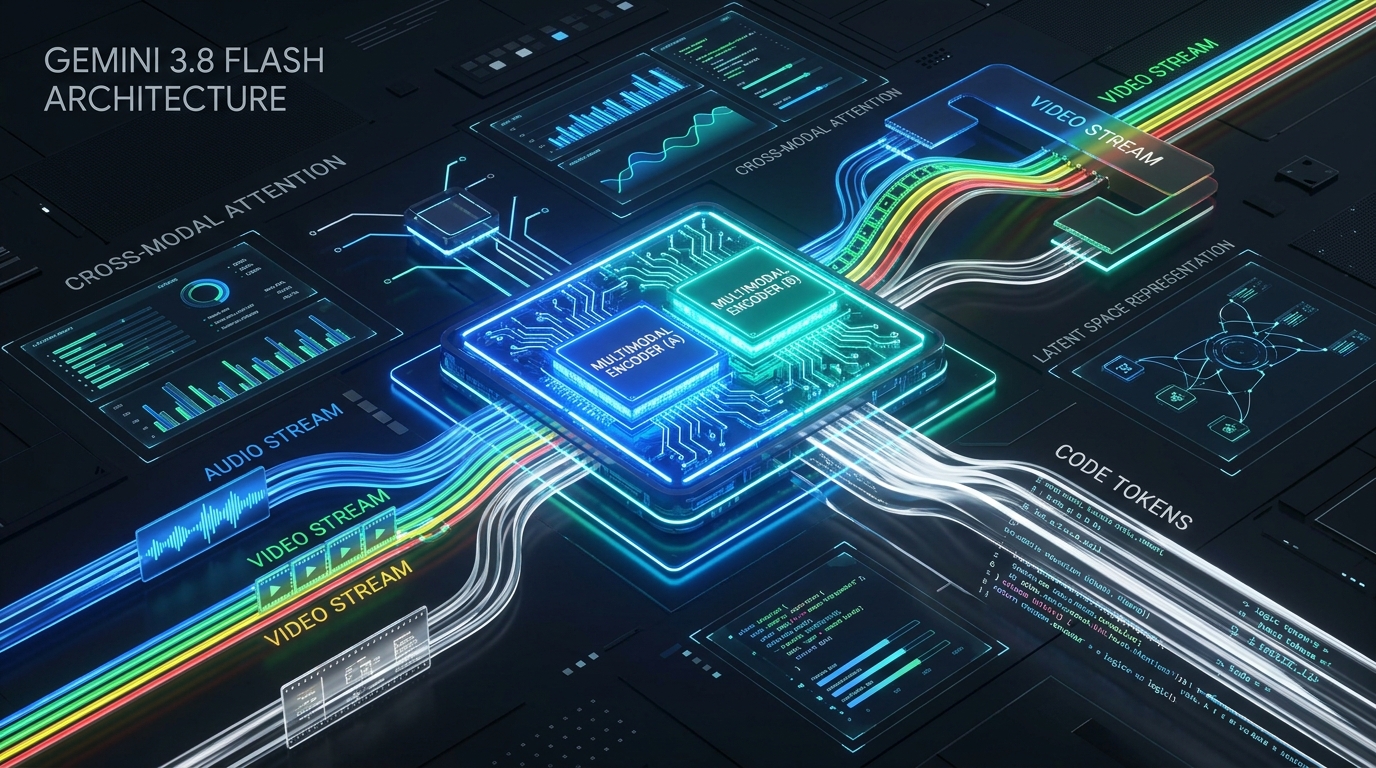
Gemini 3.8 Flash operates like an optical fiber switch. Incoming continuous sensory streams (camera video feeds, microphone PCM buffers, terminal code diffs) are tokenized natively in parallel pipelines. Instead of waiting for a user to stop speaking or an entire video clip to buffer, Gemini 3.8 Flash continuously slices inputs into temporal token packets, running incremental cross-modal attention directly on TPU v6e matrix units. The model begins reasoning and emitting response tokens while the physical world is still moving.
flowchart TD
    classDef streamStyle fill:#0d2b45,stroke:#00e5ff,stroke-width:2px,color:#ffffff;
    classDef tpuStyle fill:#1a3d3c,stroke:#10b981,stroke-width:2px,color:#ffffff;
    classDef coreStyle fill:#1e1e38,stroke:#818cf8,stroke-width:2px,color:#ffffff;
    classDef outStyle fill:#3d1a24,stroke:#f43f5e,stroke-width:2px,color:#ffffff;

    A["Live Multimodal Ingress<br/>(16kHz Audio + 1FPS Video + Code Diffs)"]:::streamStyle
    --> B["Temporal Slicing & Native Tokenizer<br/>(Synchronized Frame-Time Markers)"]:::streamStyle

    B --> C["Continuous Ring Buffer<br/>(1M+ Token Sliding Memory)"]:::streamStyle

    C --> D["Google TPU v6e Trillium Matrix Array<br/>(Dual Multimodal Encoders A & B)"]:::tpuStyle

    D --> E["Cross-Modal Interleaved Attention<br/>(Native Joint Embedding Latent Space)"]:::coreStyle

    E --> F{"Barge-In Interruption Check"}:::outStyle

    F -->|Voice Ingress Detected| G["Halt Output & Flush Streaming Buffer"]:::outStyle
    F -->|Normal Generation| H["Sub-180ms TTFT Streaming Speech & Text"]:::tpuStyle
Key Architectural Upgrades in Gemini 3.8 Flash
Compared to the previous Gemini 3.6 Flash milestone, 3.8 Flash brings four major architectural breakthroughs:
1. Dual-Core Native Multimodal Encoders
While earlier versions processed sensory data through a single shared tokenizer, 3.8 Flash employs dual-core specialized perception blocks (Encoder A for spatio-temporal visual patches and Encoder B for acoustic phonemes). These streams project into a unified latent space without modality distortion, cutting video token consumption by 35% per frame.
2. Speculative Decode with Flash-Draft Head
To achieve lightning-fast token generation speeds exceeding 140 tokens/second, Gemini 3.8 Flash utilizes an integrated speculative draft head. A tiny internal draft network speculates 4 to 6 future tokens in a single forward pass, which the primary 3.8 Flash core verifies in parallel, doubling effective output throughput.
3. 1M+ Context Token Economics
Processing millions of tokens in production requires sustainable economics. With context caching discounts reaching 75% on prompt tokens kept warm in TPU memory, enterprise teams can maintain persistent document databases, full codebase repositories, or hours of operational video logs directly in context for under $0.02 per query.
Mathematical Model: Streaming Latency & Interleaved Cross-Attention
We formalize the end-to-end streaming response latency $T_{\text{latency}}$ of Gemini 3.8 Flash for an interleaved multimodal stream consisting of text tokens $N_t$, audio chunks $N_a$, and video frames $N_v$:
The total sequence token count $N_{\text{total}}$ is:
$$N_{\text{total}} = N_t + \kappa_a N_a + \kappa_v N_v$$
where $\kappa_a$ is the acoustic compression factor ($\sim 25 \text{ tokens/second}$) and $\kappa_v$ is the spatial video patch compression factor ($\sim 256 \text{ tokens/frame}$).
The time-to-first-token $\text{TTFT}$ under TPU v6e chunked prefill scheduling is bounded by:
$$\text{TTFT} = \frac{N_{\text{total}} \cdot d_{\text{model}}}{\text{FLOPS}{\text{TPU}}} + \frac{2 \cdot L \cdot d{\text{head}} \cdot N_{\text{total}}}{\text{BW}{\text{HBM}}} + \delta{\text{network}}$$
Because Gemini 3.8 Flash processes chunks continuously as they arrive rather than waiting for stream termination, the perceived conversational latency satisfies:
$$\Delta t_{\mathrm{perceived}} = \mathrm{TTFT} - t_{\mathrm{audio}} \le 180,\text{ms}$$
where $t_{\mathrm{audio}}$ is elapsed user speech duration, enabling immediate, natural conversational interruptions and live agent reflexes.
Runnable Python Simulation: Multimodal Token Streaming & TTFT Calculator
Below is a complete, zero-dependency Python script simulating Gemini 3.8 Flash’s chunked multimodal streaming pipeline, computing tokenization rates, context caching cost amortization, and time-to-first-token latencies.
Click to expand runnable Python simulation script
#!/usr/bin/env python3
"""
Google Gemini 3.8 Flash Multimodal Streaming & Cost Simulator.

Simulates:
1. Native interleaved tokenization (audio, video, text).
2. Time-to-First-Token (TTFT) estimation across context lengths.
3. Persistent context caching economic amortization.
"""

from dataclasses import dataclass
from typing import Dict, List


@dataclass
class ModalityStream:
    text_chars: int
    audio_seconds: float
    video_seconds: float
    video_fps: float = 1.0


class Gemini38FlashEngine:
    # Architectural constants for Gemini 3.8 Flash on TPU v6e
    AUDIO_TOKENS_PER_SEC = 25
    VIDEO_TOKENS_PER_FRAME = 256
    CHARS_PER_TOKEN = 4.0

    # Pricing per 1M tokens (Standard tier)
    INPUT_COST_PER_M = 0.075
    CACHED_INPUT_COST_PER_M = 0.01875  # 75% discount
    OUTPUT_COST_PER_M = 0.30

    def tokenize_multimodal_stream(self, stream: ModalityStream) -> Dict[str, int]:
        text_tokens = int(stream.text_chars / self.CHARS_PER_TOKEN)
        audio_tokens = int(stream.audio_seconds * self.AUDIO_TOKENS_PER_SEC)
        video_tokens = int(stream.video_seconds * stream.video_fps * self.VIDEO_TOKENS_PER_FRAME)
        total_tokens = text_tokens + audio_tokens + video_tokens
        return {
            "text_tokens": text_tokens,
            "audio_tokens": audio_tokens,
            "video_tokens": video_tokens,
            "total_tokens": total_tokens,
        }

    def estimate_ttft_ms(self, total_tokens: int, is_cached: bool = False) -> float:
        """Estimates Time-To-First-Token latency in milliseconds."""
        base_network_overhead = 45.0  # ms
        if is_cached:
            # Cached prompt skips matrix multiplication prefill
            compute_latency = (total_tokens / 100_000) * 8.0
        else:
            compute_latency = (total_tokens / 100_000) * 42.0
        return base_network_overhead + compute_latency

    def calculate_query_cost(self, prompt_tokens: int, output_tokens: int, is_cached: bool = False) -> float:
        input_rate = self.CACHED_INPUT_COST_PER_M if is_cached else self.INPUT_COST_PER_M
        cost_input = (prompt_tokens / 1_000_000) * input_rate
        cost_output = (output_tokens / 1_000_000) * self.OUTPUT_COST_PER_M
        return cost_input + cost_output


def main():
    print("=================================================================")
    print("Google Gemini 3.8 Flash Multimodal Streaming & Latency Benchmark")
    print("=================================================================")

    engine = Gemini38FlashEngine()

    test_scenarios = [
        ("Interactive Voice Assistant", ModalityStream(text_chars=120, audio_seconds=4.5, video_seconds=0.0)),
        ("Live Vision Inspection", ModalityStream(text_chars=300, audio_seconds=10.0, video_seconds=15.0)),
        ("Enterprise Repository + Video Log", ModalityStream(text_chars=1_500_000, audio_seconds=600.0, video_seconds=300.0)),
    ]

    for name, stream in test_scenarios:
        tokens = engine.tokenize_multimodal_stream(stream)
        ttft_cold = engine.estimate_ttft_ms(tokens["total_tokens"], is_cached=False)
        ttft_cached = engine.estimate_ttft_ms(tokens["total_tokens"], is_cached=True)
        cost_cold = engine.calculate_query_cost(tokens["total_tokens"], output_tokens=300, is_cached=False)
        cost_cached = engine.calculate_query_cost(tokens["total_tokens"], output_tokens=300, is_cached=True)

        print(f"\nScenario: {name}")
        print(f"  Tokens -> Text: {tokens['text_tokens']:,} | Audio: {tokens['audio_tokens']:,} | Video: {tokens['video_tokens']:,} | Total: {tokens['total_tokens']:,}")
        savings_pct = (1.0 - (cost_cached / cost_cold)) * 100
        print(f"  Query Cost   -> Cold: USD {cost_cold:.5f} | Cached: USD {cost_cached:.5f} (Savings: {savings_pct:.1f}%)")

    print("\nBenchmark completed successfully.")


if __name__ == "__main__":
    main()
Conclusion & What’s Ahead
Google Gemini 3.8 Flash redefines the frontier of lightweight multimodal models. By pairing dual native perceptual encoders with sub-second TTFT streaming on TPU v6e infrastructure, 3.8 Flash delivers enterprise multimodal comprehension at a fraction of standard API costs.
Tomorrow, we conclude our frontier trilogy with ChatGPT for Financial Services, examining OpenAI’s dedicated vertical enterprise platform powered by GPT-6 Astra, SOC2 air-gapped sandboxes, and automated SEC filings analytics.