
AI Networking Silicon & Photonics: Quantum-X, Spectrum-X/XGS, ConnectX-9, BlueField-4, and Co-Packaged Optics
Mapping Quantum-X, Spectrum-X/6, Broadcom Tomahawk 6, ConnectX-9, BlueField-4, Spectrum-XGS, and TSMC COUPE Co-Packaged Optics to IB, RoCEv2, and UEC.
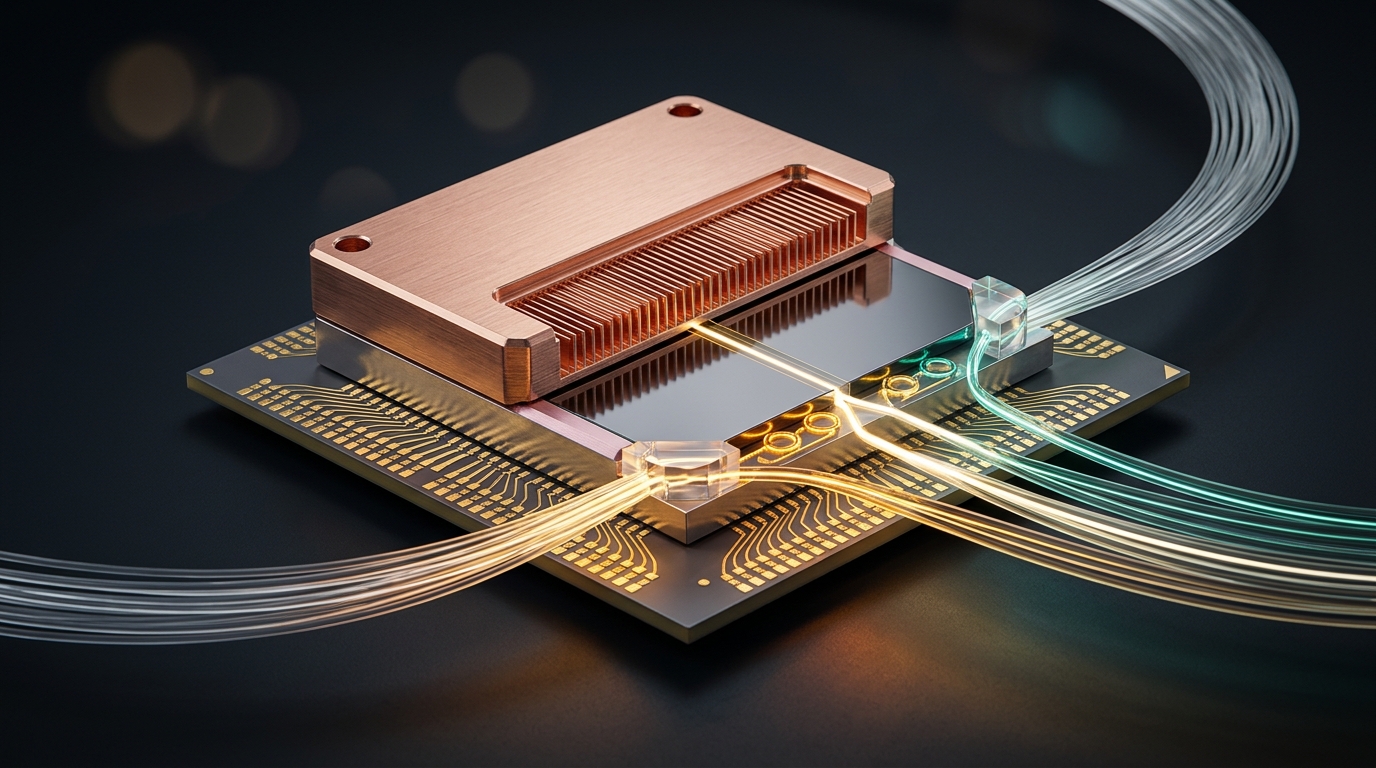
Series: Part 19 of GPU Architecture, Scale-Up Interconnects, and AI Datacenter Infrastructure Series | (Previous) Modular AI Factories: Inside NVIDIA DSX POD, 14-Day Containerized Deployments, Zero-Water Cooling, and Grid-Aware Power Balancing | (Next) The Anatomy of a Modern AI Datacenter: Power, Facility Cooling, Substations, and Megawatt Deployment
Summary
In Part 15 and Part 16, we unpacked the protocols fighting over scale-out AI fabrics: InfiniBand, RoCEv2, and Ultra Ethernet (UEC 1.0). Yet in real gigascale AI factories, protocols are only half the story—what actually determines throughput, tail latency, and power draw is the networking silicon and optics running underneath them.
In Part 19 of our GPU Architecture, Scale-Up Interconnects, and AI Datacenter Infrastructure Series, we map those protocols directly onto the physical hardware generations powering 2025–2026 AI clusters. We compare NVIDIA Quantum-X800 (115.2 Tb/s InfiniBand XDR), NVIDIA Spectrum-X800 & Spectrum-6 (51.2 Tb/s → 102.4 Tb/s AI Ethernet), and open merchant silicon like Broadcom Tomahawk 6 (102.4 Tb/s native UEC); explain why modern compute trays separate East-West SuperNICs (ConnectX-8 / ConnectX-9) from North-South DPUs (BlueField-3 / BlueField-4); unpack the third networking pillar—Scale-Across (Spectrum-XGS) for linking multi-site AI factories; and dissect how Co-Packaged Optics (CPO) built on TSMC COUPE silicon photonics slashes optical power by 3.5×–5× while boosting link reliability 10×.
Prior Reading Material
Before diving into switch ASIC generations, SuperNIC/DPU splits, and silicon photonics, catch up on the preceding networking and packaging chapters:
- Scale-Out Networking II: RoCEv2, Ultra Ethernet (UEC), and AI Ethernet Fabrics — Part 16: Why classic RoCEv2 struggles with ECMP/PFC and how UEC 1.0 reinvents Ethernet transport.
- Scale-Out Networking I: InfiniBand NDR/XDR, Quantum Switches, and In-Network Computing — Part 15: Credit-based flow control, GPUDirect RDMA, rail-optimized fat-trees, and SHARP v4.
- GPU Server Chassis & Tray Architecture: HGX Boards, Compute Trays, and Switch Trays — Part 14: How 800G OSFP scale-out NICs wire 1:1 to GPUs inside HGX baseboards and NVL72 trays.
- Advanced Packaging & The Chiplet Era: CoWoS, 3D Stacking, and Interposers — Part 7: The 2.5D/3D chiplet packaging foundations behind TSMC SoIC-X and COUPE silicon photonics.
1. Mapping Switch Silicon Generations to IB, RoCEv2, and UEC 1.0
One of the most common points of confusion in AI infrastructure is how switch hardware generations map onto networking protocols. A switch ASIC does not magically support every transport feature—SerDes speed, buffer architecture, telemetry hardware, and NIC co-design dictate whether a cluster runs native InfiniBand, enhanced RoCEv2, or open Ultra Ethernet.
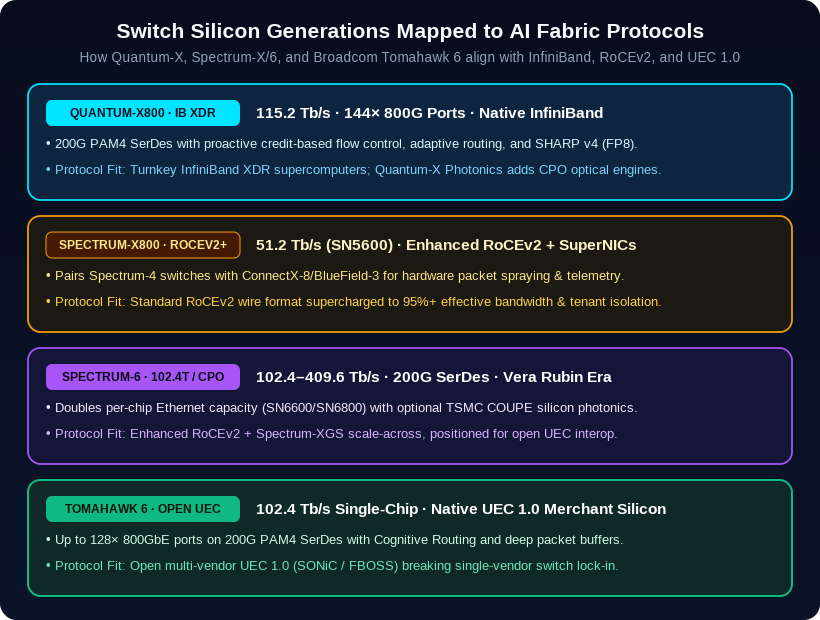 Figure 1: Generational mapping of NVIDIA Quantum-X, NVIDIA Spectrum-X800 / Spectrum-6, and Broadcom Tomahawk 6 switch silicon to InfiniBand XDR, enhanced RoCEv2, and native Ultra Ethernet (UEC 1.0).
| Switch Platform | Generation / ASIC | Switching Capacity | SerDes & Port Density | Target Protocol Stack | Defining Hardware Advantage |
|---|---|---|---|---|---|
| NVIDIA Quantum-2 | InfiniBand NDR | 25.6 Tb/s | 100G SerDes · 64× 400G | Native InfiniBand NDR | Lossless credit flow + SHARP v3 |
| NVIDIA Quantum-X800 | InfiniBand XDR | 115.2 Tb/s | 200G SerDes · 144× 800G | Native InfiniBand XDR | 14.4 TFLOPS SHARP v4 (FP8) + adaptive routing |
| NVIDIA Spectrum-X800 | Spectrum-4 (SN5600) | 51.2 Tb/s | 100G SerDes · 64× 800G | Enhanced RoCEv2 | Switch + SuperNIC packet spraying & tenant isolation |
| NVIDIA Spectrum-6 | Next-Gen AI Ethernet | 102.4 Tb/s (409.6T CPO) | 200G SerDes · 128–512× 800G | Enhanced RoCEv2 / XGS / UEC-ready | Doubled per-chip density + optional TSMC COUPE CPO |
| Broadcom Tomahawk 6 | BCM78910 / BCM78914 | 102.4 Tb/s | 100G/200G SerDes · 128× 800G | Native UEC 1.0 + RoCEv2 | Open merchant silicon (SONiC / FBOSS), Cognitive Routing |
The Switch-vs-NIC Division of Labor
Notice the critical architectural distinction between Spectrum-X and UEC 1.0:
- NVIDIA Spectrum-X800 / Spectrum-6 achieves InfiniBand-class 95%+ effective fabric bandwidth today over standard RoCEv2 wire formats by tightly co-designing the Spectrum switch ASIC with ConnectX / BlueField SuperNICs. The switch sprays packets dynamically around congested uplinks and stamps fine-grained hardware telemetry, while the SuperNIC absorbs out-of-order arrivals directly into GPU HBM.
- Broadcom Tomahawk 6 (paired with open UEC NICs like Broadcom Thor Ultra or AMD Pensando) brings those exact same capabilities—per-packet spraying, out-of-order reassembly, and packet trimming—into an open, multi-vendor contract governed by the Ultra Ethernet Consortium (UEC 1.0), allowing hyperscalers to run open switch operating systems like SONiC or Meta’s FBOSS.
2. Inside the Compute Tray: Why AI Racks Need Both SuperNICs and DPUs
If you open a Blackwell GB200/GB300 or Vera Rubin compute tray, you will not find a single generic network card. Modern AI factories physically split networking endpoints into two completely different silicon classes—SuperNICs for East-West GPU compute traffic and DPUs for North-South infrastructure control:
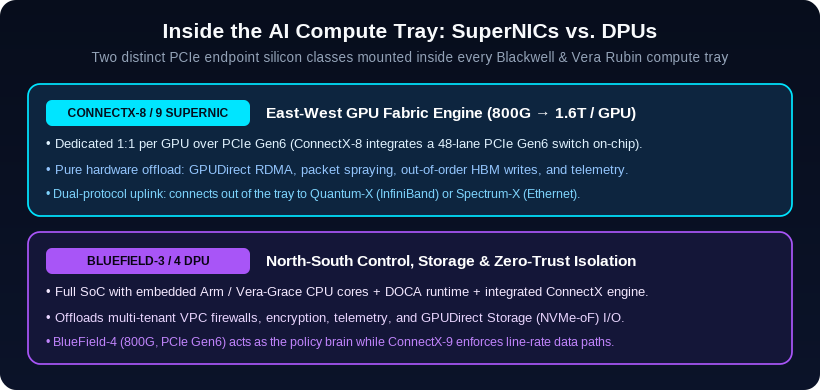 Figure 2: Endpoint silicon split inside modern Blackwell and Vera Rubin compute trays—ConnectX SuperNICs drive East-West GPU RDMA (connecting out to either Quantum-X or Spectrum-X switches), while BlueField DPUs isolate North-South security and storage.
East-West Fabric Engines: ConnectX-8 & ConnectX-9 SuperNICs
- NVIDIA ConnectX-8 SuperNIC (800 Gb/s, PCIe Gen6): The workhorse of Blackwell-era clusters. ConnectX-8 introduces an integrated 48-lane PCIe Gen6 switch directly on the NIC silicon, allowing GPUs and NICs to wire together with ultra-low latency and minimal board retimers while running either 800G InfiniBand XDR or 800GbE Spectrum-X Ethernet.
- NVIDIA ConnectX-9 SuperNIC (up to 1.6 Tb/s ecosystem scaling, PCIe Gen6): Built for Vera Rubin gigascale AI factories. Utilizing 4× 200G PAM4 SerDes lanes and Multi-Host PCIe Gen6, ConnectX-9 feeds massive MoE
AllToAlland disaggregated KV-cache transfers directly into GPU HBM with zero host CPU involvement.
North-South Infrastructure Brains: BlueField-3 & BlueField-4 DPUs
- NVIDIA BlueField-3 DPU (400 Gb/s, PCIe Gen5): Combines high-speed networking with embedded Arm cores, onboard DDR5 memory, and the NVIDIA DOCA software framework. It offloads software-defined networking (VPC routing, firewalls, inline encryption) and GPUDirect Storage (NVMe-oF) so checkpoint reads/writes never steal host CPU cycles or pollute the East-West GPU fabric.
- NVIDIA BlueField-4 DPU (800 Gb/s, PCIe Gen6): Designed for Rubin-era agentic AI factories, BlueField-4 integrates next-generation Vera / Grace CPU compute directly alongside ConnectX-9 networking on a single package. In production clusters, BlueField-4 acts as the zero-trust policy and telemetry control plane, while ConnectX-9 SuperNICs execute line-rate East-West GPU data movement in a closed hardware loop.
3. The Third Networking Pillar: Scale-Across with Spectrum-XGS
Across this series, we have already explored two physical networking tiers:
- Scale-Up (Part 13): Copper NVLink & NVSwitch unifying up to 72 GPUs inside one rack at 1.8–3.6 TB/s per chip.
- Scale-Out (Parts 15–16): Optical InfiniBand or AI Ethernet linking thousands of racks inside one datacenter hall.
Today, frontier AI labs are hitting a hard power-grid wall: a single utility substation often caps out at 100–300 MW, making it physically impossible to house a 500,000-GPU training cluster under one roof. That has created a third networking domain—Scale-Across.
NVIDIA Spectrum-XGS Ethernet is engineered specifically to bridge separate AI factories across kilometers—or even across cities—into one logical supercomputer. Because InfiniBand’s credit-based flow control cannot easily scale switch buffers across multi-kilometer fiber delays, Scale-Across is exclusively a Layer-3 routed Ethernet tier:
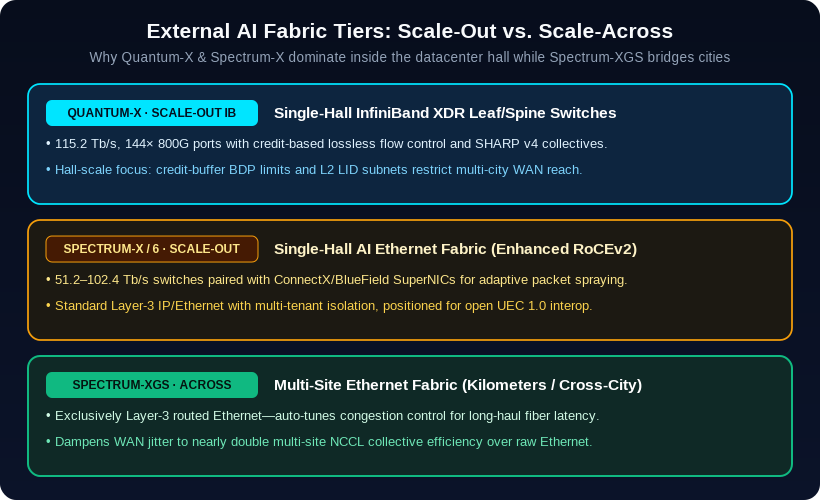 Figure 3: External networking fabric tiers—comparing single-hall Scale-Out switches (Quantum-X InfiniBand and Spectrum-X/6 AI Ethernet) against multi-site Scale-Across Ethernet (Spectrum-XGS).
- Distance-Adaptive Congestion Control: Standard datacenter congestion loops assume single-digit microsecond round-trip times. Over 10–100 km of optical fiber, speed-of-light propagation delay breaks standard ECN/DCQCN pacing. Spectrum-XGS automatically measures physical link distance and dynamically adapts congestion windows and buffer pacing to match the round-trip flight time.
- Jitter Dampening for Multi-Site Collectives: By suppressing long-haul queuing jitter and pairing Spectrum switches with BlueField/ConnectX telemetry, Spectrum-XGS nearly doubles NCCL collective communication efficiency across multi-site Ethernet links compared to raw, unoptimized WAN Ethernet.
4. Beyond Pluggable Optics: Co-Packaged Optics (CPO) & TSMC COUPE
Even if your switch silicon hits 102.4 Tb/s and your SuperNICs hit 1.6 Tb/s, there is a brutal physics bottleneck sitting on the front panel of every switch: pluggable optical transceivers.
At 200G per electrical lane (200G PAM4 SerDes), driving high-frequency electrical signals across just a few inches of motherboard PCB copper from the switch ASIC to a front-panel OSFP cage severely degrades signal integrity. To recover the signal, every pluggable OSFP module must pack a power-hungry Digital Signal Processor (DSP) retimer plus its own laser—burning roughly 25–30 watts per transceiver. Across a 100,000-GPU cluster with hundreds of thousands of optical ports, pluggable transceivers alone burn tens of megawatts of electricity and become the single largest source of link flaps and training job restarts.
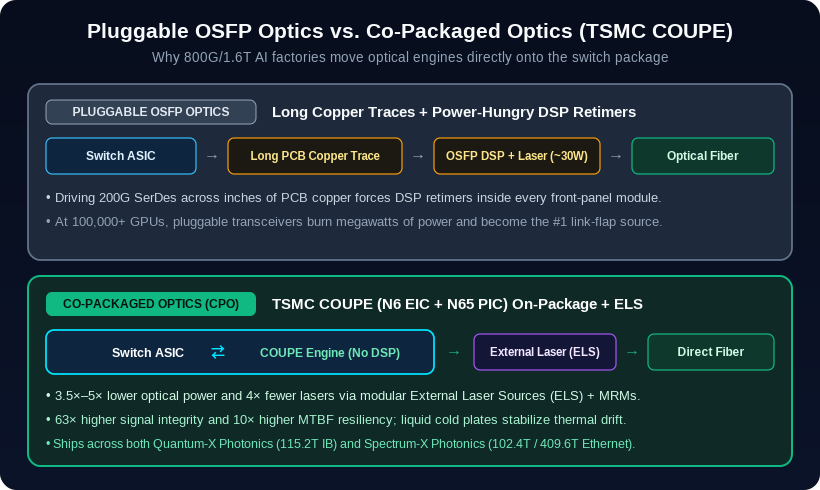 Figure 4: Architectural shift from front-panel pluggable OSFP transceivers (long copper traces + DSP retimers) to Co-Packaged Optics (CPO) built on TSMC’s COUPE 3D silicon photonics platform.
To shatter that wall, NVIDIA introduced Quantum-X Photonics (115.2 Tb/s InfiniBand) and Spectrum-X Photonics (102.4 Tb/s and 409.6 Tb/s Ethernet)—moving optical conversion directly onto the switch package using TSMC’s COUPE (Compact Universal Photonic Engine) platform:
flowchart TD
    A["1. Switch ASIC Generates 200G PAM4 Electrical Lanes (Millimeters of Trace Length)"] --> B["2. TSMC COUPE Electronic IC (N6 Node) Drives Signals Directly — Zero Retimer DSP Needed"]
    B --> C["3. 3D Hybrid-Bonded Photonic IC (N65 Node) Modulates Light via Micro-Ring Modulators (MRMs)"]
    C --> D["4. Modular External Laser Source (ELS) Supplies Continuous Light — 4x Fewer Lasers"]
    D --> E["5. Direct Fiber Egress Under Liquid Cold Plate (3.5x-5x Less Power, 10x Higher MTBF)"]

    style A fill:#0d2b45,stroke:#00e5ff,stroke-width:2px,color:#ffffff
    style B fill:#1e1b4b,stroke:#a855f7,stroke-width:2px,color:#ffffff
    style C fill:#1c1912,stroke:#f59e0b,stroke-width:2px,color:#ffffff
    style D fill:#141638,stroke:#38bdf8,stroke-width:2px,color:#ffffff
    style E fill:#0f382c,stroke:#10b981,stroke-width:2px,color:#ffffff
Figure 5: End-to-end Co-Packaged Optics (CPO) signal path inside Quantum-X Photonics and Spectrum-X Photonics switches using TSMC’s COUPE 3D-stacked EIC + PIC architecture.
Four engineering breakthroughs make CPO transformative at gigascale:
- 3D-Stacked EIC + PIC (TSMC SoIC-X): COUPE stacks a leading-edge N6 Electronic IC (EIC) directly onto a mature N65 Photonic IC (PIC) using 3D hybrid bonding. Because the optical engine sits millimeters from the switch die, DSP retimers disappear completely—cutting optical power consumption by 3.5× to 5×.
- Micro-Ring Modulators (MRMs) + External Laser Sources (ELS): Instead of baking a fragile laser inside every hot switch port, CPO keeps lasers in field-replaceable External Laser Source (ELS) modules on the front panel, feeding continuous light into ultra-compact silicon micro-ring modulators. This cuts total laser count by 4× and makes laser replacement a simple hot-swap.
- 63× Signal Integrity & 10× Higher Resiliency: Removing fragile mechanical OSFP connectors and long copper paths yields up to 63× cleaner signal integrity and 10× higher network MTBF—directly protecting multi-week frontier training runs from optical link-flap crashes.
- Liquid-Cooled Photonics: Because micro-ring modulators are sensitive to temperature drift and sit right beside high-power switch ASICs, CPO switches use closed-loop direct-to-chip liquid cold plates—tying directly into the rack-scale liquid cooling manifolds and CDUs we covered in Parts 17 and 18.
5. Interactive Simulator: Pluggable OSFP Optics vs. Co-Packaged Optics at Gigascale
Run this zero-dependency Python 3 script (scripts/cpo_optics_power_sim.py — execute via python3 cpo_optics_power_sim.py) to compare Pluggable 800G OSFP transceivers against Co-Packaged Optics (CPO) across 10k, 100k, and 1,000,000-GPU AI factories—modeling total optical megawatts burned, annual electricity cost, and expected daily optical link-failure events.
Click to expand runnable code script
"""
Pluggable 800G OSFP Transceivers vs. Co-Packaged Optics (CPO) AI Factory Simulator
Zero-dependency Python 3 script modeling:
1. Total optical transceiver power draw (MW) in a 3-tier fat-tree AI cluster
2. Annual optical electricity cost at $0.08/kWh (PUE 1.15)
3. Expected optical link-failure events per day (pluggable vs. 10x MTBF CPO)
"""


def simulate_cluster_optics(num_gpus: int, pluggable_watts_per_end: float = 28.0,
                            cpo_efficiency_gain: float = 4.0,
                            pluggable_mtbf_hours: float = 500_000.0,
                            cpo_mtbf_multiplier: float = 10.0,
                            pue: float = 1.15, kwh_price: float = 0.08):
    # In a full-bisection 3-tier rail-optimized fat-tree:
    # ~4 optical transceiver ends per GPU (1 NIC + 1 Leaf-down + 1 Leaf-up + 1 Spine-down;
    # 3-tier core adds ~2 more ends per GPU at 100k+ scale)
    ends_per_gpu = 4 if num_gpus <= 16_384 else 6
    total_optical_ends = num_gpus * ends_per_gpu

    pluggable_mw = (total_optical_ends * pluggable_watts_per_end) / 1_000_000.0
    cpo_mw = pluggable_mw / cpo_efficiency_gain
    saved_mw = pluggable_mw - cpo_mw

    hours_per_year = 8_760.0
    annual_savings_usd = saved_mw * 1_000.0 * pue * hours_per_year * kwh_price

    # Expected optical failures per day = (total_ends / MTBF_hours) * 24
    pluggable_fails_per_day = (total_optical_ends / pluggable_mtbf_hours) * 24.0
    cpo_fails_per_day = pluggable_fails_per_day / cpo_mtbf_multiplier

    return {
        "gpus": num_gpus,
        "ends": total_optical_ends,
        "pluggable_mw": pluggable_mw,
        "cpo_mw": cpo_mw,
        "saved_mw": saved_mw,
        "annual_savings_m": annual_savings_usd / 1_000_000.0,
        "plug_fails_day": pluggable_fails_per_day,
        "cpo_fails_day": cpo_fails_per_day,
    }


if __name__ == "__main__":
    print("=== Pluggable 800G OSFP Optics vs. Co-Packaged Optics (CPO) Across AI Factory Scales ===")
    print(f"{'GPUs':>10} | {'Optic Ends':>10} | {'Pluggable':>10} | {'CPO (4x)':>9} | "
          f"{'Saved MW':>9} | {'Saved $/yr':>11} | {'Fails/Day (Plug vs CPO)':>24}")
    print("-" * 102)
    for gpus in [10_000, 100_000, 1_000_000]:
        r = simulate_cluster_optics(gpus)
        print(f"{r['gpus']:>10,} | {r['ends']:>10,} | {r['pluggable_mw']:>7.2f} MW | "
              f"{r['cpo_mw']:>6.2f} MW | {r['saved_mw']:>6.2f} MW | "
              f"${r['annual_savings_m']:>8.2f} M | "
              f"{r['plug_fails_day']:>8.2f} -> {r['cpo_fails_day']:>5.2f} / day")
FAQ
-
Does NVIDIA Spectrum-X run Ultra Ethernet (UEC 1.0) or RoCEv2 today?
Answer
Today, Spectrum-X800 runs enhanced RoCEv2—preserving standard Layer-3 UDP/IP RoCEv2 packet encapsulation while using tight hardware co-design between Spectrum switches and ConnectX/BlueField SuperNICs for adaptive packet spraying, out-of-order placement, and fine-grained telemetry. Because NVIDIA joined the Ultra Ethernet Consortium in late 2024, next-generation Spectrum-6 and ConnectX-9 platforms are positioned to support open UEC interoperability alongside NVIDIA’s vertically integrated stack.
-
Why does an AI server need both a ConnectX SuperNIC and a BlueField DPU?
Answer
They serve completely different traffic planes. ConnectX SuperNICs (ConnectX-8 / ConnectX-9) sit 1:1 with GPUs to drive pure East-West RDMA collectives (
AllReduce,AllToAll, KV-cache transfers) at 800G–1.6T with zero CPU tax. BlueField DPUs (BlueField-3 / BlueField-4) embed full Arm or Vera/Grace CPU cores to isolate North-South cloud traffic, multi-tenant VPC firewalls, telemetry, and GPUDirect Storage (NVMe-oF) checkpointing so control-plane workloads never interfere with GPU compute. -
What happens if a laser fails inside a Co-Packaged Optics (CPO) switch?
Answer
You do not have to throw away the entire switch ASIC! In NVIDIA’s Quantum-X Photonics and Spectrum-X Photonics designs, the actual light-emitting lasers live in hot-swappable External Laser Source (ELS) modules on the switch front panel—completely separated from the hot silicon photonics die. If a laser degrades, technicians swap the front-panel ELS cartridge in minutes while the liquid-cooled COUPE optical engine stays untouched.
-
How does Spectrum-XGS differ from standard Spectrum-X?
Answer
Standard Spectrum-X is a Scale-Out fabric optimized for racks inside a single datacenter hall (microsecond round-trip times). Spectrum-XGS adds Scale-Across intelligence—automatically measuring multi-kilometer optical distance between separate datacenter campuses and tuning congestion control and jitter dampening so distributed NCCL collectives run nearly twice as fast across sites as they would over standard WAN Ethernet.
What’s Next in the Series?
We have now mapped the entire compute and networking silicon stack—from raw quartz wafers and Tensor Cores up through NVLink, Quantum-X/Spectrum-X switches, SuperNICs, DPUs, silicon photonics, liquid-cooled NVL72 racks, and containerized DSX PODs. Next, we zoom out to the building-scale civil and electrical engineering that powers these 100+ MW campuses.
In Part 20: The Anatomy of a Modern AI Datacenter: Power, Facility Cooling, Substations, and Megawatt Deployment, we trace electricity from 230 kV utility substations down to 480V rack busbars, dissect chiller plants vs. dry coolers, and break down how hyperscalers push PUE below 1.10 at 500 MW scale.