
Scale-Out Networking I: InfiniBand NDR/XDR, Quantum Switches, and In-Network Computing
How InfiniBand connects 100,000+ GPUs: lossless credit-based flow control, 800G Quantum-X800 switches, GPUDirect RDMA, rail-optimized fat-trees, and SHARP v4.
Series: Part 15 of GPU Architecture, Scale-Up Interconnects, and AI Datacenter Infrastructure Series | (Previous) GPU Server Chassis & Tray Architecture: HGX Boards, Compute Trays, and Switch Trays | (Next) Scale-Out Networking II: RoCEv2, Ultra Ethernet (UEC), and AI Ethernet Fabrics
Summary
Inside a single 8-GPU HGX node or a 72-GPU NVL72 rack, NVLink and NVSwitch give GPUs a blistering scale-up fabric reaching up to 1.8–3.6 TB/s per chip. Yet frontier foundation models require 10,000 to 100,000+ GPUs training in lockstep across hundreds of racks—far beyond the reach of copper NVLink cables. The moment traffic leaves the rack, you enter the Scale-Out Networking domain, where traditional enterprise Ethernet and TCP/IP collapse under microsecond synchronization barriers.
In Part 15 of our GPU Architecture, Scale-Up Interconnects, and AI Datacenter Infrastructure Series, we dissect why InfiniBand has dominated AI supercomputing for a decade. We explore credit-based lossless flow control, cut-through switching, and centralized Subnet Manager (SM / UFM) routing; trace the speed roadmap from HDR (200G) and NDR (400G) to XDR (800G) and 1.6T Co-Packaged Optics (CPO) on NVIDIA Quantum-X800 switches; and break down how GPUDirect RDMA, rail-optimized fat-tree topologies, and SHARP v4 in-network computing offload FP8/BF16 AllReduce and ReduceScatter collectives directly into switch silicon.
Prior Reading Material
Before stepping outside the server chassis into multi-rack optical fabrics, review these earlier posts in our hardware infrastructure series:
- GPU Server Chassis & Tray Architecture: HGX Boards, Compute Trays, and Switch Trays — Part 14: How 8× OSFP scale-out NICs pair 1:1 with GPUs inside HGX baseboards and GB200/GB300 NVL72 compute trays.
- Scale-Up Interconnects: NVLink, NVSwitch, and Ultra-High-Bandwidth Node Fabrics — Part 13: Intra-node NVLink/NVSwitch crossbars and how NVLS SHARP works inside a single scale-up domain.
- The CUDA Revolution III: Asynchronous Execution, Streams, Graphs, and Driver Ecosystem — Part 12: Overlapping host-device pipelines and minimizing launch latency before hitting network sync barriers.
- GPU Memory Hierarchy: Registers, Shared Memory, L1/L2, and HBM3e/HBM4 — Part 9: Why GPUDirect RDMA must stream directly into HBM without detouring through host DDR5.
1. The Scale-Out Paradigm: Why Standard TCP/IP Collapses Under AI
In traditional web datacenters, network traffic consists of millions of independent, small client requests. If one packet drops and TCP takes 5 milliseconds to notice and retransmit, one user’s webpage loads slightly slower—nobody notices.
In distributed AI training (Data Parallelism, Pipeline Parallelism, and Expert Parallelism across thousands of GPUs), the entire cluster moves at the speed of its single slowest packet:
- Synchronization Barriers: At the end of every backward pass, 16,384 GPUs hit an
AllReduceorReduceScatterbarrier to synchronize weight gradients. If even one link drops a single packet and triggers a TCP retransmission timeout, all 16,383 other GPUs sit completely idle waiting for that straggler. - The OS Kernel & CPU Copy Tax: Standard TCP/IP forces data from GPU HBM → over PCIe into host CPU DRAM → into an OS kernel socket buffer → through TCP segmentation → and finally out to the NIC. At 400 Gb/s or 800 Gb/s per GPU (up to 6.4 Tb/s per 8-GPU server), host CPUs cannot even copy memory fast enough to feed the wire, let alone run TCP checksums.
- Bufferbloat & Store-and-Forward Latency: Traditional switches receive an entire Ethernet frame before inspecting and forwarding it, adding microseconds of jitter at every hop across a multi-tier datacenter.
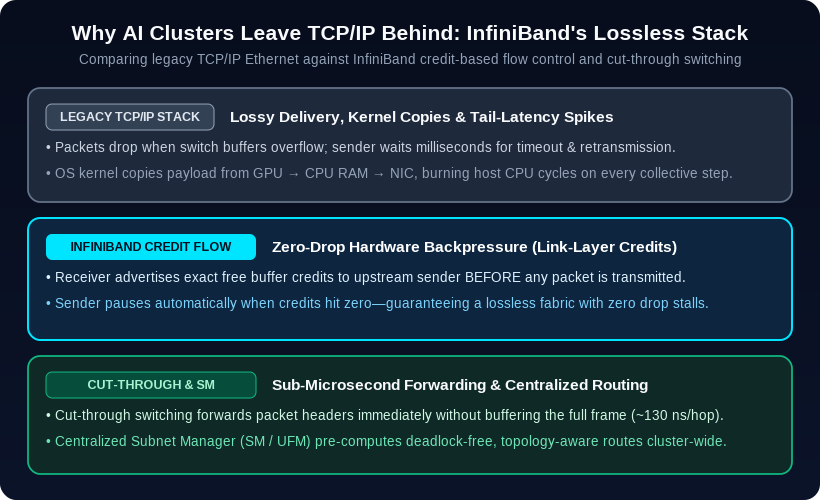 Figure 1: Architectural contrast between lossy TCP/IP Ethernet stacks and InfiniBand’s hardware credit-based flow control, cut-through switching, and centralized Subnet Manager.
2. InfiniBand Under the Hood: Credits, Cut-Through, and Subnet Managers
InfiniBand was engineered from the ground up as a compute interconnect, not a best-effort enterprise LAN. Three architectural pillars separate it from legacy networking:
1. Credit-Based Link-Layer Flow Control (Lossless by Design)
In InfiniBand, a sender is physically forbidden from transmitting a packet unless it holds explicit buffer credits granted by the downstream receiver (switch port or NIC).
- Every link continuously exchanges lightweight hardware credit updates tracking exact free receive-buffer space.
- If a downstream switch port fills up, it stops issuing new credits; the upstream port automatically pauses transmission for microseconds until buffer space frees up.
- Result: Zero congestion-induced packet drops, eliminating catastrophic TCP retransmission timeouts during synchronized gradient storms.
2. Cut-Through Switching
Instead of waiting for the entire packet payload to arrive (store-and-forward), InfiniBand switches inspect the tiny Local Route Header (LRH) at the very front of the packet and start streaming bytes out the egress port immediately—achieving ~130 nanoseconds of port-to-port switch latency.
3. Centralized Subnet Manager (SM) & Adaptive Routing
Unlike Ethernet switches that independently flood ARP broadcasts and run distributed BGP/OSPF routing protocols, an InfiniBand fabric is orchestrated by a centralized Subnet Manager (SM) (managed at datacenter scale by NVIDIA Unified Fabric Manager (UFM)).
- The SM discovers the entire physical cable graph, assigns compact 16-bit Local Identifiers (LIDs) to every port, and pre-computes deadlock-free, shortest-path routing tables pushed directly into switch hardware.
- Modern Quantum switches layer hardware Adaptive Routing (AR) on top: if a primary uplink gets momentarily busy, the switch ASIC dynamically steers packets onto an uncongested alternate spine link in nanoseconds.
3. The InfiniBand Speed Roadmap: HDR → NDR → XDR → 1.6T Optics
Over the past four GPU generations, InfiniBand per-port bandwidth has doubled every two years—keeping pace with Tensor Core FLOPS and HBM bandwidth scaling:
| Generation | Per-Port Speed (4x Lanes) | SerDes Lane Rate | Flagship Switch Silicon | Switch Port Density & Aggregate Capacity | Paired GPU / SuperNIC Era |
|---|---|---|---|---|---|
| HDR | 200 Gb/s | 50G PAM4 | Quantum-1 (QM8700) | 40× 200G ports (16 Tb/s bidirectional) | A100 · ConnectX-6 |
| NDR | 400 Gb/s | 100G PAM4 | Quantum-2 (QM9700) | 64× 400G ports (51.2 Tb/s bidirectional) | H100 / H200 · ConnectX-7 |
| XDR | 800 Gb/s | 200G PAM4 | Quantum-X800 (Q3400) | 144× 800G ports (115.2 Tb/s bidirectional) | Blackwell B200/GB200 · ConnectX-8 |
| GDR (Next) | 1.6 Tb/s | 200G×8 / CPO | Quantum-X Photonics | Co-Packaged Optics (CPO) silicon photonics | Vera Rubin / Rubin Ultra |
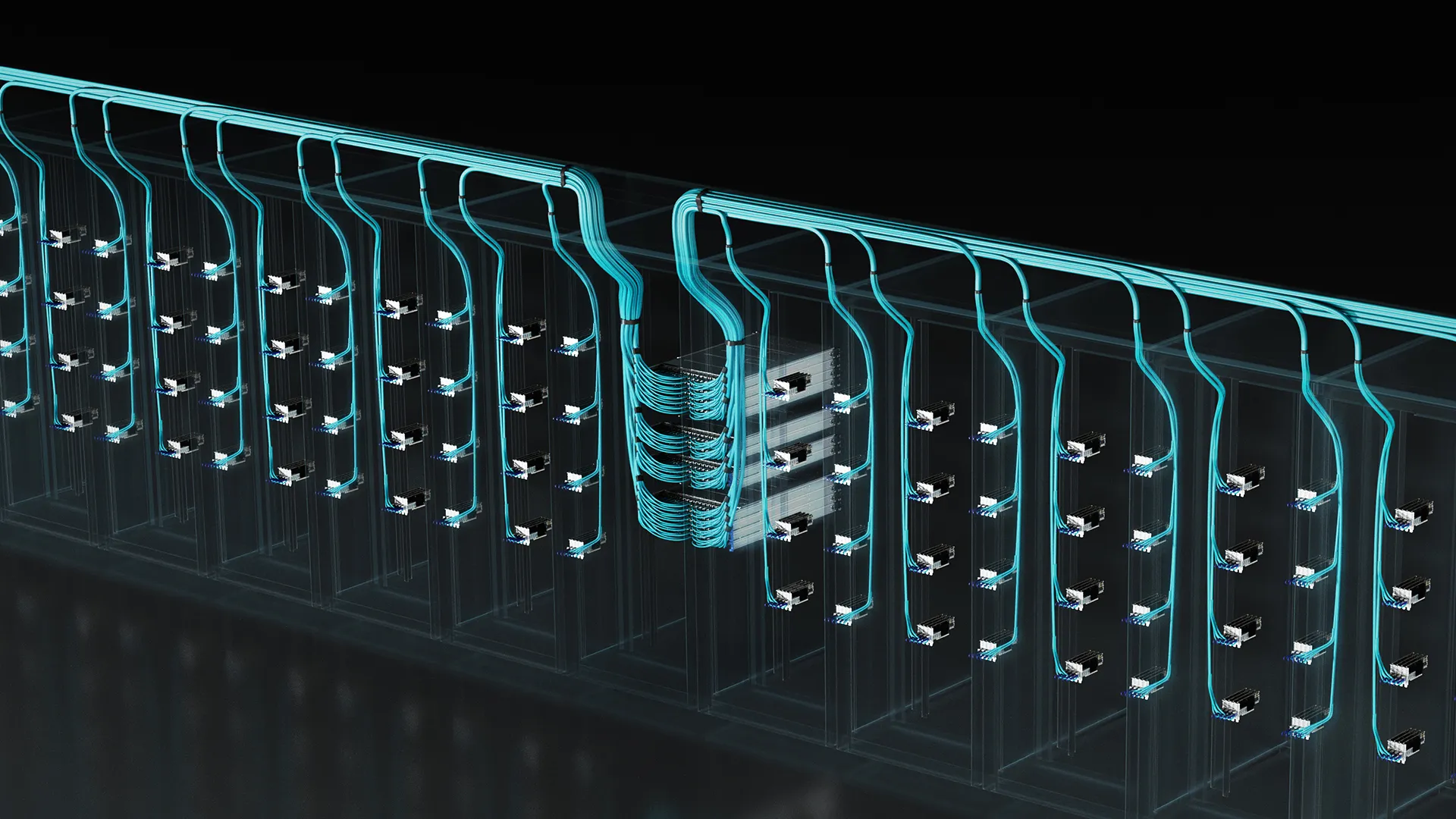 Figure 2: NVIDIA Quantum-X800 InfiniBand switch fabric linking multi-rack GPU clusters via high-density 800 Gb/s LinkX optical trunks. Source: NVIDIA.
Quantum-X800 & Co-Packaged Optics (CPO)
The Quantum-X800 switch ASIC is a massive leap in radix (port count): packing 144 ports of 800 Gb/s into a single switch domain allows a two-tier fat-tree to connect over 10,000 GPUs at full non-blocking bandwidth—cutting the number of switch hops, optical transceivers, and power consumption compared to 3-tier 400G fabrics. Looking forward, Quantum-X Photonics replaces pluggable front-panel OSFP optical modules with Co-Packaged Optics (CPO) bonded directly alongside the switch ASIC, slashing optical power draw and signal insertion loss at 800G and 1.6T.
4. GPUDirect RDMA, Rail-Optimized Fat-Trees & SHARP v4
Hardware link speed alone isn’t enough—the data path from GPU HBM to the optical fiber must eliminate every software bottleneck.
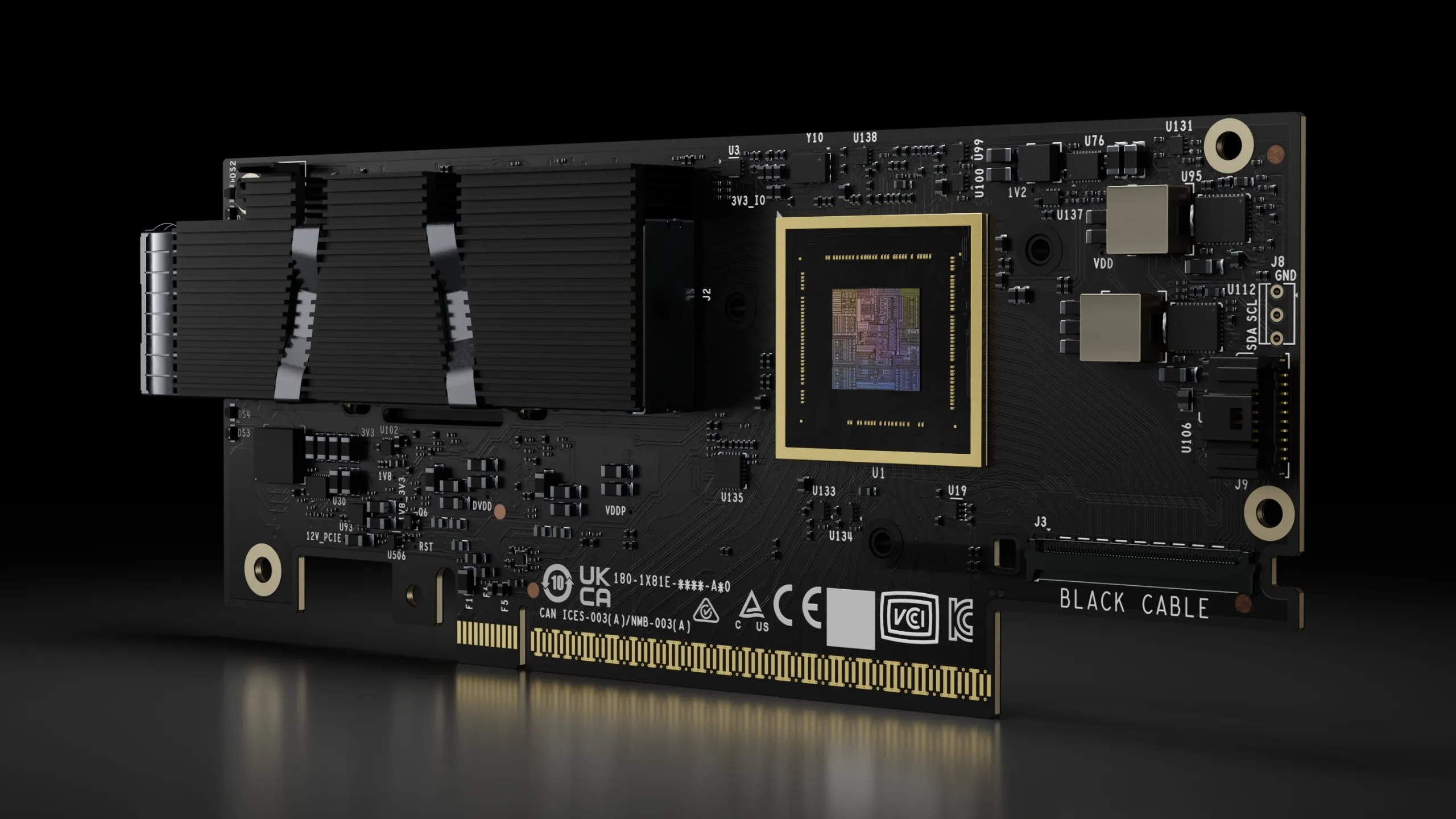 Figure 3: NVIDIA ConnectX-8 800 Gb/s SuperNIC showing the exposed network silicon die and PCIe Gen 6 host interface engineered for zero-copy GPUDirect RDMA. Source: NVIDIA.
GPUDirect RDMA: Bypassing the Host CPU Completely
With GPUDirect RDMA (Remote Direct Memory Access), the network card reads and writes directly into remote GPU HBM over PCIe—with zero OS kernel involvement and zero CPU memory copies:
flowchart TD
    A["1. GPU 0 Completes Backward Pass & Writes Gradients to Local HBM"] --> B["2. NCCL Posts Lightweight RDMA Send Descriptor to ConnectX-8 SuperNIC"]
    B --> C["3. ConnectX-8 DMAs Tensor Directly from GPU 0 HBM over PCIe Gen 6 (CPU Bypassed)"]
    C --> D["4. Quantum-X800 Fabric Routes Cut-Through Packets Across 800G Optical Links"]
    D --> E["5. Remote ConnectX-8 DMAs Payload Straight into GPU N HBM & Signals Completion"]

    style A fill:#0d2b45,stroke:#00e5ff,stroke-width:2px,color:#ffffff
    style B fill:#1e1b4b,stroke:#a855f7,stroke-width:2px,color:#ffffff
    style C fill:#0f382c,stroke:#10b981,stroke-width:2px,color:#ffffff
    style D fill:#0d2b45,stroke:#3b82f6,stroke-width:2px,color:#ffffff
    style E fill:#0f382c,stroke:#00e5ff,stroke-width:2px,color:#ffffff
Figure 4: End-to-end GPUDirect RDMA zero-copy pipeline bypassing host CPU DRAM and OS kernel network stacks.
Rail-Optimized Non-Blocking Fat-Tree Topologies
How do you wire 10,000+ GPUs without creating congestion bottlenecks? Rather than connecting all 8 NICs of a server to the same Top-of-Rack (ToR) switch, AI superclusters use a Rail-Optimized Fat-Tree:
- Every 8-GPU server has 8 dedicated InfiniBand NICs (NIC 0 through NIC 7, paired 1:1 with GPU 0 through GPU 7).
- NIC 0 on every server connects to Leaf Switch Rail 0; NIC 1 on every server connects to Leaf Switch Rail 1; and so on up to Rail 7.
- Because Data Parallelism typically runs
AllReduceacross matching GPU ranks (GPU 0 on Node A talks to GPU 0 on Node B, C, D…), 100% of intra-SU (Scalable Unit) collective traffic stays within a single Leaf Switch hop—never even touching the Spine layer! - Cross-rail traffic (e.g., GPU 0 on Node A talking to GPU 3 on Node B) simply hops over intra-node NVLink first or traverses the non-blocking Spine layer.
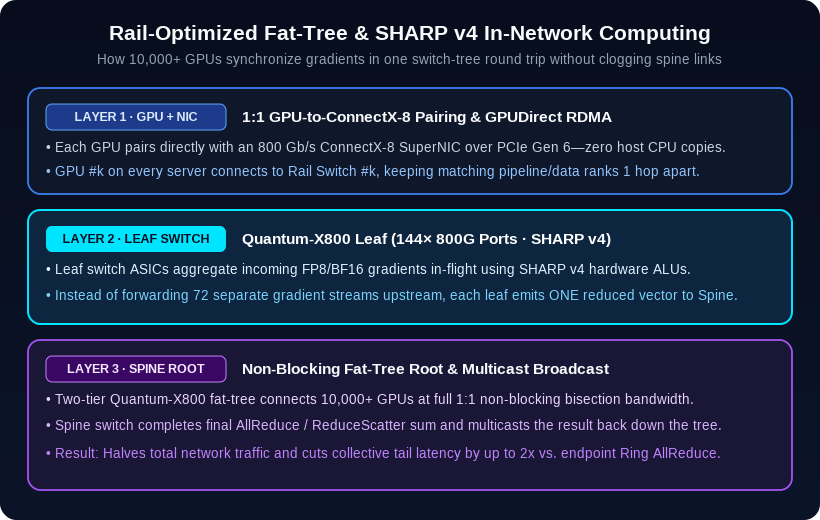 Figure 5: Three-layer Rail-Optimized Fat-Tree paired with SHARP v4 in-network computing, collapsing multi-rack gradient reductions into a single switch-tree round trip.
SHARP v4: Moving Collective Math Inside the Switch Silicon
Even on an 800G fabric, traditional Ring AllReduce forces every GPU to send and receive nearly 2× the gradient tensor size across multiple sequential hops. NVIDIA SHARP (Scalable Hierarchical Aggregation and Reduction Protocol) embeds dedicated floating-point arithmetic units directly inside Quantum switch ASICs:
- Instead of GPUs passing partial sums around a giant ring, every GPU sends its gradients once up the reduction tree to its Leaf Quantum-X800 switch.
- The Leaf switch sums all incoming gradients in hardware on the fly and forwards a single reduced tensor up to the Spine switch.
- The Spine switch performs the final global sum and hardware-multicasts the finished gradient vector back down to every GPU simultaneously.
- SHARP v4 Upgrades on Quantum-X800: Adds native FP8 hardware reduction, expands beyond
AllReduceto supportReduceScatterandScatterGather(critical for FSDP and ZeRO-3 sharded training), and delivers up to 9× higher in-network computing performance over prior generations—cutting total scale-out network traffic in half!
5. Interactive Simulator: InfiniBand Credits & SHARP v4 vs. Ring AllReduce
Run this zero-dependency Python 3 script (scripts/infiniband_sharp_sim.py — run directly via python3 infiniband_sharp_sim.py) to simulate:
- Credit-Based Flow Control preventing buffer drops during a synchronized 800G micro-burst.
- Ring AllReduce vs. SHARP v4 In-Network Reduction total bytes transferred and synchronization latency across 64 to 4,096 GPUs.
Click to expand runnable code script
"""
InfiniBand Credit-Based Flow Control & SHARP v4 Collective Simulator
Zero-dependency Python 3 script comparing:
1. Link-layer credit backpressure (0 drops) vs. lossy buffer overflow
2. Ring AllReduce vs. SHARP v4 In-Network Tree AllReduce latency & traffic
"""


def simulate_credit_flow(burst_packets: int = 24, rx_buffer_slots: int = 8, drain_per_tick: int = 2):
    """Simulate InfiniBand credit-based link-layer flow control vs. unthrottled lossy link."""
    # InfiniBand: sender only sends while credits > 0
    ib_credits = rx_buffer_slots
    ib_in_buffer = 0
    ib_sent = 0
    ib_ticks = 0
    ib_drops = 0

    while ib_sent < burst_packets or ib_in_buffer > 0:
        ib_ticks += 1
        # Sender transmits up to 4 packets/tick if credits allow
        to_send = min(4, burst_packets - ib_sent, ib_credits)
        ib_sent += to_send
        ib_in_buffer += to_send
        ib_credits -= to_send

        # Receiver drains buffer and returns credits
        drained = min(drain_per_tick, ib_in_buffer)
        ib_in_buffer -= drained
        ib_credits += drained

    # Unthrottled lossy link: blasts 4 packets/tick regardless of receiver buffer
    lossy_in_buffer = 0
    lossy_drops = 0
    for _ in range((burst_packets + 3) // 4):
        arrivals = 4
        space = rx_buffer_slots - lossy_in_buffer
        accepted = min(arrivals, space)
        lossy_drops += arrivals - accepted
        lossy_in_buffer += accepted
        lossy_in_buffer = max(0, lossy_in_buffer - drain_per_tick)

    return ib_ticks, ib_drops, lossy_drops


def simulate_allreduce(num_gpus: int, tensor_gb: float, link_gbps: float = 800.0):
    """Compare Endpoint Ring AllReduce vs. SHARP v4 In-Network Tree AllReduce."""
    link_gbs = link_gbps / 8.0  # Convert Gb/s to GB/s (e.g. 800 Gb/s = 100 GB/s)
    hop_latency_us = 0.35       # Switch cut-through + fiber flight time (~350 ns)

    # Ring AllReduce: 2 * (N-1)/N * Tensor bytes per GPU, 2*(N-1) latency steps
    ring_bytes_per_gpu = 2.0 * ((num_gpus - 1) / num_gpus) * tensor_gb
    ring_bw_ms = (ring_bytes_per_gpu / link_gbs) * 1000.0
    ring_lat_ms = (2.0 * (num_gpus - 1) * hop_latency_us) / 1000.0
    ring_total_ms = ring_bw_ms + ring_lat_ms

    # SHARP v4 Tree: each GPU sends 1x tensor up, receives 1x multicast down; O(log N) hops
    sharp_bytes_per_gpu = 1.0 * tensor_gb  # 1x uplink + 1x downlink simultaneously (full-duplex)
    tree_depth = 2 if num_gpus <= 1024 else 3
    sharp_bw_ms = (sharp_bytes_per_gpu / link_gbs) * 1000.0
    sharp_lat_ms = (2.0 * tree_depth * hop_latency_us) / 1000.0
    sharp_total_ms = sharp_bw_ms + sharp_lat_ms

    return ring_total_ms, sharp_total_ms, ring_total_ms / sharp_total_ms


if __name__ == "__main__":
    print("=== 1. Credit-Based Flow Control vs. Unthrottled Lossy Link ===")
    ticks, ib_drops, lossy_drops = simulate_credit_flow()
    print(f"InfiniBand Credit Flow : {ticks} ticks | {ib_drops} dropped packets (100% lossless)")
    print(f"Unthrottled Lossy Link : {lossy_drops} dropped packets -> triggers ms-scale TCP retransmit stall\n")

    print("=== 2. Ring AllReduce vs. SHARP v4 In-Network Reduction (1.0 GB FP8 Tensor @ 800G XDR) ===")
    print(f"{'GPUs':>8} | {'Ring AllReduce (ms)':>20} | {'SHARP v4 Tree (ms)':>20} | {'Speedup':>10}")
    print("-" * 68)
    for gpus in [64, 256, 1024, 4096]:
        r_ms, s_ms, speedup = simulate_allreduce(gpus, tensor_gb=1.0, link_gbps=800.0)
        print(f"{gpus:>8} | {r_ms:>18.2f} ms | {s_ms:>18.2f} ms | {speedup:>9.2f}x")
FAQ
-
Why can’t you just run NVLink across the entire datacenter instead of InfiniBand?
Answer
NVLink is a short-reach, ultra-high-bandwidth copper scale-up fabric designed for distances of roughly 1 to 2 meters inside an HGX baseboard or NVL72 rack. Beyond a single rack, electrical copper attenuation collapses signal integrity—so clusters switch to optical InfiniBand (or AI Ethernet) transceivers capable of spanning tens to hundreds of meters across rows of racks.
-
How does InfiniBand avoid packet drops without using Ethernet PFC pause frames?
Answer
InfiniBand uses proactive credit-based flow control baked into the link layer: a receiver continuously advertises exact free buffer credits to the sender before packets are transmitted. Because a port never sends more bytes than the receiver has guaranteed buffer space for, queues never overflow—unlike reactive pause mechanisms that can trigger cascading storms.
-
What makes a Rail-Optimized Fat-Tree faster than a standard Top-of-Rack layout?
Answer
In Data Parallelism, GPU #0 on Node A almost always synchronizes with GPU #0 on Nodes B, C, and D. By wiring every server’s NIC #0 to Leaf Switch Rail 0 (NIC #1 to Rail 1, etc.), matching GPU ranks across dozens of servers sit just one switch hop apart—keeping heavy
AllReducetraffic off the Spine layer and maximizing effective bisection bandwidth. -
What is the real-world benefit of SHARP v4 on Quantum-X800 switches?
Answer
SHARP v4 offloads collective math (
AllReduce,ReduceScatter,ScatterGather, including native FP8) directly into the Quantum-X800 switch ASICs. Instead of each GPU pushing and pulling nearly 2× the tensor size around an endpoint ring, each GPU sends its gradients once up the tree and receives the hardware-multicast result back—halving scale-out fabric traffic and dramatically lowering tail latency at multi-thousand-GPU scale.
What’s Next in the Series?
InfiniBand sets the gold standard for lossless, sub-microsecond AI networking—but it comes with a catch: single-vendor lock-in, premium pricing, and specialized operations. That is why hyperscalers like Meta, Google, Microsoft, Broadcom, Arista, and AMD are betting billions on an open-standards counter-revolution.
In Part 16: Scale-Out Networking II: RoCEv2, Ultra Ethernet (UEC), and AI Ethernet Fabrics, we dissect how Ethernet is fighting back—unpacking RoCEv2, why PFC pause storms and DCQCN break at scale, and how the Ultra Ethernet Consortium (UEC 1.0) reinvents the transport layer with packet spraying, out-of-order NIC reassembly, and modern congestion control.