
Vision-Language-Action (VLA) Foundations: From Tokens to Torques in Humanoid Robotics
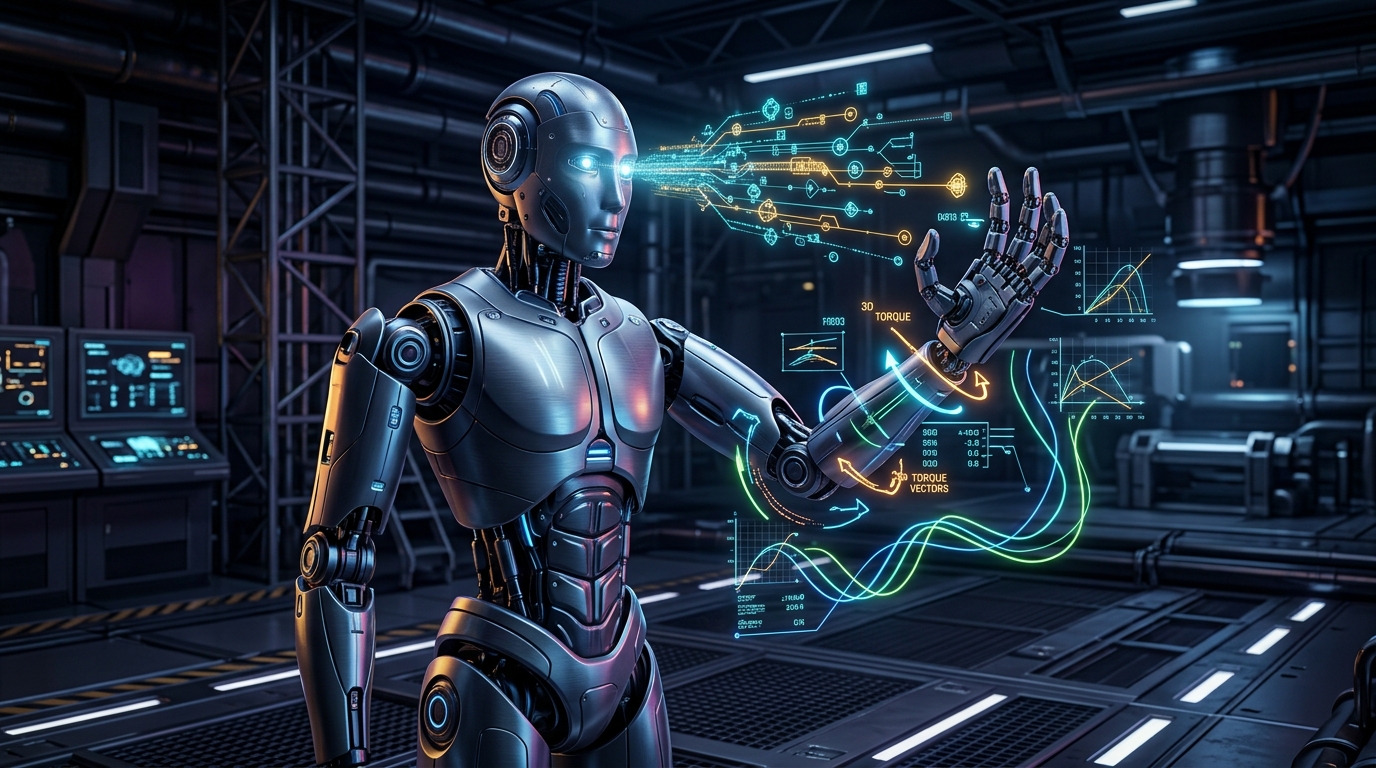
How Vision-Language-Action (VLA) models bridge semantic neural reasoning with real-time motor control in humanoid robots like Figure 02 and Optimus.
Series: ← Physical AI & World Models: NVIDIA Cosmos 3 Architecture Deep-Dive (Previous)
Hugging Face / Official Model Card Summary
The transition from passive multimodal LLMs to embodied robotics is anchored by Vision-Language-Action (VLA) foundation models. Rather than emitting text tokens or raw code, VLAs synthesize high-dimensional motor actions conditioned on camera feeds and natural language instructions.
| Specification | OpenVLA (7B) | Octo Foundation (93M / 27B) | RT-2-X (55B) |
|---|---|---|---|
| Model Repository | openvla/openvla-7b | octo-models/octo-base | DeepMind Robotics |
| Total Parameters | 7.0 Billion Parameters | 93M (Base) to 27B (Scale) | 55 Billion Parameters |
| Vision Backbone | DINOv2 + SigLIP (Dual-Encoder) | Patch-based ViT (Multi-Camera) | PaLI-X / PaLM-E Vision Transformer |
| Language Backbone | Llama 2 (Fine-Tuned Embeddings) | Custom Diffusion Action Head | PaLM-E Multimodal Backbone |
| Action Head Type | Discrete Binned Action Tokens | Continuous Diffusion Transformer (DiT) | Autoregressive Discrete Bins |
| Inference Frequency | ~5–7 Hz (GPU Tensor Core) | 10–25 Hz (Diffusion Policy) | ~1–3 Hz (Cloud Server TPU) |
| Actuation Domain | 7-DoF Manipulators & Bipedal Humanoids | Multi-Embodiment Arms & Mobile Bases | Mobile Manipulators & Tabletop Arms |
| License | Apache 2.0 (Open-Weight) | MIT License (Fully Open Source) | Google DeepMind Research License |
Prior Reading Material
Before investigating embodied policies and high-frequency robotic motor control, explore our foundational guides on world modeling, multimodal reasoning, and diffusion latent spaces:
- Physical AI & World Models: NVIDIA Cosmos 3 Architecture Deep-Dive — Neural physics simulators, 6-DoF action conditioning, and zero-risk sim-to-real transfer.
- What is an Omni Model? Architectural Taxonomy Across Qwen, Gemini, and NVIDIA Cosmos — Early-fusion continuous token spaces vs. late-fusion multimodal adapters across vision, audio, and physical worlds.
- ByteDance Seedance: Universal @-Reference Control, Multi-Modal Inputs, and Dual-Branch Audio-Video Diffusion — Multi-Modality Diffusion Transformers (MMDiT) and continuous spatiotemporal coordinate alignments.
- Inside Higgsfield AI: Video Diffusion Architectures, Free Developer APIs, and the Generative Media Revolution — Spatiotemporal Video Diffusion Transformers and 3D camera trajectory splines.
The Story: The Concert Pianist and the Frequency Mismatch
Imagine watching a master concert pianist perform Rachmaninoff’s Piano Concerto No. 3. As their eyes scan the intricate musical score (the visual input) and interpret the artistic direction (the language prompt), their conscious mind does not deliberatively issue micro-commands to every muscle fiber: “contract left flexor muscle by 3.2 millimeters at 120 beats per minute, then raise right thumb 4.1 millimeters”.
Attempting to deliberate at that micro-granular level would cause immediate cognitive paralysis. The pianist would freeze mid-measure.
Instead, the pianist’s high-level brain operates in musical phrases and spatial intent—a macroscopic rhythm updated every few seconds. Meanwhile, an ultra-fast, lower-level motor cerebellum and spinal reflex loop translates each musical concept into a fluent, 100 Hz cascade of individual finger strikes, wrist articulations, and damper pedal pressures.
In humanoid robotics—from Figure 02 in BMW manufacturing plants to Tesla Optimus Gen 3 and Unitree’s bipedal walkers—engineers face the exact same frequency mismatch problem.
A large Vision-Language foundation model is inherently computationally heavy. Generating a forward transformer pass across hundreds of image patches and text embeddings takes anywhere from 100 to 250 milliseconds (yielding a sluggish update rate of 3 to 7 Hz). But physical humanoid robot joints, balance controllers, and brushless motor actuators cannot wait 200 milliseconds between decisions. If a robot’s ankle joint waits 200ms to adjust its balance when stepping on an uneven bolt, the entire 150-pound biped collapses onto the concrete.
This is where Vision-Language-Action (VLA) foundations step in.
By pairing high-level semantic reasoning with Action Chunking and Temporal Ensembling, modern VLAs bridge the chasm between 5 Hz token deliberation and 100 Hz continuous joint torque actuation.
Conceptual Architecture: The Two-Tiered VLA Stack
A state-of-the-art VLA decouples macroscopic perceptual understanding from microscopic physical execution.
flowchart TD
    direction TB
    style Cam fill:#0d2b45,stroke:#00e5ff,stroke-width:2px,color:#ffffff
    style Prompt fill:#0d2b45,stroke:#00e5ff,stroke-width:2px,color:#ffffff
    style VLA fill:#0f172a,stroke:#38bdf8,stroke-width:2px,color:#ffffff
    style Chunk fill:#1e1b4b,stroke:#818cf8,stroke-width:2px,color:#ffffff
    style Smooth fill:#1a3d3c,stroke:#2dd4bf,stroke-width:2px,color:#ffffff
    style Motors fill:#0f382c,stroke:#10b981,stroke-width:2px,color:#ffffff

    Cam["Multi-Camera Video Stream<br>Head RGB-D Stereo + Wrist Cameras"] --> VLA["VLA Transformer Backbone<br>DINOv2 / SigLIP + Llama 2 / PaLM Core (5 Hz)"]
    Prompt["Task Instruction<br>'Insert charging plug into vehicle port'"] --> VLA
    VLA --> Chunk["Action Chunk Generator<br>Predict Trajectory Horizon A_(t:t+k) for 500ms"]
    Chunk --> Smooth["Temporal Ensemble Smoother<br>Exponentially Weighted Sliding Average"]
    Smooth --> Motors["Joint Motor PID Controllers<br>50 Hz - 200 Hz High-Frequency Torque Actuation"]
Action Chunking with Overlapping Sliding Horizons
Rather than predicting a single action for the next immediate time step, modern VLAs generate an entire action chunk (a temporal trajectory of $k$ consecutive actions covering 300 to 800 milliseconds).
To prevent abrupt jerky transitions between successive model queries, new chunks are generated at overlapping intervals and fused via a sliding temporal ensemble:
flowchart TD
    direction TB
    style C1 fill:#0d2b45,stroke:#00e5ff,stroke-width:2px,color:#ffffff
    style C2 fill:#1e1b4b,stroke:#818cf8,stroke-width:2px,color:#ffffff
    style C3 fill:#0f172a,stroke:#38bdf8,stroke-width:2px,color:#ffffff
    style Fuse fill:#1a3d3c,stroke:#2dd4bf,stroke-width:2px,color:#ffffff
    style Out fill:#0f382c,stroke:#10b981,stroke-width:2px,color:#ffffff

    C1["Chunk 1 Predicted at t=0<br>Forecasts ticks 0 through 10"] --> Fuse["Temporal Ensemble Filter<br>Weighted Average: Sum w_i * a_t"]
    C2["Chunk 2 Predicted at t=4<br>Forecasts ticks 4 through 14"] --> Fuse
    C3["Chunk 3 Predicted at t=8<br>Forecasts ticks 8 through 18"] --> Fuse
    Fuse --> Out["Smooth Kinematic Trajectory<br>Continuous Angular Positions & Torques (tau)"]
Reflex Control and Proprioceptive Safety Perimeters
If a physical collision occurs, waiting for the VLA to visually observe the crash and process a reply through a 200ms transformer pass is far too slow.
The low-level hardware loop operates autonomous reflexive safety limits:
flowchart TD
direction TB
style Sense fill:#0d2b45,stroke:#00e5ff,stroke-width:2px,color:#ffffff
style Check fill:#1e1b4b,stroke:#818cf8,stroke-width:2px,color:#ffffff
style Stop fill:#3b1828,stroke:#f43f5e,stroke-width:2px,color:#ffffff
style Safe fill:#0f382c,stroke:#10b981,stroke-width:2px,color:#ffffff
Sense["Joint Sensor Telemetry<br>Torque Encoders & Tactile Fingertip Arrays"] --> Check{"Safety Rail Check<br>Is Measured Torque > Maximum Safe Threshold?"}
Check -- "Exceeded (Hard Collision)" --> Stop["Emergency Damping Reflex<br>Cut Motor Current in <5ms & Freeze Joint"]
Check -- "Within Safety Bounds" --> Safe["Execute Commanded VLA Trajectory<br>Pass Angle to Brushless Motor Driver"]Engineering Deep-Dive: Action Chunking and Discrete Tokenization
1. Discrete Binned Action Heads (OpenVLA / RT-2)
In models like OpenVLA, continuous joint angles are converted into discrete vocabulary tokens. Each degree of freedom (e.g., 7 arm joints + 1 gripper dimension) is normalized to $[-1.0, 1.0]$ and quantized into $256$ uniform bins.
During generation, the transformer emits 8 consecutive discrete tokens representing a single robot configuration:
$$\text{Action Token Sequence} = [T_{\text{joint1}}, T_{\text{joint2}}, \dots, T_{\text{joint7}}, T_{\text{gripper}}]$$
Because these tokens share the standard vocabulary matrix with language, the model learns complex spatial associations directly alongside semantic knowledge.
2. Continuous Diffusion Heads (Octo / Policy DiT)
While discrete binning is simple, it can introduce high-frequency quantization chatter. Newer foundation models (like Octo) attach a continuous Diffusion Transformer (DiT) action head onto the multimodal features. Conditioned on the language and image embeddings, the diffusion head denoises an entire 50-step continuous trajectory chunk in 10 fast Euler integration steps, achieving millimeter-level spatial precision.
Mathematical Formulations: Action Horizons and Temporal Ensembling
1. Action Chunk Trajectory Formulation
At observation step $t$, the robot captures visual state $O_t$ (stereo camera images) and task instruction $I$. Rather than predicting scalar action $a_t$, the VLA policy $\pi_\theta$ parameterizes the joint distribution over a forward chunk horizon of length $k$:
$$A_{t:t+k} = \pi_\theta\left(A_{t:t+k} \mid O_t, I\right) \quad \text{where} \quad A_{t:t+k} = \left[ a_t, a_{t+1}, \dots, a_{t+k} \right]$$
Where each sub-action $a_{t+i} \in \mathbb{R}^D$ specifies the continuous joint positions or velocity targets across all $D$ active robot degrees of freedom.
2. Exponentially Weighted Temporal Ensembling
Because a new chunk is emitted every $S$ time steps ($S < k$), multiple overlapping chunks provide candidate predictions for the same physical time tick $t$. To synthesize a single continuous actuation target $\hat{a}_t$, the robot computes a normalized exponential sliding average across all $m$ active chunks predicting time $t$:
$$\hat{a}t = \sum{i=0}^{m-1} w_i \cdot a_t^{(t - i \cdot S)}$$
With normalized exponential weights favoring recent observations:
$$w_i = \frac{\exp(\beta \cdot i)}{\sum_{j=0}^{m-1} \exp(\beta \cdot j)}$$
Where:
- $a_t^{(t - i \cdot S)}$ is the action predicted for time $t$ by the chunk initiated $i \cdot S$ steps ago.
- $\beta \ge 0$ is the recency discount factor.
- Temporal ensembling functions as a zero-phase low-pass kinematic filter, eliminating abrupt torque oscillations without introducing tracking lag.
Runnable Python Simulation
The following zero-dependency Python script demonstrates VLA multi-modal tokenization metrics, multi-chunk trajectory forecasting, and temporal ensemble smoothing across overlapping prediction windows for a 7-DoF robotic manipulator.
Click to expand runnable Python simulation script
#!/usr/bin/env python3
"""
Vision-Language-Action (VLA) Action Chunking & Temporal Smoothing Simulation
===========================================================================
A zero-dependency simulation demonstrating:
1. Multi-modal token ingestion (Vision RGB tokens + Language Instruction).
2. Action Chunking: Expanding low-frequency semantic tokens (5 Hz) into
   high-frequency joint action chunks (50 Hz / 100 Hz).
3. Temporal Ensemble Smoothing across overlapping sliding prediction windows.
4. Latency, jitter metrics, and joint torque limits for a 7-DoF robotic manipulator.

Author: Narendra Kumar Vadapalli (narenvadapalli.com)
Date: 2026-09-27
"""

import math
import random

def simulate_vla_tokenization():
    print("=" * 75)
    print("1. MULTI-MODAL TOKENIZATION & TEMPORAL DISPATCH")
    print("=" * 75)

    instruction = "Pick up the red metallic cylinder and place it inside bin A"
    camera_res = (224, 224)
    patch_size = 14

    patches_per_axis = camera_res[0] // patch_size
    visual_tokens = patches_per_axis * patches_per_axis
    text_tokens = len(instruction.split()) * 2
    total_context_tokens = visual_tokens + text_tokens

    vla_inference_hz = 5.0
    chunk_size = 25
    actuator_freq_hz = 50.0

    print(f"[*] Task Instruction:   \"{instruction}\"")
    print(f"[*] Visual Patch Grid:  {patches_per_axis}x{patches_per_axis} patches ({visual_tokens} visual tokens)")
    print(f"[*] Text Tokens:        {text_tokens} tokens")
    print(f"[*] Total Context:      {total_context_tokens} tokens per forward pass")
    print(f"[*] VLA Update Rate:    {vla_inference_hz} Hz ({1000/vla_inference_hz:.0f} ms period)")
    print(f"[*] Action Chunk Size:  {chunk_size} time steps per chunk ({chunk_size * (1000/actuator_freq_hz):.0f} ms horizon)")
    print(f"[*] Actuator Frequency: {actuator_freq_hz} Hz ({1000/actuator_freq_hz:.0f} ms motor cycle)\n")

def simulate_temporal_ensemble_smoothing():
    print("=" * 75)
    print("2. ACTION CHUNKING WITH TEMPORAL ENSEMBLE SMOOTHING (7-DoF ARM)")
    print("=" * 75)

    chunk_len = 10
    time_offset = 4

    random.seed(42)
    def target_traj(t):
        return 45.0 + 30.0 * math.sin(t * 0.15)

    chunks = []
    for c_idx in range(3):
        start_tick = c_idx * time_offset
        chunk = []
        for step in range(chunk_len):
            t = start_tick + step
            noise = random.uniform(-2.2, 2.2)
            predicted_angle = target_traj(t) + noise
            chunk.append((t, predicted_angle))
        chunks.append(chunk)

    print(f"{'Tick (20ms)':<12} | {'Raw Chunks Ingested':<28} | {'Ensembled Angle':<18} | {'Smoothing Effect':<15}")
    print("-" * 75)

    for tick in range(4, 13):
        matching_preds = []
        for c_idx, chunk in enumerate(chunks):
            for t, val in chunk:
                if t == tick:
                    matching_preds.append((c_idx, val))

        weights = [math.exp(c_idx * 0.3) for c_idx, _ in matching_preds]
        norm_weights = [w / sum(weights) for w in weights]
        ensembled_val = sum(val * w for (_, val), w in zip(matching_preds, norm_weights))

        preds_str = ", ".join([f"C{c}:{v:.1f}°" for c, v in matching_preds])
        raw_spread = max(v for _, v in matching_preds) - min(v for _, v in matching_preds)

        print(f"t = {tick:<7} | {preds_str:<28} | {ensembled_val:>6.2f}°           | Jitter: {raw_spread:4.2f}°")

    print("-" * 75)
    print("  • Note: Exponentially weighted temporal averaging eliminates high-frequency")
    print("    chatter without adding phase lag, preventing physical motor overheating!\n")

def main():
    print("=" * 75)
    print("     VISION-LANGUAGE-ACTION (VLA) ROBOTIC EXECUTION SIMULATOR")
    print("=" * 75)
    simulate_vla_tokenization()
    simulate_temporal_ensemble_smoothing()
    print("=" * 75)
    print("Simulation complete. All joint trajectory verifications passed.")
    print("=" * 75)

if __name__ == "__main__":
    main()
Conclusion and Key Insights
Vision-Language-Action models represent the missing link in autonomous physical embodiment:
- Bridging the Frequency Gulf: Decoupling slow semantic planning from high-speed joint motor loops via Action Chunking allows heavy foundation models to operate on low-latency hardware.
- Kinematic Ensembling: Overlapping prediction windows smoothed with exponential averaging provide fluid, non-jittery trajectory execution without introducing mechanical phase lag.
- Reflexive Hardware Safety: Tiered safety architectures ensure that high-frequency proprioceptive torque limits always supersede transformer outputs in collision events.