
Inside Higgsfield AI: Video Diffusion Architectures, Free Developer APIs, and the Generative Media Revolution
Demystifying Higgsfield AI: spatiotemporal diffusion models, free developer API access, NVIDIA HGX Blackwell acceleration, and ChatGPT integration.
Prior Reading Material
Before exploring Higgsfield AI and modern generative video diffusion pipelines, review these foundational deep-dives across our blog:
- What is an Omni Model? Architectural Taxonomy Across Qwen, Gemini, and NVIDIA Cosmos — Comparing conversational omni models, streaming interfaces, and physical world models.
- Part 2: Inside NVIDIA Cosmos: World Foundation Models for Physical Commonsense & Video Trajectories — Spatiotemporal latent tokenizers ($8 \times 8 \times 8$ compression) and score-matching diffusion architectures.
- Part 6: Inside Project GR00T: Vision-Language-Action (VLA) Tokenization & Diffusion Action Heads — Conditional score-matching diffusion denoising heads and continuous trajectory generation.
- The Model Taxonomy: LLMs, Vision Models, VLAs, and Diffusion — High-level classification of autoregressive generators versus iterative reverse-diffusion architectures.
Official Platform & Release Summary
Founded by former Snap AI executive Alex Mashrabov, Higgsfield AI has emerged as a disruptive force in generative video creation. Designed from the ground up to democratize high-fidelity, cinema-grade video generation for developers, independent creators, and enterprise marketing teams, Higgsfield bridges the gap between text-prompted imagination and camera-level cinematography.
In a landmark move to accelerate developer adoption, Higgsfield expanded developer access by introducing Free Developer Tier API access, open GitHub tooling integrations, and direct Model Context Protocol (MCP) bridges into major AI orchestrators like ChatGPT.
| Specification Field | Technical Detail & Official References |
|---|---|
| Platform Homepage | Higgsfield AI Official Site |
| Developer API Portal | Higgsfield Developer API |
| Developer Access Announcement | Higgsfield Expands Developer Access with APIs and GitHub Tools (entArabi) |
| Hardware Infrastructure | NVIDIA Case Study: Scaling Video Production on HGX Blackwell |
| ChatGPT & Workflow Integration | Alex Mashrabov on Native ChatGPT Tool Integration |
| Underlying Generative Backbone | Spatiotemporal Latent Video Diffusion Transformer (VDT) & “Soul” Model Family |
| Compute Hardware | NVIDIA HGX B200 / B300 Blackwell Clusters (30% Training Acceleration) |
| Motion & Camera Control | Continuous 3D camera path controls (pan, tilt, zoom, orbit, crane) & character identity preservation |
| Developer Ecosystem | REST API, Python SDK, Model Context Protocol (MCP) server, GitHub Actions integrations |
1. The Autonomous Virtual Production Studio Analogy
To understand why Higgsfield AI represents a seismic shift in generative content creation, consider how high-budget television commercials have historically been filmed.
The Traditional Soundstage
Producing a 15-second cinematic car commercial traditionally demands millions of dollars and weeks of logistics:
- Renting an aircraft hangar or soundstage.
- Hiring a director of photography (DP), gaffers, dolly grip operators, and stunt drivers.
- Setting up motorized camera cranes ($150,000+ technocranes) to execute sweeping 3D camera moves.
- Shooting dozens of takes, followed by weeks in post-production visual effects (VFX) suites running render farms to composite backgrounds and match lighting.
If the creative director decides to change the vehicle’s paint color or shift the camera angle from ground-level to aerial drone footage, the entire soundstage must be re-booked and re-shot at catastrophic expense.
flowchart TD
    subgraph TraditionalProduction["Legacy Physical Film Production"]
        direction TB
        LogisticsStage["Location Scouting & Soundstage Rental"]
        PhysicalCrew["Camera Grips, Gaffers & Crane Operators"]
        PhysicalShoot["On-Set Filming (Rigid Real-World Lighting & Motion)"]
        PostProduction["Weeks of Post-Production CGI & Visual Effects (VFX)"]
        FinalOutput["Single Finished Commercial Asset"]
    end

    LogisticsStage --> PhysicalCrew
    PhysicalCrew --> PhysicalShoot
    PhysicalShoot --> PostProduction
    PostProduction --> FinalOutput

    style LogisticsStage fill:#0d2b45,stroke:#00e5ff,stroke-width:2px,color:#ffffff;
    style PhysicalCrew fill:#1e293b,stroke:#94a3b8,stroke-width:2px,color:#ffffff;
    style PhysicalShoot fill:#1a3d3c,stroke:#2dd4bf,stroke-width:2px,color:#ffffff;
    style PostProduction fill:#311042,stroke:#c084fc,stroke-width:2px,color:#ffffff;
    style FinalOutput fill:#431407,stroke:#f97316,stroke-width:2px,color:#ffffff;
The Higgsfield Digital Neural Stage
Higgsfield AI replaces the entire physical soundstage with a programmable spatiotemporal diffusion pipeline.
Instead of hoping a text-to-video prompt randomly produces the right camera angle, creators describe the narrative intent in natural language while programmatically parameterizing the 3D trajectory:
- A virtual 3D camera is initialized at coordinate $(x_0, y_0, z_0)$ and swept along a parabolic spline to $(x_1, y_1, z_1)$.
- Character facial identity vectors are anchored across latent frames, preventing the face-morphing artifacts common in early AI video tools.
- The diffusion backbone continuously denoises Gaussian noise into photorealistic 60 FPS video frames accelerated by NVIDIA HGX Blackwell systems.
And with the introduction of free developer API tiers, any software engineer can integrate this virtual film studio directly into an automated CI/CD pipeline, an e-commerce catalog, or a conversational ChatGPT workflow.
flowchart TD
    subgraph HiggsfieldPipeline["Higgsfield AI Neural Production Architecture"]
        direction TB
        CreativePrompt["Input: Text Prompt + Character Identity Anchor + 3D Camera Path"]
        LatentNoise["High-Dimensional Gaussian Latent Volume: z_T ~ N(0, I)"]
        BlackwellCluster["NVIDIA HGX B200/B300 Accelerated Diffusion Backbone"]
        DenoisingLoop["Iterative Reverse-Diffusion Denoising (Classifier-Free Guidance)"]
        TemporalDecoder["Spatiotemporal Neural Decoder -> 1080p / 4K Video Stream"]
        APIDispatch["Developer API & ChatGPT MCP Tool Execution"]
    end

    CreativePrompt --> LatentNoise
    LatentNoise --> BlackwellCluster
    BlackwellCluster --> DenoisingLoop
    DenoisingLoop --> TemporalDecoder
    TemporalDecoder --> APIDispatch

    style CreativePrompt fill:#0d2b45,stroke:#00e5ff,stroke-width:2px,color:#ffffff;
    style LatentNoise fill:#0f382c,stroke:#10b981,stroke-width:2px,color:#ffffff;
    style BlackwellCluster fill:#1a3d3c,stroke:#2dd4bf,stroke-width:2px,color:#ffffff;
    style DenoisingLoop fill:#311042,stroke:#c084fc,stroke-width:2px,color:#ffffff;
    style TemporalDecoder fill:#0f172a,stroke:#38bdf8,stroke-width:2px,color:#ffffff;
    style APIDispatch fill:#431407,stroke:#f97316,stroke-width:2px,color:#ffffff;
2. Core Technological Breakthroughs
2.1 Video Diffusion Transformers (VDT) vs. 2D Diffusion
Standard image diffusion models (e.g. Stable Diffusion, FLUX) denoise independent 2D spatial feature grids $z \in \mathbb{R}^{H \times W \times C}$. Attempting to generate video by independently denoising consecutive frames results in severe temporal flickering and disjointed motion.
Higgsfield leverages a Spatiotemporal Video Diffusion Transformer:
- Video is represented as a 4D spatio-temporal tensor volume $\mathbf{V} \in \mathbb{R}^{T \times H \times W \times C}$.
- The transformer architecture alternates between Spatial Self-Attention (modeling intra-frame composition, lighting, and textures) and Temporal Cross-Attention (tracking optical flow, object trajectories, and camera velocity across time frames $t$).
flowchart TD
    subgraph DualAttentionBlock["Higgsfield Spatiotemporal Diffusion Block"]
        direction TB
        InputLatents["Noisy Latent Video Tensor: z_t in R^(T x H x W x C)"]
        SpatialAttn["Spatial Self-Attention (Frame-Level Texture & Object Anatomy)"]
        TemporalAttn["Temporal Cross-Attention (Time-Step Continuity & Camera Motion)"]
        CrossModalCond["Text Prompt & Camera Spline Conditioning (Cross-Attention)"]
        FeedForward["Pointwise MLP Feed-Forward Layer"]
        DenoisedLatents["Denoised Latent State: z_(t-1)"]
    end

    InputLatents --> SpatialAttn
    SpatialAttn --> TemporalAttn
    TemporalAttn --> CrossModalCond
    CrossModalCond --> FeedForward
    FeedForward --> DenoisedLatents

    style InputLatents fill:#0d2b45,stroke:#00e5ff,stroke-width:2px,color:#ffffff;
    style SpatialAttn fill:#0f382c,stroke:#10b981,stroke-width:2px,color:#ffffff;
    style TemporalAttn fill:#1a3d3c,stroke:#2dd4bf,stroke-width:2px,color:#ffffff;
    style CrossModalCond fill:#311042,stroke:#c084fc,stroke-width:2px,color:#ffffff;
    style FeedForward fill:#1e293b,stroke:#94a3b8,stroke-width:2px,color:#ffffff;
    style DenoisedLatents fill:#431407,stroke:#f97316,stroke-width:2px,color:#ffffff;
2.2 Camera-Path Parameterization & Character Anchors
A key limitation of early generative video tools was the lack of deterministic camera direction. Prompts like “pan left” or “dolly in” were interpreted probabilistically.
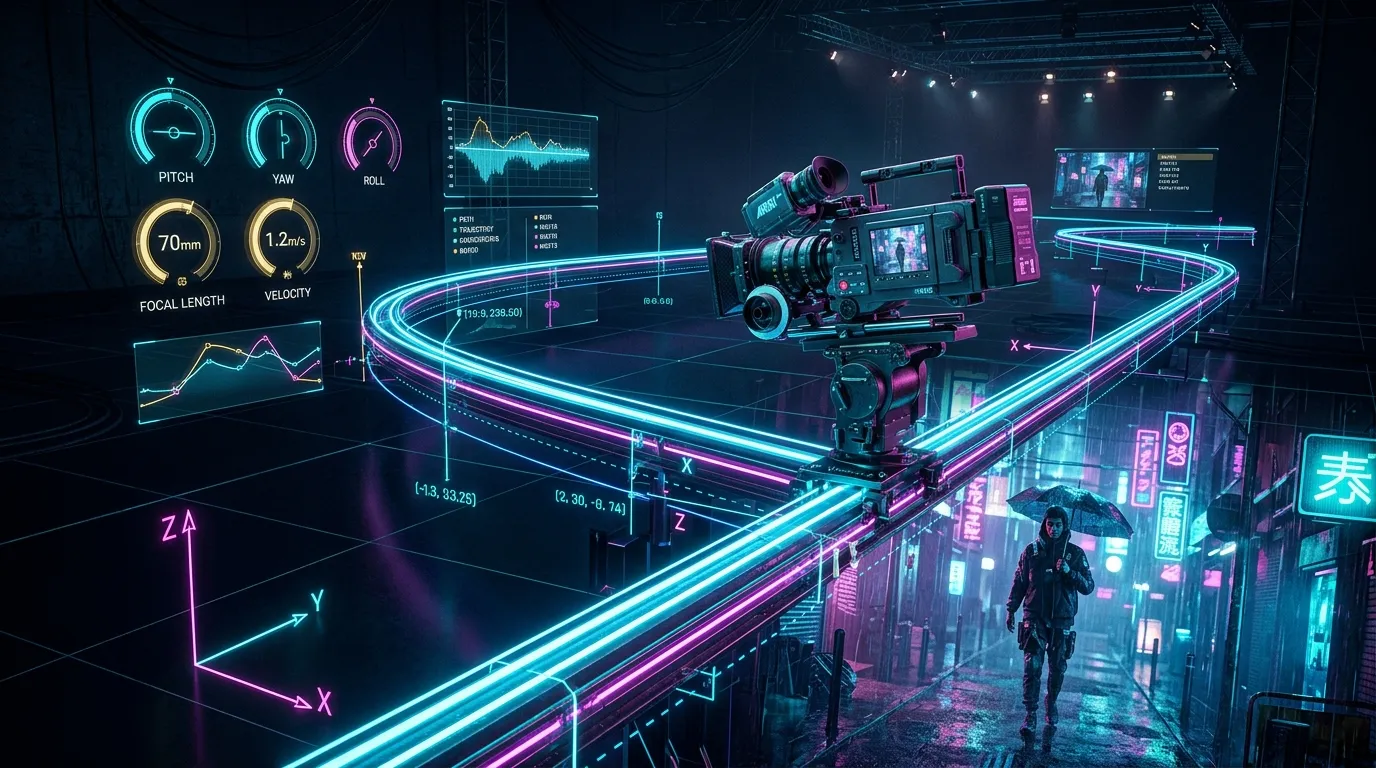
Higgsfield formalizes camera movement into explicit transformation matrices $[\mathbf{R} \mid \mathbf{t}] \in \text{SE}(3)$:
- Extrinsic Camera Conditioning: Users can feed 6-DoF camera vectors directly into the cross-attention blocks.
- Identity Preservation (Soul Model): Facial identity is extracted into low-dimensional facial embedding vectors that condition every temporal attention block, eliminating identity drift across scene transitions.
2.3 Hardware Acceleration: Scaling on NVIDIA HGX Blackwell
Video diffusion is computationally demanding: simulating dozens of denoising steps across a 4D tensor volume requires massive memory bandwidth and tensor throughput. As detailed in the official NVIDIA Higgsfield Case Study, Higgsfield scaled their training and inference pipelines on NVIDIA HGX B200 and B300 systems.
Leveraging Blackwell’s second-generation Transformer Engine and FP8/FP4 mixed precision, Higgsfield achieved a 30% reduction in model training time while slashing per-second video generation inference latency.
3. Democratizing Video AI: The Free Developer Tier & ChatGPT Integration
Until recently, programmatic access to generative video APIs was locked behind expensive minimum monthly commitments or restrictive waitlists. Higgsfield’s recent developer rollout represents a major democratization milestone:
- Free Developer API Access: Eliminates prohibitive upfront credit barriers, providing developers with a generous tier to test, prototype, and build automated video generation workflows programmatically.
- GitHub Tools & Actions: Pre-built CI/CD actions that automatically synthesize video assets from Markdown updates or issue triggers (e.g., generating personalized product demo clips on pull requests).
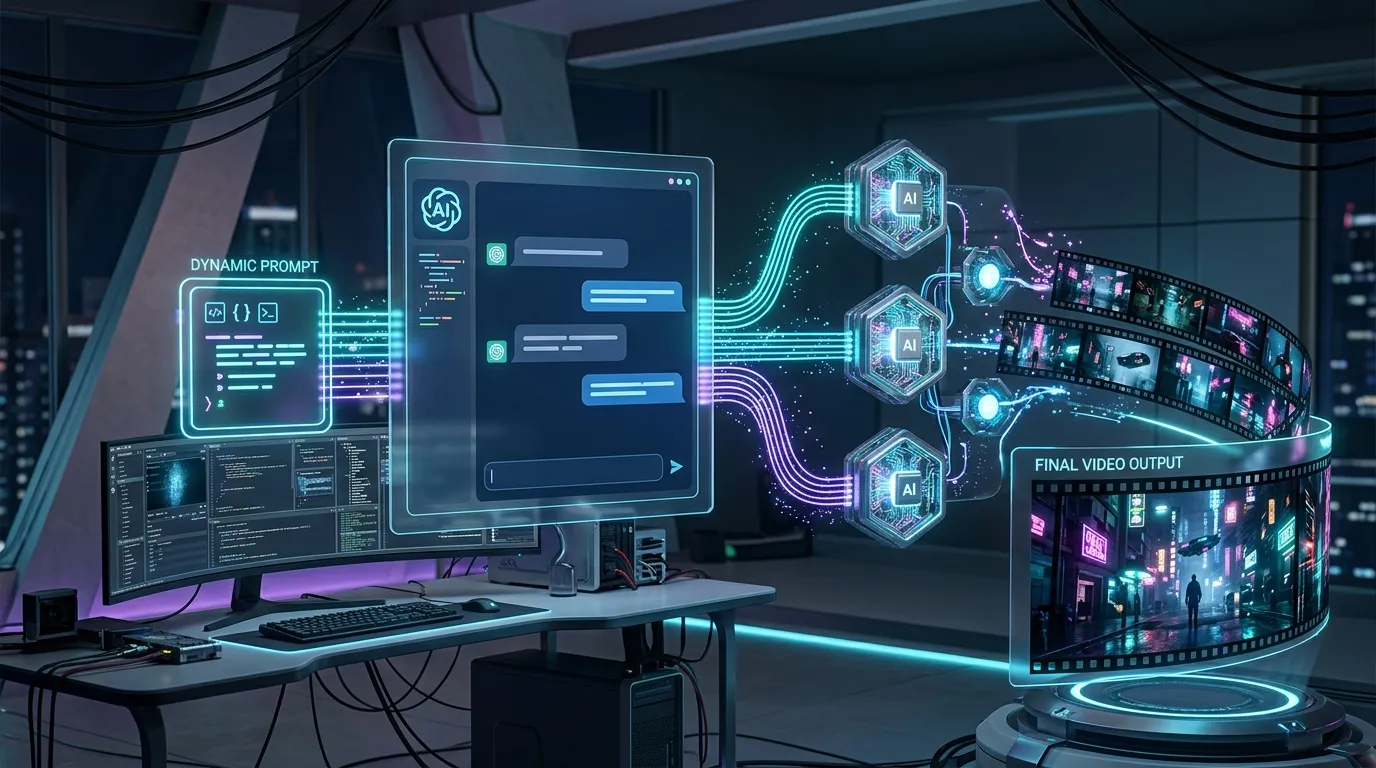
- ChatGPT & MCP Ecosystem: As highlighted by Alex Mashrabov, Higgsfield integrates natively into conversational agents like ChatGPT via the Model Context Protocol (MCP). Users can simply describe a video idea in natural language inside ChatGPT, and the assistant directly triggers Higgsfield’s API to render, refine, and return downloadable MP4 video files.
3.1 Official Developer API Quickstart: Asynchronous curl Workflow
The Higgsfield API operates via an asynchronous request-and-poll lifecycle. Because generating high-fidelity spatiotemporal diffusion latents takes several seconds, requests immediately return an active request_id and a polling status_url:
Step 1: Submit Generation Request
# Set your Higgsfield API credentials from https://console.higgsfield.ai
export HF_API_KEY_ID="your_api_key_id"
export HF_API_KEY_SECRET="your_api_key_secret"

RESPONSE=$(curl --silent --show-error --fail-with-body \
  --request POST \
  --url https://api.higgsfield.ai/higgsfield-ai/soul/v2/standard \
  --header "Authorization: Key ${HF_API_KEY_ID}:${HF_API_KEY_SECRET}" \
  --header "Content-Type: application/json" \
  --data '{
    "prompt": "Cinematic tracking shot of a cyberpunk courier running across a rain-slicked Tokyo rooftop at dusk",
    "aspect_ratio": "16:9",
    "guidance_scale": 7.5
  }')

echo "$RESPONSE" | jq
export REQUEST_ID=$(echo "$RESPONSE" | jq --raw-output '.request_id')
Initial Asynchronous Response (HTTP 200/202):
{
  "status": "queued",
  "request_id": "d7e6c0f3-6699-4f6c-bb45-2ad7fd9158ff",
  "status_url": "https://api.higgsfield.ai/requests/d7e6c0f3-6699-4f6c-bb45-2ad7fd9158ff/status",
  "cancel_url": "https://api.higgsfield.ai/requests/d7e6c0f3-6699-4f6c-bb45-2ad7fd9158ff/cancel"
}
Step 2: Poll Request Status Until Completion
curl --silent --show-error --fail-with-body \
  --url "https://api.higgsfield.ai/requests/${REQUEST_ID}/status" \
  --header "Authorization: Key ${HF_API_KEY_ID}:${HF_API_KEY_SECRET}" | jq
Final Terminal State Response:
{
  "status": "completed",
  "request_id": "d7e6c0f3-6699-4f6c-bb45-2ad7fd9158ff",
  "status_url": "https://api.higgsfield.ai/requests/d7e6c0f3-6699-4f6c-bb45-2ad7fd9158ff/status",
  "cancel_url": "https://api.higgsfield.ai/requests/d7e6c0f3-6699-4f6c-bb45-2ad7fd9158ff/cancel",
  "video": {
    "url": "https://cdn.higgsfield.ai/exports/d7e6c0f3-6699-4f6c-bb45-2ad7fd9158ff.mp4",
    "duration": 4.0,
    "fps": 24
  }
}
4. Mathematical Formulations of Video Diffusion
4.1 Forward Diffusion Process (Adding Gaussian Noise)
For a clean video latent $\mathbf{z}_0 \in \mathbb{R}^{T \times H \times W \times C}$, the forward Markovian process incrementally adds Gaussian noise across timesteps $t \in [1, K]$ according to a variance schedule $\beta_1, \dots, \beta_K$:
$$ q(\mathbf{z}t \mid \mathbf{z}{t-1}) = \mathcal{N}\left(\mathbf{z}t; \sqrt{1 - \beta_t} \mathbf{z}{t-1}, \beta_t \mathbf{I}\right) $$
Using the reparameterization trick with $\alpha_t = 1 - \beta_t$ and $\bar{\alpha}t = \prod{s=1}^t \alpha_s$:
$$ \mathbf{z}_t = \sqrt{\bar{\alpha}_t} \mathbf{z}_0 + \sqrt{1 - \bar{\alpha}_t} \boldsymbol{\epsilon}, \quad \boldsymbol{\epsilon} \sim \mathcal{N}(\mathbf{0}, \mathbf{I}) $$
4.2 Reverse Denoising with Camera & Text Conditioning
In the reverse process, the Higgsfield Video Diffusion Transformer parameterized by $\theta$ predicts the injected noise $\boldsymbol{\epsilon}\theta$ conditioned on the text prompt $\mathbf{c}{\text{text}}$, character anchor $\mathbf{c}{\text{id}}$, and 6-DoF camera trajectory $\mathbf{c}{\text{cam}}(t)$:
$$ \mathcal{L}{\text{video}}(\theta) = \mathbb{E}{t, \mathbf{z}0, \boldsymbol{\epsilon}}\left[ \left| \boldsymbol{\epsilon} - \boldsymbol{\epsilon}\theta\left(\mathbf{z}t, t, \mathbf{c}{\text{text}}, \mathbf{c}{\text{id}}, \mathbf{c}{\text{cam}}\right) \right|^2 \right] $$
4.3 Classifier-Free Guidance (CFG) for Motion Fidelity
To balance prompt fidelity and visual creativity, the model uses spatiotemporal Classifier-Free Guidance:
$$ \tilde{\boldsymbol{\epsilon}}_\theta(\mathbf{z}t, \mathbf{c}) = \boldsymbol{\epsilon}\theta(\mathbf{z}t, \emptyset) + s \cdot \left(\boldsymbol{\epsilon}\theta(\mathbf{z}t, \mathbf{c}) - \boldsymbol{\epsilon}\theta(\mathbf{z}_t, \emptyset)\right) $$
Where $s \ge 1.0$ is the guidance scale (typically tuned between 6.0 and 8.5 for cinematic balance).
5. Hands-On Implementation: Higgsfield Video Diffusion API Simulator
The following zero-dependency Python script demonstrates how developers interact with the Higgsfield API, parameterizing 3D camera paths, character anchors, and simulating the spatiotemporal reverse-diffusion schedule.
Click to expand runnable Python simulation script
#!/usr/bin/env python3
"""
higgsfield_api_simulator.py
Demonstration of Higgsfield AI Video Diffusion API interaction,
camera path spline interpolation, and spatiotemporal denoising progression.
Zero external dependencies (pure Python 3 standard library).
"""

import math
import json
import time
from dataclasses import dataclass, field
from typing import List, Dict, Any, Tuple


@dataclass
class CameraWaypoint:
    time_sec: float
    position: Tuple[float, float, float]  # (x, y, z)
    rotation_deg: Tuple[float, float, float]  # (pitch, yaw, roll)


@dataclass
class VideoGenerationRequest:
    prompt: str
    character_anchor_id: str
    duration_sec: float
    fps: int
    resolution: str
    camera_trajectory: List[CameraWaypoint]
    guidance_scale: float = 7.5


class HiggsfieldAPISimulator:
    def __init__(self, api_key: str = "hf_free_dev_tier_preview"):
        self.api_key = api_key
        self.base_url = "https://api.higgsfield.ai/v1"

    def interpolate_camera_spline(self, waypoints: List[CameraWaypoint], total_frames: int) -> List[Dict[str, Any]]:
        """Interpolates 3D camera trajectory across generated frame count."""
        trajectory = []
        if len(waypoints) < 2:
            return [{"frame": i, "pos": (0.0, 0.0, 0.0)} for i in range(total_frames)]

        w0, w1 = waypoints[0], waypoints[1]
        for frame in range(total_frames):
            alpha = frame / max(1, total_frames - 1)
            # Linear interpolation for 3D coordinates
            px = w0.position[0] + alpha * (w1.position[0] - w0.position[0])
            py = w0.position[1] + alpha * (w1.position[1] - w0.position[1])
            pz = w0.position[2] + alpha * (w1.position[2] - w0.position[2])
            trajectory.append({
                "frame": frame,
                "position": (round(px, 3), round(py, 3), round(pz, 3)),
                "interpolation_weight": round(alpha, 3)
            })
        return trajectory

    def simulate_reverse_diffusion(self, request: VideoGenerationRequest, denoising_steps: int = 25) -> Dict[str, Any]:
        """Simulates the reverse-diffusion denoising schedule on Blackwell GPU clusters."""
        total_frames = int(request.duration_sec * request.fps)
        camera_spline = self.interpolate_camera_spline(request.camera_trajectory, total_frames)

        print(f"[{request.resolution} @ {request.fps} FPS] Initializing {denoising_steps}-step Spatiotemporal Denoising...")

        # Simulate variance schedule: alpha_bar decay
        alpha_bars = [math.cos((step / denoising_steps + 0.008) / 1.008 * math.pi / 2) ** 2 for step in range(denoising_steps + 1)]

        step_metrics = []
        for step in range(1, denoising_steps + 1):
            snr_db = 10 * math.log10(max(1e-5, alpha_bars[step] / (1.0 - alpha_bars[step] + 1e-5)))
            fidelity = min(0.995, 0.20 + (0.80 * (step / denoising_steps)))
            step_metrics.append({
                "step": step,
                "signal_to_noise_ratio_db": round(snr_db, 2),
                "latent_fidelity": round(fidelity * 100, 1)
            })

        return {
            "status": "COMPLETED",
            "job_id": f"higgsfield_job_{int(time.time())}",
            "prompt": request.prompt,
            "character_anchor": request.character_anchor_id,
            "total_frames": total_frames,
            "duration_sec": request.duration_sec,
            "camera_path_waypoints_evaluated": len(camera_spline),
            "final_fidelity_percent": step_metrics[-1]["latent_fidelity"],
            "step_samples": [step_metrics[0], step_metrics[denoising_steps // 2], step_metrics[-1]],
            "api_tier": "Free Developer Tier",
            "download_url": f"https://cdn.higgsfield.ai/exports/sim_{int(time.time())}.mp4"
        }


def main():
    print("=" * 70)
    print(" HIGGSFIELD AI VIDEO DIFFUSION API & CAMERA CONTROL SIMULATION")
    print("=" * 70)

    # 1. Define Camera Trajectory (Crane shot moving from ground to aerial)
    camera_path = [
        CameraWaypoint(time_sec=0.0, position=(0.0, 1.2, -4.0), rotation_deg=(5.0, 0.0, 0.0)),
        CameraWaypoint(time_sec=5.0, position=(2.5, 6.0, -1.5), rotation_deg=(-20.0, 35.0, 0.0))
    ]

    # 2. Package generation request
    request = VideoGenerationRequest(
        prompt="Cinematic tracking shot of a cyberpunk courier running across a rain-slicked Tokyo rooftop at dusk",
        character_anchor_id="anchor_character_kai_004",
        duration_sec=4.0,
        fps=24,
        resolution="1080p",
        camera_trajectory=camera_path,
        guidance_scale=8.0
    )

    client = HiggsfieldAPISimulator()
    result = client.simulate_reverse_diffusion(request, denoising_steps=30)

    print(f"\nAPI Response Status:       {result['status']}")
    print(f"Job ID:                    {result['job_id']}")
    print(f"API Access Tier:           {result['api_tier']}")
    print(f"Prompt:                    \"{result['prompt']}\"")
    print(f"Character Anchor:          {result['character_anchor']}")
    print(f"Frames Generated:          {result['total_frames']} frames ({result['duration_sec']}s)")
    print(f"Final Latent Fidelity:     {result['final_fidelity_percent']}%")
    print(f"Simulated Video Output:    {result['download_url']}")

    print("\n--- Denoising Progression Checkpoints ---")
    for sample in result['step_samples']:
        print(f"  Step {sample['step']:2d} -> SNR: {sample['signal_to_noise_ratio_db']:6.2f} dB | Latent Fidelity: {sample['latent_fidelity']}%")

    print("=" * 70)


if __name__ == "__main__":
    main()
Conclusion & The Road Ahead: Generative Video Series
Higgsfield AI exemplifies the maturation of generative video: transitioning from erratic text-prompted animations into deterministic, camera-controlled digital production pipelines. By anchoring diffusion latents to physical camera coordinates and character identities—and democratizing access through free developer APIs—Higgsfield paves the way for software-defined cinematography.
This post inaugurates our upcoming Frontier Generative Video Series. In upcoming installments, we will explore:
- Part 2: ByteDance’s Seedance & Multimodal Reference Control: Universal
@-referencearchitectures, multi-asset prompt conditioning (text + 9 images + 3 audio tracks), and native dual-branch audio-video diffusion. - Part 3: Camera Dynamics & Trajectory Splines: Mathematical parameterization of continuous 3D camera paths in latent space.
- Part 4: Real-Time Latent Video Serving: Scaling video diffusion inference on modern GPU clusters with FP8 quantization and memory-efficient temporal cross-attention.