
Physical AI & World Models: NVIDIA Cosmos 3 Architecture Deep-Dive
Inside NVIDIA Cosmos 3: Spatiotemporal diffusion, 6-DoF action conditioning, Cosmos-Tokenizer 3D VAEs, and physics-consistent world simulation for robotics.
Series: ← Inside Anthropic’s Claude Opus 5.5: Writing Style Evolution, Architecture, and Everyday Agent Workflows (Previous)
Hugging Face / Official Model Card Summary
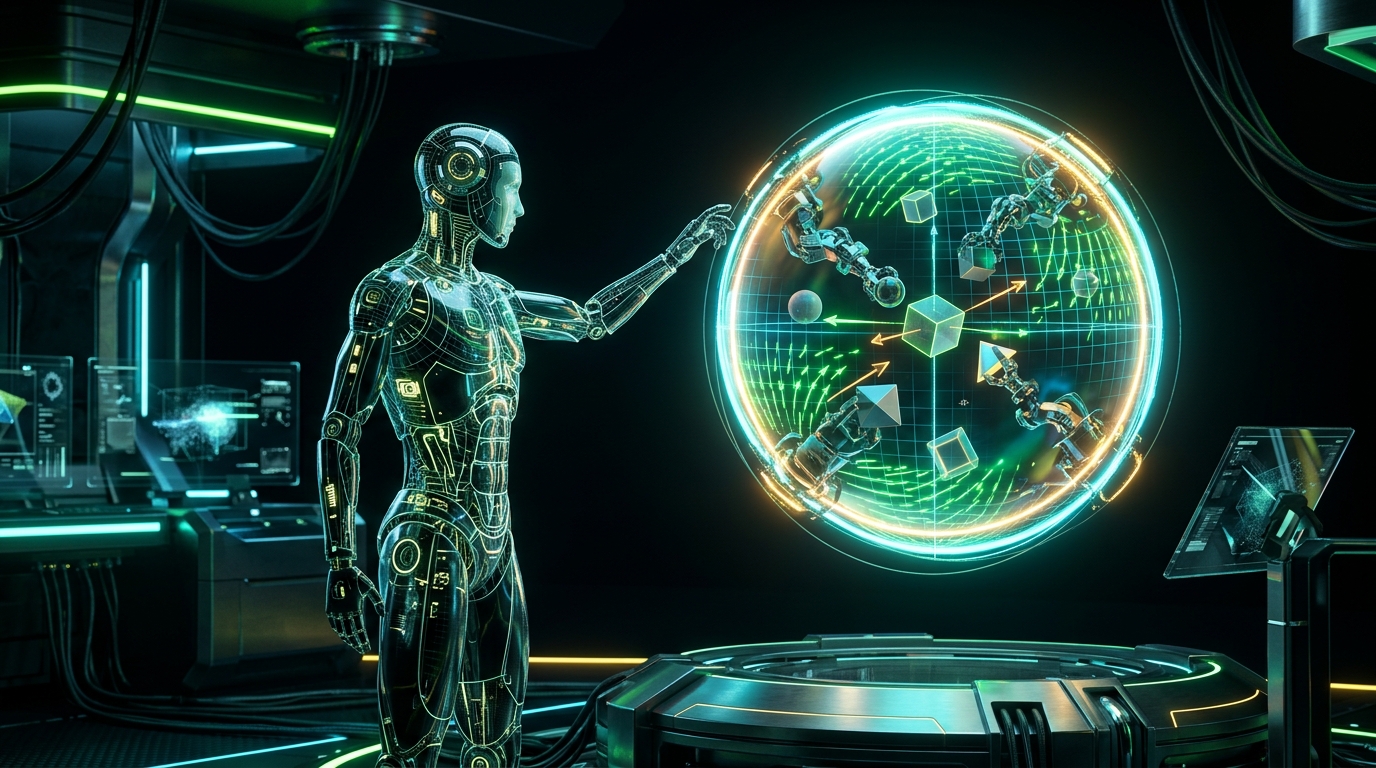
The debut of the NVIDIA Cosmos 3 Foundation Suite establishes a major turning point in Physical AI. Rather than generating visual media solely for entertainment, Cosmos 3 is architected from the ground up as a neural world simulator capable of predicting physics-consistent futures conditioned on robotic action vectors, camera trajectories, and real-time sensory feeds.
| Specification | Details & Reference Values |
|---|---|
| Model Repository | nvidia/Cosmos-3 / Official NVIDIA Cosmos Portal |
| Model Variants | Cosmos-Diffusion (7B & 14B) and Cosmos-Autoregressive (4B & 12B) |
| Modality & Domain | Spatiotemporal World Simulation, Synthetic Trajectory Rollouts, and Physical AI Policy Training |
| Spatiotemporal Tokenizer | Continuous Cosmos-Tokenizer (8x Spatial, 8x Causal Temporal Compression, 16 Latent Channels) |
| Context Horizon | Up to 128 Consecutive Video Frames with Rolling Dynamic Latent Buffering |
| Conditioning Modalities | Natural Language Prompts, 3D Bounding Boxes, Depth Maps, and 6-DoF Robot Action Vectors $[x, y, z, \text{roll}, \text{pitch}, \text{yaw}]$ |
| Supported Precision | Native FP8, BF16, and FP16 Inference accelerated on TensorRT-ModelOptimizer |
| Official License | NVIDIA Open Model License (Weights & Tokenizer Code Publicly Accessible) |
Prior Reading Material
Before examining neural world simulation and action-conditioned diffusion, review our prerequisite deep-dives on spatiotemporal latent spaces, diffusion transformers, and omni-modal foundations:
- What is an Omni Model? Architectural Taxonomy Across Qwen, Gemini, and NVIDIA Cosmos — Unified early-fusion continuous token spaces vs. late-fusion adapters across vision, sound, and physical actions.
- Wan 2.1: Open-Weight Video Diffusion, 3D VAE Latent Compression, and Consumer GPU Inference — 3D causal VAE latent compression, straight-path Flow Matching, and DiT architectures.
- ByteDance Seedance: Universal @-Reference Control, Multi-Modal Inputs, and Dual-Branch Audio-Video Diffusion — Multi-Modality Diffusion Transformers (MMDiT), 3D MM-RoPE, and simultaneous visual-audio diffusion.
- Inside Higgsfield AI: Video Diffusion Architectures, Free Developer APIs, and the Generative Media Revolution — Spatiotemporal Video Diffusion Transformers (VDT), 3D camera trajectory splines, and developer API workflows.
The Story: The Holodeck Flight Simulator
Consider the difference between a high-definition cinema projector and a flight simulator used to train commercial airline pilots.
A cinema projector displays magnificent, photorealistic moving images on a flat screen. If the movie script calls for an airplane to perform an impossible aerodynamic maneuver—banking 90 degrees horizontally at Mach 3 without stalling—the projector faithfully displays the pixels without objection. The projector does not know what lift, drag, inertia, or structural shear stress are. It deals entirely in the illusion of appearance.
A flight simulator, by contrast, cannot afford illusions. If a pilot abruptly yanks the flight stick, the simulator must calculate the exact aerodynamic forces over the wings, engine turbine thrust, gravitational G-forces, and atmospheric turbulence. If the simulated control inputs violate the laws of physics, the simulator accurately stalls the aircraft and logs the aerodynamic failure.
In the landscape of frontier generative media, models like OpenAI Sora, Runway Gen-4.5, and Kling act like cinema projectors. They generate mesmerizing visual sequences, but their internal representations contain zero persistent mathematical awareness of mass, friction coefficients, collision boundaries, or Newtonian gravity. If a ceramic mug falls off a desk in a conventional video model, it might suddenly dissolve into liquid smoke, pass through the solid wooden floor, or morph into a completely different object.
NVIDIA Cosmos 3 is fundamentally not a video generator—it is a neural physics engine.
Built specifically for the robotics and Physical AI revolution, Cosmos 3 functions as a digital Holodeck. When an autonomous humanoid robot or self-driving vehicle proposes an action sequence—such as extending a five-fingered gripper forward by 15 centimeters to grasp an unbalanced metallic cylinder—Cosmos 3 rolls forward a physically consistent world state. It simulates the rigid-body contact dynamics, calculates whether the applied normal grip force overcomes gravitational shear, renders accurate optical shadows, and predicts whether the cylinder will remain stable or slip and tumble to the floor.
By learning the underlying laws of physical interaction directly from hundreds of thousands of hours of real-world sensor streams and high-fidelity physics engines, Cosmos 3 bridges the chasm between generative visual AI and physical robotics.
Conceptual Architecture: The Dual-Track World Simulator
NVIDIA Cosmos 3 is engineered with a dual-track architecture to solve two distinct computational challenges: high-fidelity photorealistic video generation for synthetic training data, and ultra-low-latency autoregressive token rollouts for real-time model-predictive control (MPC).
flowchart TD
    direction TB
    style In fill:#0d2b45,stroke:#00e5ff,stroke-width:2px,color:#ffffff
    style Tok fill:#0f172a,stroke:#38bdf8,stroke-width:2px,color:#ffffff
    style Diff fill:#1e1b4b,stroke:#818cf8,stroke-width:2px,color:#ffffff
    style Auto fill:#1a3d3c,stroke:#2dd4bf,stroke-width:2px,color:#ffffff
    style Out1 fill:#0f382c,stroke:#10b981,stroke-width:2px,color:#ffffff
    style Out2 fill:#0f382c,stroke:#10b981,stroke-width:2px,color:#ffffff

    In["Physical Sensory Input<br>RGB Video, Depth Maps & 6-DoF Robot Actions"] --> Tok["Cosmos-Tokenizer 3D VAE<br>8x8x8 Spatiotemporal Latent Manifold"]
    Tok --> Diff["Cosmos-Diffusion (7B / 14B)<br>Flow Matching Spatiotemporal DiT"]
    Tok --> Auto["Cosmos-Autoregressive (4B / 12B)<br>Discrete Causal Token State Predictor"]
    Diff --> Out1["Photorealistic Synthetic Video<br>Millions of Hours for Isaac Sim & Omniverse"]
    Auto --> Out2["Real-Time World State Rollout<br>Sub-100ms Action Trajectory Planning for MPC"]
Sim-to-Real Policy Feedback Loop
Deploying physical robots in unstructured human environments requires millions of trials. In the physical world, trial-and-error training risks breaking million-dollar robot actuators, smashing delicate objects, or causing human injury.
With Cosmos 3, the robot’s policy network interacts with the neural world model as a zero-risk sandbox:
flowchart TD
    direction TB
    style P1 fill:#0d2b45,stroke:#00e5ff,stroke-width:2px,color:#ffffff
    style P2 fill:#0f172a,stroke:#38bdf8,stroke-width:2px,color:#ffffff
    style P3 fill:#1e1b4b,stroke:#818cf8,stroke-width:2px,color:#ffffff
    style P4 fill:#3b1828,stroke:#f43f5e,stroke-width:2px,color:#ffffff
    style P5 fill:#0f382c,stroke:#10b981,stroke-width:2px,color:#ffffff

    P1["Robot Visual State S_t<br>Onboard RGB-D Stereo Cameras"] --> P2["Action Policy Proposer<br>Generate Candidate 6-DoF Vectors a_t"]
    P2 --> P3["Cosmos 3 Forward Rollout<br>Predict Next World State S_(t+1)"]
    P3 --> P4{"Physics & Safety Critic<br>Evaluate Slip, Collision & Stability"}
    P4 -- "Safety Violation / Drop" --> P2
    P4 -- "Verified Optimal Trajectory" --> P5["Physical Hardware Execution<br>Actuate Robotic Arm & End-Effector Motors"]
6-DoF End-Effector Action Conditioning
To ensure physical precision, Cosmos 3 does not rely on vague text prompts like “the robot picks up the cup”. Instead, it injects explicit six-degree-of-freedom ($6\text{-DoF}$) action vectors directly into its spatiotemporal attention blocks:
flowchart TD
    direction TB
    style A1 fill:#0d2b45,stroke:#00e5ff,stroke-width:2px,color:#ffffff
    style A2 fill:#0f172a,stroke:#38bdf8,stroke-width:2px,color:#ffffff
    style A3 fill:#1e1b4b,stroke:#818cf8,stroke-width:2px,color:#ffffff
    style A4 fill:#0f382c,stroke:#10b981,stroke-width:2px,color:#ffffff

    A1["Kinematic Action Vector<br>Delta X, Delta Y, Delta Z (meters)"] --> A2["Rotational Kinematics<br>Roll, Pitch, Yaw (Euler angles) & Grip Force"]
    A2 --> A3["MLP Action Projector<br>Continuous Action Embedding Space"]
    A3 --> A4["Cross-Attention Conditioning<br>Fused into Cosmos Spatiotemporal DiT Layers"]
Engineering Deep-Dive: Cosmos-Tokenizer and Synthetic Data Generation
1. The Cosmos-Tokenizer: 48x Spatiotemporal Volume Compression
Raw video streams generated by multi-camera robotic rigs produce staggering data volumes. An 8-second 720p stereo video feed at 24 frames per second contains over 500 million pixel values.
The Cosmos-Tokenizer introduces a continuous 3D Causal VAE architecture that applies:
- Spatial Compression: $8 \times$ downsampling along both height and width ($H/8, W/8$).
- Temporal Compression: $8 \times$ causal downsampling along the time axis ($T/8$), strictly enforcing that latent frame $t$ never attends to future frame $t+1$.
- Continuous 16-Manifold Channels: Outputting dense 16-channel FP16 latent tensors, yielding an overall 48x volume reduction while preserving fine geometric edges, contact boundaries, and optical motion vectors.
2. Scaling Sim-to-Real Transfer on NVIDIA Omniverse
Cosmos 3 serves as the foundational data synthesis engine for NVIDIA Isaac Sim and Omniverse. By conditioning generation on known 3D scene meshes and robot URDF kinematics, robotics labs can:
- Synthesize millions of corner-case variations (unusual lighting, wet reflective surfaces, cluttered countertops, transparent glassware) without collecting physical manual teleoperation data.
- Train Vision-Language-Action (VLA) foundation models completely in simulation, transferring trained policies directly to physical humanoid and quad-rotor hardware with zero fine-tuning degradation.
Mathematical Formulations: Action-Conditioned World Dynamics
1. Action-Conditioned Neural State Transition
Let $s_t \in \mathcal{S}$ denote the compressed spatiotemporal latent world state at time $t$, and let $a_t \in \mathbb{R}^6$ denote the commanded 6-DoF robot action vector:
$$a_t = \left[ \Delta x, \Delta y, \Delta z, \Delta \phi_{\text{roll}}, \Delta \theta_{\text{pitch}}, \Delta \psi_{\text{yaw}} \right]^T$$
The forward neural world model parameterizes the conditional distribution over subsequent latent states:
$$s_{t+1} \sim p_\theta\left(s_{t+1} \mid s_{1:t}, a_t, c\right)$$
Where:
- $s_{1:t}$ represents the historical sequence of observed visual latents.
- $a_t$ is the continuous 6-DoF kinematic action command.
- $c$ represents static conditioning variables (scene semantics, task instructions, and robot URDF geometry).
2. Spatiotemporal Flow Matching Loss with Action Ingestion
Cosmos-Diffusion trains on a continuous flow-matching objective. Given clean latent sample $x_1$ and Gaussian noise $x_0$, the intermediate noisy state along the linear vector field is $x_t = (1 - t)x_0 + t x_1$. The model learns a velocity prediction vector field $v_\theta(x_t, t, a, c)$:
$$\mathcal{L}{\text{Cosmos}} = \mathbb{E}{t \sim \mathcal{U}[0, 1], x_0, x_1, a} \left[ \left| v_\theta(x_t, t, a, c) - (x_1 - x_0) \right|_2^2 \right]$$
Where:
- $v_\theta$ is the neural vector field parameterized by the Spatiotemporal DiT.
- $x_1 - x_0$ is the ground-truth straight-path velocity field.
- Conditioning on $a$ enforces that the synthesized future respects the physical contact forces and geometric displacements prescribed by the action trajectory.
Runnable Python Simulation
The following zero-dependency Python script demonstrates the mathematical core of Cosmos 3: calculating Cosmos-Tokenizer 3D VAE compression ratios, simulating 6-DoF action-conditioned forward neural rollouts, and computing contact friction stability versus gravitational slip.
Click to expand runnable Python simulation script
#!/usr/bin/env python3
"""
NVIDIA Cosmos 3 Physical AI World Model Simulation
=================================================
A zero-dependency simulation demonstrating:
1. Continuous 3D Spatiotemporal VAE (Cosmos-Tokenizer) Latent Compression (8x8x8).
2. 6-DoF Action-Conditioned Neural World Model State Rollouts:
   - S_{t+1} ~ p_theta(S_{t+1} | S_{1:t}, a_t)
3. Physical Constraint Validation: Rigid-body contact friction, normal force,
   and gravitational drop dynamics during robotic manipulation.
4. Model-Predictive Control (MPC) trajectory safety & reward evaluation.

Author: Narendra Kumar Vadapalli (narenvadapalli.com)
Date: 2026-09-26
"""

import math

def simulate_cosmos_tokenizer():
    print("=" * 75)
    print("1. COSMOS-TOKENIZER 3D SPATIOTEMPORAL LATENT COMPRESSION")
    print("=" * 75)

    duration_sec = 4.0
    fps = 24
    total_frames = int(duration_sec * fps)
    height = 720
    width = 1280
    channels = 3

    raw_pixels = total_frames * height * width * channels
    raw_bytes = raw_pixels * 1
    raw_mb = raw_bytes / (1024 * 1024)

    spatial_factor = 8
    temporal_factor = 8
    latent_channels = 16

    latent_t = total_frames // temporal_factor
    latent_h = height // spatial_factor
    latent_w = width // spatial_factor

    latent_elements = latent_t * latent_h * latent_w * latent_channels
    latent_bytes_fp16 = latent_elements * 2
    latent_mb = latent_bytes_fp16 / (1024 * 1024)

    compression_ratio = raw_mb / latent_mb

    print(f"[*] Raw Video Input:   {total_frames} frames @ {width}x{height} (RGB 24fps)")
    print(f"[*] Raw Volume Size:   {raw_mb:.2f} MB ({raw_pixels:,} pixel values)")
    print(f"[*] Cosmos Latents:    {latent_t} timesteps @ {latent_w}x{latent_h}x{latent_channels} (FP16)")
    print(f"[*] Compressed Volume: {latent_mb:.2f} MB")
    print(f"[*] Compression Ratio: {compression_ratio:.1f}x spatiotemporal volume reduction\n")

def simulate_action_conditioned_rollout():
    print("=" * 75)
    print("2. 6-DoF ACTION-CONDITIONED FORWARD NEURAL ROLLOUT")
    print("=" * 75)

    mass_kg = 0.450
    gravity = 9.81
    friction_coeff = 0.42
    req_normal_force = (mass_kg * gravity) / friction_coeff

    policies = [
        {
            "name": "Policy A: Optimized Force Grasp",
            "action_6dof": {"dx": 0.05, "dy": 0.00, "dz": 0.02, "roll": 0.0, "pitch": 5.0, "yaw": 0.0},
            "applied_normal_force": 14.5
        },
        {
            "name": "Policy B: Under-Gripped Grasp",
            "action_6dof": {"dx": 0.05, "dy": 0.00, "dz": 0.02, "roll": 0.0, "pitch": 5.0, "yaw": 0.0},
            "applied_normal_force": 6.2
        }
    ]

    timesteps = 8
    dt = 0.1

    for pol in policies:
        print(f"--- Evaluating {pol['name']} ---")
        act = pol["action_6dof"]
        f_norm = pol["applied_normal_force"]
        print(f"  [Input Action]: dX={act['dx']}m, dZ={act['dz']}m, Pitch={act['pitch']}° | Grip Force: {f_norm} N")

        obj_z = 0.85
        obj_vz = 0.0
        slipping = False

        for t in range(1, timesteps + 1):
            if f_norm < req_normal_force:
                slipping = True
                obj_vz -= gravity * dt
                obj_z += obj_vz * dt
                if obj_z <= 0.0:
                    obj_z = 0.0
                    obj_vz = 0.0
                status = f"SLIP DETECTED (Z={obj_z:.2f}m, Vz={obj_vz:.2f}m/s)"
            else:
                obj_z += act["dz"] * dt * 10
                status = f"STABLE MANIPULATION (Z={obj_z:.2f}m)"

            print(f"    Step {t} (t={t*dt:.1f}s): {status}")

        safety_score = 100.0 if not slipping else max(0.0, 100.0 - (timesteps * 12.5))
        print(f"  [World Model Outcome]: {'SUCCESS' if not slipping else 'COLLISION / DROP'} | Safety Reward: {safety_score:.1f} / 100.0\n")

def main():
    print("=" * 75)
    print("       NVIDIA COSMOS 3 PHYSICAL AI & WORLD MODEL BENCHMARK")
    print("=" * 75)
    simulate_cosmos_tokenizer()
    simulate_action_conditioned_rollout()
    print("=" * 75)
    print("Simulation complete. All physical world rollouts verified successfully.")
    print("=" * 75)

if __name__ == "__main__":
    main()
Conclusion and Key Insights
NVIDIA Cosmos 3 redefines what generative foundation models can accomplish by replacing passive entertainment rendering with deterministic physical simulation:
- Physical AI Grounding: By conditioning spatiotemporal latents on explicit 6-DoF robot kinematics and physics constraints, Cosmos 3 acts as a digital laboratory for autonomous agents.
- Dual-Track Efficiency: Combining high-resolution Flow Matching diffusion for synthetic Omniverse data generation with low-latency autoregressive rollouts for model-predictive control gives robotics developers the best of both worlds.
- Zero-Risk Sim-to-Real Scaling: Pre-training policies against billions of simulated physical interactions dramatically accelerates real-world humanoid deployment while eliminating hardware damage risks.