
Thinking Machines Inkling 2 Mini: Looped MoE Architecture, Benchmarks, and Running Locally on a Laptop
Inside Thinking Machines' 26.4B Inkling 2 Mini: 3-pass looped MoE giving 48 logical layers in 20GB, AA Index 20, DSpark 4.4x decode, and Mac/PC local setup.
Series: Frontier AI Model Releases & Local Open-Weights Architectures
Summary
On November 20, 2026, Thinking Machines Lab (founded by former OpenAI CTO Mira Murati) released Inkling 2 Mini—an open-weights, Apache 2.0 multimodal model engineered from the ground up to bring frontier-style coding agents and 1-million-token reasoning to a single local laptop. Unlike conventional transformers that force a painful tradeoff between model depth and memory footprint, Inkling 2 Mini pairs a 26.4B sparse Mixture-of-Experts (MoE) backbone with a 3-pass looped transformer core: its middle 12 layers execute three times per token using shared weights, turning 24 physical layers (~20 GB in native mixed NVFP4/MXFP8 precision) into 48 logical layer visits (~5.4B effective active parameters per token).
In this deep dive, we dissect what actually differentiates Inkling 2 Mini under the hood—its Prelude–Loop–Coda topology, depth-wise cross-pass attention messages with learned gates, 5:1 hybrid local/global attention with dynamic K/V convolutions, bundled DSpark speculative decoding (3.1× to 4.4× faster decode), and Thinking Machines’ chain-of-thought monitorability study. We then audit both Thinking Machines’ model card evaluations and independent Artificial Analysis benchmarks—where Inkling 2 Mini ties dense Qwen3.8-27B at 20 on the Intelligence Index while using ~2.8× less compute, ~4× less wall-clock time (9.0 min vs. 38.2 min), and ~6× lower API cost ($0.59 vs. $3.53 per task). Finally, we walk through a complete, hands-on guide to running Inkling 2 Mini locally on Apple Silicon Macs (Ollama 0.40.17+), 16–24 GB laptops and Windows/Linux PCs (LM Studio, Unsloth GGUF, llama.cpp), and DGX Spark / 32 GB+ GPUs, including how to fix the common 412 Ollama pull error and safely wire it into coding agents like Claude Code and OpenCode.
Official Model Card & Release Summary
| Specification | Thinking Machines Inkling 2 Mini (thinkingmachines/Inkling-2-Mini) |
|---|---|
| Developer / Lab | Thinking Machines Lab |
| Release Date | November 20, 2026 |
| License | Apache 2.0 (permissive open weights; commercial use & fine-tuning permitted) |
| Architecture Type | Multimodal autoregressive Looped Transformer + Sparse Mixture-of-Experts (MoE) |
| Layer Topology | 24 physical layers → 48 logical layer visits (6 Prelude + 12 Loop Core × 3 passes + 6 Coda) |
| Total / Active Parameters | 26.4B total · 3.4B unique active (3.1B text-only) → 5.4B effective active across 3 loop passes |
| MoE Routing | 128 routed SwiGLU experts per layer, Top-8 active (sigmoid router + selection bias, scaled by 8) |
| Attention & Context | 5:1 Hybrid Attention (five 1,024-token sliding-window local layers + one full causal layer with dynamic K/V convolutions) · 1,048,576 (1M) token context |
| Input / Output Modalities | Multimodal Input (UTF-8 text + images 40px–4096px via Vision Transformer) → Text Output |
| Checkpoint Precision & Size | ~20 GB single checkpoint (20 layers in NVFP4 + last 4 layers in MXFP8) |
| Speculative Decoding | Bundled DSpark multi-token speculator (3.1×–4.4× decode speedup; up to 147.8 tok/s at C=1) |
| Artificial Analysis Index | 20 (v5.0.1, tied with Qwen3.8-27B & Nanbeige4.3-33B) · $0.59 / task · 9.0 min / task |
| First-Party API Pricing | $0.15 / 1M input · $0.50 / 1M output · $0.015 / 1M cache hit (via Tinker API) |
| Minimum Local Hardware | Apple Silicon Mac (32 GB+ unified memory for Ollama), 1× NVIDIA DGX Spark, or 32 GB+ VRAM GPU (16–24 GB laptops supported via 2- to 4-bit GGUF) |
| Official Links | Launch Blog · Hugging Face Model Card · HF Technical Blog · Ollama Library · LM Studio · Artificial Analysis · Tinker Playground |
Prior Reading Material
Before diving into Inkling 2 Mini’s looped MoE internals and local serving setup, these earlier deep dives provide essential background on the lineage, architectures, and local runtimes referenced throughout this post:
- Thinking Machines’ Inkling: Under the Hood of the 975B Parameter Open Multimodal MoE — Our architectural breakdown of Thinking Machines Lab’s original 975B flagship open multimodal MoE, setting the stage for how Inkling 2 Mini compresses frontier agentic habits into 20 GB.
- NVIDIA Nemotron Labs Dory 1.0 4B: The Looped 4B With a Runtime Compute Dial — A deep dive into NVIDIA’s dense 4B looped transformer (variable 1–4 loops,
last_loopvs.per_loopKV caching), which offers a direct architectural contrast to Inkling 2 Mini’s sparse MoE looping. - Understanding Mixture-of-Experts (MoE): From Specialist Clinics to Kimi K3’s 896-Expert Router — Visual intuition for sparse expert routing, active vs. total parameter economics, and load-balancing routers.
- Understanding the KV Cache: The VRAM Bottleneck of LLM Serving — Why KV cache memory grows with context length and layer count—critical for understanding why Inkling 2 Mini’s 48 per-visit KV caches and 5:1 sliding-window attention matter on a 32 GB MacBook.
- The Tensor Core Revolution: From FP32 Matrix Multiplication to FP4/FP8 Acceleration — Hardware context on NVFP4 and MXFP8 mixed-precision formats that allow Inkling 2 Mini to train and serve natively in ~20 GB without post-training quantization degradation.
- Running Local LLMs: Ollama vs. vLLM & vLLM vs. llama.cpp: Which is the Real Production King? — Practical foundations for choosing between Ollama,
llama.cpp, and vLLM when deploying models locally.
1. Why Inkling 2 Mini Matters: Breaking the Local Laptop Scaling Wall
For the past two years, running a truly capable coding and vision agent locally on a laptop ran straight into a wall of physics. If you wanted a model smart enough to debug a real repository or parse dense PDFs, you faced two unattractive choices:
- Dense 27B–32B models (like
Qwen3.8-27BorGemma 4 31B): Every single token must stream all 27B–31B weights out of unified memory or VRAM. On a 32 GB laptop, you are permanently memory-bandwidth bound, crawling through multi-step agent loops while leaving barely enough memory for a long context window. - Large Sparse MoE models (like
Nemotron 3.5 Super VLat 125B total orInkling 2 Small/Kimi K3.1 Pro): Active compute per token is low, but storing 100B+ total parameters across 48–90 layers physically won’t fit on a 32 GB MacBook or single desktop GPU.
Inkling 2 Mini attacks this bottleneck from a third dimension: depth-wise weight reuse inside a sparse MoE. Instead of stacking 48 separate decoder layers in RAM, Thinking Machines built 24 distinct physical layers (~20 GB in native NVFP4/MXFP8) and instructed the middle 12 layers to loop three times per token.
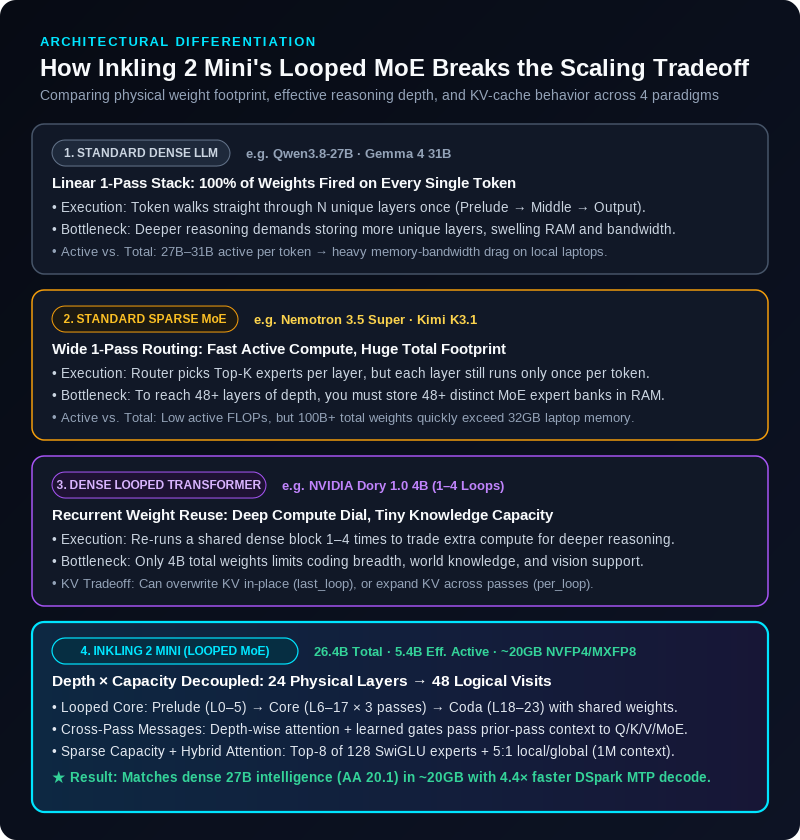 Figure 1: Architectural comparison showing how Inkling 2 Mini decouples physical memory footprint from logical reasoning depth compared to dense LLMs, standard sparse MoEs, and dense looped transformers like NVIDIA Dory 1.0 4B.
In plain English, think of a standard transformer as an assembly line with 48 different workstations—you have to pay rent for all 48 stations even if each one only does a quick pass. Inkling 2 Mini builds 24 workstations (6 entry stations, 12 specialist core stations, and 6 exit stations), and sends every token around the 12 specialist core stations three full laps before moving to the exit. You store half the weights in RAM, yet every token receives 48 layers of iterative deliberation.
2. Inside the Looped Transformer Architecture
The official architecture diagram published by Thinking Machines and Hugging Face reveals that Inkling 2 Mini is far more sophisticated than simply wrapping a for loop around a standard transformer block. Four interlocking design choices make the 3-pass loop stable, fast, and capable of handling a 1-million-token context window.
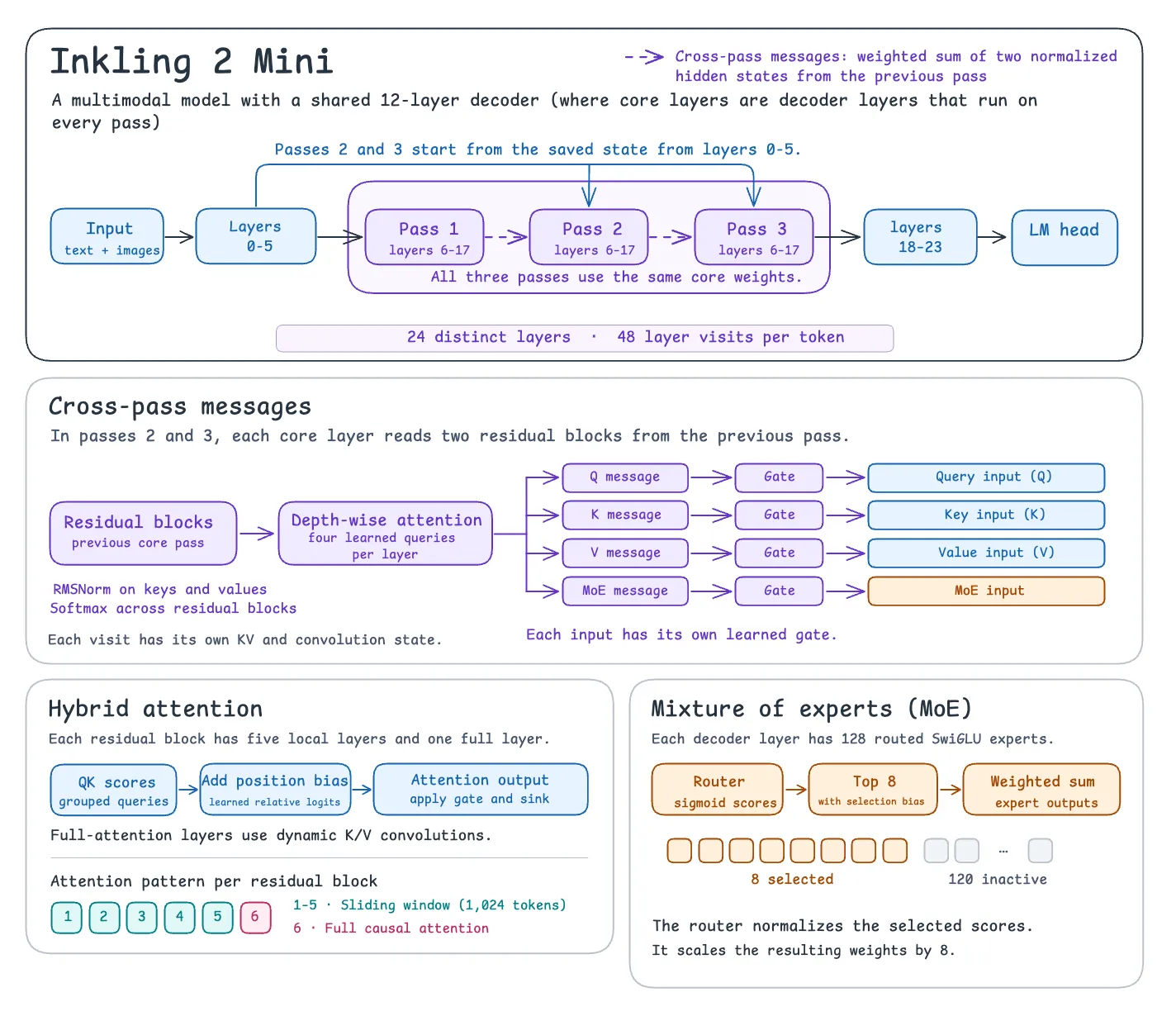 Figure 2: Official Inkling 2 Mini architecture diagram detailing the Prelude (L0–5), 3-pass shared Loop Core (L6–17), Coda (L18–23), depth-wise cross-pass messages with learned gates, 5:1 hybrid local/global attention, and Top-8 of 128 SwiGLU MoE routing. Source: Hugging Face / Thinking Machines Lab.
2.1 Prelude, 3-Pass Loop Core, and Coda (24 Physical → 48 Logical Visits)
Every token—whether text or a visual patch encoded by the built-in Vision Transformer—travels through a strict three-stage pipeline with hidden dimension 2,304:
flowchart TD
    IN["Multimodal Input<br/>UTF-8 Text + Vision Transformer Patches"] --> PRE["Prelude: Layers 0–5 (Run Once)<br/>Builds Initial Hidden State & Saves Anchor"]
    PRE --> P1["Loop Pass 1: Core Layers 6–17<br/>12 Shared MoE Layers · Own KV & Conv Cache"]
    P1 --> MSG1["Cross-Pass Message Bridge (Pass 1 → 2)<br/>Depth-Wise Attention + 4 Learned Gates (Q, K, V, MoE)"]
    MSG1 --> P2["Loop Pass 2: Core Layers 6–17<br/>Starts from Prelude Anchor + Gated Pass-1 Messages"]
    P2 --> MSG2["Cross-Pass Message Bridge (Pass 2 → 3)<br/>Depth-Wise Attention + 4 Learned Gates (Q, K, V, MoE)"]
    MSG2 --> P3["Loop Pass 3: Core Layers 6–17<br/>Starts from Prelude Anchor + Gated Pass-2 Messages"]
    P3 --> CODA["Coda: Layers 18–23 (Run Once)<br/>Final Refinement & Next-Token Projection"]
    CODA --> HEAD["LM Head + Bundled DSpark Speculator<br/>Predicts Verified Multi-Token Drafts"]

    style IN fill:#0d2b45,stroke:#00e5ff,stroke-width:2px,color:#ffffff
    style PRE fill:#132a4a,stroke:#38bdf8,stroke-width:2px,color:#ffffff
    style P1 fill:#1e1b4b,stroke:#a855f7,stroke-width:2px,color:#ffffff
    style MSG1 fill:#1a3d3c,stroke:#34d399,stroke-width:2px,color:#ffffff
    style P2 fill:#1e1b4b,stroke:#a855f7,stroke-width:2px,color:#ffffff
    style MSG2 fill:#1a3d3c,stroke:#34d399,stroke-width:2px,color:#ffffff
    style P3 fill:#1e1b4b,stroke:#a855f7,stroke-width:2px,color:#ffffff
    style CODA fill:#132a4a,stroke:#38bdf8,stroke-width:2px,color:#ffffff
    style HEAD fill:#0f382c,stroke:#10b981,stroke-width:2px,color:#ffffff
Figure 3: Single-column vertical execution trace of one token through Inkling 2 Mini’s 24 physical layers across 48 logical layer visits.
Notice two crucial details in the loop mechanics:
- Prelude Anchor Reinjection: Passes 2 and 3 do not blindly drift away from the original token representation—each new pass starts from the saved hidden state produced by Layers 0–5 (the Prelude), keeping the loop grounded in the original input while layering deeper refinements on top.
- Parameter Accounting: Running once through the model activates ~3.4B unique parameters (~3.1B for text-only tokens). Each extra loop pass through the 12 core layers adds roughly 1.0B effective active parameters, giving ~5.4B effective active parameters per token across all three passes (
3.4B + 1.0B + 1.0B = 5.4B).
2.2 Cross-Pass Messages & Learned Gated Controllers
If you naively feed a transformer’s output straight back into its own middle layers, gradients explode and internal representations collapse into repetitive noise. Inkling 2 Mini solves this with depth-wise cross-pass messages:
- During Passes 2 and 3, every core layer looks back at two residual blocks from the previous pass using depth-wise attention with four learned query vectors per layer (applying RMSNorm on keys/values and Softmax across the residual blocks).
- This produces four distinct, targeted messages: a Query (Q) message, a Key (K) message, a Value (V) message, and an MoE message.
- Each message passes through its own learned gated controller (zero-initialized at the start of training so the network begins like a clean feed-forward stack and gradually opens the cross-pass highway as training matures) before merging into the layer’s Q, K, V, and MoE inputs.
2.3 Per-Visit KV Caches & 5:1 Hybrid Local/Global Attention
A subtle engineering choice separates Inkling 2 Mini from earlier looped prototypes like NVIDIA Dory 1.0 4B:
- Isolated KV & Convolution States per Pass: Rather than overwriting the same KV cache slot across loops, every single pass maintains its own KV cache and dynamic convolution state—totaling 48 logical cache states. That preserves rich pass-specific memory across multi-step reasoning, though it also means long contexts consume more RAM than a naive 24-layer calculation might suggest.
- 5:1 Hybrid Attention for 1M Context: To keep those 48 cache visits manageable all the way up to 1,048,576 tokens, each 6-layer residual block uses five local sliding-window attention layers (1,024-token window) followed by one full causal attention layer. Only 1 in 6 layers pays global long-context KV cache cost! Furthermore, the full-attention layers incorporate dynamic K/V convolutions, grouped queries (GQA), learned relative position bias logits, and an attention gate plus attention sink to prevent attention collapse at extreme sequence lengths.
2.4 Sparse MoE + Native NVFP4 / MXFP8 Training
Inside every decoder layer sits a fine-grained Mixture-of-Experts block with 128 routed SwiGLU experts. A sigmoid router with load-balancing selection bias picks the Top 8 experts per token (leaving 120 inactive), normalizes their scores, and scales the resulting weights by 8.
Equally important for local users: Thinking Machines trained and shipped Inkling 2 Mini natively in mixed low-bit precision—20 layers in NVFP4 and the final 4 layers in MXFP8 (built for modern FP4/FP8 Tensor Cores). Because the ~20 GB release checkpoint is the native precision format, runtimes like Ollama serve it directly with zero post-training quantization degradation.
3. Bundled DSpark Speculative Decoding: 4.4× Faster Decode
Looping middle layers three times buys intelligence per gigabyte of RAM, but it also adds sequential compute per generated token. To neutralize that latency penalty, Thinking Machines bundles a DSpark multi-token prediction (MTP) speculator directly alongside Inkling 2 Mini.
Unlike naive parallel drafters whose accuracy decays rapidly after the second token, DSpark pairs a parallel drafting backbone with a lightweight sequential dependency repair head and confidence-scheduled verification—dynamically adjusting how many draft tokens it verifies based on acceptance probability and current server load.
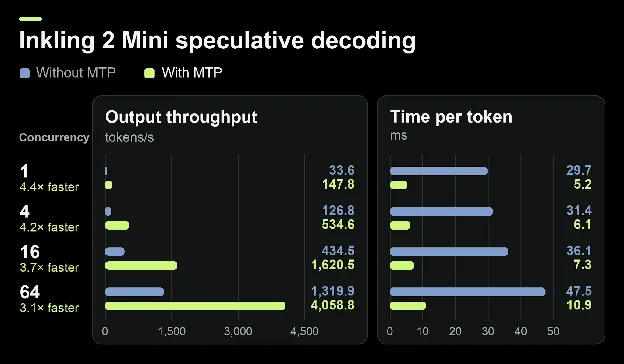 Figure 4: Official Thinking Machines / Hugging Face speculative decoding benchmark comparing Inkling 2 Mini without MTP vs. with bundled DSpark MTP across concurrency levels 1 to 64. Source: Hugging Face / Thinking Machines Lab.
The throughput jump in Figure 4 is dramatic across every concurrency tier:
| Concurrency | Without MTP (tok/s) | With DSpark MTP (tok/s) | Speedup | Time per Token (ms) |
|---|---|---|---|---|
| 1 (Single user) | 33.6 | 147.8 | 4.4× faster | 29.7 ms → 5.2 ms |
| 4 | 126.8 | 534.6 | 4.2× faster | 31.4 ms → 6.1 ms |
| 16 | 434.5 | 1,620.5 | 3.7× faster | 36.1 ms → 7.3 ms |
| 64 (High batch) | 1,319.9 | 4,058.8 | 3.1× faster | 47.5 ms → 10.9 ms |
At single-stream concurrency—the exact regime of a developer running a local coding agent on a single GPU or DGX Spark—DSpark slashes per-token latency from 29.7 ms down to 5.2 ms (147.8 tok/s).
4. Benchmark Audit: Artificial Analysis & Model Card Results
To evaluate Inkling 2 Mini objectively, we pair independent third-party measurements from Artificial Analysis with Thinking Machines’ full model card evaluation suite.
4.1 Independent Artificial Analysis Findings (Pareto Frontier, Speed, and Cost)
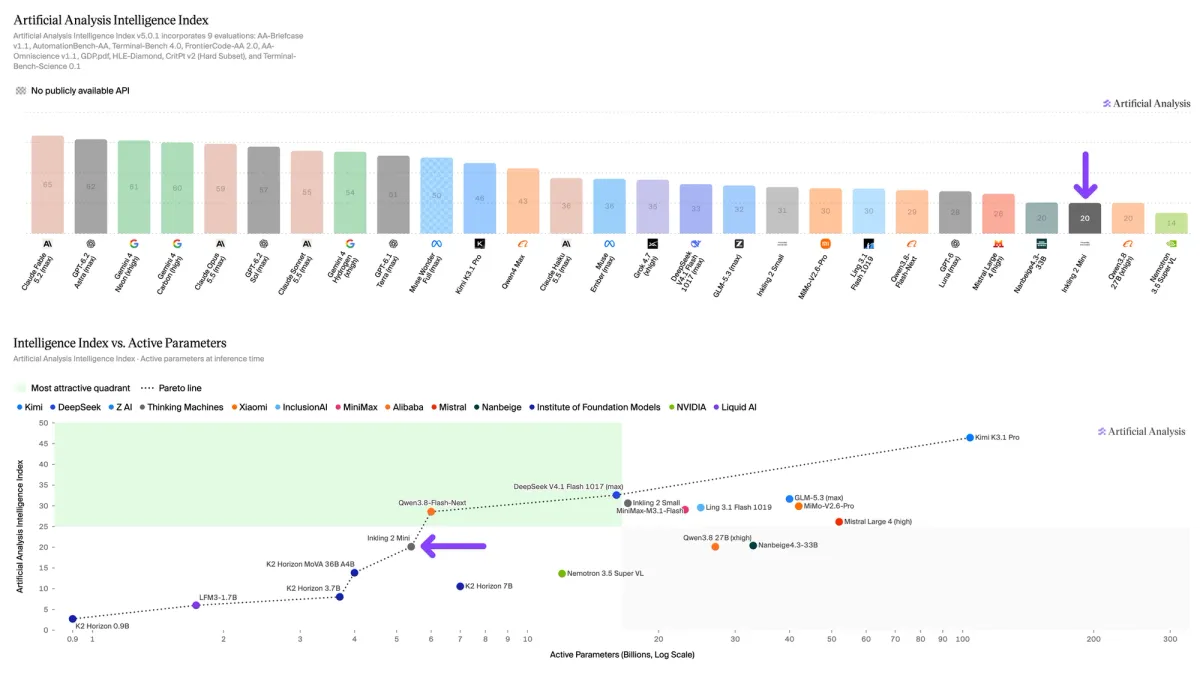 Figure 5: Independent Artificial Analysis Intelligence Index v5.0.1 rankings and Intelligence vs. Active Parameters Pareto frontier. Inkling 2 Mini scores 20—matching Qwen3.8-27B and Nanbeige4.3-33B while activating 5× to 6× fewer parameters. Source: Artificial Analysis.
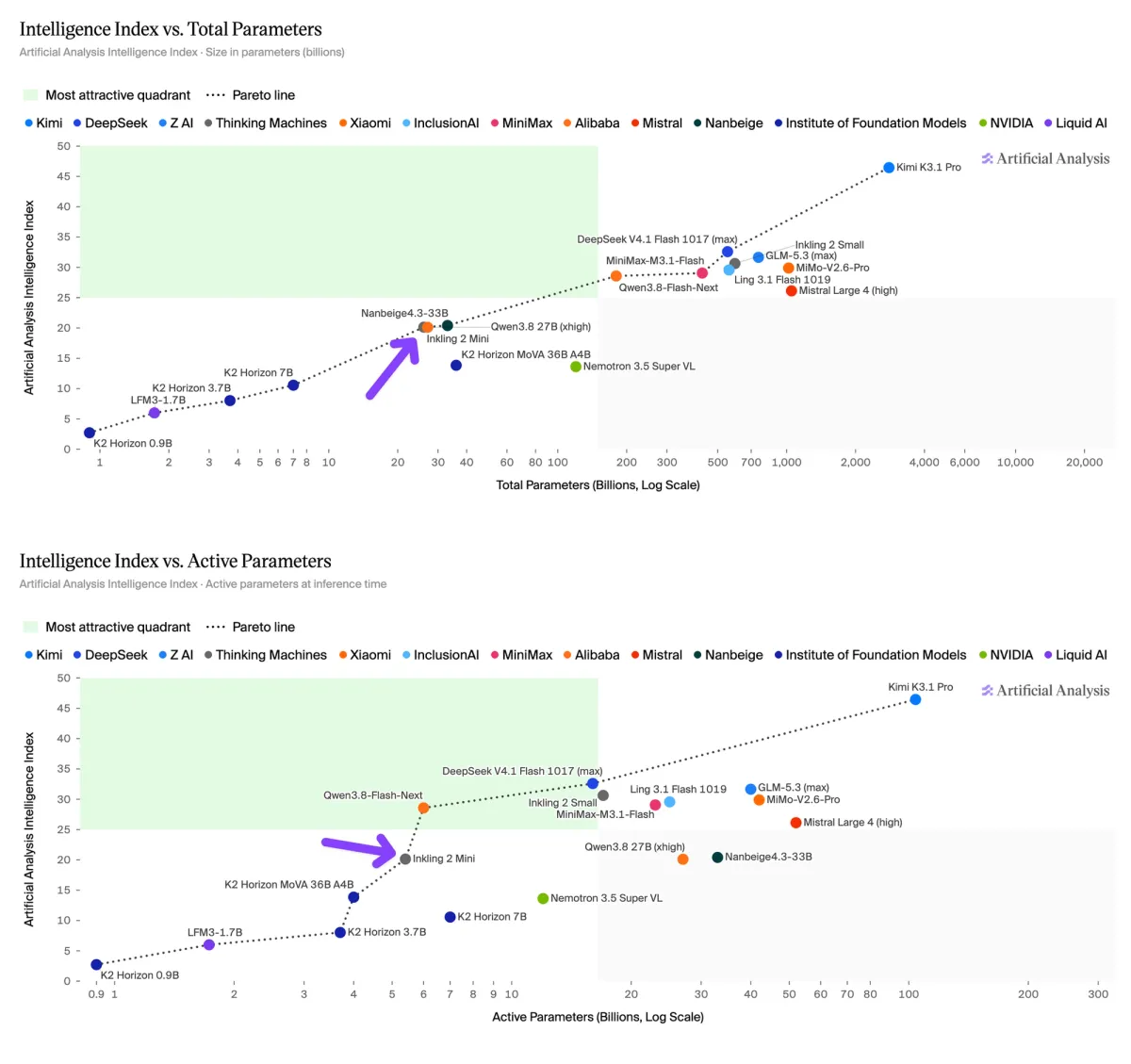 Figure 6: Artificial Analysis Pareto frontiers for Intelligence Index vs. Total Parameters (top) and Active Parameters (bottom). Inkling 2 Mini sits directly on the efficiency frontier across both axes. Source: Artificial Analysis.
The independent numbers from Artificial Analysis validate the looped MoE thesis cleanly:
- Pareto Frontier on Both Total & Active Size: Scoring 20 on the Intelligence Index v5.0.1, Inkling 2 Mini ties dense
Qwen3.8-27B (xhigh)andNanbeige4.3-33Busing ~5× and ~6× fewer active parameters, and outperformsNemotron 3.5 Super VL(12B active / 125B total, score 14). - The Verbosity vs. Compute Nuance: Inkling 2 Mini is more verbose than
Qwen3.8-27B—averaging ~152K output tokens per Intelligence Index task versus ~110K forQwen3.8-27B(~38% more tokens). Yet because each token activates only 5.4B effective parameters instead of 27B, its total compute proxy (active parameters × tokens) is still ~2.8× lower thanQwen3.8-27Band ~5× lower thanNanbeige4.3-33B. - 6× Cheaper & 4× Faster per Task: On Thinking Machines’ first-party Tinker API (
$0.15 / $0.50 / $0.015per 1M input / output / cache hit tokens, reaching up to ~280 tok/s output speed), Inkling 2 Mini finishes an Intelligence Index task for $0.59 in 9.0 minutes—compared to $3.53 and 38.2 minutes forQwen3.8-27B. In wall-clock speed, 9.0 minutes ranks #3 fastest across the entire evaluated frontier cohort, trailing only Meta Muse Ember (3.0 min) andNemotron 3.5 Super VL(4.7 min).
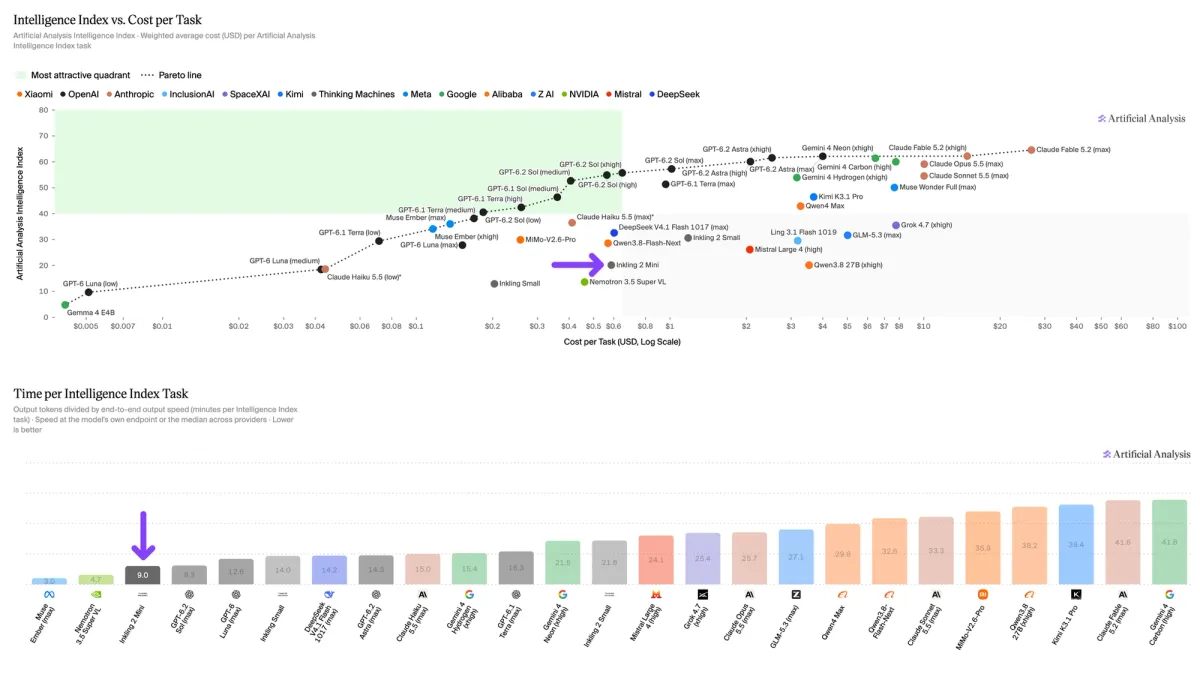 Figure 7: Independent Artificial Analysis Intelligence Index vs. Cost per Task (top) and Time per Intelligence Index Task in minutes (bottom). Inkling 2 Mini ($0.59, 9.0 min) delivers a ~6× cost reduction and ~4× speedup over Qwen3.8-27B ($3.53, 38.2 min). Source: Artificial Analysis.
4.2 Full Category Breakdown: Where Inkling 2 Mini Wins vs. Where It Trails
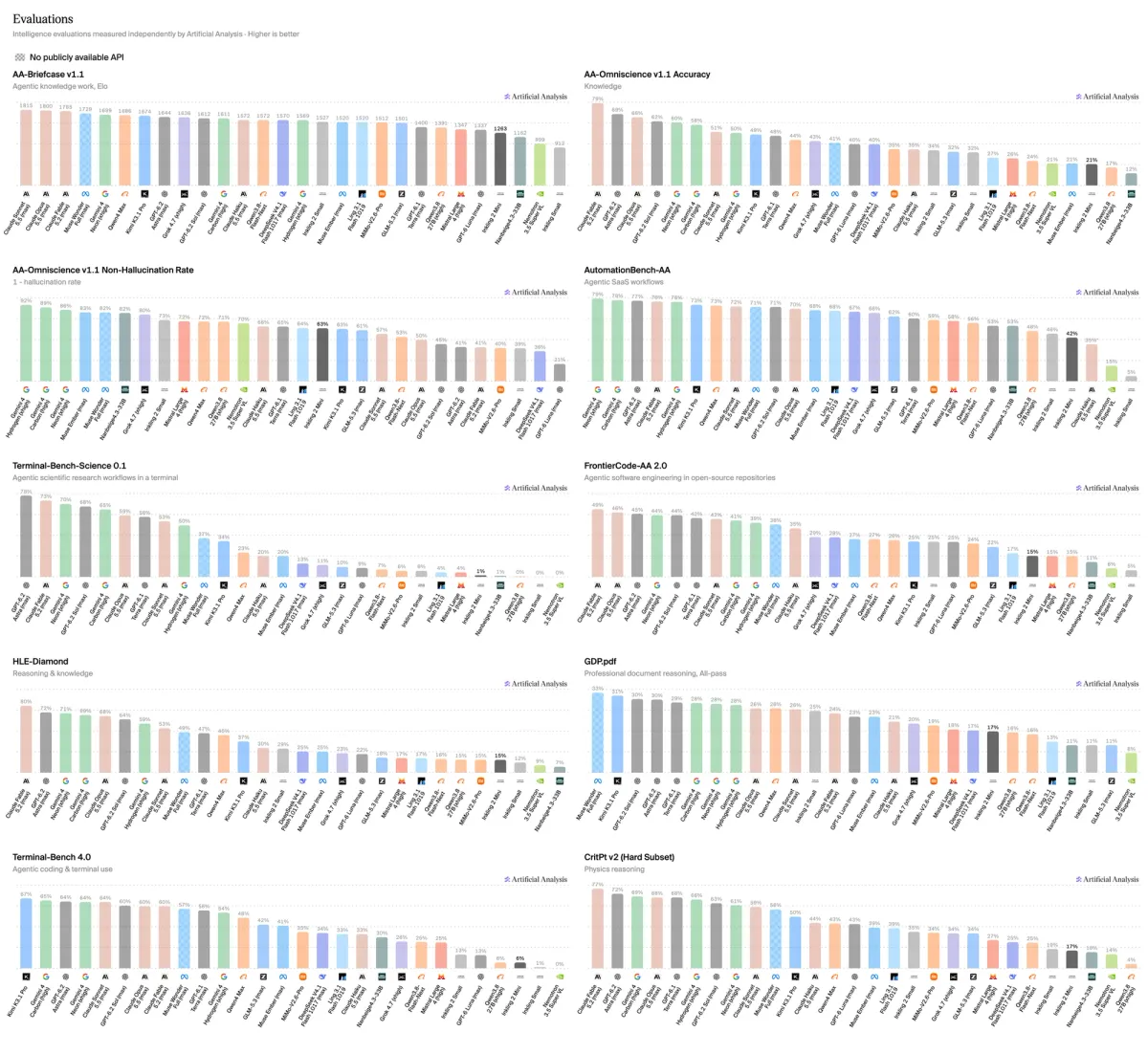 Figure 8: Granular Artificial Analysis breakdown across all 9 evaluations comprising the Intelligence Index v5.0.1. Source: Artificial Analysis.
Combining Thinking Machines’ self-reported model card table with Artificial Analysis’s independent run gives us a sharp, honest picture of Inkling 2 Mini’s strengths and blind spots:
| Benchmark | Inkling 2 Mini (5.4B/26.4B) | Qwen3.8-27B (27B/27B) | Gemma 4 31B (31B/31B) | Nemotron 3.5 Super VL (12B/125B) | Category |
|---|---|---|---|---|---|
| AA Index v5.0 | 20.1 | 20.1 | 4.4 | 13.6 | Overall Index |
| SWE-bench Verified (bash only) | 79.2% | 77.8% | 46.1% | 71.1% | Agentic Coding |
| SWE-bench Pro v2 (Hard) | 77.9% | 73.8% | 14.2% | 44.1% | Agentic Coding |
| SWE-bench Multilingual | 73.7% | 70.0% | 43.0% | 67.7% | Agentic Coding |
| DeepSWE v1.1 | 48.2% | 42.2% | 0.3% | 24.7% | Repo-Level SWE |
| Vibe Code Bench v1.1 | 77.9% | 64.9% | – | 3.5% | App Generation |
Terminal-Bench 2.1 (pi harness) | 71.6% | 73.0% | 43.4% | 60.7% | Terminal Agents |
| BrowseComp (w/ compaction) | 79.0% | 61.6% | 37.0% | 78.9% | Agentic Search |
| MCP Atlas (Public) | 82.7% | 77.3% | 54.2% | 67.7% | Tool / MCP Use |
| OmniDocBench v1.6 | 92.8% | 91.5% | 82.5% | 77.9% | Vision / OCR |
| ScreenSpot Pro (w/ Python) | 87.7% | 78.9% | – | – | GUI Grounding |
| Chartography (w/ Python) | 72.5% | 52.1% | 11.8% | 29.3% | Visual Reasoning |
| LongBench v2 | 66.9% | 52.3% | 52.9% | 62.1% | Long Context |
| GraphWalks BFS (256K) | 69.7% | 50.4% | – | 63.3% | Long Context |
| CritPt v2 Hard (Physics) | 17.0% | 4.0% | 4.0% | 13.5% | Hard Reasoning |
| ARC-AGI v2 | 49.3% | 42.4% | – | 1.5% | Abstract Reasoning |
| AA-Briefcase v1.1 (Elo) | 1263 | 1391 | 369 | 999 | Knowledge Work |
| AutomationBench-AA | 41.8% | 48.2% | 4.9% | 14.8% | SaaS Automation |
| AA-Omniscience v1.1 (Non-Halluc.) | 63.4% | 71.4% | 14.5% | 69.5% | Factual Recall |
The Honest Audit:
- Where Inkling 2 Mini dominates: Agentic software engineering (
79.2%SWE-bench Verified,77.9%SWE-bench Pro v2 Hard,48.2%DeepSWE v1.1), MCP tool calling (82.7%MCP Atlas), long-context retrieval (66.9%LongBench v2,69.7%GraphWalks 256K), GUI/document vision (92.8%OmniDocBench,87.7%ScreenSpot Pro w/ Python), and offline local demos—Thinking Machines showcased Inkling 2 Mini building a playable flight simulator in airplane mode on a 48 GB M5 Pro MacBook Pro and running 20 concurrent autonomous agents in its Thinkyville pixel-town demo. - Where it trails: Like NVIDIA Dory 1.0 4B, looping amplifies reasoning and agentic execution far more than raw encyclopedic memory. Inkling 2 Mini trails
Qwen3.8-27Bon factual non-hallucination (63.4%vs.71.4%on AA-Omniscience), enterprise knowledge work (1263vs.1391on AA-Briefcase), and SaaS automation (41.8%vs.48.2%on AutomationBench-AA). It also scores lower on non-English languages (with observed clipped phrasing and language mixing in Chinese tests) and is explicitly not a drop-in replacement for cloud giants like Gemini 4 Neon (AA Index 61) or GPT-6.2 Astra (AA Index 62).
4.3 Monitorability & Safety: Does Looping Hide Thoughts?
A genuinely novel research question raised by looped transformers is chain-of-thought (CoT) monitorability: if a model loops its middle layers three times inside its latent hidden state before emitting a single visible token, does it start hiding reasoning steps where human overseers can no longer read them?
Thinking Machines explicitly tested this in its launch post and model card (and ran safety alignment using on-policy distillation). They found that while looping makes CoT traces slightly more compact, Inkling 2 Mini retains human-legible reasoning traces, has very low controllability over hiding its own chain of thought, and failed to execute covert side tasks in agentic environments—scoring 9.8% on internal misbehavior and 8.3% on covert misbehavior (dramatically lower than Qwen3.8-27B’s 57.7% / 33.2% and Nemotron 3.5 Super VL’s 52.8% / 43.4%).
5. Hands-On Guide: Running Inkling 2 Mini on a Local Laptop
Because Inkling 2 Mini introduces a non-standard looped-layer execution graph (inkling2_loop), your setup path depends directly on your operating system and available RAM/VRAM. Use the matrix below to pick the right runtime before downloading 20 GB of weights.
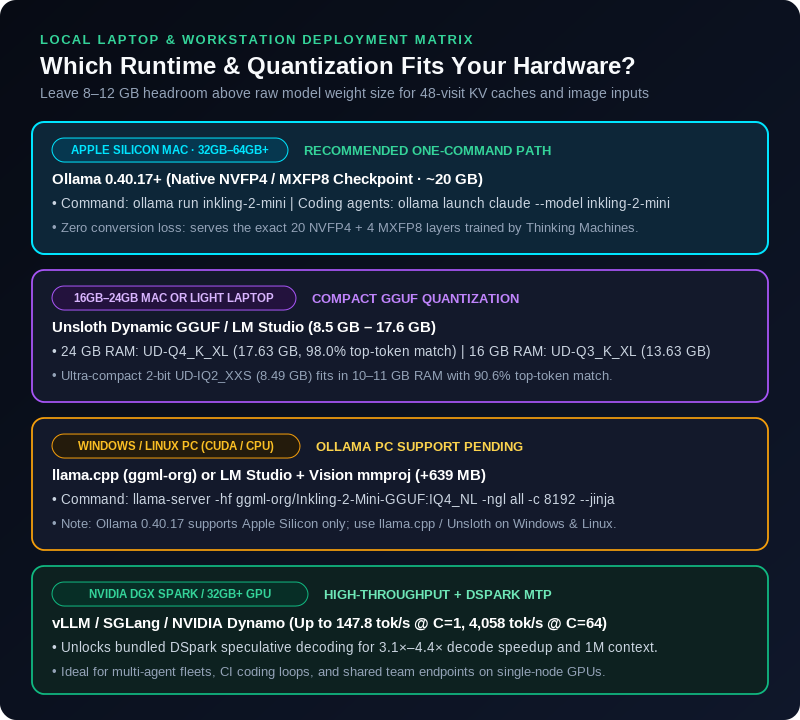 Figure 9: Decision matrix for running Inkling 2 Mini locally across 32 GB+ Apple Silicon Macs, 16–24 GB laptops, Windows/Linux PCs, and NVIDIA DGX Spark / 32 GB+ GPUs.
5.1 Option A: Apple Silicon Macs (32 GB+ Unified Memory) via Ollama (Fastest Setup)
If you are on an M-series MacBook Pro, Mac mini, or Mac Studio with 32 GB or more of unified memory, Ollama is the official zero-conversion path. Ollama serves Thinking Machines’ exact ~20 GB native NVFP4/MXFP8 checkpoint directly via its Apple Silicon MLX backend, leaving ~12 GB+ of headroom for macOS, image inputs, and the 48-visit KV cache.
Platform & Version Requirement: Support for Inkling 2 Mini landed in Ollama
0.40.17and is currently Apple Silicon only (Windows and Linux PC support in Ollama is pending—PC users should jump to Option B below).
Step 1 — Verify Ollama version (must be 0.40.17 or newer):
# Terminal (interactive shell on macOS)
ollama -v
If you see an older version—or if pulling the model fails with:
Error: pull model manifest: 412: The model you are attempting to pull requires a newer version of Ollama
download the latest macOS build from ollama.com, quit the Ollama menu-bar app completely, and relaunch it. (Troubleshooting tip from AgentsPulse: if ollama -v still reports an older version after upgrading, check if an IDE extension spawned a background copy of an older Ollama binary, terminate that process, and restart the app.)
Step 2 — Pull and chat (text + images):
# Terminal (interactive CLI chat — downloads ~20 GB once)
# Note: latest, 26b-a5b, and 26b-a5b-nvfp4 all point to the same 20 GB native build
ollama run inkling-2-mini
Step 3 — Call it from local scripts or apps (OpenAI/Ollama REST API on port 11434):
# Terminal (headless HTTP check against local Ollama server)
curl http://localhost:11434/api/chat -d '{
  "model": "inkling-2-mini",
  "messages": [{"role": "user", "content": "Explain why 5:1 local/global attention helps 1M context."}],
  "stream": false
}'
Ollama 0.40.17 also unlocked concurrent multi-request serving on Apple Silicon (enabling multi-agent setups on one MacBook) and maps thinking-off flags to Inkling 2 Mini’s lowest reasoning tier—though per the model card, minimum effort “does not fully disable reasoning”, so expect a brief internal thought block even at low effort.
Step 4 — Wire Inkling 2 Mini into Claude Code, OpenCode, or OpenClaw:
# Terminal (interactive coding agent launcher on macOS)
ollama launch claude --model inkling-2-mini

# Same pattern works for OpenCode and OpenClaw:
# ollama launch opencode --model inkling-2-mini
# ollama launch openclaw --model inkling-2-mini
5.2 Option B: Windows, Linux PCs, and 16–24 GB Macs via GGUF (llama.cpp, Unsloth, LM Studio)
If you are on Windows or Linux (while Ollama’s PC looped-transformer backend is still in progress) OR running a 16 GB to 24 GB Mac, use quantized GGUF builds from ggml-org or unsloth with LM Studio, llama.cpp, or Unsloth CLI.
| Unsloth Dynamic GGUF Quant | Disk Size | Total RAM + VRAM Needed | Top-Token Agreement vs. 8-bit | Best Target Machine |
|---|---|---|---|---|
UD-IQ1_S (1-bit) | 7.76 GB | ~9 GB | Lower (emergency only) | Constrained 12–16 GB laptops |
UD-IQ2_XXS (2-bit) | 8.49 GB | 10–11 GB | 90.6% | 16 GB Mac / 12 GB GPU |
UD-Q3_K_XL (3-bit) | 13.63 GB | 13–15 GB | High | 16 GB–24 GB Mac / 16 GB GPU |
UD-Q4_K_XL (4-bit — Recommended) | 17.63 GB | 17–18 GB | 98.0% | 24 GB+ Mac / 24 GB RTX 3090/4090 |
UD-Q8_K_XL (8-bit) | 22.87 GB | ~24 GB+ | 100% (reference) | 32 GB+ Mac / 32 GB RTX 5090 |
(Note: Add 639 MB for the F16 vision projector mmproj if you want image/screenshot inputs, plus extra memory headroom for long contexts.)
Running via llama.cpp (ggml-org official GGUF):
# Terminal (starts local OpenAI-compatible server with 8K starter context & full GPU offload)
llama-server -hf ggml-org/Inkling-2-Mini-GGUF:IQ4_NL \
  -ngl all \
  -c 8192 \
  --jinja
(Start with -c 8192 or -c 32768 rather than jumping straight to 256K–1M context, since 48 logical cache visits grow RAM usage quickly at extreme context lengths.)
Running via Unsloth CLI (recommended sampling settings):
# Terminal (macOS, Windows, or Linux)
unsloth run --model unsloth/Inkling-2-Mini-GGUF:UD-Q4_K_XL \
  --temp 1.0 --top-p 1.0 --top-k 0 --min-p 0.0
(Important compatibility note: Unsloth’s root GGUF files use its custom looped-layer layout requiring Unsloth’s llama.cpp build; if using mainline upstream llama.cpp, pull from Unsloth’s Mainline_Support folder or ggml-org/Inkling-2-Mini-GGUF. In LM Studio, simply search for Inkling 2 Mini, pick your quantization, and ensure GPU offload is maxed out.)
5.3 Option C: NVIDIA DGX Spark & 32 GB+ Workstation GPUs (vLLM / SGLang + DSpark)
For teams or power users on a 1× NVIDIA DGX Spark or 32 GB+ datacenter GPU, deploy via vLLM or SGLang to unlock the bundled DSpark speculative decoding engine (achieving up to 147.8 tok/s at concurrency 1 and 4,058.8 tok/s at concurrency 64).
5.4 Four Practical Guardrails Before Giving Inkling 2 Mini Shell Access
Thinking Machines’ own model card is refreshingly candid about local agent failure modes. Before turning Inkling 2 Mini loose on a real codebase with Claude Code or OpenCode, apply these four guardrails:
- Always run inside a sandbox or throwaway git worktree: The model card explicitly warns that Inkling 2 Mini “may take destructive actions, such as deleting or overwriting files, without confirmation.” Keep shell approval prompts enabled.
- Cap output tokens and agent turns: During debugging, Inkling 2 Mini can occasionally fall into repetitive self-checking reasoning loops without making forward progress. Set strict
max_tokensand turn-count caps in your harness. - Verify
git diffyourself: Never trust a small local model’s summary of what it changed—inspect the actual diff and test output. - Budget context conservatively on 32 GB laptops: Even though the architecture supports 1M tokens, start local coding sessions at
16K–64Kcontext so macOS doesn’t swap unified memory to SSD and tank tokens-per-second.
FAQ
-
How does Inkling 2 Mini get 48 layers of reasoning from only 24 physical layers?
Answer
Inkling 2 Mini splits its 24 physical decoder layers into three zones: a 6-layer Prelude (L0–5, runs once), a 12-layer Loop Core (L6–17, runs 3 times with shared weights), and a 6-layer Coda (L18–23, runs once). Because
6 + (12 × 3) + 6 = 48, every token receives 48 logical layer visits while only storing 24 layers of weights (~20 GB) in memory. During Passes 2 and 3, each core layer reads depth-wise cross-pass messages from the previous pass through learned gates so information refines iteratively without collapsing. -
Why does Inkling 2 Mini report both 3.4B active and 5.4B effective active parameters?
Answer
Each unique pass through the 24 physical MoE layers touches roughly 3.4B unique parameters (about 3.1B for text-only tokens) by routing to Top-8 of 128 SwiGLU experts per layer. Because the middle 12 layers execute two additional times, each extra loop adds roughly 1.0B effective active parameters of compute—bringing the total compute per token to ~5.4B effective active parameters (
3.4B + 1.0B + 1.0B). -
Can I run Inkling 2 Mini on a 16 GB or 24 GB MacBook, or a Windows PC with an NVIDIA GPU?
Answer
Yes—with a caveat on runtime choice. Ollama
0.40.17currently supports Inkling 2 Mini on Apple Silicon Macs with 32 GB+ unified memory only (serving the ~20 GB native NVFP4/MXFP8 checkpoint). On 16–24 GB Macs or Windows/Linux PCs, use LM Studio, Unsloth CLI, orllama.cppwith GGUF quantizations:UD-Q4_K_XL(17.63 GB, 98.0% top-token match) fits 24 GB machines, whileUD-Q3_K_XL(13.63 GB) andUD-IQ2_XXS(8.49 GB, 90.6% top-token match) fit 16 GB laptops. -
How does Inkling 2 Mini compare to Qwen3.8-27B for local coding?
Answer
On Artificial Analysis, both models tie at 20 on the Intelligence Index v5.0.1—but Inkling 2 Mini achieves that score with ~5× fewer active parameters, ~2.8× less total compute, ~4× faster task completion (9.0 min vs. 38.2 min), and ~6× lower API cost ($0.59 vs. $3.53 per task). In Thinking Machines’ benchmarks, Inkling 2 Mini pulls ahead on agentic coding (
79.2%vs.77.8%SWE-bench Verified;48.2%vs.42.2%DeepSWE v1.1), long context (66.9%vs.52.3%LongBench v2), and GUI vision, whereasQwen3.8-27Bremains stronger on factual recall (71.4%vs.63.4%AA-Omniscience non-hallucination) and general knowledge work (1391vs.1263AA-Briefcase). -
Why did I get
Error: pull model manifest: 412when runningollama run inkling-2-mini?Answer
A
412manifest error means the Ollama server responding to your CLI is older than0.40.17and does not recognize Inkling 2 Mini’s looped-transformer architecture. Upgrade Ollama from ollama.com, quit and relaunch the macOS menu-bar app, and confirmollama -vprints0.40.17or newer. If an older version still replies, check for a rogue backgroundollamaprocess started by an editor extension and stop it before restarting the app.