
Memory Architectures for Long-Running Agents: Vector Indexes vs. Knowledge Graphs
Why single-vector RAG fails long-horizon agent loops, and how uniting episodic ledgers, HNSW vector manifolds, and relational property graphs creates resilient multi-week state.
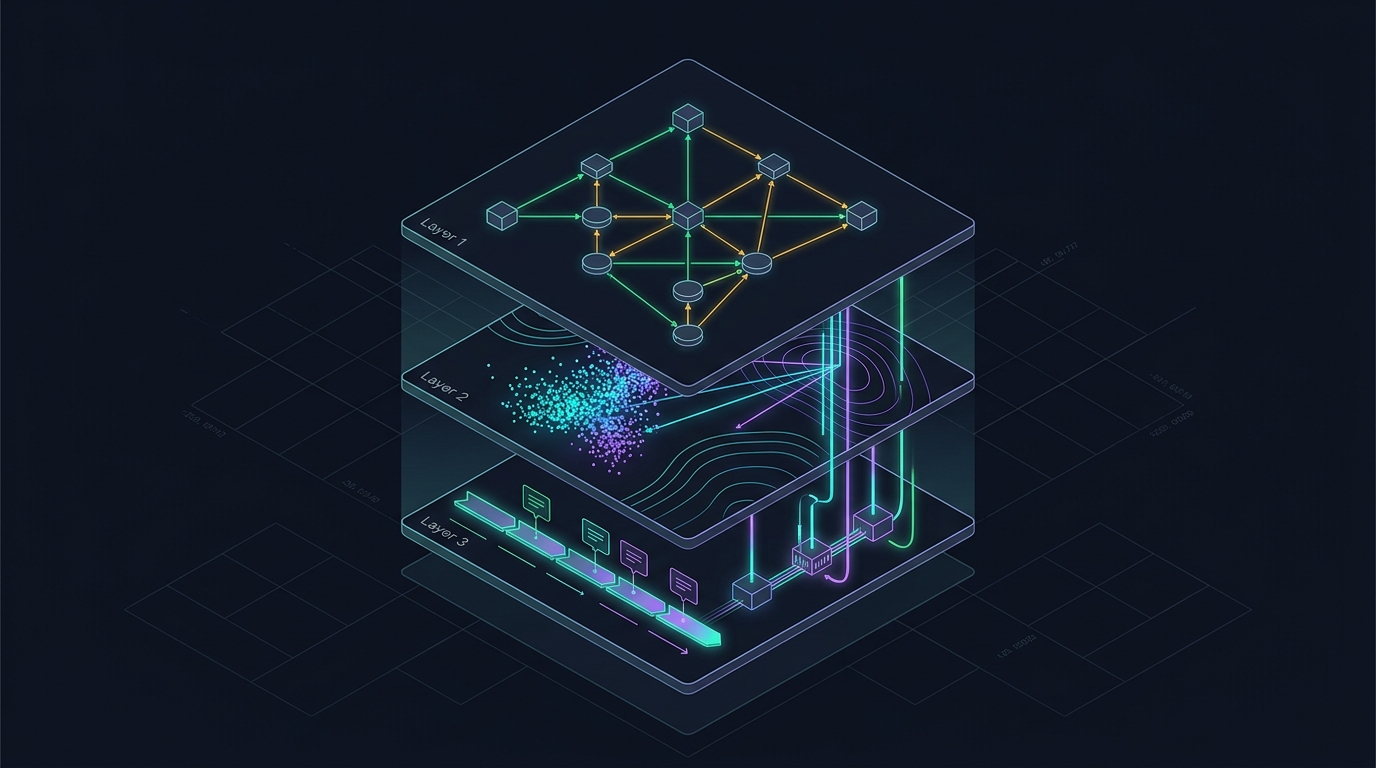
This article is Part 12 of the Autonomous AI Agents & Frameworks Series. If you haven’t yet read Part 11: Harnessing Reasoning Models in Agentic Workflows: Integrating o1/R1, Hidden Thinking Tokens, and Cost vs. Depth Optimization, check it out to understand how deliberate chain-of-thought models orchestrate multi-step execution loops!
Summary
As autonomous AI agents evolve from ephemeral single-turn chatbots into long-running digital workers that execute tasks across days, weeks, and months, memory persistence becomes the defining architectural bottleneck. Naive Retrieval-Augmented Generation (RAG)—which dumps conversation chunks into a flat vector database—reliably breaks down over extended horizons. Vector embeddings compress semantic similarity into high-dimensional geometric distances, rendering them blind to temporal ordering, causal timelines, negation, and multi-hop entity relationships.
To build agents that remember past decisions without hallucinating or overflowing context windows, production systems deploy a Tri-Layer Memory Matrix:
- Episodic Memory: An immutable, chronological event stream recording raw dialogue, observations, and tool side-effects with precise timestamps.
- Semantic Memory: High-dimensional vector stores indexed with Hierarchical Navigable Small World (HNSW) graphs, enabling fuzzy conceptual recall across unstructured documents and past task summaries.
- Procedural & Relational Memory: Labeled Property Knowledge Graphs (Neo4j, FalkorDB) that capture structured entity facts, permissions, dependencies, and evolving relational state.
This post explores the engineering trade-offs between dense vector indexes and knowledge graphs, demonstrates hybrid retrieval dispatch routines, and introduces sleep-cycle memory consolidation to prevent infinite context drift.
Prior Reading Material
To ground our exploration of long-running agent persistence, explore these related architecture guides across our index:
- Autonomous AI Agents & Frameworks Series (Part 11): Harnessing Reasoning Models in Agentic Workflows: Integrating o1/R1, Hidden Thinking Tokens, and Cost vs. Depth Optimization — Balancing reasoning token budgets and cognitive dispatch loops.
- Autonomous AI Agents & Frameworks Series (Part 10): Evaluating Agentic Systems: Benchmark Frameworks, Trajectory Analysis, and LLM-as-a-Judge — Measuring trajectory accuracy, state-action alignment, and regression loops.
- Autonomous AI Agents & Frameworks Series (Part 7): State Management and Persistence in Multi-Agent Graphs — Checkpointing, durable execution threads, and replay logs in LangGraph and Temporal.
- Hybrid Search: Combining BM25 and Vector Search with Reciprocal Rank Fusion — Fusing lexical and dense vector rankings for resilient retrieval.
1. The Tale of the Amnesiac Site Reliability Engineer
Imagine hiring a brilliant senior Site Reliability Engineer (SRE). She possesses an encyclopedic understanding of distributed systems, Linux internals, and database failover protocols. However, due to a rare neurological condition, every evening at midnight her mind completely resets.
On Monday morning, she investigates a sudden CPU spike on your primary Redis cluster, diagnoses a memory leak caused by a buggy Redis client library, patches the configuration, and verifies normal metrics.
On Thursday afternoon, a similar CPU spike hits the same cluster. When asked to fix it, she cannot recall what she did on Monday. She opens up your internal wiki (her “flat vector database”), searches for "Redis CPU spike", and finds fifty unrelated runbooks, three outdated incidents from 2024, and notes from a colleague’s staging experiment. Because vector similarity matches words and meanings rather than time and causal chains, she cannot discern whether Monday’s patch succeeded, failed, or was rolled back. She repeats the exact same diagnostics from scratch, taking four hours to reach the same conclusion.
This is the exact failure mode of modern autonomous agents running on top of basic vector RAG.
flowchart TD
    A["Raw Agent Trajectory & Interaction History"] --> B["Chunk & Vector Embeddings Store"]
    B --> C["Cosine Similarity Top-K Retrieval"]
    C --> D["Context Window Flooding"]
    D --> E["Temporal Amnesia: Cannot determine what happened first vs last"]
    E --> F["Relational Blindness: Inability to trace multi-hop entity ownership"]
    F --> G["Contradiction Hallucination: Conflating old plans with active directives"]

    style A fill:#0f172a,stroke:#38bdf8,stroke-width:2px,color:#f8fafc
    style B fill:#0f172a,stroke:#a855f7,stroke-width:2px,color:#f8fafc
    style C fill:#0f172a,stroke:#f59e0b,stroke-width:2px,color:#f8fafc
    style D fill:#052e16,stroke:#22c55e,stroke-width:2px,color:#f8fafc
    style E fill:#0f172a,stroke:#6366f1,stroke-width:2px,color:#f8fafc
    style F fill:#0f172a,stroke:#ef4444,stroke-width:2px,color:#f8fafc
    style G fill:#0f172a,stroke:#10b981,stroke-width:2px,color:#f8fafc
Human cognition solves this dilemma through tripartite memory partitioning:
- Your episodic memory (centered in the hippocampus) records what happened this morning: “I typed
kubectl restart deploymentat 10:14 AM and received a timeout error.” - Your semantic memory (distributed across the neocortex) retains timeless conceptual knowledge: “Redis is an in-memory key-value store, and OOM kills occur when memory limits are exceeded.”
- Your procedural memory (basal ganglia) encodes structured workflows, operational habits, and relational rules: “To deploy changes to production, I must request approval from Alice and obtain an audited token from Vault.”
For an agent to execute reliably over multi-week missions, its architecture must reflect this identical tripartite separation.
2. Tri-Layer Memory Matrix: High-Level Architecture
Below is the complete engineering architecture of a production-grade long-running autonomous agent memory system:
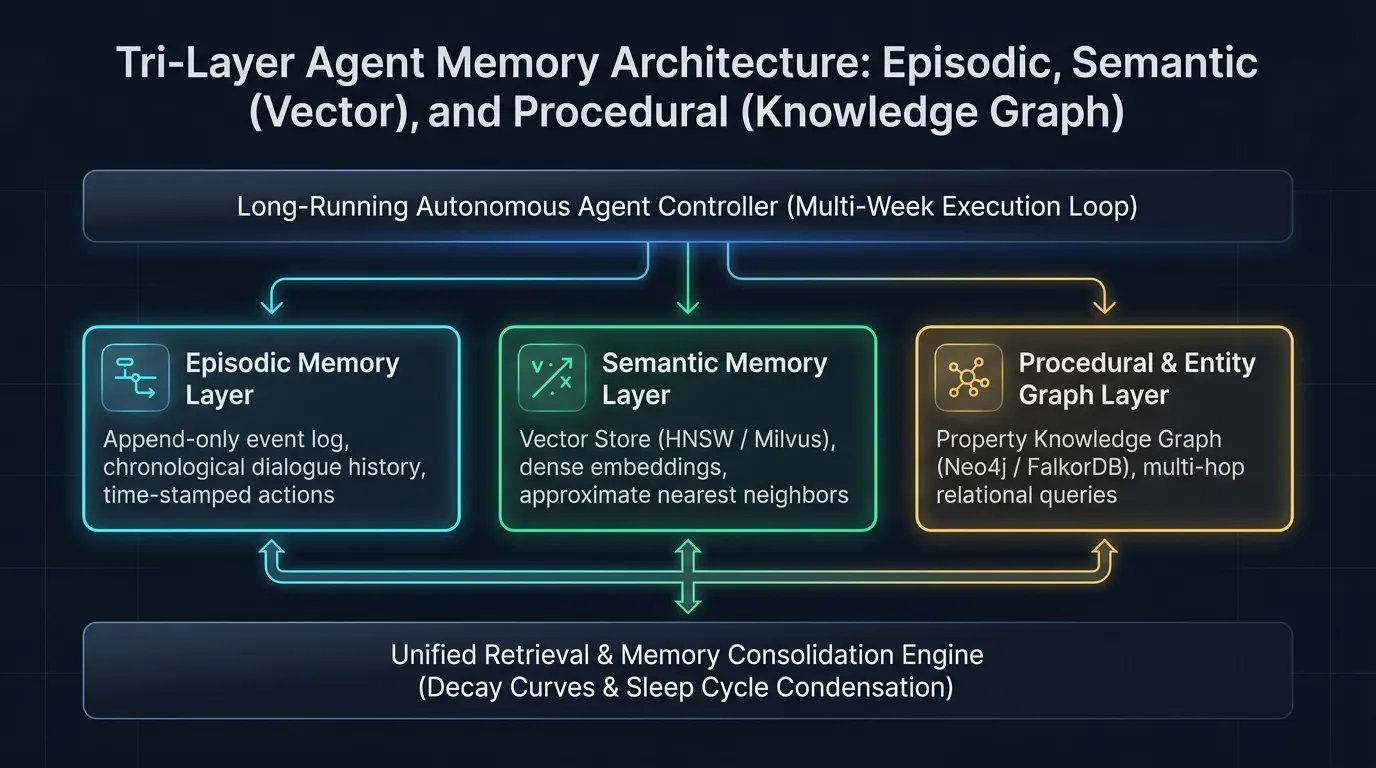 Figure 1: Complete engineering architecture of the Tri-Layer Agent Memory Matrix uniting episodic event streams, semantic vector manifolds, and relational property graphs. Source: Autonomous agent memory architecture synthesis based on LangGraph, Neo4j, and Qdrant production patterns.
Let us examine each tier of the memory matrix and how they collaborate.
flowchart TD
    A["Agent Perception & Tool Event"] --> B["Memory Router Engine"]
    B --> C["1. Episodic Ledger: Append-Only Event Log"]
    C --> D["2. Semantic Store: HNSW Vector Manifold"]
    D --> E["3. Relational Graph: Property Knowledge Graph"]
    E --> F["Async Background Sleep Cycle Consolidation"]
    F --> G["Consolidated Long-Term Memory State"]

    style A fill:#0f172a,stroke:#38bdf8,stroke-width:2px,color:#f8fafc
    style B fill:#0f172a,stroke:#a855f7,stroke-width:2px,color:#f8fafc
    style C fill:#0f172a,stroke:#f59e0b,stroke-width:2px,color:#f8fafc
    style D fill:#052e16,stroke:#22c55e,stroke-width:2px,color:#f8fafc
    style E fill:#0f172a,stroke:#6366f1,stroke-width:2px,color:#f8fafc
    style F fill:#0f172a,stroke:#10b981,stroke-width:2px,color:#f8fafc
    style G fill:#0f172a,stroke:#38bdf8,stroke-width:2px,color:#f8fafc
3. Comparing the Tiers: Vector Indexes vs. Knowledge Graphs
Why can’t we simply use a bigger vector database or a 10-million-token context window? To understand why, consider how dense vectors and structured graphs represent reality:
| Dimension | Vector Database (HNSW / Milvus / Qdrant) | Knowledge Graph (Neo4j / FalkorDB / GraphRAG) | Episodic Ledger (Postgres / ClickHouse) |
|---|---|---|---|
| Data Representation | 1536–3072 dimensional dense vectors $\vec{v} \in \mathbb{R}^d$ | Nodes (Entities) and Directed Edges (Relations) with Properties | Immutable, append-only chronological event logs with timestamps |
| Primary Strength | Unstructured semantic nuance, fuzzy conceptual similarity, natural language querying | Multi-hop relational reasoning, strict constraints, deterministic entity resolution | Exact chronological replay, causal auditability, state reconstruction |
| Primary Weakness | Blind to temporal ordering, negation, and transitivity ($A \to B \to C$) | Requires structured schema extraction; poor at fuzzy natural language prose | Unbounded growth; querying raw logs consumes prohibitive context space |
| Query Latency | Ultra-fast ($2\text{—}15\text{ ms}$) via Approximate Nearest Neighbor (ANN) | Moderate ($10\text{—}50\text{ ms}$) for 1-hop to 3-hop graph traversals | Fast ($5\text{—}20\text{ ms}$) indexed on temporal range and agent session ID |
| Best Used For | Searching documentation, historical case studies, broad conceptual context | Tracking project schemas, team hierarchies, tool permissions, software dependency graphs | Recording exact tool execution arguments, raw API responses, user prompts |
The Blind Spots of Vector Search
- Temporal Decay and Version Confusion: If an agent drafts a software architecture document in Version 1, revises it in Version 2, and deletes a microservice in Version 3, vector search against the query “What is our auth service design?” will return chunks from all three versions with near-identical cosine similarity scores. The agent has no native mechanism to know that Version 3 completely superseded Version 1.
- Multi-Hop Traversal Failure: Suppose your agent needs to answer: “Which database does the microservice owned by Sarah’s direct report connect to?” A vector store has no concept of traversable pointers. It must hope that an exact single text chunk explicitly states all four relationships together. In contrast, a Property Knowledge Graph traverses
(Sarah)-[:MANAGES]->(Engineer)-[:OWNS]->(Service)-[:CONNECTS_TO]->(Database)deterministically in 8 milliseconds.
flowchart TD
    N1["Person: Sarah"] -->|MANAGES| N2["Engineer: Dave"]
    N2 -->|OWNS| N3["Service: AuthGateway"]
    N3 -->|CONNECTS_TO| N4["Database: SpannerCluster-US"]

    style N1 fill:#0f172a,stroke:#38bdf8,stroke-width:2px,color:#f8fafc
    style N2 fill:#0f172a,stroke:#a855f7,stroke-width:2px,color:#f8fafc
    style N3 fill:#052e16,stroke:#22c55e,stroke-width:2px,color:#f8fafc
    style N4 fill:#0f172a,stroke:#10b981,stroke-width:2px,color:#f8fafc
4. Hybrid Memory Dispatch: Unifying Semantic and Relational Queries
In production frameworks like LangGraph, AutoGen, and custom enterprise agent frameworks, retrieval does not query vectors in isolation. Instead, a Hybrid Memory Router decomposes the agent’s current objective into parallel retrieval channels:
flowchart TD
    A["Incoming Task / User Message"] --> B["Query Intent Analyzer"]
    B --> C["1. Relational Extraction: Graph Traversal (Cypher)"]
    C --> D["2. Semantic Vectorization: Cosine ANN Search"]
    D --> E["3. Temporal Window Slicing: Postgres Event Ledger"]
    E --> F["Reciprocal Rank Fusion & Context Reranker"]
    F --> G["Synthesized Grounded Context Prompt"]

    style A fill:#0f172a,stroke:#38bdf8,stroke-width:2px,color:#f8fafc
    style B fill:#0f172a,stroke:#a855f7,stroke-width:2px,color:#f8fafc
    style C fill:#0f172a,stroke:#f59e0b,stroke-width:2px,color:#f8fafc
    style D fill:#052e16,stroke:#22c55e,stroke-width:2px,color:#f8fafc
    style E fill:#0f172a,stroke:#6366f1,stroke-width:2px,color:#f8fafc
    style F fill:#0f172a,stroke:#10b981,stroke-width:2px,color:#f8fafc
    style G fill:#0f172a,stroke:#38bdf8,stroke-width:2px,color:#f8fafc
When the agent receives a prompt like:
“Why did our payment webhook fail during yesterday’s staging deployment, and who approved that change?”
The retrieval engine dispatches three operations:
- Episodic Query: Pull the event slice covering yesterday’s staging deployment window (
timestamp BETWEEN T_start AND T_end), retrieving exact error codes returned by the webhook listener. - Graph Traversal: Execute a Cypher query:
MATCH (d:Deployment {id: 'deploy-2026-10-16'})<-[:APPROVED]-(p:Person) RETURN p.name, p.slack_handle, d.commit_sha - Vector Semantic Search: Query the technical troubleshooting vector collection with the embedding of the webhook error payload to surface relevant post-mortems and Stripe API documentation.
The results are concatenated into a structured markdown context block:
### Retrieved Memory Context
#### 1. Relational Entities (Source: Knowledge Graph)
- Deployment ID: deploy-2026-10-16
- Approved By: Alex Chen (@alex.c)
- Target Service: PaymentWebhookService (v2.14.1)

#### 2. Episodic Timeline (Source: Event Ledger)
- 14:22:01 UTC: Git commit e4b29f deployed to Staging-US-East
- 14:23:15 UTC: Webhook listener emitted HTTP 401 Unauthorized (Stripe Webhook Signature Verification Failed)

#### 3. Semantic Runbook Guidance (Source: HNSW Vector Store)
- Doc: "Stripe Webhook Rotation Guidelines" (Relevance: 0.91)
  "When rolling out v2.14+, ensure STRIPE_ENDPOINT_SECRET is fetched from AWS Secrets Manager rather than legacy environment variables."
With this structured synthesis, the reasoning agent resolves the root cause in a single deliberative step without guessing or asking clarifying questions it should already know.
5. Sleep-Cycle Memory Consolidation: Taming Context Drift
The most formidable engineering challenge in long-running agents is memory bloat. Over multi-week loops, raw episodic event logs grow to hundreds of thousands of tokens. Storing every raw event causes two major issues:
- Prohibitive storage and vector index degradation.
- Noise pollution in retrieval sets, diluting high-priority operational facts.
To counter this, modern agentic systems implement biological sleep-cycle memory consolidation. During scheduled idle windows (e.g., nightly cron cycles or periods of low task queue pressure), an asynchronous background worker consolidates episodic memories into long-term knowledge graphs:
flowchart TD
    A["Raw Daily Episodic Ledger (10,000+ Events)"] --> B["Background Sleep-Cycle Worker"]
    B --> C["Ebbinghaus Exponential Decay Filter: Retain High-Salience Events"]
    C --> D["Entity-Relation-Fact Extraction (Structured LLM Parsing)"]
    D --> E["Knowledge Graph Insertion & Edge Weight Reinforcement"]
    E --> F["Episodic Summarization: Compress 100 turns into 1 Milestone"]
    F --> G["Prune Stale & Redundant Vector Embeddings"]
    G --> H["Updated Long-Term Memory State"]

    style A fill:#0f172a,stroke:#38bdf8,stroke-width:2px,color:#f8fafc
    style B fill:#0f172a,stroke:#a855f7,stroke-width:2px,color:#f8fafc
    style C fill:#0f172a,stroke:#f59e0b,stroke-width:2px,color:#f8fafc
    style D fill:#052e16,stroke:#22c55e,stroke-width:2px,color:#f8fafc
    style E fill:#0f172a,stroke:#6366f1,stroke-width:2px,color:#f8fafc
    style F fill:#0f172a,stroke:#10b981,stroke-width:2px,color:#f8fafc
    style G fill:#0f172a,stroke:#ef4444,stroke-width:2px,color:#f8fafc
    style H fill:#0f172a,stroke:#38bdf8,stroke-width:2px,color:#f8fafc
The Ebbinghaus Memory Decay Formulation
To decide whether a memory node should be retained, compressed, or archived, the consolidation engine applies a modified Ebbinghaus retention curve:
$$R(t) = S \cdot e^{-\frac{\Delta t}{\tau}} + I_{\text{access}}$$
Where:
- $R(t)$ is the current retrieval salience score of the memory item.
- $S$ is the initial intrinsic importance score (assigned by the agent during generation, based on task criticality).
- $\Delta t$ is the elapsed time since the event occurred.
- $\tau$ is the memory half-life parameter (e.g., 7 days for general chatter, 90 days for system architectural decisions).
- $I_{\text{access}}$ is an access boost incremented every time the agent retrieves or references that memory item during execution.
If $R(t)$ falls below a retention threshold, the raw episodic node is compressed into a weekly narrative summary, stripped of ephemeral tool arguments, and archived into cold object storage (S3). Conversely, entities with high access frequencies have their graph edge weights reinforced.
6. Runnable Python Simulation: Tri-Layer Memory Consolidation
Below is a complete, standalone Python implementation of a Tri-Layer Memory Engine featuring episodic event logging, Ebbinghaus decay calculation, entity extraction, and hybrid retrieval.
Click to expand runnable Python simulation script
"""
Tri-Layer Agent Memory Simulation: Episodic, Semantic, and Relational Consolidation.
Demonstrates:
1. Episodic event capture with salience tagging.
2. Ebbinghaus exponential decay pruning.
3. Structured entity-relation knowledge graph updates.
4. Unified hybrid retrieval across memory tiers.
"""

from dataclasses import dataclass, field
import datetime
import math
from typing import Dict, List, Optional, Set, Tuple


@dataclass
class EpisodicEvent:
    id: str
    timestamp: datetime.datetime
    content: str
    salience: float  # Initial importance score (0.0 to 1.0)
    access_count: int = 0
    last_accessed: Optional[datetime.datetime] = None

    def compute_retention_score(self, current_time: datetime.datetime, tau_days: float = 7.0) -> float:
        delta_days = (current_time - self.timestamp).total_seconds() / 86400.0
        decay = math.exp(-delta_days / tau_days)
        access_boost = min(0.5, self.access_count * 0.1)
        return min(1.0, (self.salience * decay) + access_boost)


@dataclass
class KnowledgeGraphEdge:
    source: str
    relation: str
    target: str
    weight: float = 1.0
    last_updated: datetime.datetime = field(default_factory=datetime.datetime.now)


class AgentMemoryEngine:
    def __init__(self):
        self.episodic_ledger: List[EpisodicEvent] = []
        self.semantic_store: Dict[str, str] = {}  # Mock vector store: key -> content
        self.knowledge_graph: List[KnowledgeGraphEdge] = []
        self.entities: Set[str] = set()

    def record_episodic_event(self, event_id: str, content: str, salience: float, timestamp: Optional[datetime.datetime] = None):
        if timestamp is None:
            timestamp = datetime.datetime.now()
        event = EpisodicEvent(id=event_id, timestamp=timestamp, content=content, salience=salience)
        self.episodic_ledger.append(event)
        print(f"[Episodic Logged] ID={event_id} | Salience={salience:.2f} | '{content}'")

    def insert_graph_relation(self, source: str, relation: str, target: str):
        self.entities.add(source)
        self.entities.add(target)
        for edge in self.knowledge_graph:
            if edge.source == source and edge.relation == relation and edge.target == target:
                edge.weight += 0.5
                edge.last_updated = datetime.datetime.now()
                print(f"[Graph Reinforced] ({source}) -[{relation}]-> ({target}) (Weight={edge.weight:.1f})")
                return
        edge = KnowledgeGraphEdge(source=source, relation=relation, target=target)
        self.knowledge_graph.append(edge)
        print(f"[Graph Created] ({source}) -[{relation}]-> ({target})")

    def run_sleep_cycle_consolidation(self, current_time: datetime.datetime, retention_threshold: float = 0.25):
        print("\n--- Starting Background Sleep-Cycle Memory Consolidation ---")
        retained_events = []
        archived_count = 0

        for event in self.episodic_ledger:
            score = event.compute_retention_score(current_time)
            if score >= retention_threshold:
                retained_events.append(event)
            else:
                archived_count += 1
                # Auto-summarize & extract into semantic long-term record before purging
                summary_key = f"archived_{event.id}"
                self.semantic_store[summary_key] = f"Summarized archival record: {event.content}"

        self.episodic_ledger = retained_events
        print(f"Consolidation Complete: Retained {len(retained_events)} salient events. Archived {archived_count} degraded events to cold storage.\n")

    def hybrid_retrieve(self, query: str, entity_focus: Optional[str] = None) -> Dict[str, List]:
        print(f"[Hybrid Retrieval Query]: '{query}' (Target Entity: {entity_focus})")
        results = {"episodic": [], "relational": [], "semantic": []}

        # 1. Relational Graph Lookup
        if entity_focus:
            for edge in self.knowledge_graph:
                if edge.source.lower() == entity_focus.lower() or edge.target.lower() == entity_focus.lower():
                    results["relational"].append(f"({edge.source}) -[{edge.relation}]-> ({edge.target}) [weight={edge.weight}]")

        # 2. Episodic Ledger Match
        query_terms = query.lower().split()
        for event in self.episodic_ledger:
            if any(term in event.content.lower() for term in query_terms):
                event.access_count += 1
                event.last_accessed = datetime.datetime.now()
                results["episodic"].append(f"[{event.id} @ {event.timestamp.strftime('%Y-%m-%d')}] {event.content}")

        # 3. Semantic Store Match
        for key, text in self.semantic_store.items():
            if any(term in text.lower() for term in query_terms):
                results["semantic"].append(f"[{key}] {text}")

        return results


def main():
    memory = AgentMemoryEngine()
    now = datetime.datetime.now()

    # Step 1: Ingest multi-week episodic events
    t_minus_14_days = now - datetime.timedelta(days=14)
    t_minus_2_days = now - datetime.timedelta(days=2)
    t_today = now

    memory.record_episodic_event(
        "evt_001",
        "Configured Redis cache cluster with 16GB RAM and enabled cluster mode.",
        salience=0.90,
        timestamp=t_minus_14_days
    )
    memory.record_episodic_event(
        "evt_002",
        "Checked user typing status in channel #dev-chat; harmless idle ping.",
        salience=0.10,
        timestamp=t_minus_14_days
    )
    memory.record_episodic_event(
        "evt_003",
        "Deployed AuthGateway service v2.14 to staging cluster.",
        salience=0.85,
        timestamp=t_minus_2_days
    )
    memory.record_episodic_event(
        "evt_004",
        "Observed Stripe webhook 401 signature failure on staging deployment.",
        salience=0.95,
        timestamp=t_today
    )

    # Step 2: Establish structured entity relationships in Knowledge Graph
    memory.insert_graph_relation("AuthGateway", "DEPENDS_ON", "RedisCache")
    memory.insert_graph_relation("Dave", "OWNS", "AuthGateway")
    memory.insert_graph_relation("Sarah", "MANAGES", "Dave")

    # Step 3: Run sleep-cycle consolidation (simulating time progression)
    memory.run_sleep_cycle_consolidation(current_time=now, retention_threshold=0.30)

    # Step 4: Perform multi-tier hybrid retrieval
    retrieval_output = memory.hybrid_retrieve(query="Redis AuthGateway webhook", entity_focus="AuthGateway")

    print("--- Retrieval Results Delivered to Agent Reasoning Core ---")
    print("1. Relational Knowledge Graph Facts:")
    for fact in retrieval_output["relational"]:
        print(f"   • {fact}")
    print("\n2. Active Episodic Events (Preserved by Salience):")
    for event in retrieval_output["episodic"]:
        print(f"   • {event}")
    print("\n3. Long-Term Semantic / Cold Storage Summaries:")
    for item in retrieval_output["semantic"]:
        print(f"   • {item}")


if __name__ == "__main__":
    main()
7. Key Takeaways and Architectural Blueprint
When building autonomous agents designed to persist across weeks or months of continuous execution:
- Avoid Flat Vector RAG for Agent State: Vector similarity cannot distinguish between causal timelines, superseded specifications, and multi-hop relationships. Relying solely on vector RAG guarantees context corruption as execution horizon expands.
- Implement Explicit Memory Separation:
- Keep a time-indexed, immutable Episodic Ledger for verifiable playback and short-term auditability.
- Use an HNSW Vector Store for fuzzy semantic retrieval of broad guidelines, research papers, and static organizational documentation.
- Deploy a Property Knowledge Graph (Neo4j, FalkorDB) to maintain strict, traversable entity relationships, dependency trees, and permission scopes.
- Consolidate on Sleep Cycles: Never let episodic memories accumulate unchecked. Apply exponential decay functions (e.g. Ebbinghaus curves) to prune transient tool observations, extract persistent relational facts into your graph, and summarize aging threads before context overflow occurs.
By uniting vector manifolds with structured graph semantics, your agents graduate from amnesiac single-turn calculators to persistent, context-aware digital collaborators.