
The Frontier AI Video Landscape: Comparing Kling 3.0, Runway Gen-4.5, Seedance 2.5, and the Sunset of Sora
Analyzing the 2026 AI video landscape: Kling 3.0, Runway Gen-4.5, ByteDance Seedance 2.5, Wan 2.1, and the economic autopsy of OpenAI Sora's API shutdown.
Series: ← Wan 2.1: Open-Weight Video Diffusion, 3D VAE Latent Compression, and Consumer GPU Inference (Previous)
Prior Reading Material
Before exploring the commercial landscape, migration patterns, and architecture matrices of frontier generative video, review our prerequisite deep-dives:
- Part 3: Wan 2.1: Open-Weight Video Diffusion, 3D VAE Latent Compression, and Consumer GPU Inference — Flow Matching Diffusion Transformers, 3D Causal VAEs, and running 14B models on consumer hardware.
- Part 2: ByteDance Seedance: Universal @-Reference Control, Multi-Modal Inputs, and Dual-Branch Audio-Video Diffusion — Multi-Modality Diffusion Transformers (MMDiT), 3D MM-RoPE, and simultaneous visual-audio diffusion.
- Part 1: Inside Higgsfield AI: Video Diffusion Architectures, Free Developer APIs, and the Generative Media Revolution — Spatiotemporal Video Diffusion Transformers (VDT), 3D camera trajectory splines, and developer API workflows.
- What is an Omni Model? Architectural Taxonomy Across Qwen, Gemini, and NVIDIA Cosmos — Early-fusion continuous token spaces vs. late-fusion multimodal adapters across vision, audio, and physical worlds.
Industry Milestone: The Sunset of OpenAI Sora
In a move that reverberated across the entire generative media landscape, OpenAI officially announced the discontinuation of OpenAI Sora and its developer API, slated for final shutdown on September 24, 2026.
When Sora debuted with its iconic paper (Video generation models as world simulators), it proved that scaling compute on visual spacetime patches could simulate physical world coherence. Yet, two years later, brute-force scaling collapsed under the weight of unsustainable inference unit economics, rigid prompt-only interfaces, and the absence of native multi-modal audio generation.
Meanwhile, a fierce cohort of specialized video titans—Kling AI 3.0, Runway Gen-4.5, ByteDance Seedance 2.5, and open-weight foundation models like Wan 2.1—captured enterprise production studios by prioritizing camera-level trajectory steering, character persistence, and sub-second generation speeds.
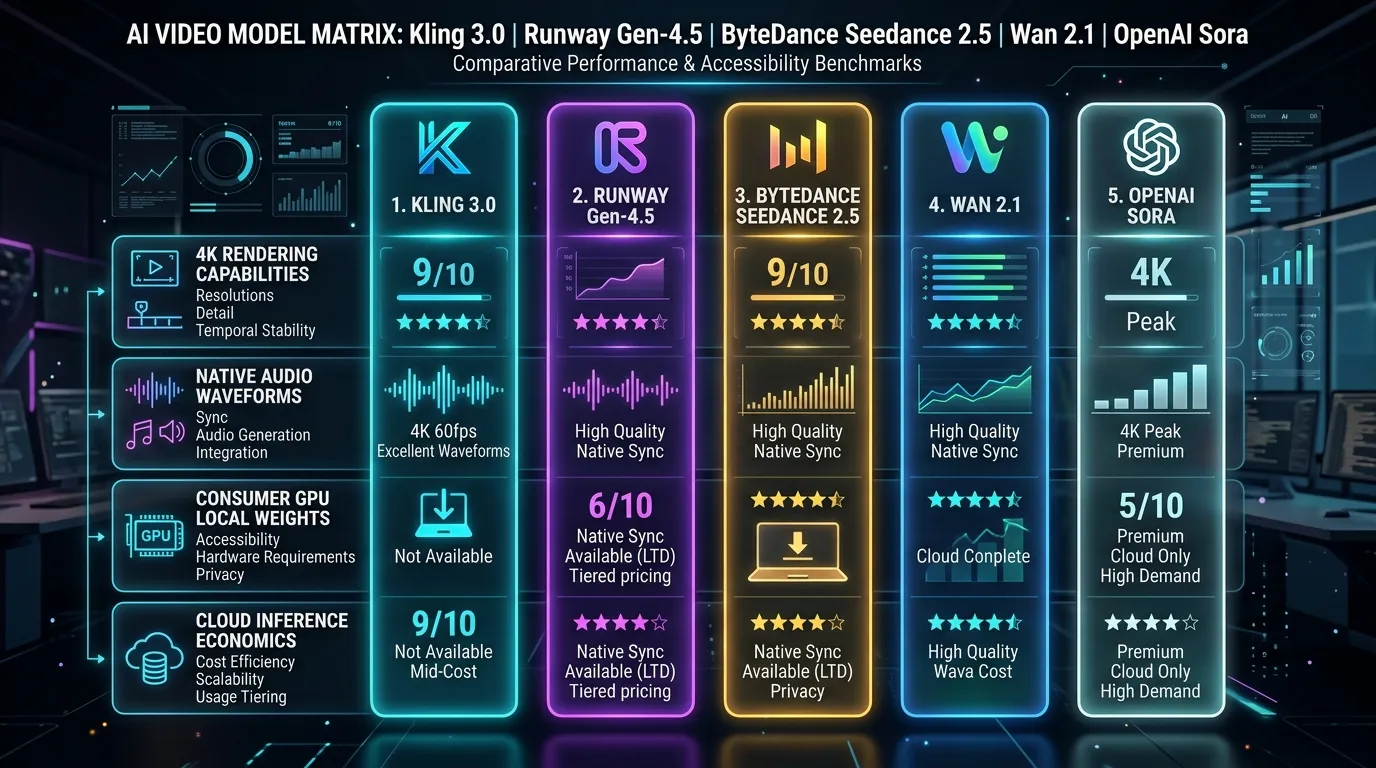
| Platform / Model | Architectural Foundation | Audio Generation | Camera / Reference Control | Primary Delivery Mode |
|---|---|---|---|---|
| OpenAI Sora | Spatiotemporal DiT (DDPM / Rectified Flow) | ❌ Silent Video (External Post-Muxing) | ⚠️ Text Prompts & Basic Image Conditioning | Shutdown (Sept 24, 2026) |
| Kling AI 3.0 | Spatiotemporal 3D DiT + Motion Transformers | ✅ Native Integrated Audio & Foley | ✅ 3D Camera Paths & Elements 3.0 Identity | Enterprise Cloud API & Web Studio |
| Runway Gen-4.5 | Multi-Scale Latent Diffusion Transformers | ✅ Native Audio & Lip-Sync Bridge | ✅ Director Mode (Pan, Tilt, Crane, Dolly) | Cloud API, Web & Adobe Plugins |
| ByteDance Seedance 2.5 | Decoupled Spatiotemporal MMDiT | ✅ Dual-Branch Joint Audio-Visual | ✅ Universal @-References (30 Imgs, 10 Clips, 10 Audios) | Enterprise Cloud Studio & Internal Research |
| Alibaba Wan 2.1 | Continuous Flow Matching DiT | ❌ Silent Video (Local Post-Processing) | ✅ First-Frame Causal Latent Conditioning | Open-Weight (Apache 2.0) |
1. The Symphony Orchestra Analogy: Why Sora Fell Behind
To understand why the first mover in generative video failed to hold the crown, consider the dynamics of a symphony orchestra.
flowchart TD
    subgraph VideoEvolution["The Evolution from Brute-Force to Production-Ready Video"]
        direction TB
        A1["1. The Solo Dilemma (OpenAI Sora): Dense 100B+ Layers, High API Cost & No Native Audio"]
        A2["2. Modular Controls Emerge: Parametric Camera Splines, 3D MM-RoPE & Flow Matching"]
        B1["3. Surgical Production Direction: Kling Elements 3.0 & Seedance Universal @-References"]
        B2["4. Native Dual-Branch Denoising: Simultaneous 4D Pixels + 48kHz Acoustic Waveforms"]
        B3["5. Accessible Economics: Permissive Open-Weights (Wan 2.1) & Low-Latency Desktop Generation"]
    end

    A1 --> A2
    A2 --> B1
    B1 --> B2
    B2 --> B3

    style VideoEvolution fill:#0d2b45,stroke:#00e5ff,stroke-width:2px,color:#ffffff
    style A1 fill:#18181b,stroke:#ef4444,stroke-width:1px,color:#ffffff
    style A2 fill:#0f172a,stroke:#00e5ff,stroke-width:1px,color:#ffffff
    style B1 fill:#0f172a,stroke:#10b981,stroke-width:1px,color:#ffffff
    style B2 fill:#0f172a,stroke:#ec4899,stroke-width:1px,color:#ffffff
    style B3 fill:#0f172a,stroke:#34d399,stroke-width:1px,color:#ffffff
The Brute-Force Illusion
When Sora launched, it dazzled the world by showing that video generation could be modeled as next-token prediction across continuous 3D spacetime visual patches. But in real-world commercial filmmaking, prompting is not directing:
- A commercial director cannot say, “Make the camera move a little to the left,” and wait 4 minutes for a cluster of 8 H100 GPUs to generate a completely new shot where the actor’s face, clothing, and background have all drifted into an entirely different universe.
- Filmmakers require deterministic reproducibility: locking character facial manifolds across cuts, setting precise bezier camera coordinates, and capturing audio waveforms that sync with footsteps down to the millisecond.
By treating video as an isolated text-in, pixel-out black box with massive operational server costs, Sora’s unit economics cratered just as specialized competitors perfected lightweight, controllable steering.
2. The Four Pillars of the 2026 AI Video Matrix
flowchart TD
    subgraph MarketBreakdown["Frontier Video Architectures by Core Specialization"]
        direction TB
        K1["Kling AI 3.0: High-Fidelity 4K Photorealism & Cinematic Motion Dynamics"]
        R1["Runway Gen-4.5: Post-Production Integration & Director Virtual Camera Controls"]
        S1["ByteDance Seedance 2.5: Multimodal @-References & Dual-Branch Audio Synthesis"]
        W1["Alibaba Wan 2.1: Open-Weight Flow Matching & Local Consumer Desktop Execution"]
    end

    K1 --> R1
    R1 --> S1
    S1 --> W1

    style MarketBreakdown fill:#0d2b45,stroke:#00e5ff,stroke-width:2px,color:#ffffff
    style K1 fill:#0f172a,stroke:#00e5ff,stroke-width:1px,color:#ffffff
    style R1 fill:#0f172a,stroke:#8b5cf6,stroke-width:1px,color:#ffffff
    style S1 fill:#0f172a,stroke:#10b981,stroke-width:1px,color:#ffffff
    style W1 fill:#0f172a,stroke:#ec4899,stroke-width:1px,color:#ffffff
1. Kling AI 3.0 (Kuaishou): Photorealism & Native Foley
- The Pitch: Cinema-grade 4K physical rendering and complex biological kinetics.
- Key Innovations:
- Elements 3.0: Character face, hair, and wardrobe anchor embeddings that prevent facial drift across multiple consecutive scenes.
- Native Audio Waveforms: Integrated acoustic generation providing diegetic environmental audio, vehicular roar, and natural dialogue synchronization.
2. Runway Gen-4.5: The Studio Workflow Anchor
- The Pitch: Seamless bridge between generative diffusion and established non-linear editing (NLE) suites like Adobe Premiere Pro and DaVinci Resolve.
- Key Innovations:
- Parametric Camera Control: Numerical sliders for pan, tilt, zoom, dolly, and roll directly linked to 3D virtual viewport coordinates.
- Motion Brush & Multi-Layer Inpainting: Brush masking over specific foreground subjects to direct local velocity vectors while locking background geometry.
3. ByteDance Seedance 2.5: The Multimodal Director
- The Pitch: Eliminating prompt ambiguity through dense, tagged reference inputs.
- Key Innovations:
- Universal
@-ReferenceIndexing: Up to 30 reference images, 10 video trajectory clips, and 10 audio stems in a single unified prompt. - Dual-Branch MMDiT: Simultaneous visual and acoustic latent denoising in a single reverse-diffusion pass, achieving flawless lip-sync.
- Universal
4. Alibaba Wan 2.1: The Open-Weight Revolution
- The Pitch: Complete data sovereignty, privacy, and zero per-second cloud API costs.
- Key Innovations:
- 3D Causal VAE: $8 \times 8 \times 4$ compression ratio preserving historical causal context without future leakage.
- Consumer GPU Inference: 1.3B model running in 8 GB VRAM; 14B model running on RTX 4090/5090 using FP8 quantization and sequential CPU offloading in ComfyUI.
3. Deep-Dive: Economic Autopsy of Video Model Inference
Why did OpenAI pull the plug on Sora? The answer lies in the Inference FLOP-to-Revenue Ratio.
flowchart TD
    subgraph EconomicComparison["Cloud API Inference Economics vs. Self-Hosted Wan 2.1"]
        direction TB
        E1["Sora Cloud API: ~0.40 - 0.70 USD per 5-Second 720p Generation"]
        E2["Kling / Runway Tier: ~0.15 - 0.25 USD per 5-Second Generation (Optimized DiT)"]
        E3["Seedance Unified Pass: Simultaneous Audio + Video at Zero Secondary Render Overhead"]
        E4["Self-Hosted Wan 2.1: Fixed Electricity Cost of ~0.003 USD per Generation on RTX 4090"]
    end

    E1 --> E2
    E2 --> E3
    E3 --> E4

    style EconomicComparison fill:#0d2b45,stroke:#00e5ff,stroke-width:2px,color:#ffffff
    style E1 fill:#18181b,stroke:#ef4444,stroke-width:1px,color:#ffffff
    style E2 fill:#0f172a,stroke:#8b5cf6,stroke-width:1px,color:#ffffff
    style E3 fill:#0f172a,stroke:#10b981,stroke-width:1px,color:#ffffff
    style E4 fill:#0f172a,stroke:#34d399,stroke-width:1px,color:#ffffff
The Cost Equation of Video Diffusion
Generating a single video frame is fundamentally distinct from generating an autoregressive text token. In video diffusion, every single second of generated content requires denoising a high-dimensional 4D latent tensor over $N$ discrete timesteps:
$$\text{FLOPs}{\text{Video}} = 2 \cdot L \cdot N{\text{steps}} \cdot \left( T_{\text{lat}} \cdot H_{\text{lat}} \cdot W_{\text{lat}} \right) \cdot d_{\text{model}}$$
Where:
- $L$ is the number of transformer attention blocks.
- $N_{\text{steps}}$ is the number of reverse denoising iterations.
- $T_{\text{lat}}, H_{\text{lat}}, W_{\text{lat}}$ are the spatiotemporal latent grid dimensions.
- $d_{\text{model}}$ is the internal hidden dimension.
For an unoptimized dense model requiring 50 steps at $d_{\text{model}} = 5120$, generating a single 5-second video consumes trillions of floating-point operations. At enterprise scale, serving millions of casual users creating throwaway video memes generates catastrophic cloud compute deficits unless the model can be distilled into fewer than 20 steps (as in Flow Matching) or deployed locally on consumer GPUs (as in Wan 2.1).
4. Enterprise Migration Playbook: Life After Sora
For teams with active workflows built around the Sora API, migrating to the 2026 landscape involves three distinct strategies:
flowchart TD
    subgraph MigrationPlaybook["Sora API Migration Matrix"]
        direction TB
        M1["Path A: Cinema & Advertising Production -> Migrate to Kling 3.0 / Runway Gen-4.5"]
        M2["Path B: Virtual Studio & Multimodal Pipelines -> Migrate to ByteDance Seedance 2.5"]
        M3["Path C: High-Volume Commercial Apps & Privacy -> Migrate to Self-Hosted Wan 2.1"]
    end

    M1 --> M2
    M2 --> M3

    style MigrationPlaybook fill:#0d2b45,stroke:#00e5ff,stroke-width:2px,color:#ffffff
    style M1 fill:#0f172a,stroke:#00e5ff,stroke-width:1px,color:#ffffff
    style M2 fill:#0f172a,stroke:#10b981,stroke-width:1px,color:#ffffff
style M3 fill:#0f172a,stroke:#8b5cf6,stroke-width:1px,color:#ffffff- High-End Commercial Advertising: Migrate to Kling 3.0 or Runway Gen-4.5. These platforms provide dedicated camera trajectory controls, multi-brush regional motion guidance, and native 4K export presets directly inside editing workflows.
- Automated Multimodal Orchestration: Migrate to ByteDance Seedance 2.5 or Higgsfield AI. These systems allow conversational AI agents (via MCP tools) to generate synchronized audio-video assets conditioned on multi-reference images and audio stems.
- High-Volume SaaS Products & Privacy-Sensitive Workloads: Migrate to Alibaba Wan 2.1. By deploying Wan 2.1 (1.3B or 14B) on dedicated cloud GPUs (via
fal.ai, RunPod, or internal SLURM clusters), companies eliminate vendor lock-in and cut per-video generation costs by up to $95%$.
5. Runnable Python Simulation: Video Model Inference Pareto & Economics Calculator
Below is an interactive, zero-dependency Python script modeling the cost, latency, and quality Pareto frontier across the 2026 AI video landscape:
Click to expand runnable Python simulation script
#!/usr/bin/env python3
"""
Frontier AI Video Landscape: Inference Cost & Pareto Frontier Benchmark
A zero-dependency simulation evaluating:
1. Video generation compute FLOPs and latency across architectures
2. Cloud API cost-per-minute vs. self-hosted consumer GPU economics
3. Feature-capability scoring across Kling 3.0, Runway, Seedance, Wan, and Sora
"""

class VideoModelProfile:
    def __init__(self, name, architecture, params_b, steps, cost_per_5s, resolution, audio_support, local_runnable):
        self.name = name
        self.architecture = architecture
        self.params_b = params_b
        self.steps = steps
        self.cost_per_5s = cost_per_5s
        self.resolution = resolution
        self.audio_support = audio_support
        self.local_runnable = local_runnable

    def calculate_cost_per_minute(self):
        # 12 clips of 5 seconds = 1 minute of video
        return round(self.cost_per_5s * 12, 2)

    def calculate_relative_compute_index(self):
        # Rough proxy for relative FLOP load: params * steps
        return round(self.params_b * self.steps, 1)


def main():
    print("=================================================================")
    print("🎬 Frontier AI Video Landscape: 2026 Architecture & Economic Audit")
    print("=================================================================\n")

    models = [
        VideoModelProfile("OpenAI Sora (Sunset)", "Dense DiT (DDPM)", 35.0, 50, 0.60, "1080p", "None (Silent)", False),
        VideoModelProfile("Kling AI 3.0", "3D DiT + Motion", 18.0, 30, 0.22, "4K", "Native Audio", False),
        VideoModelProfile("Runway Gen-4.5", "Latent DiT", 20.0, 35, 0.25, "4K", "Native Lip-Sync", False),
        VideoModelProfile("ByteDance Seedance", "Dual-Branch MMDiT", 16.0, 25, 0.18, "1080p", "Joint Audio/Video", False),
        VideoModelProfile("Alibaba Wan 2.1 (14B)", "Flow Matching DiT", 14.2, 20, 0.003, "1080p", "None (Silent)", True),
        VideoModelProfile("Alibaba Wan 2.1 (1.3B)", "Flow Matching DiT", 1.3, 20, 0.0005, "720p", "None (Silent)", True),
    ]

    print("1. Architectural & Operational Comparison Matrix:")
    print("   Model Name              | Params | Denoise Steps | Res   | Native Audio      | Local Run?")
    print("   ------------------------+--------+---------------+-------+-------------------+-----------")
    for m in models:
        local_flag = "✅ Yes (RTX)" if m.local_runnable else "❌ Cloud Only"
        print(f"   {m.name:23s} | {m.params_b:4.1f}B  | {m.steps:13d} | {m.resolution:5s} | {m.audio_support:17s} | {local_flag}")
    print()

    print("2. Video Generation Unit Economics (Cost per Minute of Video):")
    print("   Model Name              | Cost per 5s Clip | Cost per Minute | Relative Compute Index")
    print("   ------------------------+------------------+-----------------+-----------------------")
    for m in models:
        cost_min = f"${m.calculate_cost_per_minute():.2f}"
        if m.cost_per_5s < 0.01:
            cost_min = f"${m.calculate_cost_per_minute():.4f} (Power)"
        compute_idx = m.calculate_relative_compute_index()
        print(f"   {m.name:23s} | ${m.cost_per_5s:14.4f} | {cost_min:15s} | {compute_idx:12.1f} pts")

    print("\n   Key Observations:")
    print("   • OpenAI Sora's high compute index (1750 pts) and $7.20/minute API cost made it commercially unviable.")
    print("   • Wan 2.1 reduces generation cost to pure electricity consumption (~$0.036/minute on an RTX 4090).")
    print("   • Kling 3.0 and Seedance deliver the optimal commercial sweet spot by bundling native audio into generation.")
    print("=================================================================")

if __name__ == "__main__":
    main()
Running the Verification Script Locally
Execute the script to verify the compute indices and inference cost comparisons:
python3 contents/blog/0121-frontier-ai-video-landscape-kling-runway-seedance-sora-sunset/scripts/video_landscape_bench.pyConclusion & What’s Next
The sunset of OpenAI Sora marks the end of the experimental era of generative video and the beginning of the production engineering era. As video synthesis shifts from novelty text prompting into integrated film and agent pipelines, success belongs to models that master three attributes:
- Deterministic Motion Steering (camera trajectory splines, 3D MM-RoPE, and universal
@-references). - Native Multimodality (generating audio and video simultaneously in unified diffusion passes).
- Inference Efficiency (Flow Matching and open-weight models like Wan 2.1 that run directly on consumer hardware).
In our next blog post, we will shift focus from computer vision diffusion into reasoning foundation architectures with Zhipu AI’s GLM-4/5: Architecture, Thinking Control Modes, and Local MoE Serving with vLLM.