
The CUDA Revolution II: The Programming Model (Grids, Blocks, Threads, and Warps)
Mastering the CUDA execution hierarchy: thread coordinates, 2D matrix indexing, block barriers (__syncthreads), and register warp shuffles.

Series: Part 11 of GPU Architecture, Scale-Up Interconnects, and AI Datacenter Infrastructure Series | (Previous) The CUDA Revolution I: The Genesis of GPGPU and the Billion-Dollar Gamble | (Next) The CUDA Revolution III: Asynchronous Execution, Streams, Graphs, and Driver Ecosystem
Summary
Writing high-performance GPU software requires an entirely different mental model than programming multi-core CPUs. Instead of managing a handful of heavy OS threads with preemptive scheduling and mutex locks, a CUDA developer coordinates millions of lightweight threads executing concurrently across a sea of silicon execution units. The key to unlocking peak performance lies in understanding how software abstractions—Grids, Thread Blocks, and individual Threads—map directly onto physical hardware execution engines: the GPU Device, Streaming Multiprocessors (SMs), and 32-thread hardware Warps.
In Part 11 of our GPU Architecture, Scale-Up Interconnects, and AI Datacenter Infrastructure Series, we deconstruct the core CUDA Programming Model. We dissect multi-dimensional thread coordinate indexing across 1D and 2D arrays, examine boundary guard conditions, explore the hardware mechanics of block barrier synchronization (__syncthreads()) and deadlock traps, and dive into register-to-register warp shuffle intrinsics (__shfl_sync) that execute binary tree reductions in single-digit clock cycles without touching shared memory.
Prior Reading Material
To trace how hardware execution units coordinate parallel thread hierarchies, explore these prerequisite deep dives:
- The CUDA Revolution I: The Genesis of GPGPU and the Billion-Dollar Gamble — Part 10: Fragment shader raster hacks, BrookGPU at Stanford, and Jensen Huang’s 2006 G80 gamble.
- GPU Memory Hierarchy: Registers, Shared Memory, L1/L2, and HBM3e/HBM4 — Part 9: Nanosecond memory ladders, shared memory banking, and 128-byte coalescing protocols.
- Streaming Multiprocessors (SM) & Compute Units: Schedulers, Registers, and Warps — Part 6: 32-thread lockstep warps, zero-overhead hardware schedulers, and Little’s Law latency hiding.
- Under the Silicon Hood: Core GPU Building Blocks and Stream Processors — Part 5: GigaThread engine, GPCs, TPCs, and SM execution pipelines.
1. The Mental Model: Mapping Software Threads to Physical Silicon
When you invoke a CUDA kernel, you specify the execution configuration using the execution syntax kernel<<<gridDim, blockDim>>>(...). This configuration creates a hierarchy of concurrent software entities that map directly onto the GPU silicon:
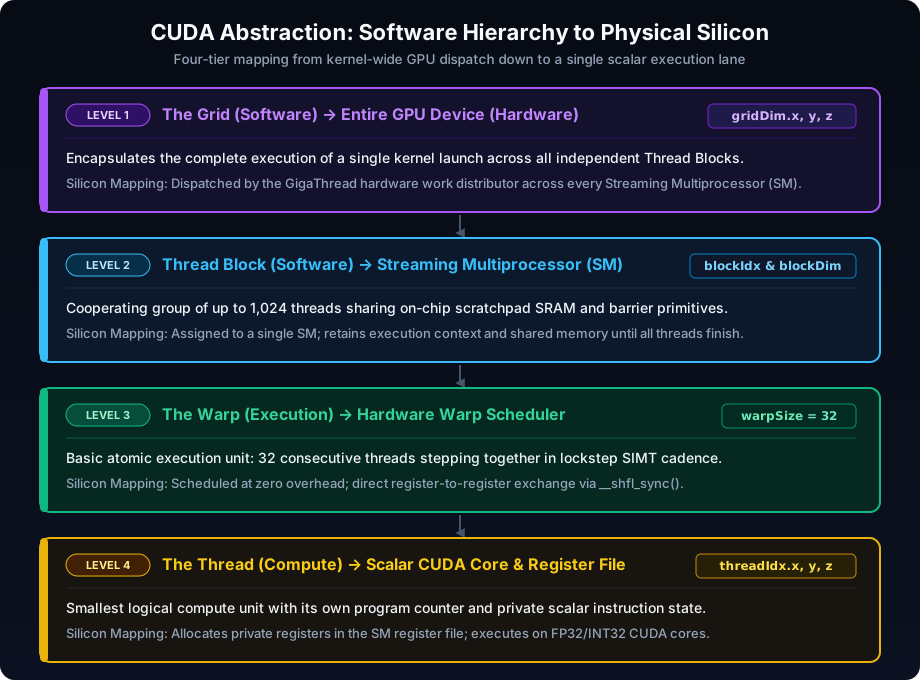 Figure 1: The two-sided abstraction ladder of CUDA. Software entities (Grid, Thread Block, Warp, Thread) mapped 1:1 to their physical hardware counterparts (GPU Device, Streaming Multiprocessor, Warp Scheduler, CUDA Core). Source: Conceptual architecture adapted from NVIDIA CUDA Programming Guides.
1. The Grid (Software) $\to$ Entire GPU Device (Hardware)
A Grid represents the entirety of a kernel execution. It contains all thread blocks required to process a dataset. When launched, the hardware GigaThread engine distributes the blocks across all available Streaming Multiprocessors (SMs) on the chip.
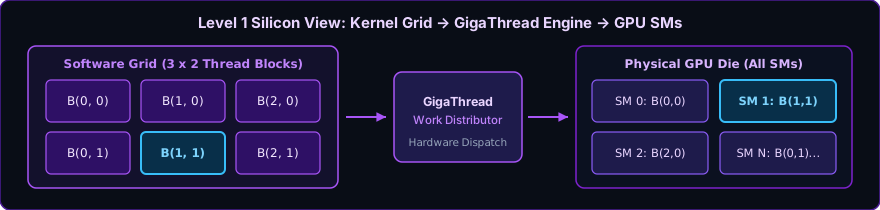 Figure 2: The GigaThread work distributor dispatches all Thread Blocks in a software Grid across the physical Streaming Multiprocessors (SMs) on the GPU die.
2. The Thread Block (Software) $\to$ Streaming Multiprocessor (Hardware)
A Thread Block (or Cooperative Thread Array, CTA) is a cluster of up to 1,024 threads that execute cooperatively.
- Once a block is dispatched to an SM, it resides on that specific SM until all of its threads terminate.
- All threads within a block share the SM’s on-chip Shared Memory (SRAM) and can synchronize their execution using hardware block barriers (
__syncthreads()). - An SM can host multiple active thread blocks concurrently, provided there are sufficient registers and shared memory available.
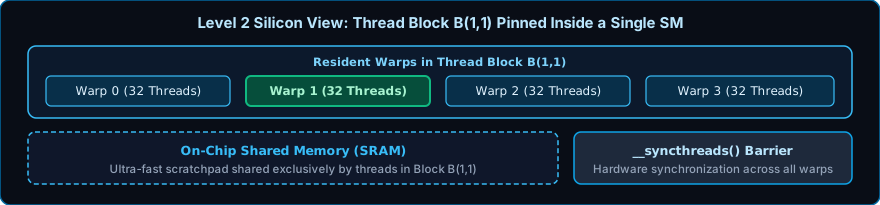 Figure 3: Inside a single SM, a Thread Block’s resident Warps share on-chip Shared Memory (SRAM) and coordinate via
__syncthreads() barriers.
3. The Warp (Software & Hardware SIMT Unit) $\to$ Warp Scheduler
While developers think in terms of individual threads, the physical silicon never manages individual threads. Instead, the hardware groups consecutive threads in blocks of 32 threads called a Warp.
- The Warp is the fundamental unit of execution.
- The SM’s hardware warp schedulers select ready warps each clock cycle and issue instructions to the execution pipelines in lockstep cadence.
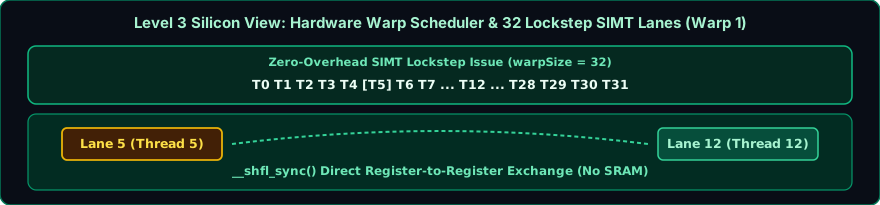 Figure 4: A Warp Scheduler issues instructions to 32 SIMT lanes in lockstep cadence, enabling direct register-to-register exchange via
__shfl_sync().
4. The Thread (Software) $\to$ CUDA Core & Register File Slice
A Thread is the basic scalar execution context. Each thread maintains its own program counter, private local registers, and coordinate identifiers.
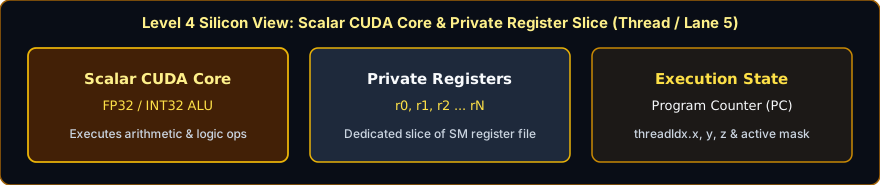 Figure 5: Each individual thread executes on a scalar FP32/INT32 CUDA Core with its own private slice of the SM register file and Program Counter (PC).
2. Multi-Dimensional Coordinate Indexing
CUDA allows grids and thread blocks to be configured in 1, 2, or 3 dimensions using the dim3 type. This abstraction allows developers to naturally map parallel workloads to 1D vectors, 2D images or matrices, and 3D volumetric physics simulations.
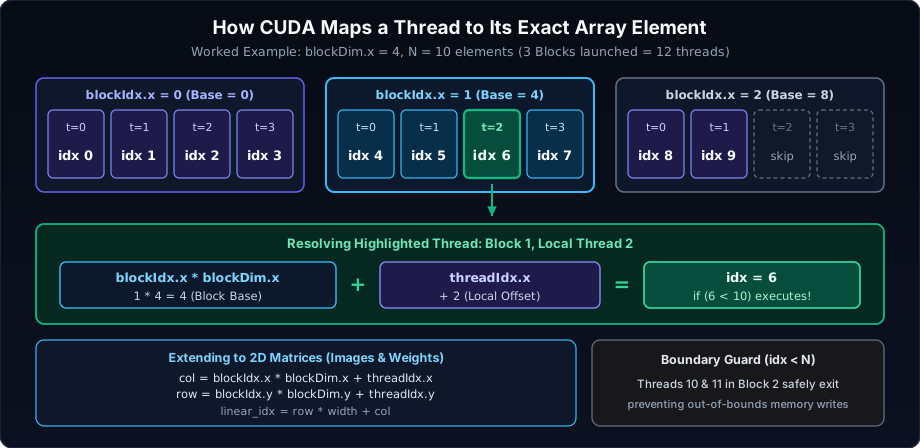 Figure 6: Visual trace of
int idx = blockIdx.x * blockDim.x + threadIdx.x with blockDim.x = 4 and N = 10, showing how Block 1 Thread 2 resolves to idx = 6 while trailing threads in Block 2 are safely skipped by the boundary guard.
1D Linear Vector Indexing
For a 1D vector addition of size $N$, threads calculate their global memory index with:
int idx = blockIdx.x * blockDim.x + threadIdx.x;
if (idx < N) {
    c[idx] = a[idx] + b[idx];
}- The Boundary Guard (
if (idx < N)): Because thread blocks are allocated in fixed multiples (typically 128, 256, or 512 threads), the total number of threads launched rarely divides evenly into arbitrary dataset sizes. The boundary guard ensures threads beyond $N$ exit safely without writing into unallocated memory.
2D Matrix Indexing
When processing 2D matrices (such as neural network weights or image pixels), blocks and grids are structured in two dimensions:
// Thread coordinate within matrix
int col = blockIdx.x * blockDim.x + threadIdx.x; // X corresponds to columns
int row = blockIdx.y * blockDim.y + threadIdx.y; // Y corresponds to rows

// Flatten 2D row/col into 1D linear memory address
if (row < height && col < width) {
    int linear_idx = row * width + col;
    output[linear_idx] = input[linear_idx] * 2.0f;
}
3. Thread Synchronization: Block Barriers & Deadlock Pitfalls
When threads inside a block cooperate (for example, staging data into shared memory before performing tiled matrix multiplication), execution must be synchronized to prevent race conditions.
The __syncthreads() Primitive
The __syncthreads() intrinsic acts as an execution and memory barrier for all threads in a thread block:
- When a thread reaches
__syncthreads(), it halts execution and waits until every other thread in the block reaches the exact same barrier. - All shared memory writes issued by any thread prior to the barrier are guaranteed to be globally visible to all threads in the block after the barrier.
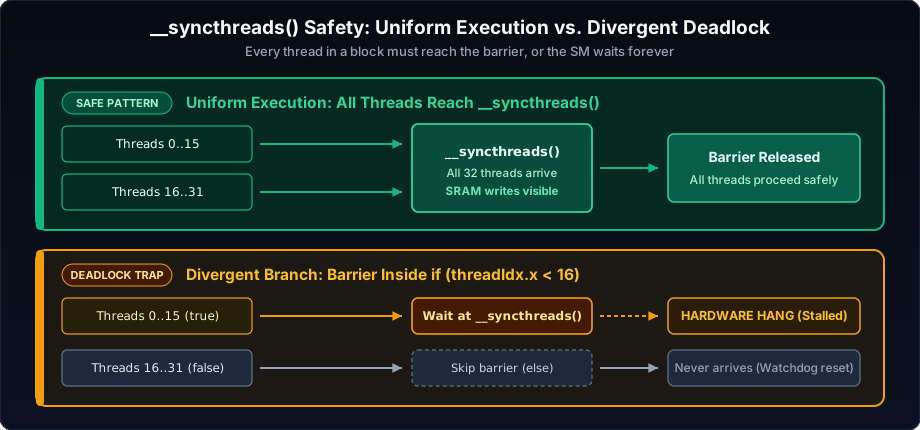 Figure 7: Uniform execution allows all threads in the block to reach
__syncthreads() and proceed, whereas placing the barrier inside a divergent if branch leaves half the warp stalled forever.
The Conditional Deadlock Trap
A classic bug in GPU programming is placing a barrier inside a conditional branch that evaluates differently across threads:
// CATASTROPHIC DEADLOCK:
if (threadIdx.x < 16) {
    // Threads 0..15 hit barrier and wait
    __syncthreads();
} else {
    // Threads 16..31 never reach barrier!
    do_something_else();
}
Because the hardware waits indefinitely for threads 16 through 31 to arrive at the barrier, the SM deadlocks, the kernel times out, and the GPU driver triggers a hardware watchdog reset. In modern CUDA, all threads in a block must evaluate the conditional expression identically if it encloses a barrier.
4. Warp-Level Primitives: Shuffle Intrinsics (__shfl_sync)
Before the introduction of Kepler (2012) and Volta (2017), if threads in a warp wanted to exchange numbers, they had to write values to Shared Memory, issue a barrier, and read them back.
NVIDIA introduced Warp Shuffle Intrinsics to allow threads within the same 32-thread warp to read directly from another thread’s private registers—completely bypassing shared memory, L1 cache, and address generation logic.
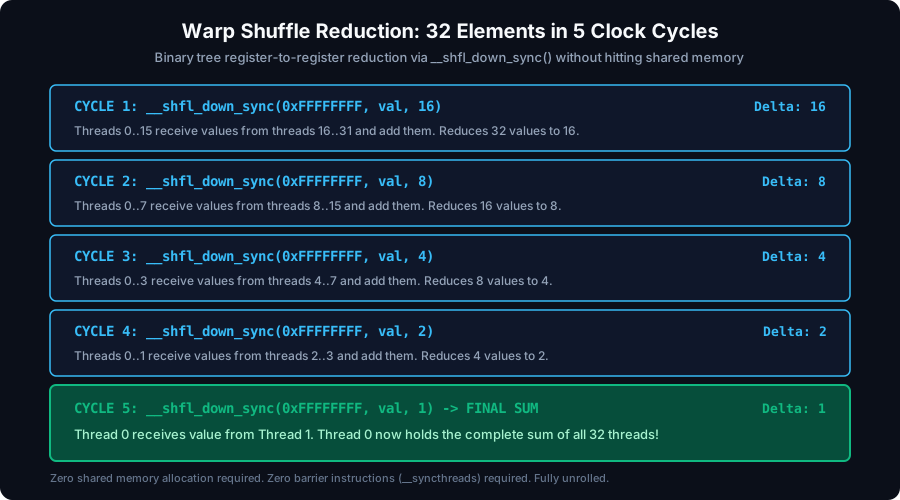 Figure 8: Step-by-step binary tree parallel reduction using
__shfl_down_sync(). Thirty-two values are reduced down to a single sum in Thread 0 in exactly 5 clock cycles without touching shared memory. Source: Algorithmic reduction pattern adapted from NVIDIA Parallel Forall Engineering Guides.
How __shfl_down_sync() Works
The __shfl_down_sync(mask, var, delta) intrinsic instructs each thread to fetch the value of var from the thread whose lane ID is laneId + delta:
// 32-thread warp-level sum reduction in 5 instructions
inline __device__ float warp_reduce_sum(float val) {
    // 0xFFFFFFFF mask: all 32 threads participate
    val += __shfl_down_sync(0xFFFFFFFF, val, 16); // Cycle 1: 32 -> 16
    val += __shfl_down_sync(0xFFFFFFFF, val, 8);  // Cycle 2: 16 -> 8
    val += __shfl_down_sync(0xFFFFFFFF, val, 4);  // Cycle 3: 8  -> 4
    val += __shfl_down_sync(0xFFFFFFFF, val, 2);  // Cycle 4: 4  -> 2
    val += __shfl_down_sync(0xFFFFFFFF, val, 1);  // Cycle 5: 2  -> 1
    return val; // Thread 0 holds the grand total sum!
}- Zero Shared Memory: Uses zero bytes of shared memory SRAM, preserving the entire SRAM pool for other thread blocks.
- Zero Barrier Overhead: Because all 32 threads in a warp already execute in lockstep SIMT cadence, no
__syncthreads()call is required. - Blistering Speed: The reduction completes in exactly 5 clock cycles (less than 4 nanoseconds), delivering peak theoretical throughput for attention softmax and layer-norm reductions.
5. Analytical Simulation: Thread Indexing & Warp Shuffle Reducer
The following Python script simulates CUDA thread coordinate indexing and traces a clock-by-clock 32-element warp shuffle reduction tree.
Click to expand runnable code script
"""
CUDA Programming Model Simulator: Thread Coordinates & Warp Shuffle Reduction.
Models 1D/2D grid-block coordinate resolution and step-by-step binary tree
warp shuffle operations across 32 threads.
"""

from typing import List, Tuple

WARP_SIZE = 32

def resolve_2d_coordinates(block_idx: Tuple[int, int],
                           thread_idx: Tuple[int, int],
                           block_dim: Tuple[int, int]) -> Tuple[int, int]:
    """Resolves 2D (row, col) matrix coordinates from block and thread vectors."""
    col = block_idx[0] * block_dim[0] + thread_idx[0]
    row = block_idx[1] * block_dim[1] + thread_idx[1]
    return row, col

def simulate_warp_shuffle_down_reduction(values: List[float]) -> float:
    """
    Simulates the 5-cycle warp binary tree reduction using __shfl_down_sync.
    Trace each cycle's delta and active lanes.
    """
    assert len(values) == WARP_SIZE
    state = list(values)

    deltas = [16, 8, 4, 2, 1]
    print(f"{'Cycle':<7} | {'Delta':<7} | {'Active Participating Lanes':<30} | {'Sample Sum (Lane 0)'}")
    print("-" * 75)

    for cycle_num, delta in enumerate(deltas, start=1):
        # Each lane i adds value from lane i + delta (if i + delta < 32)
        next_state = list(state)
        for lane in range(WARP_SIZE):
            if lane + delta < WARP_SIZE:
                next_state[lane] += state[lane + delta]
        state = next_state
        print(f"Cycle {cycle_num:<2} | {delta:<7} | Lanes 0 to {WARP_SIZE - delta - 1:<23} | {state[0]:.2f}")

    return state[0]

def main():
    print("=" * 75)
    print("CUDA PROGRAMMING MODEL SIMULATION: INDEXING & WARP SHUFFLE")
    print("=" * 75)

    # 1. Coordinate Indexing Example
    block_dim = (16, 16)  # 256 threads per block
    b_idx = (2, 3)        # Block at column 2, row 3
    t_idx = (4, 7)        # Thread at local (4, 7)

    row, col = resolve_2d_coordinates(b_idx, t_idx, block_dim)
    width = 1024
    linear_addr = row * width + col

    print("\n[PART 1: 2D THREAD COORDINATE RESOLUTION]")
    print(f"  Block Dimension: ({block_dim[0]}, {block_dim[1]}) (256 threads)")
    print(f"  Block Index:     ({b_idx[0]}, {b_idx[1]})")
    print(f"  Thread Index:    ({t_idx[0]}, {t_idx[1]})")
    print(f"  Resolved Matrix: Row {row}, Column {col}")
    print(f"  Linear Offset:   {linear_addr} (for row-major matrix width={width})")

    # 2. Warp Shuffle Reduction Example
    # Initialize 32 threads with numbers 1.0 to 32.0 (Sum = 528.0)
    warp_inputs = [float(i + 1) for i in range(WARP_SIZE)]
    expected_sum = sum(warp_inputs)

    print("\n[PART 2: 32-THREAD WARP SHUFFLE REDUCTION TRACE]")
    final_sum = simulate_warp_shuffle_down_reduction(warp_inputs)

    print("-" * 75)
    print(f"  Expected Sum:   {expected_sum:.2f}")
    print(f"  Warp Sum (T0):  {final_sum:.2f}")
    print(f"  Total Cycles:   5 clock cycles (Zero shared memory used!)")
    print("=" * 75)

if __name__ == "__main__":
    main()
FAQ
-
What does “Base” (
0,4,8) represent in the coordinate indexing diagram?Answer
Base is the starting global array index for a given Thread Block, computed as
blockIdx.x * blockDim.x. WithblockDim.x = 4, Block 0 starts at0(idx 0..3), Block 1 starts at4(idx 4..7), and Block 2 starts at8(idx 8..11). AddingthreadIdx.x(0..3) gives each thread its unique global index. -
Why did the diagram use 4 threads per block (
blockDim.x = 4)?Answer
4is a small toy example chosen so all 3 blocks (12 threads total) fit cleanly in the visual. In real CUDA code, developers almost always pick128,256, or512threads per block (multiples of the 32-thread warp size) so no warp lanes sit idle. -
Does a warp or thread block always have a max of 1,024, or does it differ by hardware?
Answer
Two different limits apply:
- 1 Warp is always 32 threads (
warpSize = 32) across all NVIDIA CUDA GPUs. - 1 Thread Block has a hardware maximum of 1,024 threads (
32 warps) on every NVIDIA GPU since Fermi (2010) through Blackwell (early G80/Tesla 1.x GPUs had a 512-thread block limit). What does vary by GPU architecture is the max resident threads per SM across multiple concurrent blocks (typically 1,536 on Ampere/Ada or 2,048 on Hopper/Blackwell).
- 1 Warp is always 32 threads (
-
If threads map directly to thread blocks, why are warps needed at all?
Answer
Warps solve two opposing hardware constraints simultaneously:
- Silicon area: Giving 1,024 individual threads their own instruction fetch/decode units would waste huge amounts of die area. Grouping 32 threads into a warp lets them share one instruction fetch/decode unit (SIMT), leaving most of the silicon for math cores.
- Memory latency hiding: When a warp stalls waiting 400–800 cycles on HBM/VRAM, the SM’s Warp Scheduler swaps in another ready warp in zero clock cycles (keeping all registers live on-chip) so the CUDA cores stay busy instead of stalling an entire 1,024-thread block.
-
Do programmers ever work with warps directly if they are for hardware scheduling?
Answer
Yes. While you don’t declare warps in
kernel<<<gridDim, blockDim>>>, high-performance CUDA kernels explicitly design around them:- Warp-level primitives (
__shfl_sync(),__ballot_sync()) exchange values directly between registers in ~1 cycle without touching Shared Memory or__syncthreads(). - Warp divergence avoidance aligns conditional branches on warp boundaries (
threadIdx.x / 32) so 32 lockstep lanes don’t serialize. - Coalesced memory access groups 32 consecutive thread loads into a single 128-byte memory transaction.
- Block sizing always uses multiples of 32 (
128,256,512) for 100% warp utilization.
- Warp-level primitives (
What’s Next in the Series?
Now that we understand how software threads coordinate within a single kernel launch, we face a broader system orchestration challenge:
How does the host CPU coordinate hundreds of separate kernel launches, memory copies, and deep learning layers without blocking the CPU or leaving the GPU idle?
In Part 12: The CUDA Revolution III: Asynchronous Execution, Streams, Graphs, and Driver Ecosystem, we explore asynchronous concurrency: overlapping host-to-device transfers with compute via CUDA Streams, eliminating CPU launch latency with CUDA Graphs, and tracing the software stack through the Driver API, UVM, and GSP firmware.