
Part 8: Silicon at the Edge: NVIDIA Jetson Thor Architecture & Isaac ROS Acceleration
Explore NVIDIA Jetson Thor edge computing, Blackwell 800 TFLOPS architecture, NITROS zero-copy IPC, and Isaac ROS sub-50ms humanoid reflexes.
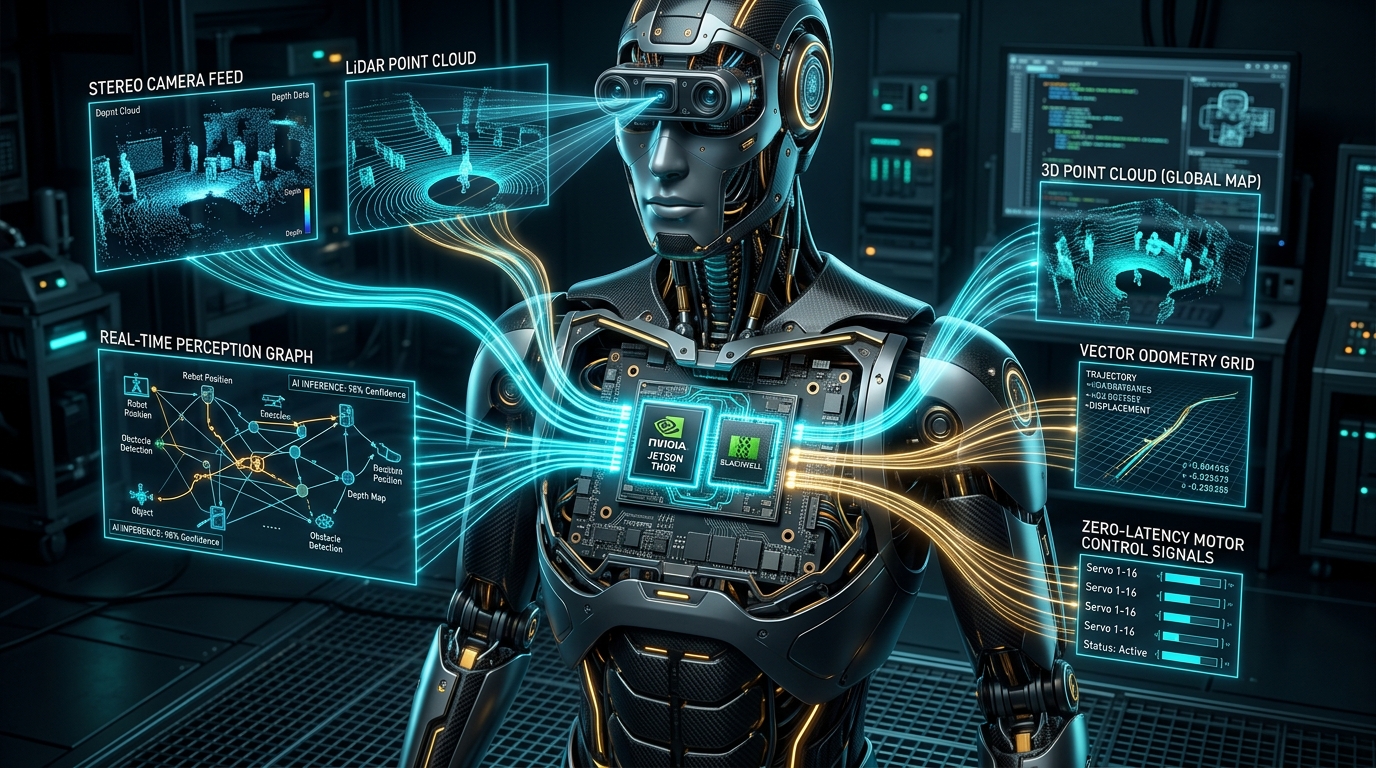
Series: NVIDIA Physical AI & Robotics Ecosystem Series - Part 8
Series: ← Part 7: From Simulation to Streets: NVIDIA DRIVE & Alpamayo Autonomous Vehicle Architecture (Previous)
Prior Reading Material
Before exploring edge silicon acceleration and zero-copy robotics middleware, inspect these foundational articles across our series:
- Part 1: Unpacking the NVIDIA Physical AI Data Factory (PAIDF) Stack — The end-to-end framework uniting Cosmos, Omniverse, Isaac Sim, and Jetson edge deployment.
- Part 5: Scaling Physics with Isaac Sim & Omniverse Replicator — Massively parallel GPU dynamics, synthetic sensor synthesis, and Sim-to-Real transfer.
- Part 6: Inside Project GR00T — Vision-Language-Action (VLA) tokenization and diffusion policy action heads for humanoid motor control.
- Part 7: From Simulation to Streets: NVIDIA DRIVE & Alpamayo Autonomous Vehicle Architecture — Surround-view Bird’s-Eye-View (BEV) transformer fusion and ASIL-D functional safety.
- Google DeepMind’s Gemini Robotics ER 2 — Decoupling high-level multimodal reasoning from real-time low-level VLA motor execution.
- Part 9: The Evolutionary Arc of Computer Vision — Convolutional feature extractors, ResNet skip connections, and spatial 3D vision.
NVIDIA Jetson Thor & Isaac ROS Hardware Architecture Summary
| Specification / Dimension | Details & Technical Parameters |
|---|---|
| Edge System-on-Chip (SoC) | NVIDIA Jetson Thor (Compact Blackwell Robotics Module) |
| AI Compute Throughput | Up to 800 TFLOPS (FP8 / FP4 Tensor Cores with Gen 5 NVLink-C2C) |
| CPU Complex | 14-core ARM Neoverse V3AE (Automotive Enhanced 64-bit Server Cores) |
| Unified Memory Subsystem | 128 GB LPDDR5X (204.8 GB/s High-Bandwidth Unified Physical Memory) |
| Robotics Middleware | NVIDIA Isaac ROS (ROS 2 Humble / Jazzy Hardware-Accelerated GEMs) |
| Zero-Copy IPC Transport | NITROS (NVIDIA Isaac Transport for ROS via cudaIpcMemHandle_t pointer exchange) |
| Thermal Power Envelope | 40W to 100W Configurable TDP (Designed for Untethered Humanoid Robots & Mobile AMRs) |
1. The Story of the Human Reflex Arc vs. The Mailroom Bottleneck
When you accidentally touch a red-hot stove, your hand pulls back in under 30 milliseconds—long before your conscious brain even registers pain. This lightning-fast reaction happens because your body utilizes a localized Spinal Reflex Arc: high-bandwidth sensory nerves bypass bureaucratic brain loops to trigger motor neurons directly.
In classical robotics software, however, every sensor reading is forced through an inefficient corporate Mailroom:
flowchart TD
    subgraph ClassicalROS["1. Classical CPU-GPU ROS 2 Mailroom Bottleneck"]
        direction TB
        A1["Stereo Camera Frame (12.4 MB)"] --> B1["CPU Memory Allocation & Serialization"]
        B1 --> C1["PCIe Bus Host-to-Device (H2D) Transfer"]
        C1 --> D1["GPU Kernel Execution (Disparity / SLAM)"]
        D1 --> E1["PCIe Bus Device-to-Host (D2H) Transfer"]
        E1 --> F1["Next ROS Node Serialization Loop (70ms+ Latency)"]
    end
    style ClassicalROS fill:#0f172a,stroke:#ef4444,stroke-width:2px,color:#ffffff
    style A1 fill:#1e293b,stroke:#ef4444,stroke-width:1px,color:#ffffff
    style B1 fill:#1e293b,stroke:#ef4444,stroke-width:1px,color:#ffffff
    style C1 fill:#1e293b,stroke:#ef4444,stroke-width:1px,color:#ffffff
    style D1 fill:#1e293b,stroke:#ef4444,stroke-width:1px,color:#ffffff
    style E1 fill:#1e293b,stroke:#ef4444,stroke-width:1px,color:#ffffff
    style F1 fill:#1e293b,stroke:#ef4444,stroke-width:1px,color:#ffffff
flowchart TD
subgraph IsaacNITROS["2. NVIDIA Jetson Thor & NITROS Zero-Copy Reflex Arc"]
direction TB
A2["Stereo Camera Image Frame"] --> B2["Direct DMA Ingestion into Unified GPU Memory"]
B2 --> C2["NITROS 64-Bit Pointer Exchange (0.03ms IPC Overhead)"]
C2 --> D2["Isaac ROS cuVSLAM & ESS TensorRT CUDA Kernels"]
D2 --> E2["In-VRAM GR00T VLA Action Diffusion Head"]
E2 --> F2["Sub-50ms Closed-Loop Actuator Torque Commands"]
end
style IsaacNITROS fill:#0f172a,stroke:#00e5ff,stroke-width:2px,color:#ffffff
style A2 fill:#0d2b45,stroke:#00e5ff,stroke-width:1px,color:#ffffff
style B2 fill:#0d2b45,stroke:#00e5ff,stroke-width:1px,color:#ffffff
style C2 fill:#1a3d3c,stroke:#10b981,stroke-width:2px,color:#ffffff
style D2 fill:#0d2b45,stroke:#00e5ff,stroke-width:1px,color:#ffffff
style E2 fill:#1e1b4b,stroke:#818cf8,stroke-width:2px,color:#ffffff
style F2 fill:#0f382c,stroke:#10b981,stroke-width:1px,color:#ffffffWhen high-resolution stereo cameras (2x 1080p @ 60 FPS) generate hundreds of megabytes per second, transferring tensors back and forth across the system memory bus creates an insurmountable bottleneck. By the time a humanoid robot’s CPU finishes serializing message packets, the robot has already tipped past its center of mass and fallen over.
To give humanoid robots human-like balance and reflexes, NVIDIA engineered Jetson Thor and Isaac ROS NITROS, creating a hardware-accelerated, zero-copy neural reflex arc.
2. NVIDIA Jetson Thor SoC: Silicon Built for Embodied AI
Running multimodal foundation models like Project GR00T (Part 6) and real-time visual odometry simultaneously on a bipedal robot requires data-center AI performance packed into a 50-watt battery budget.
NVIDIA Jetson Thor achieves this through a tightly integrated System-on-Chip (SoC) architecture:
flowchart TD
    subgraph ComputeComplex["1. Heterogeneous Compute Complex (Jetson Thor)"]
        direction TB
        GPU["Blackwell GPU (800 TFLOPS FP4/FP8 Tensor Cores + NVLink)"] --> CPU["14-Core ARM Neoverse V3AE Server Cluster"]
        CPU --> DLA["Dual Deep Learning Accelerators (Fixed-Point NPU)"]
        DLA --> PVA["Programmable Vision Accelerators (Optical Flow / Stereo)"]
    end
    style ComputeComplex fill:#0f172a,stroke:#00e5ff,stroke-width:2px,color:#ffffff
    style GPU fill:#0d2b45,stroke:#00e5ff,stroke-width:1px,color:#ffffff
    style CPU fill:#0d2b45,stroke:#00e5ff,stroke-width:1px,color:#ffffff
    style DLA fill:#0d2b45,stroke:#00e5ff,stroke-width:1px,color:#ffffff
    style PVA fill:#0d2b45,stroke:#00e5ff,stroke-width:1px,color:#ffffff
flowchart TD
subgraph MemoryIO["2. Unified Memory & Real-Time I/O Fabric"]
direction TB
GMSL["GMSL2 / FPD-Link Multi-Camera Deserializers (Up to 12 Streams)"] --> UMA["128 GB Unified LPDDR5X Memory (204.8 GB/s Shared Fabric)"]
UMA --> PCIE["PCIe Gen 5 x8 Lanes & 10GbE Time-Sensitive Network (TSN)"]
end
style MemoryIO fill:#0f172a,stroke:#10b981,stroke-width:2px,color:#ffffff
style GMSL fill:#1e1b4b,stroke:#818cf8,stroke-width:1px,color:#ffffff
style UMA fill:#1a3d3c,stroke:#10b981,stroke-width:2px,color:#ffffff
style PCIE fill:#0f382c,stroke:#10b981,stroke-width:1px,color:#ffffffKey Silicon Innovations in Jetson Thor
- Blackwell FP4/FP8 Tensor Cores: Delivers 800 TFLOPS of generative AI compute, enabling real-time diffusion denoising action heads to execute in under 12 milliseconds directly on-device.
- Unified Memory Architecture (UMA): The ARM CPU complex, Blackwell GPU, and hardware Vision Accelerators share a single contiguous 128 GB LPDDR5X memory pool, eliminating costly host-to-device memory copies.
- Hardware Optical Flow & Stereo Engines: Dedicated silicon accelerators compute dense optical flow and pixel-level disparity without consuming main GPU shader cycles.
3. Isaac ROS & NITROS: Eliminating the Serialization Tax
The Robot Operating System (ROS 2) is the global standard for robotics software, organizing robot capabilities into modular communicating processes called Nodes.
However, standard ROS 2 introduces severe serialization overhead:
flowchart TD
    A["Camera Driver Node (Captures RGB Image)"] --> B["Serialize sensor_msgs/Image to Shared Memory / Socket"]
    B --> C["Deserialize into cuVSLAM Node Memory"]
    C --> D["cuMemAlloc & Host-to-Device (H2D) PCIe Transfer"]
    D --> E["Run Visual Odometry CUDA Kernel"]
    E --> F["Device-to-Host (D2H) Transfer Back to CPU"]
    F --> G["Serialize geometry_msgs/PoseStamped for Next Node"]

    style A fill:#0d2b45,stroke:#ef4444,stroke-width:1px,color:#ffffff
    style B fill:#1e293b,stroke:#ef4444,stroke-width:1px,color:#ffffff
    style C fill:#1e293b,stroke:#ef4444,stroke-width:1px,color:#ffffff
    style D fill:#1e293b,stroke:#ef4444,stroke-width:1px,color:#ffffff
    style E fill:#0d2b45,stroke:#ef4444,stroke-width:1px,color:#ffffff
    style F fill:#1e293b,stroke:#ef4444,stroke-width:1px,color:#ffffff
    style G fill:#1e293b,stroke:#ef4444,stroke-width:1px,color:#ffffff
The NITROS Solution (NVIDIA Isaac Transport for ROS)
NITROS replaces standard message passing with Type Adaptation and Zero-Copy IPC:
flowchart TD
    N1["Camera Hardware DMA Buffer in Unified VRAM (nitros_image)"] --> N2["Pass 64-Bit Memory Pointer via cudaIpcHandle (0.03ms)"]
    N2 --> N3["Isaac ROS cuVSLAM Kernel Executes Directly in Same VRAM"]
    N3 --> N4["Pass Output Pointer to Isaac ROS ESS Stereo Node"]
    N4 --> N5["In-VRAM GR00T VLA Multimodal Action Model Execution"]

    style N1 fill:#0d2b45,stroke:#00e5ff,stroke-width:1px,color:#ffffff
    style N2 fill:#1a3d3c,stroke:#10b981,stroke-width:2px,color:#ffffff
    style N3 fill:#0d2b45,stroke:#00e5ff,stroke-width:1px,color:#ffffff
    style N4 fill:#1a3d3c,stroke:#10b981,stroke-width:2px,color:#ffffff
    style N5 fill:#1e1b4b,stroke:#818cf8,stroke-width:2px,color:#ffffff
Because image and point cloud tensors never leave GPU memory, data copy overhead drops to zero, reducing inter-node transmission time from over 15 milliseconds to under 30 microseconds.
Essential Hardware-Accelerated Isaac ROS GEMs
isaac_ros_visual_slam(cuVSLAM): High-precision real-time visual inertial odometry delivering sub-centimeter localization at over 60 FPS while consuming less than 10% GPU load.isaac_ros_ess(Stereo Disparity): Deep-learning-based disparity estimation network trained in Isaac Sim (Part 5), providing dense 3D depth maps even on untextured surfaces and glare.isaac_ros_foundationpose: Real-time 6D object pose tracking and 3D bounding box estimation for robotic grasping without CAD retraining.
4. The Sub-50ms Humanoid Reflex Latency Budget
To maintain upright balance on uneven terrain, a humanoid robot’s control loop must operate within a strict Dynamic Stability Horizon ($\tau \le 50\text{ms}$):
flowchart TD
    subgraph LatencyBudget["Humanoid Reflex Loop Timing Waterfall (36.1ms Total)"]
        direction TB
        L1["Camera & Sensor Ingestion: 2.1 ms"] --> L2["NITROS Zero-Copy Pointer Passing: 0.03 ms"]
        L2 --> L3["cuVSLAM Visual Odometry: 5.2 ms"]
        L3 --> L4["ESS Stereo Disparity: 6.8 ms"]
        L4 --> L5["FoundationPose Object Tracking: 8.5 ms"]
        L5 --> L6["Project GR00T VLA Action Diffusion Head: 11.5 ms"]
        L6 --> L7["MPC Low-Level Joint Torque Actuation: 1.8 ms"]
    end

    style LatencyBudget fill:#0f172a,stroke:#00e5ff,stroke-width:2px,color:#ffffff
    style L1 fill:#0d2b45,stroke:#00e5ff,stroke-width:1px,color:#ffffff
    style L2 fill:#1a3d3c,stroke:#10b981,stroke-width:2px,color:#ffffff
    style L3 fill:#0d2b45,stroke:#00e5ff,stroke-width:1px,color:#ffffff
    style L4 fill:#0d2b45,stroke:#00e5ff,stroke-width:1px,color:#ffffff
    style L5 fill:#0d2b45,stroke:#00e5ff,stroke-width:1px,color:#ffffff
    style L6 fill:#1e1b4b,stroke:#818cf8,stroke-width:2px,color:#ffffff
    style L7 fill:#0f382c,stroke:#10b981,stroke-width:2px,color:#ffffff
When running non-accelerated CPU nodes, cumulative latency swells to 73.5 ms (13.6 Hz). At 13 Hz, control corrections arrive too late, inducing resonant oscillations that destabilize the robot.
With Jetson Thor and Isaac ROS NITROS, total end-to-end loop latency drops to 36.1 ms (27.7 Hz), comfortably inside the critical 50ms stability window and ensuring agile, rock-solid physical balance.
5. Engineering Deep-Dive: Mathematical Formulations
To understand how hardware zero-copy memory transport and visual odometry algorithms operate at the silicon level, we review the formal mathematical formulations.
Mathematical Formulation 1: Zero-Copy Memory Bandwidth Conservation
In standard ROS 2 pipelines with $N$ nodes passing tensor $D$ of size $S_{\text{tensor}}$ across the system memory bus, total inter-process memory copy time $T_{\text{copy}}$ is governed by:
$$T_{\text{copy}} = \sum_{k=1}^{N-1} \left( \frac{2 \cdot S_{\text{tensor}}}{\text{BW}{\text{host}}} + \frac{S{\text{tensor}}}{\text{BW}{\text{H2D}}} + \frac{S{\text{tensor}}}{\text{BW}_{\text{D2H}}} \right)$$
Where:
- $\text{BW}_{\text{host}}$: CPU memory bandwidth ($~32\text{ GB/s}$).
- $\text{BW}{\text{H2D}}, \text{BW}{\text{D2H}}$: PCIe bus bandwidth ($~16\text{ GB/s}$).
Under Isaac ROS NITROS with Unified Physical Address space $P_{\text{CUDA}}$, all nodes reference the exact same memory allocation:
$$T_{\text{NITROS}} = \sum_{k=1}^{N-1} \frac{\text{sizeof}(\text{cudaIpcHandle})}{\text{BW}{\text{register}}} \approx \sum{k=1}^{N-1} \frac{64\text{ bytes}}{\text{BW}_{\text{register}}} \to 0.03\text{ ms}$$
Resulting in a near $100\times$ reduction in IPC overhead and zero bus saturation.
Mathematical Formulation 2: cuVSLAM Bundle Adjustment & Reprojection Loss
Isaac ROS cuVSLAM tracks 6-DoF robot poses $T_j \in \text{SE}(3)$ and 3D landmark points $X_i \in \mathbb{R}^3$ by solving non-linear least-squares bundle adjustment over a sliding temporal window:
$$\min_{X_i, T_j} \sum_{j \in \mathcal{F}} \sum_{i \in \mathcal{K}j} \rho\left( \left| p{ij} - \pi(K, T_j, X_i) \right|{\Sigma{ij}}^2 \right) + \sum_{k \in \mathcal{I}} \left| e_{\text{IMU}}^{(k)} \right|{\Sigma{\text{IMU}}}^2$$
Where:
- $\pi(K, T_j, X_i) = K \begin{bmatrix} R_j & t_j \end{bmatrix} X_i$: Camera pinhole projection model.
- $p_{ij}$: Observed 2D feature keypoint in frame $j$.
- $\rho(\cdot)$: Huber robust loss function mitigating outlier feature matches.
- $e_{\text{IMU}}^{(k)}$: Pre-integrated visual-inertial odometry error residual.
Jetson Thor’s Blackwell Tensor Cores and CUDA warp-level matrix solvers accelerate the sparse Levenberg-Marquardt optimizer, completing full bundle adjustment in under $5.2\text{ ms}$.
Mathematical Formulation 3: Humanoid Zero-Moment Point (ZMP) Stability Bound
For a humanoid robot of center-of-mass height $z_c$ under gravity $g$, the natural frequency of inverted pendulum dynamics is given by $\omega_0 = \sqrt{\frac{g}{z_c}}$.
The maximum permissible perception-to-actuation control loop latency $\tau_{\text{feedback}}$ to prevent tipping is strictly bounded by:
$$\tau_{\text{feedback}} \le \frac{1}{\omega_0} \ln\left( 1 + \frac{\Delta x_{\text{support}}}{z_c \cdot \theta_{\text{max}}} \right) \approx 50\text{ ms}$$
Where:
- $\Delta x_{\text{support}}$: Half-width of the robot’s foot support polygon ($~0.08\text{m}$).
- $\theta_{\text{max}}$: Maximum recoverable tilt angle before unrecoverable angular momentum builds.
Maintaining $\tau_{\text{feedback}} = 36.1\text{ ms} < 50\text{ ms}$ guarantees continuous balance restoration before angular momentum exceeds actuator torque limits.
6. Interactive Python Simulation
The zero-dependency Python script below simulates the end-to-end humanoid perception-to-action graph, comparing standard ROS 2 memory serialization against NVIDIA Isaac ROS NITROS zero-copy IPC:
Click to expand runnable Python simulation script
#!/usr/bin/env python3
"""
NVIDIA Jetson Thor & Isaac ROS Hardware Acceleration Simulator
================================================================
A standalone, zero-dependency Python simulation demonstrating:
1. End-to-end Humanoid Perception-to-Action Robotics Pipeline.
2. Standard ROS 2 (CPU-GPU Host Copy) vs. NVIDIA Isaac ROS NITROS (Zero-Copy CUDA IPC).
3. Sub-50ms Reflex Latency Budget & Dynamic Balance Stability Analysis.
"""

import math
import time
from typing import List, Dict, Tuple

# ============================================================================
# 1. ROBOTIC PIPELINE NODE DEFINITIONS
# ============================================================================

class PipelineNode:
    def __init__(self, name: str, compute_time_gpu_ms: float, input_tensor_mb: float, is_gpu_accelerated: bool):
        self.name = name
        self.gpu_compute_ms = compute_time_gpu_ms
        self.tensor_size_mb = input_tensor_mb
        self.is_gpu_accelerated = is_gpu_accelerated

    def simulate_standard_ros2(self, pcie_bandwidth_gbps: float = 16.0, cpu_copy_bandwidth_gbps: float = 32.0) -> Dict[str, float]:
        """Simulates standard ROS 2 host-device memory serialization copy."""
        cpu_copy_time_ms = (self.tensor_size_mb / 1024.0) / cpu_copy_bandwidth_gbps * 1000.0 * 2.0
        h2d_transfer_ms = (self.tensor_size_mb / 1024.0) / pcie_bandwidth_gbps * 1000.0
        d2h_transfer_ms = (self.tensor_size_mb / 1024.0) / pcie_bandwidth_gbps * 1000.0 if self.is_gpu_accelerated else 0.0

        ipc_overhead_ms = cpu_copy_time_ms + h2d_transfer_ms + d2h_transfer_ms
        compute_ms = self.gpu_compute_ms if self.is_gpu_accelerated else self.gpu_compute_ms * 3.5
        total_ms = ipc_overhead_ms + compute_ms

        return {
            "ipc_overhead_ms": ipc_overhead_ms,
            "compute_ms": compute_ms,
            "total_ms": total_ms,
            "bytes_copied_mb": self.tensor_size_mb * 3.0,
        }

    def simulate_nitros_zero_copy(self) -> Dict[str, float]:
        """Simulates NVIDIA Isaac ROS NITROS Zero-Copy CUDA IPC."""
        ipc_overhead_ms = 0.03
        compute_ms = self.gpu_compute_ms
        total_ms = ipc_overhead_ms + compute_ms

        return {
            "ipc_overhead_ms": ipc_overhead_ms,
            "compute_ms": compute_ms,
            "total_ms": total_ms,
            "bytes_copied_mb": 0.0,
        }


# ============================================================================
# 2. FULL ROBOTIC PIPELINE BENCHMARK
# ============================================================================

def run_jetson_ros_simulation():
    print("=" * 85)
    print("NVIDIA JETSON THOR & ISAAC ROS HARDWARE ACCELERATION BENCHMARK")
    print("=" * 85)

    nodes = [
        PipelineNode("1. Stereo Camera Ingestion (2x 1080p RGB-D)", compute_time_gpu_ms=2.1, input_tensor_mb=12.4, is_gpu_accelerated=True),
        PipelineNode("2. Visual SLAM (Standard CPU vs. cuVSLAM)", compute_time_gpu_ms=5.2, input_tensor_mb=12.4, is_gpu_accelerated=False),
        PipelineNode("3. Stereo Disparity (OpenCV vs. cuStereo/ESS)", compute_time_gpu_ms=6.8, input_tensor_mb=12.4, is_gpu_accelerated=False),
        PipelineNode("4. 6D Object Pose (FoundationPose TensorRT)", compute_time_gpu_ms=8.5, input_tensor_mb=8.0, is_gpu_accelerated=True),
        PipelineNode("5. Project GR00T VLA Action Diffusion Head", compute_time_gpu_ms=11.5, input_tensor_mb=4.2, is_gpu_accelerated=True),
        PipelineNode("6. MPC Low-Level Actuator Trajectory Solver", compute_time_gpu_ms=1.8, input_tensor_mb=0.5, is_gpu_accelerated=True),
    ]

    print("\n[1] PIPELINE STAGES & TENSOR PAYLOADS (Humanoid Reflex Graph):")
    print("-" * 85)
    print(f"{'Pipeline Node':<45} | {'Tensor (MB)':<12} | {'GPU Compute (ms)':<15}")
    print("-" * 85)
    for n in nodes:
        print(f"{n.name:<45} | {n.tensor_size_mb:>9.1f} MB | {n.gpu_compute_ms:>13.1f} ms")

    std_results = [n.simulate_standard_ros2() for n in nodes]
    nitros_results = [n.simulate_nitros_zero_copy() for n in nodes]

    std_total_time = sum(r["total_ms"] for r in std_results)
    std_ipc_time = sum(r["ipc_overhead_ms"] for r in std_results)
    std_data_copied = sum(r["bytes_copied_mb"] for r in std_results)

    nitros_total_time = sum(r["total_ms"] for r in nitros_results)
    nitros_ipc_time = sum(r["ipc_overhead_ms"] for r in nitros_results)
    nitros_data_copied = sum(r["bytes_copied_mb"] for r in nitros_results)

    print("\n[2] END-TO-END LATENCY WATERFALL BREAKDOWN:")
    print("-" * 85)
    print(f"{'Pipeline Node':<40} | {'Std ROS 2 (ms)':<16} | {'Isaac ROS NITROS (ms)':<20}")
    print("-" * 85)
    for i, n in enumerate(nodes):
        s_t = std_results[i]["total_ms"]
        n_t = nitros_results[i]["total_ms"]
        speedup = s_t / n_t
        print(f"{n.name:<40} | {s_t:>12.2f} ms | {n_t:>14.2f} ms ({speedup:.1f}x)")

    print("-" * 85)
    print(f"{'TOTAL END-TO-END LOOP LATENCY':<40} | {std_total_time:>12.2f} ms | {nitros_total_time:>14.2f} ms ({std_total_time/nitros_total_time:.2f}x)")
    print(f"{'TOTAL INTER-PROCESS COPY OVERHEAD':<40} | {std_ipc_time:>12.2f} ms | {nitros_ipc_time:>14.2f} ms")
    print(f"{'MEMORY TRANSFERRED PER LOOP':<40} | {std_data_copied:>12.1f} MB | {nitros_data_copied:>14.1f} MB")

    target_stability_limit_ms = 50.0
    max_hz_std = 1000.0 / std_total_time
    max_hz_nitros = 1000.0 / nitros_total_time

    print("\n[3] HUMANOID BALANCE & REAL-TIME REFLEX FEASIBILITY:")
    print("-" * 85)
    print(f"• Dynamic Stability Horizon Limit: < {target_stability_limit_ms:.1f} ms (Min 20 Hz closed-loop reaction)")
    print(f"• Standard ROS 2 Pipeline:       {std_total_time:.2f} ms ({max_hz_std:.1f} Hz) -> ❌ UNSTABLE (Loop lag induces falling)")
    print(f"• Isaac ROS NITROS on Thor:      {nitros_total_time:.2f} ms ({max_hz_nitros:.1f} Hz) -> ✅ STABLE (Instantaneous reflex authority)")

    print("\n[4] VISUAL LATENCY COMPARISON:")
    print("-" * 85)
    bar_scale = 1.2
    std_bars = "█" * int(std_total_time * bar_scale)
    nitros_bars = "█" * int(nitros_total_time * bar_scale)
    limit_bars = "│" + " " * int(target_stability_limit_ms * bar_scale - 1) + "⚠️ 50ms Critical Limit"

    print(f"Std ROS 2   : [{std_bars}] {std_total_time:.1f} ms")
    print(f"Isaac ROS   : [{nitros_bars}] {nitros_total_time:.1f} ms")
    print(f"Threshold   :  {limit_bars}")
    print("=" * 85)


if __name__ == "__main__":
    run_jetson_ros_simulation()
7. Conclusion: The Edge Physical AI Frontier
The convergence of NVIDIA Jetson Thor and Isaac ROS marks a pivotal milestone in Embodied AI:
- Silicon Specialization: Blackwell Tensor Cores deliver 800 TFLOPS of generative foundation model compute within an energy envelope suited for untethered humanoid operation.
- Zero-Copy Middleware: NITROS eliminates the CPU serialization bottleneck, transforming ROS 2 from a high-latency mailroom into a sub-millisecond reflex network.
- From Simulation to the Edge: Models trained across thousands of parallel Isaac Sim environments (Part 5) deploy seamlessly to physical Jetson Thor hardware with zero architectural redesign.
By uniting high-throughput foundation models with sub-50ms reflex loops, Physical AI machines achieve the cognitive depth to understand human instructions and the physical agility to navigate the real world safely.