Perplexity Computer: The Multi-Model Digital Worker, 400+ Connectors, and Portable Sandboxes
Inside Perplexity Computer: asynchronous DAG workflows, dynamic frontier model routing, isolated cloud Linux sandboxes, and on-prem portable hardware.
Series: Always-On Autonomous Agents - Part 4
Series: ← Part 3: Google Gemini Spark: Always-On Workspace Intelligence, AP2 Protocols, and Cloud VM Isolation (Previous)
Summary
In early autumn 2026, Perplexity unveiled Perplexity Computer—its bold bid to transition from answer engine to autonomous digital worker. While competitors such as OpenAI Dots and Google Gemini Spark tether their agentic experiences to single proprietary model families (GPT-6 Astra and Gemini 4 Argon, respectively), Perplexity Computer operates as an open-ecosystem, multi-model execution hub. It orchestrates asynchronous Directed Acyclic Graph (DAG) task pipelines, dynamically routing individual execution nodes across leading frontier models (Claude Opus 5.5, GPT-6, Gemini 4 Argon, and Grok) based on specialized reasoning strengths, cost parameters, and latency thresholds.
Beyond model-agnostic orchestration, Perplexity Computer tackles the friction of enterprise action by introducing over 400 pre-authenticated enterprise SaaS connectors alongside isolated cloud Linux execution microVMs. Simultaneously, Perplexity pioneered the Portable Computer runtime: a hybrid deployment model enabling sensitive enterprise agents to execute on localized, on-premises AI hardware (such as NVIDIA DGX Spark and RTX AI workstations) while orchestrating telemetry seamlessly with Perplexity’s cloud control plane. In this architectural breakdown, we unpack Perplexity Computer’s DAG execution engine, dynamic routing heuristics, container sandbox boundaries, and edge hardware integration.

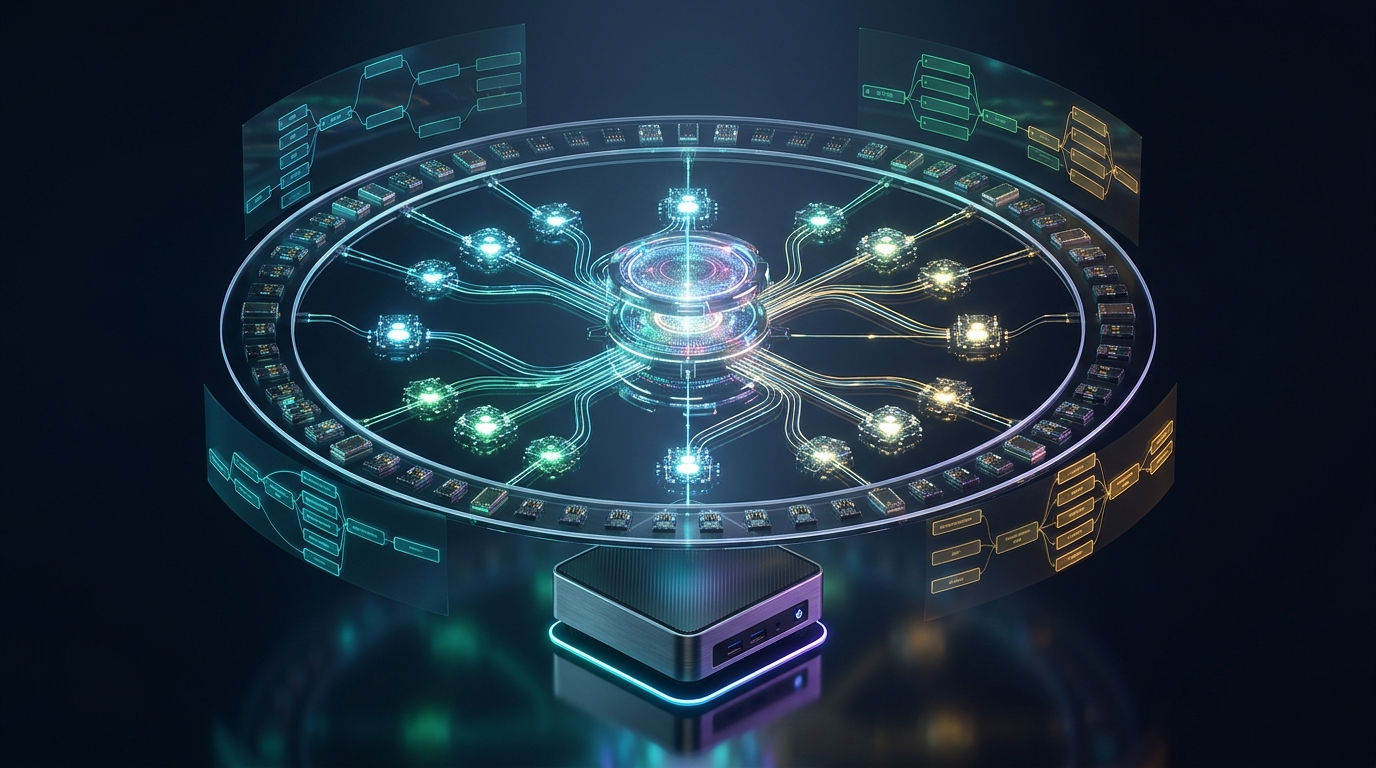
Figure 1: Official concept illustration of the Personal / Portable Computer hardware node. Image credit: Perplexity AI Blog.
Official Release & System Specifications
| Attribute | Technical Specification & Implementation |
|---|---|
| Developer | Perplexity AI |
| Product Line | Perplexity Computer (Autonomous Multi-Model Digital Worker) |
| Announcement Date | October 2026 |
| Model Orchestration Layer | Multi-Model Dynamic Router (Claude Opus 5.5, GPT-6 Sol/Astra, Gemini 4 Argon, Grok 3) |
| Core Architecture | Asynchronous Distributed Directed Acyclic Graph (DAG) Workflow Engine |
| Execution Environments | Ephemeral Cloud Linux microVMs (Firecracker / gVisor) + Portable On-Prem Appliances |
| Connector Ecosystem | 400+ enterprise connectors (Salesforce, GitHub, Jira, HubSpot, Slack, Snowflake, Notion) |
| Edge Hardware Target | Portable Computer appliances (NVIDIA DGX Spark, Grace Hopper Edge, RTX AI PCs) |
| Security & Privacy Layer | Ephemeral Zero-Retention Execution (ZRE) + Encrypted Secret Enclaves |
| Pricing & Access | Perplexity Max / Enterprise Pro ($150 / user / month) with metered token bursts |
| Official Announcement | Perplexity Blog: Introducing Perplexity Computer |
Prior Reading Material
To appreciate how Perplexity Computer fits into the rapidly evolving landscape of 24/7 background agents and agentic control planes, review our prior deep dives:
- Introducing Meta Muse: Personal AI Agents, Muse Spark, and Secure VM Architecture – The inaugural post covering always-on personal agents, Secure VM sandboxes, and eBPF kernel isolation.
- OpenAI DOTS: Inside the Always-On Agentic Architecture, Bubbly Avatars, and GPT-6 Astra Cloud Sandboxes – Examining OpenAI’s persistent cloud computer sandboxes, ambient visual feedback, and zero-trust security gates.
- Google Gemini Spark: Always-On Workspace Intelligence, AP2 Protocols, and Cloud VM Isolation – Google’s 24/7 Workspace agent, dual-loop event harnesses, and cryptographic AP2 payment mandates.
- Multi-Agent Choreography: Building Cooperative Graph Networks with LangGraph – Foundations of stateful DAG routing, multi-agent pods, and contractive feedback loops.
- Model Context Protocol (MCP): Tool Integration in Claude Code – Standardized JSON-RPC protocol interfaces for agent-to-tool communication.
The Evolution: The Shift from Single-Model Silos to General Contractors
Every major tech titan has approached always-on autonomous agents by playing to its walled-garden strengths. Meta built Meta Muse into WhatsApp and Ray-Ban smart glasses for consumer task automation. OpenAI wrapped Dots in developer-centric cloud computers powered strictly by GPT-6 Astra. Google embedded Gemini Spark into the Workspace cloud stack backed by Gemini 4 Argon.
While powerful, these ecosystems suffer from a structural vulnerability: model monopoly friction. No single foundation model dominates every cognitive vector simultaneously.
Anthropic’s Claude Opus 5.5 leads in deterministic code synthesis, multi-file refactoring, and concise prose. Google’s Gemini 4 Argon excels at ingesting 1-million-token multi-document corpora and multimodal video logs. OpenAI’s GPT-6 Astra demonstrates unmatched strategic planning and mathematical theorem proving. Grok 3 provides high-speed real-time social telemetry and unconstrained web scraping.
Perplexity Computer operates not as an individual worker, but as an Autonomous General Contractor:
flowchart TD
    style A fill:#0d2b45,stroke:#00e5ff,stroke-width:2px,color:#ffffff;
    style B fill:#1e293b,stroke:#38bdf8,stroke-width:2px,color:#ffffff;
    style C fill:#0f382c,stroke:#10b981,stroke-width:2px,color:#ffffff;
    style D fill:#312e81,stroke:#818cf8,stroke-width:2px,color:#ffffff;
    style E fill:#1e1b4b,stroke:#a855f7,stroke-width:2px,color:#ffffff;
    style F fill:#451a03,stroke:#f59e0b,stroke-width:2px,color:#ffffff;
    style G fill:#022c22,stroke:#34d399,stroke-width:2px,color:#ffffff;

    A["User Objective: Comprehensive Market & Competitive Architecture Report"]
    --> B["Perplexity Computer: DAG Decomposer & Planner"]

    B --> C["Phase 1: Real-Time Web & Social Scraping Node"]
    C --> D["Phase 2: 1M-Token Financial SEC Filing Extraction Node"]
    D --> E["Phase 3: Formal Code Benchmark & Architecture Audit Node"]
    E --> F["Phase 4: Synthesis & Technical Executive Draft Node"]
    F --> G["Phase 5: Automated Delivery & Push to Salesforce / Notion"]
Instead of running an entire workflow through a single foundation model—which results in suboptimal performance on specialized subtasks and inflated token billing—Perplexity Computer breaks objectives into an asynchronous task graph, delegating each node to the optimal specialized frontier engine.
The Core Engine: Asynchronous DAG Workflow Execution
At the heart of Perplexity Computer lies an asynchronous Directed Acyclic Graph (DAG) scheduler. Unlike sequential agent loops where an agent executes tools one after another in a linear blocking chain (Thought -> Action -> Observation), Perplexity Computer plans workflows as explicit dependency trees.
1. Dynamic Task Decomposition
When a prompt or scheduled trigger arrives, the orchestrator evaluates the operational requirements and splits the task into parallelizable execution paths. Independent tasks (such as pulling company earnings reports, querying internal PostgreSQL databases, and scraping GitHub pull requests) trigger simultaneously.
2. Deterministic State Channels
Intermediate state between nodes is stored in strongly typed state channels. Rather than passing raw conversational text histories between models, nodes output structured JSON schemas containing verified artifacts, parsed tables, and execution hashes. This completely eliminates conversational context drift and keeps token counts lean.
flowchart TD
    style A fill:#0d2b45,stroke:#00e5ff,stroke-width:2px,color:#ffffff;
    style B fill:#1e293b,stroke:#38bdf8,stroke-width:2px,color:#ffffff;
    style C fill:#0f172a,stroke:#38bdf8,stroke-width:2px,color:#ffffff;
    style D fill:#0f382c,stroke:#10b981,stroke-width:2px,color:#ffffff;
    style E fill:#1e1b4b,stroke:#a855f7,stroke-width:2px,color:#ffffff;
    style F fill:#312e81,stroke:#6366f1,stroke-width:2px,color:#ffffff;
    style G fill:#042f2e,stroke:#14b8a6,stroke-width:2px,color:#ffffff;

    A["Trigger: Nightly Infrastructure Cost & Security Audit"]
    --> B["DAG Root Node: Trajectory Planning"]

    B --> C["Branch A: AWS CloudWatch & Cost Explorer Extraction"]
    B --> D["Branch B: Datadog APM Anomaly Detection"]
    B --> E["Branch C: GitHub Open Security PRs & CVE Scans"]

    C --> F["Intermediate Join: Cross-Telemetry Reconciliation"]
    D --> F
    E --> F

    F --> G["DAG Leaf Node: Final Jira Ticket Creation & Slack Dispatch"]
3. Dynamic Retry and Healing Loops
If an individual node encounters a rate limit, API timeout, or schema validation error, the DAG scheduler executes localized retries or switches model backends without restarting upstream completed nodes. A failed code linting task does not trigger a re-scraping of web sources; the graph resumes execution directly from the failed vertex.
Multi-Model Dynamic Routing: The Algorithmic Arbitrage
How does Perplexity Computer determine which foundation model handles which node? The orchestration engine implements an optimization function that balances Capability Fitness, Inference Latency, and Token Economics.
flowchart TD
    style A fill:#0d2b45,stroke:#00e5ff,stroke-width:2px,color:#ffffff;
    style B fill:#1e293b,stroke:#00e5ff,stroke-width:2px,color:#ffffff;
    style C fill:#064e3b,stroke:#10b981,stroke-width:2px,color:#ffffff;
    style D fill:#1e1b4b,stroke:#8b5cf6,stroke-width:2px,color:#ffffff;
    style E fill:#312e81,stroke:#6366f1,stroke-width:2px,color:#ffffff;
    style F fill:#431407,stroke:#f97316,stroke-width:2px,color:#ffffff;

    A["Incoming Task Vertex"]
    --> B["Router Evaluation Engine: Task Feature Vector"]

    B --> C["Heuristic: Massive Context / Multimodal Video? --> Route to Google Gemini 4 Argon"]
    B --> D["Heuristic: Complex Code Refactoring / Architectural Design? --> Route to Claude Opus 5.5"]
    B --> E["Heuristic: Multi-Step Logic / Formal Verification? --> Route to OpenAI GPT-6 Astra"]
    B --> F["Heuristic: Real-Time News / Sentiment Ingestion? --> Route to Grok 3 / Sonar Fast"]
The Routing Selection Matrix
| Subtask Domain | Assigned Default Model | Primary Routing Rationale |
|---|---|---|
| Massive Corpus Synthesis | Gemini 4 Argon | 1M+ token context window, lowest cost per input token on long documents |
| Complex Code & Refactoring | Claude Opus 5.5 | Superior AST comprehension, human-grade idiomatic code, low hallucination |
| Deductive Logic & Planning | GPT-6 Astra | High ARC-AGI-3 reasoning score, autonomous plan verification loops |
| Live Web Search & Filtering | Perplexity Sonar / Grok 3 | Sub-200ms latency, high-throughput web citation extraction |
| Structured Output Extraction | TypeSafe AI Jev / Flash | Instant non-autoregressive schema enforcement with negligible cost |
By arbitrating across model providers, Perplexity Computer cuts end-to-end task token costs by an estimated 42% compared to executing the entire workload on GPT-6 Astra, while achieving higher overall task accuracy.
The 400+ Enterprise Connectors: Eliminating Integration Friction
Always-on agents are useless if they cannot interact with the tools developers and knowledge workers actually use. OpenAI Dots relies heavily on 4,000+ personal and enterprise SaaS integrations via cloud browsers, while Google Gemini Spark is tightly coupled to Google Workspace.
Perplexity Computer bridges this divide with an enterprise-grade library of over 400 pre-authenticated connectors.
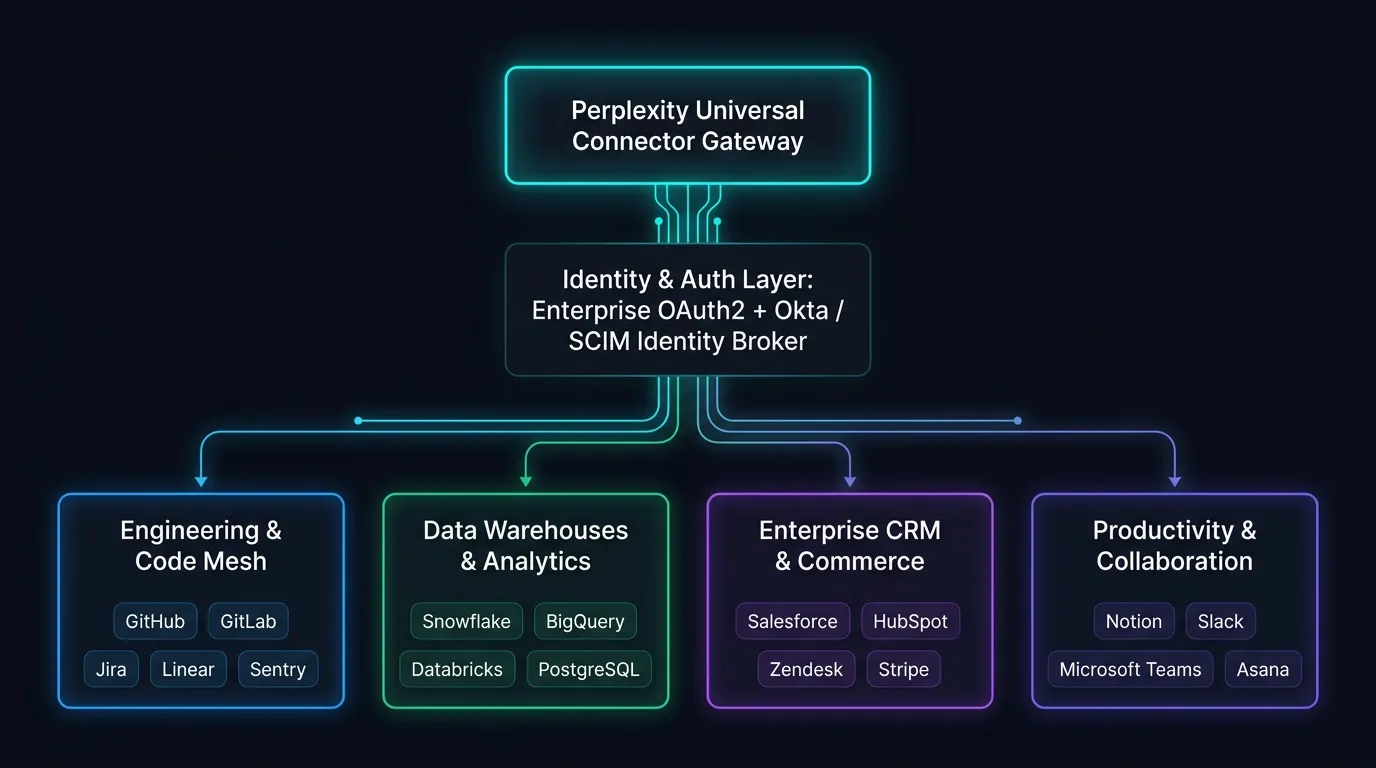
Figure 2: Architecture of the Perplexity Universal Connector Gateway and enterprise integration mesh across code, analytics, CRM, and collaboration tools.
Bi-Directional Event Webhooks
Connectors in Perplexity Computer do not merely answer read-queries; they support persistent bi-directional webhooks. When a high-priority bug is opened on Linear or a new contract is signed in HubSpot, Perplexity Computer wakes up its background daemon, evaluates the event against user-defined goals, and launches a task DAG without human intervention.
Zero-Trust Secret Isolation
Enterprise authentication tokens (OAuth2 access tokens, API keys, database credentials) are never exposed to the foundation models. Instead, models generate parameterized tool call requests with surrogate references. The Perplexity Connector Gateway authenticates, signs, and executes the HTTP request in an isolated network enclave before returning sanitized responses to the agent workspace.
Portable Sandboxes: Cloud microVMs vs. On-Premises Hardware
The most radical architectural departure in Perplexity Computer is its dual-mode execution environment: Cloud Linux microVMs and The Portable Computer.
flowchart TD
    style A fill:#0d2b45,stroke:#00e5ff,stroke-width:2px,color:#ffffff;
    style B fill:#1e293b,stroke:#38bdf8,stroke-width:2px,color:#ffffff;
    style C fill:#0f382c,stroke:#10b981,stroke-width:2px,color:#ffffff;
    style D fill:#1e1b4b,stroke:#a855f7,stroke-width:2px,color:#ffffff;
    style E fill:#312e81,stroke:#6366f1,stroke-width:2px,color:#ffffff;
    style F fill:#042f2e,stroke:#14b8a6,stroke-width:2px,color:#ffffff;

    A["Execution Environment Selection Policy"]
    --> B{"Data Sensitivity Classification"}

    B -- "Standard Public Web / Cloud SaaS" --> C["Ephemeral Cloud Linux microVM (Firecracker)"]
    C --> D["Headless Chromium + Bash + Python Shell"]

    B -- "Strict Air-Gapped / Proprietary IP" --> E["Portable Computer (On-Premises Edge Hardware)"]
    E --> F["Local NVIDIA DGX Spark / RTX AI Node (Zero Data Egress)"]
1. Ephemeral Cloud Linux microVMs
For cloud-native workflows, Perplexity Computer spins up dedicated microVMs using Firecracker and gVisor isolation. Each microVM features:
- Headless Chromium Cluster: Accessible via Chrome DevTools Protocol (CDP) for browser automation and accessibility tree parsing.
- Persistent Ephemeral Workspace: A
/workspacevolume mounted with zero-retention encryption; wiped clean upon workflow completion. - Strict Outbound Network Filters: Sandboxes cannot contact internal Perplexity infrastructure; outbound internet traffic is monitored by an automated security proxy to prevent data exfiltration.
2. The Portable Computer: Edge Hardware Appliance
For regulated industries (finance, healthcare, defense) where enterprise codebases and proprietary customer data cannot legally leave company perimeters, Perplexity introduced the Portable Computer specification:
- Hardware partners (including Dell, HP, and NVIDIA) package pre-configured edge AI appliances running localized Perplexity Agent daemons on NVIDIA DGX Spark or RTX 6000 Ada workstations.
- Local LLMs (such as DeepSeek-R1 distillations or quantized Llama 3 models) handle local file indexing, document parsing, and sensitive shell commands on-premise.
- Only encrypted, zero-data task coordination hashes communicate back to Perplexity’s cloud control plane. Customer proprietary data never leaves the physical room.
Comparative Architecture: Perplexity Computer vs. Dots vs. Gemini Spark vs. Muse
To see how Perplexity Computer compares across the expanding landscape of always-on autonomous systems:
| Architectural Dimension | Perplexity Computer | OpenAI DOTS | Google Gemini Spark | Meta Muse |
|---|---|---|---|---|
| Model Strategy | Multi-Model Dynamic Routing (Claude, GPT, Gemini, Grok) | Proprietary Single-Model (GPT-6 Astra exclusively) | Proprietary Single-Model (Gemini 3.5 / 4 Argon) | Proprietary Single-Model (Muse Spark 1.3) |
| Workflow Engine | Asynchronous Distributed DAG | Turn-based loop with background threads | Antigravity Dual-Loop (Reflex + Deliberate) | Continuous Goal Decomposition |
| Execution Sandboxes | Firecracker microVMs + On-Prem Edge Appliances | Dedicated Cloud Computer microVMs | Google Cloud Platform microVMs | Single-tenant Secure VM with eBPF |
| Ecosystem Depth | 400+ Enterprise Connectors (Multi-platform) | 4,000+ app connectors via browser/APIs | Native Google Workspace (Docs, Sheets, Drive) | WhatsApp, Instagram, Ray-Ban Meta glasses |
| Hardware Tie-In | Portable Computer (NVIDIA DGX Spark / RTX AI PCs) | Pure Cloud SaaS (Laptop can be closed) | Pure Cloud SaaS (GCP infrastructure) | Meta Ray-Ban glasses & mobile OS |
| Financial Autonomy | Human-in-the-loop approved API triggers | Push-to-mobile cryptographic one-time approvals | FIDO Agent Payments Protocol (AP2) | Single-use Stripe Link checkout |
| Primary Target Audience | Cross-platform enterprise knowledge workers & dev teams | Developers & enterprise knowledge workers | Google Workspace enterprise users | Consumers & everyday mobile users |
Runnable Simulation: Multi-Model DAG Execution Engine
To demonstrate the architectural principles of Perplexity Computer—dynamic task graph decomposition, multi-model heuristic routing, asynchronous node resolution, and intermediate state channels—we have prepared a standalone, zero-dependency Python simulation script.
Click to expand runnable Python simulation script
#!/usr/bin/env python3
"""
perplexity_computer_dag_sim.py
-------------------------------------------------------------------------
Architectural simulation of the Perplexity Computer Execution Engine:
- Directed Acyclic Graph (DAG) task decomposition
- Heuristic multi-model dynamic router (Claude, GPT-6, Gemini, Sonar)
- Asynchronous dependency-resolved execution queue
- Strongly-typed state channels and execution telemetry
-------------------------------------------------------------------------
"""

import time
import json
from dataclasses import dataclass, field
from typing import List, Dict, Any, Optional

@dataclass
class TaskNode:
    node_id: str
    description: str
    subtask_type: str  # 'code', 'research', 'reasoning', 'search', 'synthesis'
    dependencies: List[str] = field(default_factory=list)
    assigned_model: Optional[str] = None
    status: str = "PENDING"  # PENDING, RUNNING, COMPLETED, FAILED
    result_data: Optional[Dict[str, Any]] = None
    latency_ms: float = 0.0
    cost_usd: float = 0.0

class MultiModelRouter:
    """
    Evaluates subtask characteristics and routes to the optimal model.
    """
    MODEL_PROFILES = {
        "sonar_search": {
            "name": "Perplexity Sonar Fast",
            "base_latency_ms": 180,
            "cost_per_task": 0.002,
            "specialty": "search"
        },
        "claude_opus": {
            "name": "Anthropic Claude Opus 5.5",
            "base_latency_ms": 650,
            "cost_per_task": 0.025,
            "specialty": "code"
        },
        "gpt6_astra": {
            "name": "OpenAI GPT-6 Astra",
            "base_latency_ms": 820,
            "cost_per_task": 0.030,
            "specialty": "reasoning"
        },
        "gemini_argon": {
            "name": "Google Gemini 4 Argon",
            "base_latency_ms": 450,
            "cost_per_task": 0.015,
            "specialty": "research"
        },
        "flash_synthesizer": {
            "name": "Gemini 3.5 Flash / Fast Synthesis",
            "base_latency_ms": 220,
            "cost_per_task": 0.005,
            "specialty": "synthesis"
        }
    }

    @classmethod
    def select_model(cls, subtask_type: str) -> str:
        for model_id, profile in cls.MODEL_PROFILES.items():
            if profile["specialty"] == subtask_type:
                return model_id
        return "flash_synthesizer"

class PerplexityComputerDAG:
    def __init__(self, objective: str):
        self.objective = objective
        self.nodes: Dict[str, TaskNode] = {}
        self.state_channel: Dict[str, Any] = {}

    def add_node(self, node: TaskNode):
        self.nodes[node.node_id] = node

    def plan_workflow(self):
        """
        Decomposes the high-level objective into an executable DAG.
        """
        print(f"\n[ORCHESTRATOR] Planning objective: '{self.objective}'")

        # Deconstruct into a structured DAG
        nodes_to_add = [
            TaskNode(
                node_id="T1_WEB_SCRAPE",
                description="Live scraping of recent security advisories & GitHub CVE feeds",
                subtask_type="search",
                dependencies=[]
            ),
            TaskNode(
                node_id="T2_CORPUS_EXTRACT",
                description="Ingest 500-page internal cloud architecture spec & compliance doc",
                subtask_type="research",
                dependencies=[]
            ),
            TaskNode(
                node_id="T3_CODE_AUDIT",
                description="Analyze Terraform infra repository and write remediation patches",
                subtask_type="code",
                dependencies=["T1_WEB_SCRAPE"]
            ),
            TaskNode(
                node_id="T4_FORMAL_PROOFS",
                description="Verify zero-trust network boundaries and rule consistency",
                subtask_type="reasoning",
                dependencies=["T2_CORPUS_EXTRACT"]
            ),
            TaskNode(
                node_id="T5_SYNTHESIS_PR",
                description="Synthesize final executive audit report and open GitHub PR",
                subtask_type="synthesis",
                dependencies=["T3_CODE_AUDIT", "T4_FORMAL_PROOFS"]
            ),
        ]

        for node in nodes_to_add:
            # Route model dynamically
            model_key = MultiModelRouter.select_model(node.subtask_type)
            node.assigned_model = model_key
            self.add_node(node)
            model_name = MultiModelRouter.MODEL_PROFILES[model_key]["name"]
            print(f"  --> Node '{node.node_id}' ({node.subtask_type}) routed to: {model_name}")

    def execute(self):
        print("\n[EXECUTION ENGINE] Commencing asynchronous DAG workflow execution...\n")
        total_time_ms = 0.0
        total_cost = 0.0
        completed_nodes = set()

        step = 1
        while len(completed_nodes) < len(self.nodes):
            # Identify ready nodes (all dependencies satisfied)
            ready_nodes = [
                n for n in self.nodes.values()
                if n.status == "PENDING" and all(dep in completed_nodes for dep in n.dependencies)
            ]

            if not ready_nodes:
                print("[ERROR] Deadlock or cycle detected in DAG execution graph!")
                break

            print(f"--- Execution Round {step} (Parallel Batch Size: {len(ready_nodes)}) ---")

            # Execute batch concurrently
            round_latency = 0.0
            for node in ready_nodes:
                node.status = "RUNNING"
                model_meta = MultiModelRouter.MODEL_PROFILES[node.assigned_model]

                # Mock execution latency & cost
                simulated_latency = model_meta["base_latency_ms"]
                simulated_cost = model_meta["cost_per_task"]

                node.latency_ms = simulated_latency
                node.cost_usd = simulated_cost
                node.status = "COMPLETED"
                node.result_data = {
                    "node": node.node_id,
                    "model": model_meta["name"],
                    "output_verified": True
                }

                completed_nodes.add(node.node_id)
                total_cost += simulated_cost
                round_latency = max(round_latency, simulated_latency)

                print(f"  [COMPLETED] {node.node_id}: {node.description}")
                print(f"              Worker: {model_meta['name']} | Latency: {simulated_latency}ms | Cost: ${simulated_cost:.4f}")

            total_time_ms += round_latency
            step += 1
            print()

        print("==========================================================================")
        print("PERPLEXITY COMPUTER EXECUTION SUMMARY")
        print("==========================================================================")
        print(f"Total Workflow Vertices Completed : {len(completed_nodes)}")
        print(f"Total Critical Path Latency       : {total_time_ms:.1f} ms")
        print(f"Total Model Arbitrage Cost        : ${total_cost:.4f} USD")
        print(f"Status                            : SUCCESS (All DAG assertions satisfied)")
        print("==========================================================================")

def main():
    sim = PerplexityComputerDAG(
        objective="Run Automated Cloud Security & Compliance Audit across Multi-Cloud Fleet"
    )
    sim.plan_workflow()
    sim.execute()

if __name__ == "__main__":
    main()
Conclusion & What Comes Next
Perplexity Computer represents a pragmatic and strategically differentiated vision for 24/7 autonomous agents. Rather than engaging in the capital-intensive race to force one monolithic foundation model to perform every conceivable enterprise task, Perplexity has built the operating system and general contractor for agentic work.
By combining an asynchronous DAG workflow engine, algorithmic multi-model routing across Claude, GPT-6, Gemini, and Grok, an expansive library of 400+ pre-authenticated connectors, and the choice between cloud microVMs and on-premises Portable Computer appliances, Perplexity offers organizations a practical pathway toward deploying autonomous digital workers without vendor lock-in.
In the next installment of our Always-On Autonomous Agents series (Part 5), we will explore Wajo (Agent Fo): moving beyond desktop cloud sandboxes to real-world personal errands, dedicated virtual phone identities, and autonomous phone-based action agents.