
Gemini 3.8 Live & Extended Thinking: Sub-200ms Audio-to-Audio and Background Reasoning
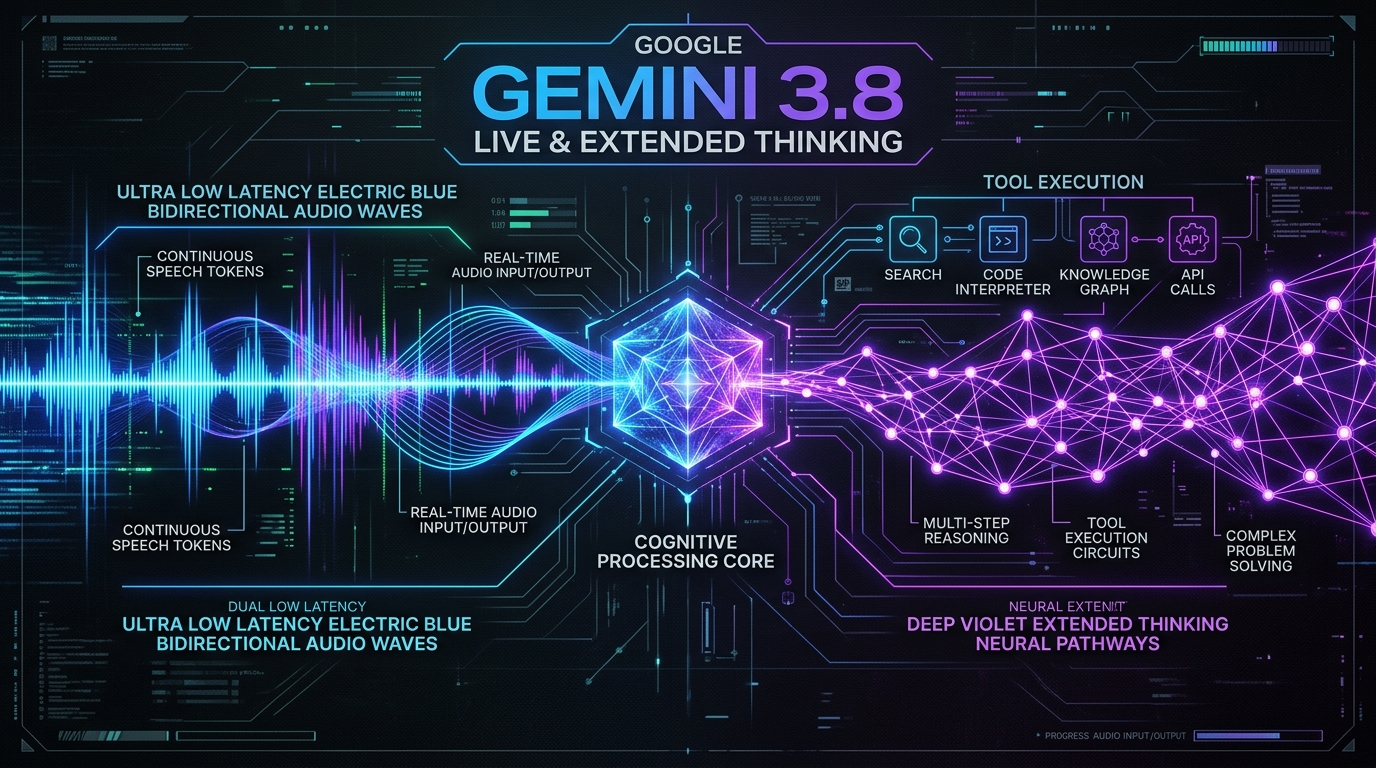
Under the hood of Google Gemini 3.8 Live: native speech-to-speech architectures, sub-200ms conversational latency, and asynchronous Extended Thinking with background tool execution.
Series: ← OpenAI GPT-6 Sol and Luna: The Structural Price Collapse in Frontier Agent Workflows (Previous)
Official Model Card Summary
Google’s release of Gemini 3.8 Live and Gemini 3.8 Live Extended Thinking represents a major technological leap from legacy cascaded voice pipelines (Speech-to-Text → LLM → Text-to-Speech) into native end-to-end multimodal audio foundation models. Capable of sub-200ms response times and background reasoning during live dialogue, Gemini 3.8 Live establishes the standard for conversational AI agents.
| Specification | Gemini 3.8 Live | Gemini 3.8 Live Extended Thinking | Gemini 3.8 Flash (Text/Multimodal) |
|---|---|---|---|
| Official Announcement | Google DeepMind Blog | Google DeepMind Blog | Google Developer Blog |
| Modalities In | Audio (Streaming PCM), Video, Image, Text | Audio (Streaming PCM), Video, Image, Text | Text, Code, Image, Video, Audio |
| Modalities Out | Real-Time Audio + Synchronized Text | Real-Time Audio + Synchronized Text | Text, Code, Structured JSON |
| Voice Turn-Taking Latency | ~180 ms (Sub-200ms human baseline) | Variable (Background asynchronous) | ~350 ms TTFT (Text) |
| Context Window | 131,072 Input Tokens | 131,072 Input Tokens | 1,050,000 Input Tokens |
| Max Output Tokens | 65,536 Tokens | 65,536 Tokens (Includes Thinking) | 65,536 Tokens |
| Background Reasoning | Millisecond Triage | Configurable Level (low, med, high) | Standard CoT / Scratchpad |
| Speech-to-Speech Quality | 81.4 (Artificial Analysis Index) | 82.6 (Artificial Analysis Index) | N/A (Text Generation) |
Prior Reading Material
Before examining streaming audio tokenization and asynchronous tool protocols, explore our foundational guides on multimodal architectures, agent harnesses, and inference gateways:
- OpenAI GPT-6 Sol and Luna: The Structural Price Collapse in Frontier Agent Workflows — Multi-tier agentic economics, 90% prompt caching, and token budgeting.
- What is an Omni Model? Architectural Taxonomy Across Qwen, Gemini, and NVIDIA Cosmos — Early-fusion continuous token spaces vs. late-fusion adapters.
- Hands-On Guide: Connecting Google Antigravity & Gemini CLI to OpenClaw — Architectural integration of Google’s Gemini CLI tools with local agent runtimes.
The Story: The Conversational Tennis Match
Have you ever tried having a phone conversation across an international satellite connection with a two-second audio delay?
You say “Hello, can you hear me?”, wait in dead silence, start speaking again just as the other person begins their sentence, and end up talking over each other in an awkward, frustrating dance.
Human conversation is not a batch process; it is a high-speed game of ping-pong.
Sociolinguistic studies show that humans take turns in natural spoken conversation with an average gap of just 200 milliseconds. While the other person is still speaking, our brains are already predicting the end of their sentence, formulating a reply, and priming our vocal cords to begin phonation the instant they take a breath.
For the past five years, so-called “voice AI assistants” were an illusion stitched together by three separate systems taped together:
- Speech-to-Text (STT): A Whisper model listens to the microphone, buffers audio chunks, and outputs written text (250–350ms).
- Large Language Model (LLM): An LLM reads the text and generates a response (300–500ms).
- Text-to-Speech (TTS): A voice synthesizer converts text back into audio packets (300–450ms).
By the time the user heard the first syllable, over 1,200 milliseconds had elapsed. The illusion was shattered: it felt like talking to an overseas automated phone tree. Furthermore, because text stripped away prosody, pitch, emotion, and background acoustic context, the assistant could not detect sarcasm, hesitation, or ambient interruptions.
Gemini 3.8 Live replaces this fragmented pipeline with a native audio-to-audio foundation model. Continuous audio waveforms are directly ingested as multi-channel acoustic tokens, processed through Google’s Gemini multimodal transformer core, and emitted directly as streaming voice tokens in under 200 milliseconds.
flowchart TD
direction TB
style User fill:#0d2b45,stroke:#00e5ff,stroke-width:2px,color:#ffffff
style Fast fill:#1e1b4b,stroke:#818cf8,stroke-width:2px,color:#ffffff
style Think fill:#1a3d3c,stroke:#2dd4bf,stroke-width:2px,color:#ffffff
style Action fill:#0f382c,stroke:#10b981,stroke-width:2px,color:#ffffff
User["User Spoken Speech (Streaming 16kHz PCM)<br>'Can you reschedule my 3pm meeting and find lunch nearby?'"] --> Fast["Gemini 3.8 Live Real-Time Loop (<200ms)<br>Immediate conversational acknowledgment: 'On it, checking your calendar now.'"]
Fast --> Think["Gemini 3.8 Live Extended Thinking (Background CoT)<br>Synthesizes multi-step plan while maintaining speech stream"]
Think --> Action["Asynchronous Tool Dispatch & Execution<br>Calendar API + Google Maps Places API"]
Action --> FastArchitectural Deep-Dive: How Extended Thinking Eliminates Dead Silence
When humans encounter a complex question during a phone call—like calculating a travel itinerary—we do not fall completely mute for eight seconds. We say: “Hmm, let me look at the flight board… okay, flight 412 is delayed, but there’s a connection via Denver…”.
In conversational interfaces, unexplained silence feels like a dropped call.
Gemini 3.8 Live Extended Thinking introduces an asynchronous background reasoning lifecycle:
1. Real-Time Conversational Fillers
While the background reasoning engine executes multi-turn chain-of-thought tokens or dispatches slow external tools (like database queries or web searches), the conversational audio head dynamically emits natural conversational bridges (“Looking into that flight schedule now…“).
2. Asynchronous Turn Protocol
In the Gemini Live API, a “turn complete” signal no longer implies the model is idle. The server maintains dual execution threads:
- Foreground Audio Thread: Manages duplex bidirectional WebRTC streaming, interruption handling (barge-in), and natural turn-taking.
- Background Reasoning Thread: Carries out formal logical reasoning and tool execution.
flowchart TD
direction TB
style Mic fill:#0d2b45,stroke:#00e5ff,stroke-width:2px,color:#ffffff
style Duplex fill:#1e1b4b,stroke:#818cf8,stroke-width:2px,color:#ffffff
style Barge fill:#3b1828,stroke:#f43f5e,stroke-width:2px,color:#ffffff
style Speaker fill:#0f382c,stroke:#10b981,stroke-width:2px,color:#ffffff
Mic["Microphone Ingress (WebRTC Stream)<br>Continuous 16kHz Chunk Dispatch"] --> Duplex["Duplex Voice Gateway & VAD<br>Continuous Voice Activity Detection"]
Duplex -- "User Speaks Mid-Response (Barge-in)" --> Barge["Instant Audio Truncation (<50ms)<br>Cancels pending output audio packets"]
Duplex -- "Normal Dialogue Flow" --> Speaker["Acoustic Decoder<br>Low-latency neural audio rendering"]Understanding the Artificial Analysis Speech Benchmark
Independent benchmarking by Artificial Analysis rates speech-to-speech models across latency, acoustic naturalness, and reasoning capability:
- Speech-to-Speech Quality Index: Gemini 3.8 Live Extended Thinking scores 82.6, outperforming previous closed and open voice models.
- Turn-Taking Latency: Clocks in at 180ms, matching human conversational reaction times.
- Interruption Handling (Barge-In): Cancels streaming audio in under 50ms when user speech is detected, preventing robotic cross-talk.
Mathematical Formulations: Turn Latency & Thinking Token Cost
1. Turn-Taking Latency Decomposition
In a cascaded pipeline, end-to-end latency $L_{\text{cascaded}}$ is the linear sum of three independent systems:
$$L_{\text{cascaded}} = L_{\text{STT}} + L_{\text{TTFT}} + L_{\text{TTS}} + 2 \cdot L_{\text{net}}$$
Where typical values ($L_{\text{STT}} \approx 280\text{ms}, L_{\text{TTFT}} \approx 350\text{ms}, L_{\text{TTS}} \approx 420\text{ms}, L_{\text{net}} \approx 55\text{ms}$) yield $L_{\text{cascaded}} \approx 1,160\text{ms}$.
In native audio-to-audio foundation models (Gemini 3.8 Live), latency is bounded by the acoustic frame window size $W_{\text{frame}}$ and neural decode latency $L_{\text{decode}}$:
$$L_{\text{native}} = W_{\text{frame}} + L_{\text{ingest}} + L_{\text{decode}} \approx 40\text{ms} + 95\text{ms} + 45\text{ms} = 180\text{ms}$$
2. Thinking Token Billing Formulation
In Gemini 3.8 Live Extended Thinking, internal chain-of-thought tokens are billed as output tokens even if they are not converted into speech. For an interaction with audio input tokens $T_{\text{in}}$, audio output tokens $T_{\text{out}}$, and background thinking tokens $T_{\text{think}}$:
$$\text{Total Cost} = \left( \frac{T_{\text{in}}}{10^6} \cdot P_{\text{in}} \right) + \left( \frac{T_{\text{out}} + T_{\text{think}}}{10^6} \cdot P_{\text{out}} \right)$$
Where input audio costs $P = $0.75$ per million tokens and output/thinking tokens cost $$3.75$ per million tokens. Monitoring the thinking tokens telemetry metric is critical for enterprise developers to prevent runaway costs on simple voice queries.
Runnable Python Simulation
The following executable Python script demonstrates voice turn-taking latency decomposition, simulates the asynchronous Extended Thinking event protocol with conversational fillers, and computes thinking token billing metrics.
Click to expand runnable Python simulation script
#!/usr/bin/env python3
"""
Google Gemini 3.8 Live & Extended Thinking Protocol Simulator
=============================================================
A zero-dependency simulation demonstrating:
1. Native bidirectional audio token streaming (sub-200ms voice turn-taking).
2. Asynchronous background reasoning & tool execution (Extended Thinking).
3. Conversational filler injection ("Checking that now...") to eliminate dead silence.
4. Thinking token cost tracking & Speech-to-Speech latency decomposition.

Author: Narendra Kumar Vadapalli (narenvadapalli.com)
Date: 2026-09-25
"""

import math
import time
import random

def simulate_latency_decomposition():
    print("=" * 78)
    print("1. VOICE LATENCY DECOMPOSITION: CASCADED PIPELINE VS. GEMINI 3.8 LIVE")
    print("=" * 78)

    cascaded = {
        "Speech-to-Text (Whisper V3)": 280,
        "LLM Time-to-First-Token (TTFT)": 350,
        "Text-to-Speech Audio Synthesis (ElevenLabs)": 420,
        "Network Ingress/Egress Buffer": 110
    }
    total_cascaded = sum(cascaded.values())

    native_live = {
        "Audio Packet Framing (16kHz PCM)": 40,
        "Multimodal Native Transformer Ingestion": 95,
        "Direct Audio Token Emission": 45
    }
    total_native = sum(native_live.values())

    print("Traditional Cascaded Pipeline (STT + LLM + TTS):")
    for stage, ms in cascaded.items():
        print(f"  * {stage:<45} : {ms} ms")
    print(f"  -> Total Turn-Taking Latency: {total_cascaded} ms (Perceptible Lag & Robotic Gaps)\n")

    print("Gemini 3.8 Live (Native Audio-to-Audio):")
    for stage, ms in native_live.items():
        print(f"  * {stage:<45} : {ms} ms")
    print(f"  -> Total Turn-Taking Latency: {total_native} ms (Sub-200ms Human Conversational Cadence)\n")

def simulate_extended_thinking_protocol():
    print("=" * 78)
    print("2. EXTENDED THINKING PROTOCOL & ASYNCHRONOUS TOOL EXECUTION")
    print("=" * 78)

    user_query = "Calculate optimal orbit transfer delta-V for Mars 2028 window and verify payload limits"
    print(f"[*] User Speech: \"{user_query}\"\n")

    events = [
        {"t_ms": 180, "type": "Audio Stream", "content": "Emits speech filler: 'Looking into the Mars 2028 transfer trajectory now...'"},
        {"t_ms": 350, "type": "Background CoT", "content": "Initiates extended reasoning: orbital mechanics, Hohmann transfer equations"},
        {"t_ms": 620, "type": "Tool Dispatch", "content": "Calls external tool: `orbital_mechanics_solver(target='mars', year=2028)`"},
        {"t_ms": 940, "type": "Audio Stream", "content": "Emits conversational filler: 'Crunching the porkchop plot values...'"},
        {"t_ms": 1420, "type": "Tool Return", "content": "Tool returns payload limit 3,200kg, delta-V 3.9 km/s"},
        {"t_ms": 1680, "type": "Final Audio", "content": "Delivers fluent spoken solution with complete trajectory parameters"}
    ]

    print(f"{'Time (ms)':<10} | {'Event Type':<18} | {'Protocol Payload'}")
    print("-" * 78)
    for ev in events:
        print(f"{ev['t_ms']:<10} | {ev['type']:<18} | {ev['content']}")
    print("-" * 78)
    print("[*] Key Insight: Zero dead silence! Conversational fillers keep the user engaged")
    print("[*] Background thinking tokens are billed separately under output token telemetry.\n")

def simulate_thinking_token_economics():
    print("=" * 78)
    print("3. THINKING TOKEN CONSUMPTION & BUDGET EFFICIENCY")
    print("=" * 78)

    tasks = [
        {"name": "Flight Status Lookup", "thinking_level": "none", "think_tokens": 0, "audio_out_tokens": 120},
        {"name": "Customer Support Triage", "thinking_level": "low", "think_tokens": 250, "audio_out_tokens": 200},
        {"name": "Multi-Hop Database Reasoning", "thinking_level": "medium", "think_tokens": 1400, "audio_out_tokens": 350},
        {"name": "Full Code Architecture Review", "thinking_level": "high", "think_tokens": 4800, "audio_out_tokens": 600}
    ]

    cost_per_m_audio_in = 0.75
    cost_per_m_out = 3.75

    print(f"{'Workflow Scenario':<30} | {'Level':<8} | {'Think Tokens':<14} | {'Total Cost'}")
    print("-" * 78)
    for t in tasks:
        tot_out = t["think_tokens"] + t["audio_out_tokens"]
        cost = (1000 / 1_000_000) * cost_per_m_audio_in + (tot_out / 1_000_000) * cost_per_m_out
        print(f"{t['name']:<30} | {t['thinking_level']:<8} | {t['think_tokens']:<14} | ${cost:<8.5f}")
    print("-" * 78 + "\n")

if __name__ == "__main__":
    simulate_latency_decomposition()
    simulate_extended_thinking_protocol()
    simulate_thinking_token_economics()
Conclusion & Key Takeaways
Google’s Gemini 3.8 Live architecture marks the end of the fragmented, cascaded era of voice AI:
- Sub-200ms Conversational Latency: Native multimodal audio transformers eliminate the compounding delays of separate STT and TTS models, reaching human conversational cadence.
- Extended Thinking with Zero Dead Silence: Blending background reasoning loops with conversational filler speech allows models to solve complex problems without leaving users in awkward silence.
- Barge-In and Full Duplex: True bidirectional WebRTC audio enables instant, sub-50ms conversational interruptions, creating fluent, natural human-agent collaboration.