NVIDIA Colang 2.0: Event-Driven Conversational Modeling, Asynchronous Flow Orchestration, and UMIM Architecture
Master NVIDIA Colang 2.0. Explore event-driven dialog orchestration, UMIM multimodal interaction loops, asynchronous flows, and dynamic LLM generation.
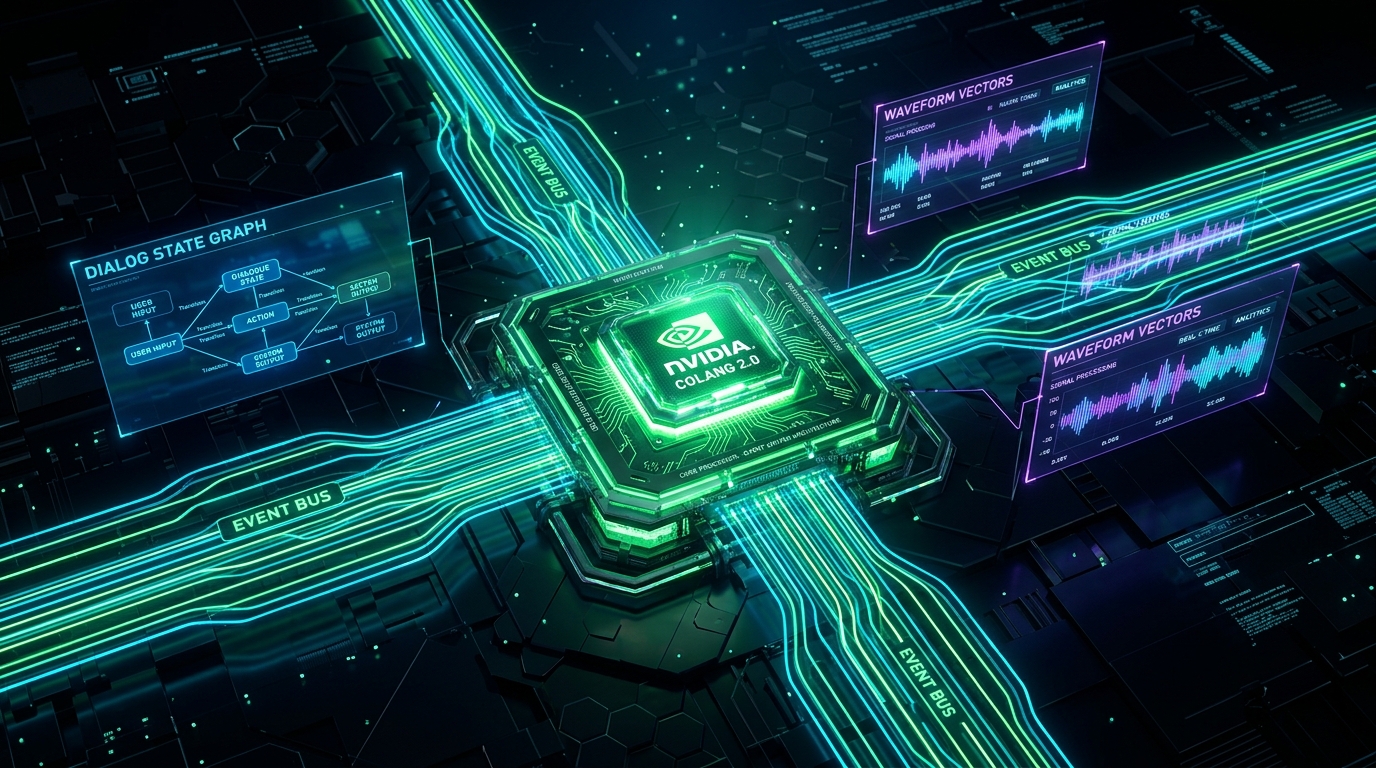
Series: Autonomous AI Agents & Frameworks Series - Part 10
Series: ← Part 9: NVIDIA NeMo Guardrails: Programmable Agent Safety and Colang 2.0 Workflows (Previous)
Prior Reading Material
Before diving into event-driven dialog modeling and asynchronous flow execution, explore our foundational deep-dives on conversational guardrails, state graphs, and enterprise agent serving:
- Part 9: NVIDIA NeMo Guardrails: Programmable Agent Safety and Colang 2.0 Workflows — Enterprise alignment, programmable perimeter rails, semantic topic fencing, and runtime tool validation.
- Part 8: Human-in-the-Loop & State Time-Travel in LangGraph — Breakpoints, durable state snapshots, and human-in-the-loop governance.
- Part 7: Multi-Agent Choreography: Building Cooperative Graph Networks with LangGraph — Managing state schemas, channel reducers, and multi-agent coordination.
- Part 15: NVIDIA NIM: Containerized Enterprise GenAI Serving Architecture — Containerized runtime serving with hardware profiling.
The Air Traffic Controller Analogy
Traditional conversational AI operates like a series of telephone calls: one party speaks, the other listens, processes in isolation, and replies. In a simple customer support widget, this synchronous request-response turn-taking works fine. But modern autonomous agents, interactive 3D avatars, and physical robots do not live in a quiet room with turn-taking phone calls.
Imagine an Air Traffic Control (ATC) Tower during a thunderstorm. The controller cannot freeze the entire sky while composing a radio transmission to Flight 402. Radar pings arrive every second (sensor data), wind shear alerts fire asynchronously (environmental alarms), ground crews report runway obstructions (tool responses), and pilots interrupt mid-sentence (voice barge-in). The tower operates on a unified event bus: incoming telemetry signals trigger immediate safety protocols, while long-running aircraft taxi maneuvers proceed in the background without blocking runway departures.
flowchart TD
    classDef busStyle fill:#0d2b45,stroke:#00e5ff,stroke-width:2px,color:#ffffff;
    classDef procStyle fill:#1a3d3c,stroke:#10b981,stroke-width:2px,color:#ffffff;
    classDef alertStyle fill:#3d1a24,stroke:#f43f5e,stroke-width:2px,color:#ffffff;
    classDef actionStyle fill:#1e1e38,stroke:#818cf8,stroke-width:2px,color:#ffffff;

    A["External Data Ingress<br/>(Audio Stream / Camera Feeds / Sensors)"]:::busStyle
    --> B["Sensor Servers<br/>(Feature Extraction & Event Tokenization)"]:::busStyle

    B --> C["Common Event Channel<br/>(Unified Bus: UserUtterance, GazeVector, SilenceEvent)"]:::procStyle

    C --> D["Colang 2.0 Interpreter<br/>(Interaction Manager: Active Flow Matching Engine)"]:::procStyle

    D --> E{"Pattern Condition Gate<br/>(when / or when Matching)"}:::alertStyle

    E -->|Interrupt / Barge-In| F["Preempt Active Utterance<br/>(Send StopBotAction)"]:::alertStyle
    E -->|Concurrent Action| G["Start Non-Blocking Flow<br/>(start GestureAction)"]:::actionStyle
    E -->|Blocking Execution| H["Await External Service<br/>(await DatabaseQueryAction)"]:::actionStyle

    F --> I["Action Servers<br/>(TTS, Avatar Animation, Motor Control)"]:::actionStyle
    G --> I
    H --> I
This is precisely the design philosophy behind NVIDIA Colang 2.0. While Colang 1.0 focused primarily on static guardrailing rules in text-based chatbots, Colang 2.0 re-engineers the language into a full-fledged asynchronous, event-driven dialog orchestration grammar. It treats user utterances, tool completions, avatar gestures, and vision tokens as unified, strongly-typed events evaluated over a continuous timeline.
The Interactive System Architecture
Under the hood, Colang 2.0 powers the Interaction Manager inside NVIDIA’s multimodal system architecture (such as the NVIDIA Avatar Cloud Engine, or ACE). The Colang interpreter sits squarely between perceptual sensor ingestion and physical or graphical actuation:
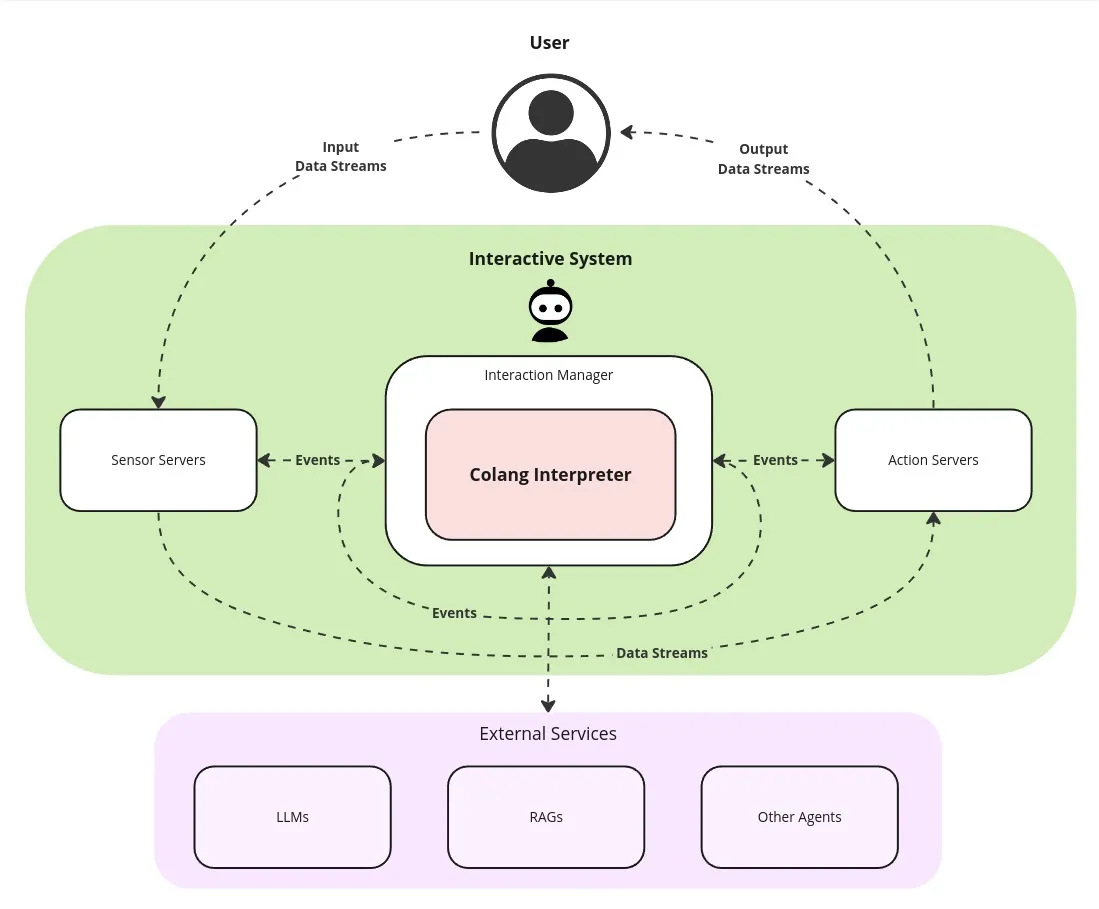
As shown in the official NVIDIA system schema above:
- Sensor Servers: Ingest high-bandwidth input streams (raw audio buffers, video frames from cameras, sensor arrays) and distill them into lightweight, discrete Events (e.g.,
UtteranceUserActionFinished(final_transcript="Hello"),UserGestureDetected(gesture="wave")). - Interaction Manager (Colang Interpreter): Subscribes to the common event channel. It continuously evaluates incoming events against active flows, manages conversation state, schedules concurrent tasks, and invokes external services.
- Action Servers: Listen for action initiation events emitted by the Colang runtime (e.g.,
StartUtteranceBotAction(script="Welcome!"),StartGestureBotAction(gesture="nod")), driving TTS synthesis, facial blendshapes, or robotic joint motors. - External Services: LLMs, vector search databases (RAG), and external tool APIs connect via standardized async adapters, enabling the interpreter to offload generative tasks or semantic classification without stalling real-time interaction loops.
The Paradigm Shift: Colang 1.0 vs. Colang 2.0
To understand why Colang 2.0 represents a leap forward, consider how the language was refactored:
| Dimension | Colang 1.0 | Colang 2.0 | Architectural Benefit |
|---|---|---|---|
| Execution Model | Synchronous, turn-blocking | Asynchronous event loop (await & start) | Enables non-blocking background tasks and parallel multimodal actions |
| Program Entry Point | Implicit (all flows active by default) | Explicit flow main with deliberate activate | Drastically reduces state graph complexity and unintended flow activation |
| Scope & Variables | All variables global by default | Local by default; explicit global $var | Prevents variable pollution across concurrent conversational threads |
| Core Primitives | Rigid define user ... and define bot ... | Low-level send <Event> and match <Event> | Treats text, voice barge-in, gestures, and timers with identical syntax |
| Branching Semantics | Sequential when / else when | Event-driven concurrent when / or when / else | Evaluates racing multimodal events simultaneously |
| Modality Support | Primarily text-based chat | UMIM (Unified Multimodal Interaction Management) | Seamless orchestration of avatars, voice, gaze, and robotics |
| Dynamic Generation | Rigid template substitution | Generation Operator (...) for dynamic LLM flows | Allows LLMs to synthesize natural language flows at runtime |
Event Primitives: Generation and Matching
At its foundational layer, Colang 2.0 scripts operate as event pattern matchers. All events follow PascalCase naming and carry structured parameter dictionaries:
# Bot speech utterance initiation
StartUtteranceBotAction(script="Security clearance verified.", intensity=1.0)

# Final user transcription event emitted by ASR sensor server
UtteranceUserActionFinished(final_transcript="Open the vault door.")

# Multimodal perception event emitted by facial tracking server
UserGazeStarted(target="screen", duration_ms=450)
Colang programs interact with these events through two primary statements: send and match.
flowchart TD
    classDef matchStyle fill:#0d2b45,stroke:#00e5ff,stroke-width:2px,color:#ffffff;
    classDef sendStyle fill:#1e1e38,stroke:#818cf8,stroke-width:2px,color:#ffffff;
    classDef evalStyle fill:#1a3d3c,stroke:#10b981,stroke-width:2px,color:#ffffff;

    M1["match Statement Registered<br/>match UtteranceUserActionFinished(final_transcript=$text)"]:::matchStyle
    --> E1["Event Arrival on Bus<br/>UtteranceUserActionFinished(final_transcript='Open door', speaker_id=1)"]:::evalStyle

    E1 --> P1{"Partial Match Check:<br/>Are specified parameters identical?"}:::evalStyle

    P1 -->|Yes: Subset Matches| B1["Bind Local Variables<br/>$text = 'Open door'"]:::evalStyle
    P1 -->|No: Parameter Mismatch| W1["Continue Awaiting Matching Event"]:::matchStyle

    B1 --> S1["Advance Flow to Next Statement"]:::sendStyle
    S1 --> S2["send Event to Channel<br/>send StartUtteranceBotAction(script='Opening door.')"]:::sendStyle
Partial Matching Semantics
A critical feature in Colang 2.0 is partial matching. An event on the bus typically carries rich telemetry (timestamp, speaker ID, confidence scores, session metadata). A Colang match statement does not need to specify every field; as long as the parameters declared in the match statement align with the processed event, the match succeeds:
flow main
    # Matches any UtteranceUserActionFinished where transcript is "restart",
    # regardless of confidence, speaker ID, or audio duration.
    match UtteranceUserActionFinished(final_transcript="restart") as $event_ref

    send StartUtteranceBotAction(script="Rebooting session controllers.")
Flow Orchestration: Concurrency, Branching, and Actions
Flows in Colang 2.0 are first-class constructs similar to Python functions. They take typed inputs, emit outputs, and can run sequentially or concurrently.
flow bot say $text $intensity=1.0
    """Bot delivers speech with specified intensity."""
    await StartUtteranceBotAction(script=$text, intensity=$intensity)
Blocking vs. Non-Blocking Actions: await vs. start
When an action must complete before the conversation can proceed (such as fetching account balances or validating security credentials), Colang uses await. When an action should execute in the background while the bot continues speaking or listening (such as waving or streaming telemetry), Colang uses start:
flow bot greet and wave
    # Non-blocking: avatar begins gesture animation immediately
    start GestureBotAction(gesture="friendly_wave")

    # Blocking: flow pauses until TTS audio finishes playback
    await bot say "Hello there! How can I assist your mission today?"
Event Branching with when / or when
Colang 2.0 eliminates clumsy callback loops by introducing declarative event branching. All branches inside a when / or when construct are evaluated concurrently. The first branch whose pattern resolves wins the race:
flow manage checkout confirmation
    bot say "Please confirm purchase of $500."

    when user said "Yes" or user said "Confirm"
        await execute payment transaction
        bot say "Payment approved."
    or when user said "Cancel" or user said "No"
        bot say "Transaction aborted."
    or when user was silent 15.0
        bot say "Session timed out for security. Goodbye."
        send AbortSession()
Notice how user was silent 15.0 seamlessly integrates a timer guardrail into conversational branching without manual thread timers or background polling loops.
The Generation Operator (...) and Natural Language Flows
One of Colang 2.0’s most elegant innovations is the Generation Operator (...). In complex conversations, hardcoding every dialog path is impossible, yet leaving the LLM completely unconstrained invites hallucinations.
The ... operator allows developers to write natural language flows, where a high-level docstring specifies the intent, and the Colang runtime prompts an underlying LLM to generate the flow’s intermediate statements dynamically:
flow negotiate appointment time $slot
    -> $confirmed
    """Guide the user through scheduling an appointment.
    Verify clinic availability against $slot.
    If unavailable, negotiate the nearest available slot and return $confirmed.
    """
    ...
At runtime, the Colang interpreter evaluates the flow’s docstring, inspects active state variables, and queries the LLM to generate the appropriate sequence of bot say, await CheckCalendarAction, and match UtteranceUserActionFinished events on the fly, while still remaining bound to the outer deterministic state machine.
Mathematical Model: Event Transition Spaces and Concurrency
We can formalize Colang 2.0’s event matching engine as a state transition system over an asynchronous event lattice.
Let $\mathcal{E}$ be the universe of all possible events, where an event $e \in \mathcal{E}$ is defined as a tuple:
$$e = \left(\text{type}, \mathbf{p}\right), \quad \mathbf{p} \in \mathcal{K} \to \mathcal{V}$$
where $\text{type}$ is the PascalCase event identifier, $\mathcal{K}$ is the set of parameter keys, and $\mathcal{V}$ is the set of parameter values.
A pattern matcher $m = (\text{type}_m, \mathbf{p}_m)$ succeeds against event $e$ under the partial match relation $\sqsubseteq$:
$$m \sqsubseteq e \iff (\text{type}_m = \text{type}_e) ;\land; \forall (k, v) \in \mathbf{p}_m, ;\mathbf{p}_e(k) = v$$
Concurrent Race Resolution
When $K$ concurrent branches are active in a when / or when block:
$$\mathcal{B} = { b_1, b_2, \dots, b_K }$$
each branch $b_k$ is guarded by an event predicate $P_k: \mathcal{E} \to {0, 1}$. Given an arrival stream of timestamped events $(e_1, t_1), (e_2, t_2), \dots$, the activated branch $b^*$ is determined by the minimum arrival time that satisfies any predicate:
$$b^* = \arg\min_{b_k \in \mathcal{B}} \left{ t_i \mid P_k(e_i) = 1 \right}$$
Preemption Hazard Rate
If a user initiates a barge-in utterance while an action $a(t)$ of planned duration $T_a$ is running, the interruption hazard rate $\lambda(t)$ determines the probability of clean cancellation:
$$P(\text{preempted before } t) = 1 - \exp\left( - \int_{0}^{t} \lambda(\tau) , d\tau \right), \quad t \le T_a$$
Upon interruption, the Colang interpreter generates a StopBotAction event with the target action identifier, truncating execution within a deterministic latency bound:
$$t_{\mathrm{stop}} = t_{\mathrm{in}} + \delta_s + \delta_i + \delta_a \le 120,\text{ms}$$
where $t_{\mathrm{in}}$ is barge-in speech onset, $\delta_s$ is sensor ingestion latency, $\delta_i$ is interpreter dispatch latency, and $\delta_a$ is actuator cancellation latency. This guarantees fluid, human-grade conversational recovery.
Runnable Python Simulation: Colang 2.0 Event Interpreter
Below is a complete, standalone Python implementation demonstrating the core mechanics of a Colang 2.0 runtime: the asynchronous event bus, partial pattern matching, await vs. start action concurrency, and when / or when branch evaluation with user barge-in and timeout handling.
Click to expand runnable Python simulation script
#!/usr/bin/env python3
"""
Colang 2.0 Event-Driven Dialog Interpreter Simulator.

Simulates:
1. Common Event Channel (Pub/Sub Bus).
2. Partial Pattern Matching Engine.
3. Asynchronous Flow Scheduler (await vs start).
4. Concurrent Event Branching (when / or when) with barge-in preemption.
"""

import asyncio
import time
from dataclasses import dataclass, field
from typing import Any, Callable, Dict, List, Optional


@dataclass
class Event:
    name: str
    params: Dict[str, Any] = field(default_factory=dict)
    timestamp: float = field(default_factory=time.time)

    def matches(self, pattern_name: str, pattern_params: Dict[str, Any]) -> bool:
        """Partial matching: pattern parameters must be a subset of event parameters."""
        if self.name != pattern_name:
            return False
        for k, v in pattern_params.items():
            if self.params.get(k) != v:
                return False
        return True

    def __repr__(self) -> str:
        param_str = ", ".join(f"{k}={v!r}" for k, v in self.params.items())
        return f"{self.name}({param_str})"


class EventChannel:
    def __init__(self):
        self.subscribers: List[asyncio.Queue] = []
        self.history: List[Event] = []

    def subscribe(self) -> asyncio.Queue:
        q: asyncio.Queue = asyncio.Queue()
        self.subscribers.append(q)
        return q

    def unsubscribe(self, q: asyncio.Queue):
        if q in self.subscribers:
            self.subscribers.remove(q)

    async def publish(self, event: Event):
        self.history.append(event)
        print(f"  [BUS EVENT] -> {event}")
        for q in list(self.subscribers):
            await q.put(event)


class ColangInterpreter:
    def __init__(self, channel: EventChannel):
        self.channel = channel
        self.active_actions: Dict[str, asyncio.Task] = {}

    async def send(self, name: str, **params):
        """Emit an event to the common event channel."""
        event = Event(name=name, params=params)
        await self.channel.publish(event)

    async def match(self, queue: asyncio.Queue, pattern_name: str, **pattern_params) -> Event:
        """Wait until a matching event arrives on the subscriber queue."""
        while True:
            event = await queue.get()
            if event.matches(pattern_name, pattern_params):
                return event

    async def start_action(self, action_name: str, duration_s: float, **params) -> str:
        """Start a non-blocking asynchronous action (background task)."""
        action_id = f"{action_name}_{int(time.time() * 1000)}"
        await self.send(f"Start{action_name}", action_id=action_id, **params)

        async def _run():
            try:
                await asyncio.sleep(duration_s)
                await self.send(f"{action_name}Finished", action_id=action_id, status="success")
            except asyncio.CancelledError:
                await self.send(f"Stop{action_name}", action_id=action_id, reason="preempted")
                raise

        task = asyncio.create_task(_run())
        self.active_actions[action_id] = task
        return action_id

    async def await_action(self, action_name: str, duration_s: float, **params) -> Event:
        """Execute an action and block flow until ActionFinished event is received."""
        sub = self.channel.subscribe()
        try:
            action_id = await self.start_action(action_name, duration_s, **params)
            finished_event = await self.match(sub, f"{action_name}Finished", action_id=action_id)
            return finished_event
        finally:
            self.channel.unsubscribe(sub)

    def cancel_action(self, action_id: str):
        """Preempt an active background action."""
        if action_id in self.active_actions:
            self.active_actions[action_id].cancel()
            del self.active_actions[action_id]


async def simulated_sensor_environment(channel: EventChannel):
    """Simulates external multimodal sensors feeding the common event channel."""
    await asyncio.sleep(0.5)
    # Sensor detects user waving
    await channel.publish(Event("UserGestureDetected", {"gesture": "friendly_wave"}))

    await asyncio.sleep(1.0)
    # Sensor detects user speech
    await channel.publish(Event("UtteranceUserActionFinished", {"final_transcript": "Transfer $2500 to savings"}))

    await asyncio.sleep(1.2)
    # Sensor detects user confirmation
    await channel.publish(Event("UtteranceUserActionFinished", {"final_transcript": "confirm"}))


async def simulated_colang_flows(interpreter: ColangInterpreter):
    """Simulates active Colang 2.0 flows running in the Interaction Manager."""
    sub = interpreter.channel.subscribe()
    print("\n--- [Colang 2.0] Activating flow main ---")

    try:
        # Flow 1: Reactive gesture flow (concurrent listener)
        async def reactive_gesture_flow():
            gesture_sub = interpreter.channel.subscribe()
            try:
                while True:
                    ev = await interpreter.match(gesture_sub, "UserGestureDetected", gesture="friendly_wave")
                    print("  [FLOW: gesture] User waved -> Starting non-blocking bot nod gesture.")
                    await interpreter.start_action("GestureBotAction", duration_s=0.8, gesture="subtle_nod")
            finally:
                interpreter.channel.unsubscribe(gesture_sub)

        gesture_task = asyncio.create_task(reactive_gesture_flow())

        # Flow 2: Banking Dialog Flow with Guardrail Check
        print("  [FLOW: dialog] Waiting for user banking command...")
        user_speech = await interpreter.match(sub, "UtteranceUserActionFinished")
        transcript = user_speech.params.get("final_transcript", "")
        print(f"  [FLOW: dialog] Processed input: '{transcript}'")

        if "Transfer" in transcript:
            # Blocking action: verify parameters with backend service
            print("  [FLOW: dialog] Awaiting fraud verification service...")
            await interpreter.await_action("VerifyRiskAction", duration_s=0.6, amount=2500)

            # Bot initiates prompt utterance
            await interpreter.await_action("UtteranceBotAction", duration_s=0.5, script="High amount. Please confirm.")

            # Event branching: when confirm or when cancel
            print("  [FLOW: dialog] Entering event branching gate (when confirm or when cancel)...")
            branch_sub = interpreter.channel.subscribe()
            try:
                while True:
                    ev = await branch_sub.get()
                    if ev.name == "UtteranceUserActionFinished":
                        text = ev.params.get("final_transcript", "").lower()
                        if "confirm" in text:
                            print("  [BRANCH: confirm] Matched 'confirm'! Dispatching ledger execution.")
                            await interpreter.await_action("ExecuteTransferAction", duration_s=0.4, amount=2500)
                            await interpreter.await_action("UtteranceBotAction", duration_s=0.4, script="Transfer complete.")
                            break
                        elif "cancel" in text:
                            print("  [BRANCH: cancel] Matched 'cancel'! Aborting transaction.")
                            await interpreter.await_action("UtteranceBotAction", duration_s=0.3, script="Transaction aborted.")
                            break
            finally:
                interpreter.channel.unsubscribe(branch_sub)

        gesture_task.cancel()
        print("\n--- [Colang 2.0] Session flows completed successfully ---")

    finally:
        interpreter.channel.unsubscribe(sub)


async def main():
    channel = EventChannel()
    interpreter = ColangInterpreter(channel)

    print("=================================================================")
    print("NVIDIA Colang 2.0 Event-Driven Orchestration Runtime Simulation")
    print("=================================================================")

    # Run sensor feed and Colang interpreter concurrently
    await asyncio.gather(
        simulated_sensor_environment(channel),
        simulated_colang_flows(interpreter),
    )


if __name__ == "__main__":
    asyncio.run(main())
Conclusion & What’s Ahead
NVIDIA Colang 2.0 transforms conversational AI from brittle, turn-based script templates into an industrial-grade, asynchronous event-driven state system. By grounding the interaction lifecycle in the Unified Multimodal Interaction Management (UMIM) standard, Colang allows developers to:
- Unify Modalities: Handle text, voice interruptions, visual gaze, and robot actions through identical
sendandmatchmechanics. - Execute Concurrently: Combine blocking
awaitsafety gates with non-blocking backgroundstartgestures. - Bridge Determinism and Generative Power: Constrain execution using
when / or whenguards while leveraging the...operator for dynamic LLM flow synthesis.
In Part 11, we will explore Memory Architectures for Long-Running Agents, dissecting vector search retrieval versus knowledge graph topologies for maintaining state across weeks of autonomous operation.