
Hosting Moonshot AI's Kimi K3 Open Weights with vLLM: High-Throughput Serving at Scale
A comprehensive developer guide to hosting Moonshot AI's Kimi K3 open weights on vLLM. Exploring MXFP4 MoE serving, KDA hybrid prefix caching, DSpark speculative decoding (370 tok/s), and NVIDIA/AMD multi-GPU cluster recipes.
Series: ← Physical AI Models: Grounding Intelligence in Space, Physics, and Robotics (Previous)
Prior Reading Material
Before exploring self-hosted Kimi K3 inference, review our prerequisite deep-dives into model architecture, serving runtimes, and distributed disaggregation:
- Under the Hood of Moonshot AI’s Kimi K3: The Architecture of 3-Trillion Parameter Thinking Models — Comprehensive architectural breakdown of Kimi K3’s 2.8T MoE, KDA linear attention, and 1M context window.
- Scale and Performance: Serving LLMs with vLLM and llm-d — PagedAttention virtual memory paging and distributed prefill/decode disaggregation.
- Physical AI Models: Grounding Intelligence in Space, Physics, and Robotics — Spatial 3D geometry priors, neural physics simulators, and embodied VLA control loops.
The landscape of frontier artificial intelligence reached a historic turning point when Moonshot AI officially open-sourced the full model weights for Kimi K3 under open access licenses (Hugging Face Model Repository).
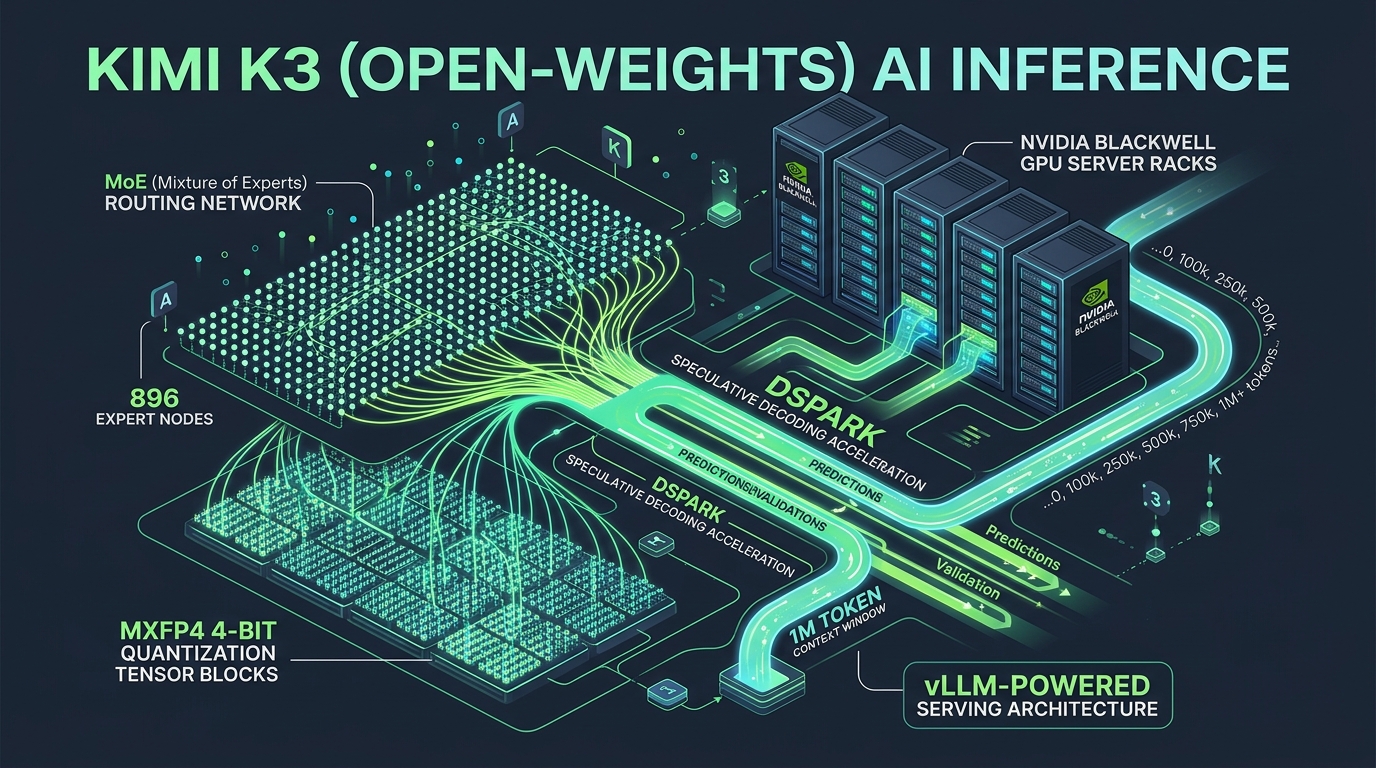
With 2.8 trillion total parameters (activating 37B across 16 of 896 routing experts per token) and a native 1-million-token context window, Kimi K3 delivers reasoning capabilities that rival closed API flagships like OpenAI GPT-5 and Anthropic Claude Opus 5. As highlighted in Tom’s Hardware’s Coverage, self-hosting open-weight frontier models allows enterprises to achieve up to 10x cost savings on cached prompt workloads while maintaining absolute data sovereignty.
Simultaneously, the vLLM core engineering team and Inferact announced Day-0 production serving support for Kimi K3 (vLLM Kimi K3 Release Announcement). By integrating hybrid Kimi Delta Attention (KDA) prefix caching, native MXFP4 4-bit quantization kernels, and open-source DSpark speculative decoding, vLLM accelerates Kimi K3 single-user streaming throughput from 118 tokens/sec up to 370 tokens/sec (a 3.14x speedup).
In this technical guide, we examine the open-weights paradigm shift, break down vLLM’s day-0 Kimi K3 serving architecture, inspect official Hugging Face specifications, deploy vLLM container recipes on NVIDIA and AMD hardware, and execute a runnable Python streaming benchmark script.
Official Model Card Summary: Moonshot AI Kimi K3
| Attribute Specification | Official Model Card Details |
|---|---|
| Model Repository | moonshotai/Kimi-K3 |
| Total Parameter Count | 2.8 Trillion Parameters (2,800B) |
| Active Routing Parameters | 37 Billion Active Parameters (16 of 896 experts routed per token) |
| Context Window Size | 1,048,576 Tokens (1M Native Context) |
| Weight Quantization | Native Micro-Scaling FP4 (MXFP4 4-bit) |
| Attention Mechanism | Kimi Delta Attention (KDA) + Periodic Full-Attention Layers |
| Residual Architecture | Block Attention Residuals (AttnRes) |
| Serving Throughput (vLLM) | 118 tok/s (Baseline) → 370 tok/s (with DSpark Speculator) |
| Hardware Requirements | 8x NVIDIA B300 / GB300 NVL72 or 8x AMD MI355X GPUs |
| License Type | Modified Apache-2.0 / Open Access |
The Open-Weights Paradigm Shift & Jensen Huang’s Declaration
The release of Kimi K3’s weights coincided with a historic declaration by NVIDIA CEO Jensen Huang, who published an industry manifesto titled “Open Weights and American AI Leadership”:
“The world needs both frontier closed models and frontier open models. Open-weight models ensure that enterprises do not suffer single-vendor lock-in, preserve strict data control, and allow researchers worldwide to audit safety mechanisms directly.”
— Jensen Huang, CEO of NVIDIA
By deploying open-weight foundation models locally or within private cloud VPCs, organizations retain control over proprietary fine-tuning, system prompts, and sensitive customer records without transmitting telemetry to third-party managed API endpoints.
The Self-Hosting Reality: Hardware Costs, VRAM Calculations & The “Open-Weights Illusion”
While the release of Kimi K3’s weights under open licenses is a monumental achievement, developer community discussions (e.g. Reddit r/AI_Agents Discussion) highlight a stark hardware reality: Kimi K3 is open-weights, but it is not easily self-hostable by individual developers or small labs.
flowchart TD
    subgraph VRAMFootprint["Kimi K3 Minimum VRAM Allocation (1,680 GB+ Total)"]
        direction TB
        V1["1. Raw MXFP4 Model Weights: ~1,400 GB (1.4 TB)"] --> V2["2. 1M Context KV Cache & Activations: 280 GB - 500 GB"]
        V2 --> V3["3. Minimum Cluster Target: 8x NVIDIA B300 (2,304 GB HBM3e) or 16x H200 (2,256 GB HBM3e)"]
    end
1. The 1.4 TB Memory Weight Floor
Even when utilizing native Micro-Scaling FP4 (MXFP4 4-bit) quantization, Kimi K3’s 2.8 trillion parameters require ~1,400 GB to 1,560 GB of VRAM just to load the model parameters into GPU memory before processing a single input token.
When factoring in runtime workspace overhead, intermediate activations, and KV cache memory for 1M-token context streams across concurrent user sessions, total serving requirements reach 1,680 GB+ to 2,300 GB+ of High-Bandwidth Memory (HBM3e).
2. GPU Cluster Configurations & Financial Capital Expenditure
| GPU Architecture | VRAM per GPU | Minimum GPUs Required | Node Count & Interconnect | Estimated Hardware / Cloud Cost |
|---|---|---|---|---|
| NVIDIA B300 (Blackwell Ultra) | 288 GB HBM3e | 8 GPUs (2,304 GB Total) | 1 HGX B300 Node (NVLink) | ~$300,000+ per node / ~$25/hr Cloud |
| NVIDIA H200 (Hopper) | 141 GB HBM3e | 16 GPUs (2,256 GB Total) | 2 HGX H200 Nodes (NVSwitch) | ~$350,000+ total / ~$35/hr Cloud |
| NVIDIA H100 (Hopper) | 80 GB HBM3e | 24 GPUs (1,920 GB Total) | 3 HGX H100 Nodes (NVSwitch) | ~$450,000+ total / ~$45/hr Cloud |
| AMD MI355X | 288 GB HBM3e | 8 GPUs (2,304 GB Total) | 1 MI355X Node (Infinity Fabric) | Enterprise Data Center |
3. The Developer Accessibility Gap & Data Sovereignty Paradox
- Consumer Hardware Impossibility: No consumer workstation (e.g. dual RTX 4090s with 48GB VRAM or Apple M3/M4 Max Mac Studio with 192GB Unified Memory) can load 1.4TB of model weights. CPU RAM offloading reduces inference speeds to $<0.1$ tokens/sec, rendering local execution unusable.
- API Fallback Tension: Because self-hosting requires a $300k+ enterprise GPU cluster, over 95% of developers building autonomous agent workflows end up defaulting to Moonshot’s hosted API endpoints. This creates an ongoing debate in the open-source community: open weights grant code transparency and auditability, but hardware barriers force reliance on centralized infrastructure.
vLLM’s Day-0 Kimi K3 Serving Architecture
According to the official vLLM Engineering Deep-Dive, serving a 2.8T hybrid MoE model requires overcoming three major computational bottlenecks:
flowchart TD
    subgraph vLLMServingStack["vLLM Day-0 Serving Pipeline for Kimi K3"]
        direction TB
        M1["1. User Request (1M Context Prompt)"] --> M2["2. Hybrid KDA & Paged KV Cache Manager"]
        M2 --> M3["3. Stable LatentMoE MXFP4 Kernel Dispatch (16/896 Experts)"]
        M3 --> M4["4. DSpark Block-Diffusion Speculative Verification (370 tok/s)"]
    end
1. Hybrid KDA & Paged KV Cache Manager
Kimi K3 replaces quadratic multi-head attention across most sublayers with Kimi Delta Attention (KDA)—a linear attention mechanism maintaining a compact fixed-size recurrent state—interleaved with periodic full-attention layers.
vLLM’s scheduler manages two distinct memory pools side-by-side:
- Paged KV Blocks: Allocates standard PagedAttention virtual memory pages for full-attention layers.
- Recurrent State Snapshots: Manages compact recurrent-state blocks for KDA layers. When a shared prompt prefix matches in cache, vLLM copies recurrent state snapshots in $O(1)$ time, eliminating prefill compute for long system prompts.
flowchart TD
    subgraph HybridMemory["vLLM Hybrid KV-Cache Architecture"]
        direction TB
        H1["Request Input Stream"] --> H2["PagedAttention Memory (Full-Attention Layers)"]
        H1 --> H3["Recurrent State Snapshots (KDA Layers)"]
        H2 --> H4["Merged Scheduler & Prefill Engine"]
        H3 --> H4
    end
2. DSpark Speculative Decoding (370 Tokens/sec)
To reach single-stream speeds of 370 tokens/sec, vLLM supports DSpark—a block-diffusion speculative decoding algorithm open-sourced by Inferact (Inferact/Kimi-K3-DSpark).
flowchart TD
    subgraph DSparkLoop["DSpark Draft-and-Verify Execution Loop"]
        direction TB
        D1["DSpark Block-Diffusion Draft Model (Proposes 7 Candidate Tokens)"] --> D2["Kimi K3 Target Model (Single Parallel Verification Pass)"]
        D2 --> D3["Confidence Head Validation & Token Acceptance"]
        D3 --> D4["Stream Output (370 tok/s Peak Throughput)"]
end- Block-Diffusion Drafting: A lightweight draft model generates 7 candidate tokens in a single parallel pass.
- High Acceptance Rates: On low-entropy tasks (e.g. coding and mathematics), DSpark achieves 4.73 accepted tokens per verification step, yielding a 3.14x speedup over standard single-token decoding.
Production Deployment Commands & Container Recipes
You can launch a production-ready OpenAI-compatible Kimi K3 inference server using vLLM’s official Docker recipes (vLLM Recipes Repository):
# Production Docker Serve Command for Kimi K3 on 8x GPUs
docker run --gpus all --ipc=host --net=host \
  vllm/vllm-openai:latest \
  vllm serve moonshotai/Kimi-K3 \
  --tensor-parallel-size 8 \
  --trust-remote-code \
  --load-format fastsafetensors \
  --enable-prefix-caching \
  --enable-auto-tool-choice \
  --tool-call-parser kimi_k3 \
  --reasoning-parser kimi_k3 \
  --speculative-config '{"model":"Inferact/Kimi-K3-DSpark","method":"dspark","num_speculative_tokens":7,"attention_backend":"FLASHINFER_MLA","draft_sample_method":"probabilistic","rejection_sample_method":"block"}'
Runnable Benchmark: vLLM Kimi K3 Client & Profiler
Below is a runnable Python benchmark script (scripts/kimi_k3_vllm_host.py) using the OpenAI client SDK to connect to a local or remote vLLM Kimi K3 instance, measuring Time-to-First-Token (TTFT), Inter-Token Latency (ITL), and streaming generation speed.
#!/usr/bin/env python3
"""
scripts/kimi_k3_vllm_host.py
----------------------------
Async Python benchmark client for vLLM self-hosted Kimi K3 open weights.
Measures Time-to-First-Token (TTFT), Inter-Token Latency (ITL), and Tok/s throughput.
"""

import asyncio
import time
from openai import AsyncOpenAI

# Initialize OpenAI-compatible client pointing to local vLLM server
client = AsyncOpenAI(
    base_url="http://localhost:8000/v1",
    api_key="EMPTY"  # vLLM local dev key
)

async def benchmark_kimi_k3_stream():
    prompt = "Explain the architectural differences between Kimi Delta Attention (KDA) and standard Multi-Head Attention."
    print("=== vLLM Kimi K3 Open Weights Streaming Benchmark ===")
    print(f"Target Server : http://localhost:8000/v1")
    print(f"Prompt        : '{prompt}'\n")

    start_time = time.perf_counter()
    first_token_time = None
    token_timestamps = []

    try:
        response = await client.chat.completions.create(
            model="moonshotai/Kimi-K3",
            messages=[{"role": "user", "content": prompt}],
            temperature=0.6,
            extra_body={
                "reasoning_effort": "high"
            },
            stream=True
        )

        output_text = ""
        async for chunk in response:
            if chunk.choices and chunk.choices[0].delta.content:
                now = time.perf_counter()
                if first_token_time is None:
                    first_token_time = now
                token_timestamps.append(now)
                output_text += chunk.choices[0].delta.content

        end_time = time.perf_counter()
        total_tokens = len(token_timestamps)

        if total_tokens > 0:
            ttft_ms = (first_token_time - start_time) * 1000
            total_duration = end_time - start_time
            decode_duration = end_time - first_token_time
            tps = total_tokens / decode_duration if decode_duration > 0 else 0

            print("--- Benchmark Results ---")
            print(f"  • Total Tokens Generated : {total_tokens}")
            print(f"  • Time-to-First-Token (TTFT): {ttft_ms:.2f} ms")
            print(f"  • Generation Throughput   : {tps:.1f} tokens/sec")
            print(f"  • Total Latency           : {total_duration:.2f} s")
            print("-------------------------\n")
            print(f"Response Preview:\n{output_text[:200]}...\n")

    except Exception as e:
        print(f"⚠️ Could not connect to vLLM endpoint: {e}")
        print("Note: Ensure vLLM server is running locally on port 8000.")

if __name__ == "__main__":
    asyncio.run(benchmark_kimi_k3_stream())
Run the client script:
python3 scripts/kimi_k3_vllm_host.pyKey Takeaways
- Open-Weights Frontier Equality: Moonshot AI’s release of Kimi K3 open weights enables self-hosted inference matching closed-source flagships.
- vLLM Day-0 Optimization: vLLM’s hybrid KDA cache manager and native MXFP4 kernels eliminate memory bottlenecks across 1M token contexts.
- DSpark Speculative Acceleration: Deploying Inferact’s open-source DSpark speculator boosts single-user streaming throughput up to 370 tokens/sec on NVIDIA B300 and AMD MI355X hardware.