
The Evolution of Edge AI: NVIDIA Jetson Nano, Jetson Orin Nano, and the All-New Jetson Orin Nano 2
Explore the generational leap in edge robotics silicon from the original 2019 Jetson Nano to the 78 TOPS Jetson Orin Nano 2 for Physical AI.
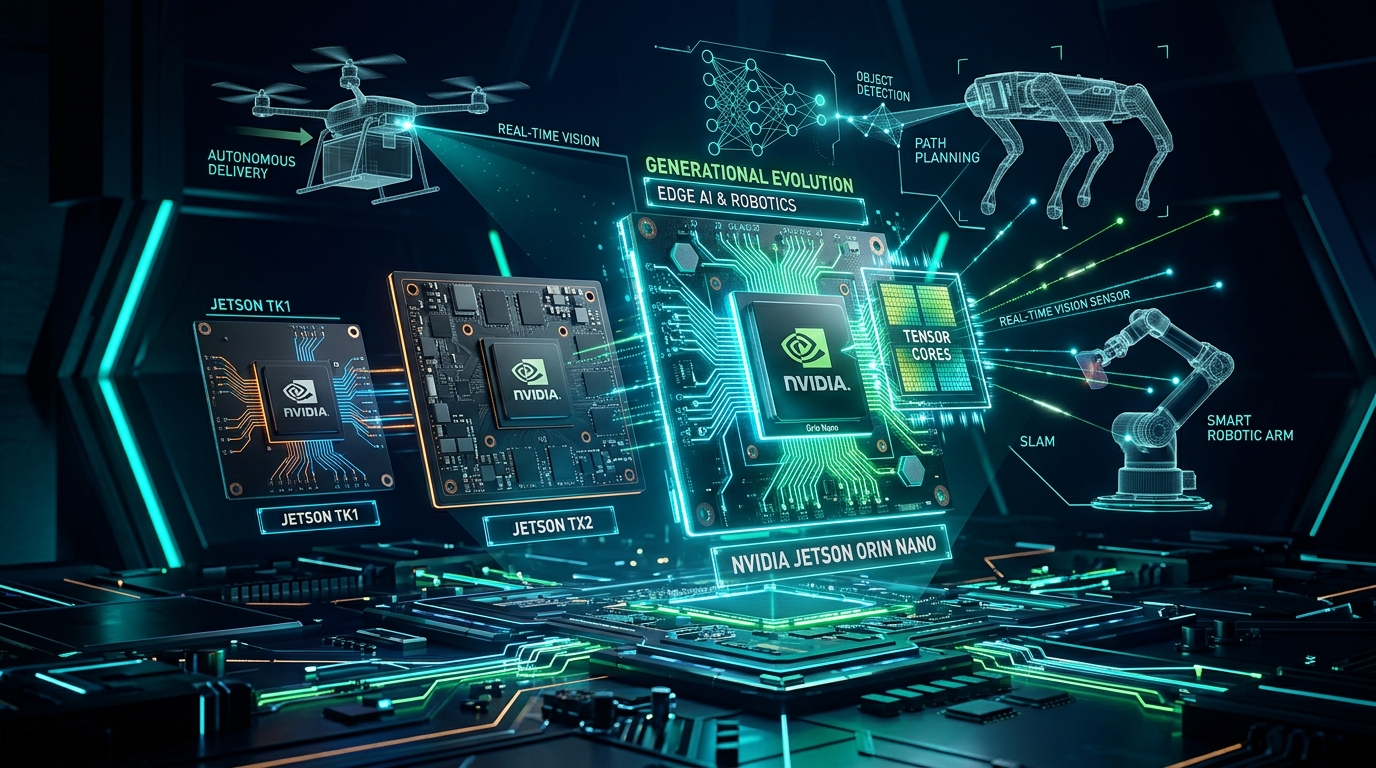
Series: NVIDIA Physical AI & Robotics Ecosystem Series - Part 14
Series: ← Part 10: Inside Newton: Open-Source Differentiable Physics for Generalist Robotics (Previous)
Prior Reading Material
Before exploring edge silicon architectures, unified memory subsystems, and robotics compute envelopes, inspect these foundational articles across our Physical AI series:
- Part 1: Unpacking the NVIDIA Physical AI Data Factory (PAIDF) Stack — The end-to-end synthetic-to-real physical AI ecosystem.
- Part 6: Inside Project GR00T — Multimodal Vision-Language-Action (VLA) tokenization and diffusion policy action heads.
- Part 8: Silicon at the Edge: NVIDIA Jetson Thor Architecture & Isaac ROS Acceleration — Blackwell edge compute, NITROS zero-copy memory transport, and sub-50ms humanoid reflex budgets.
- Part 9: Demystifying Autonomous Vehicles: The 3-Computer Architecture, SAE Autonomy Levels, and the Sensor Fusion Triad — The 3-computer paradigm spanning data center training, simulation, and edge inference.
- Part 10: Inside Newton: Open-Source Differentiable Physics for Generalist Robotics — Differentiable physics engines for high-throughput robot policy learning.
NVIDIA Jetson Orin Nano 2 Specification Summary
| Specification / Dimension | Details & Technical Parameters |
|---|---|
| Official Announcement | NVIDIA Press Release (August 2026) |
| Edge Platform | NVIDIA Jetson Embedded Systems |
| GPU Architecture | Enhanced NVIDIA Ampere Architecture with updated 3rd Gen Tensor Cores |
| AI Compute Throughput | Up to 78 TOPS (INT8 Dense / Sparse Acceleration) |
| CPU Complex | 8-core Arm Cortex-A78 CPU Complex |
| Unified Memory | 8 GB LPDDR5X with up to 120 GB/s Memory Bandwidth (128-bit bus) |
| Generational Speedup | 2x Inference Throughput vs. Jetson Orin Nano Super; 40% Power Reduction at 15W iso-performance |
| Configurable Power Modes | 10W to 40W operating envelopes |
| Form Factor & Pins | 260-pin SO-DIMM (69.6 mm x 45 mm), drop-in pin-compatible with Jetson Orin Nano carrier boards |
| Target Edge Workloads | NVIDIA Cosmos Edge Decoders, Nemotron-3 Nano, Gemma 4, Qwen 3, YOLOv11, FastSAM, Isaac ROS cuVSLAM |
| Ecosystem Adopters | Cognex, Doosan Bobcat, Matic Robots, Alphabet Wing Drones, Advantech, AAEON, Seeed Studio |
1. The Tale of the Micro-Workshop: From Fixed Tools to Autonomous Artisans
Imagine a tiny craftsman’s workshop set up inside an untethered, battery-powered delivery drone or a household robotic vacuum cleaner.
In 2019, the workshop was equipped with the Jetson Nano. It had a single workbench, a modest 128-core Maxwell GPU, and a narrow conveyor belt that could move 25.6 GB of raw materials per second. The craftsman could reliably recognize basic shapes—detecting a pedestrian or a pet using a lightweight convolutional neural network like MobileNet or YOLOv3. However, if the robot encountered an unexpected obstacle, it had no commonsense reasoning. It could only flag a bounding box and stop in place.
flowchart TD
    subgraph Gen1["1. Era 2019: Jetson Nano (Maxwell Arch)"]
        direction TB
        N1["128 Maxwell CUDA Cores (472 GFLOPS FP16)"] --> N2["25.6 GB/s LPDDR4 Memory Bandwidth"]
        N2 --> N3["Fixed-Function CNN Object Detection (YOLOv3 / MobileNet)"]
        N3 --> N4["Rigid Rule-Based State Machines (No Edge Generative AI)"]
    end
    style Gen1 fill:#0f172a,stroke:#64748b,stroke-width:2px,color:#ffffff
    style N1 fill:#1e293b,stroke:#64748b,stroke-width:1px,color:#ffffff
    style N2 fill:#1e293b,stroke:#64748b,stroke-width:1px,color:#ffffff
    style N3 fill:#1e293b,stroke:#64748b,stroke-width:1px,color:#ffffff
    style N4 fill:#1e293b,stroke:#ef4444,stroke-width:1px,color:#ffffff
By 2023, the Jetson Orin Nano transformed the workshop into an automated assembly line. Equipped with Ampere Tensor Cores and 68 GB/s of LPDDR5 bandwidth, it delivered up to 40 TOPS (and later 67 TOPS in Super mode). For the first time, edge robots could run real-time stereo depth estimation, feature tracking, and visual SLAM simultaneously on a single sub-15W module.
flowchart TD
    subgraph Gen2["2. Era 2023: Jetson Orin Nano (Ampere Arch)"]
        direction TB
        O1["1024 Ampere CUDA Cores + 32 Tensor Cores (40-67 TOPS)"] --> O2["68 GB/s LPDDR5 Unified Memory Bandwidth"]
        O2 --> O3["Multi-Camera Perception + Real-Time cuVSLAM"]
        O3 --> O4["Early Edge Transformers & Compact LLMs (4-bit Quantized)"]
    end
    style Gen2 fill:#0d2b45,stroke:#00e5ff,stroke-width:2px,color:#ffffff
    style O1 fill:#132e4a,stroke:#00e5ff,stroke-width:1px,color:#ffffff
    style O2 fill:#132e4a,stroke:#00e5ff,stroke-width:1px,color:#ffffff
    style O3 fill:#132e4a,stroke:#00e5ff,stroke-width:1px,color:#ffffff
    style O4 fill:#132e4a,stroke:#00e5ff,stroke-width:1px,color:#ffffff
Now, with the Jetson Orin Nano 2, the workshop evolves into a self-directed physical AI studio. Packing 78 TOPS of AI compute, an 8-core Arm Cortex-A78 CPU complex, and a massive 120 GB/s LPDDR5X memory pipeline within the same compact 260-pin SO-DIMM footprint, it shatters the memory bandwidth bottleneck that historically choked edge generative models.
Untethered robots no longer need to phone home to a centralized data center to interpret complex instructions or generate dynamic navigation trajectories. They run multimodal Vision-Language Models (VLMs), diffusion action decoders, and world foundation models entirely on the device.
flowchart TD
    subgraph Gen3["3. Era 2026/2027: Jetson Orin Nano 2 (Enhanced Ampere Arch)"]
        direction TB
        ON1["Enhanced Ampere Tensor Cores (78 TOPS AI Compute)"] --> ON2["120 GB/s LPDDR5X High-Speed Memory Highway"]
        ON2 --> ON3["On-Device Generative Physical AI (Cosmos, Nemotron, Gemma, Qwen)"]
        ON3 --> ON4["Zero-Copy Closed-Loop Autonomous Reflexes (Sub-50ms)"]
    end
    style Gen3 fill:#0f382c,stroke:#10b981,stroke-width:2px,color:#ffffff
    style ON1 fill:#174738,stroke:#10b981,stroke-width:1px,color:#ffffff
    style ON2 fill:#174738,stroke:#10b981,stroke-width:1px,color:#ffffff
    style ON3 fill:#174738,stroke:#10b981,stroke-width:1px,color:#ffffff
    style ON4 fill:#174738,stroke:#10b981,stroke-width:1px,color:#ffffff
2. The Edge Physical AI Trilemma
Every robotics engineer designing autonomous systems encounters the fundamental Edge AI Trilemma:
- Compute Throughput (TOPS & TFLOPS): Modern Physical AI demands transformer-based attention, spatial 3D voxel processing, and diffusion denoising steps.
- Thermal Dissipation & Form Factor: Drones, robotic vacuum cleaners, and robotic grippers cannot carry bulky water-cooling loops or heavy heatsinks.
- Battery Longevity (Watt-Hours): Every milliwatt drawn by the computing SoC directly subtracts from the robot’s operational flight time or cleaning area.
flowchart TD
    subgraph Trilemma["The Edge Physical AI Trilemma"]
        direction TB
        T1["Compute Density (TOPS / mm²)"] --> T2["Thermal Dissipation Budget (Passive / Low-Noise Fan)"]
        T2 --> T3["Battery Run-Time Envelope (Watt-Hours)"]
        T3 --> T4["Jetson Orin Nano 2 Sweet Spot: 78 TOPS at 10W-40W (1.75x Bandwidth)"]
    end
    style Trilemma fill:#1e1b4b,stroke:#818cf8,stroke-width:2px,color:#ffffff
    style T1 fill:#312e81,stroke:#818cf8,stroke-width:1px,color:#ffffff
    style T2 fill:#312e81,stroke:#818cf8,stroke-width:1px,color:#ffffff
    style T3 fill:#312e81,stroke:#818cf8,stroke-width:1px,color:#ffffff
    style T4 fill:#0f382c,stroke:#10b981,stroke-width:2px,color:#ffffff
While high-end flagship systems like Jetson Thor (delivering up to 800 TFLOPS FP8 at 100W+) serve large bipedal humanoids and autonomous commercial vehicles, the Jetson Orin Nano 2 is engineered specifically for high-volume, cost-sensitive, and battery-constrained machines:
- Autonomous Delivery Drones (Alphabet’s Wing): Navigating suburban airspace with real-time stereo obstacle avoidance and onboard visual landing site verification.
- Smart Consumer Robots (Matic Robots): Quiet, fully private in-home floor cleaning that interprets natural language instructions (“clean the spilled cereal under the kitchen island”) without streaming private camera feeds to the cloud.
- Industrial Smart Cameras & Inspection Grippers (Cognex, Doosan Bobcat): Sub-millimeter visual defect classification and robotic bin-picking on factory conveyor lines.
3. Generational Architecture Comparison: Nano vs. Orin Nano vs. Orin Nano 2
The evolution of NVIDIA’s entry-level Jetson silicon represents an astronomical leap in both raw compute density and memory subsystem architecture:
| Architectural Feature | Jetson Nano (2019) | Jetson Orin Nano 8GB (2023) | Jetson Orin Nano Super (2024) | Jetson Orin Nano 2 (2026/2027) | Jetson Thor (Flagship) |
|---|---|---|---|---|---|
| GPU Architecture | Maxwell | Ampere | Ampere | Enhanced Ampere | Blackwell |
| CUDA Cores | 128 | 1024 | 1024 | 1024 (Updated) | ~2048+ |
| Tensor Cores | N/A (FP16 via CUDA) | 32 (3rd Gen) | 32 (3rd Gen) | 32 (Enhanced 3rd Gen) | 5th Gen (FP4/FP8) |
| CPU Complex | 4-core Cortex-A57 @ 1.43 GHz | 6-core Cortex-A78AE @ 1.5 GHz | 6-core Cortex-A78AE @ 1.5 GHz | 8-core Cortex-A78 @ 2.0+ GHz | 14-core Neoverse V3AE |
| AI Performance | 472 GFLOPS (FP16) | 40 TOPS (INT8 Dense) | 67 TOPS (INT8 Sparse) | 78 TOPS (INT8 Dense/Sparse) | 800 TFLOPS (FP8/FP4) |
| Memory Capacity | 4 GB LPDDR4 | 8 GB LPDDR5 | 8 GB LPDDR5 | 8 GB LPDDR5X | 128 GB LPDDR5X |
| Memory Bus Width | 64-bit | 128-bit | 128-bit | 128-bit | 256-bit |
| Memory Bandwidth | 25.6 GB/s | 68 GB/s | 68 GB/s | 120 GB/s (1.76x) | > 500 GB/s |
| Precision Formats | FP32, FP16 | FP32, FP16, INT8 | FP32, FP16, INT8 | FP32, FP16, INT8, INT4 | FP32, FP16, FP8, FP4, INT8 |
| Power Consumption | 5W / 10W | 7W – 15W | 10W – 25W | 10W – 40W (Iso-15W @ -40% Pwr) | 50W – 120W+ |
| Form Factor | 260-pin SO-DIMM | 260-pin SO-DIMM | 260-pin SO-DIMM | 260-pin SO-DIMM (Drop-in) | BGA / Custom Mezzanine |
| Primary Workloads | TinyYOLO, MobileNet | YOLOv8, cuVSLAM, FastSAM | YOLOv10, Small SLMs | Cosmos Decoders, Nemotron, Gemma, Qwen | Full GR00T Humanoid VLA |
4. Hardware System Architecture & Drop-In Carrier Integration
One of the most critical engineering advantages of the Jetson Orin Nano 2 is its drop-in mechanical and pin compatibility. System integrators and robotics OEMs who designed carrier boards for the Jetson Orin Nano can upgrade their fleet simply by swapping the module and updating the JetPack board support package (BSP).
flowchart TD
    subgraph JetsonSoC["Jetson Orin Nano 2 System-on-Module (SOM) Architecture"]
        direction TB
        GPU["Enhanced Ampere GPU (1024 CUDA Cores + 32 Tensor Cores)"] --> MEM["8 GB LPDDR5X Unified Memory (120 GB/s Bandwidth)"]
        CPU["8-Core Arm Cortex-A78 CPU Complex"] --> MEM
        ISP["Dual Hardware Image Signal Processors (ISP)"] --> MEM
    end
    style JetsonSoC fill:#0f2b24,stroke:#10b981,stroke-width:2px,color:#ffffff
    style GPU fill:#174738,stroke:#10b981,stroke-width:1px,color:#ffffff
    style CPU fill:#174738,stroke:#10b981,stroke-width:1px,color:#ffffff
    style MEM fill:#174738,stroke:#10b981,stroke-width:1px,color:#ffffff
    style ISP fill:#174738,stroke:#10b981,stroke-width:1px,color:#ffffff
flowchart TD
subgraph Interfaces["260-Pin SO-DIMM Edge Connector Carrier Bus"]
direction TB
CSI["MIPI CSI-2 (Up to 4x 2-lane / 2x 4-lane Cameras)"] --> PCIE["PCIe Gen4 Express Lanes (NVMe SSD / WiFi 7)"]
PCIE --> GPIO["Industrial I/O: CAN Bus, I2C, SPI, UART, PWM"]
GPIO --> ETH["Gigabit Ethernet (1GbE / 2.5GbE MAC)"]
end
style Interfaces fill:#0f172a,stroke:#00e5ff,stroke-width:2px,color:#ffffff
style CSI fill:#1e293b,stroke:#00e5ff,stroke-width:1px,color:#ffffff
style PCIE fill:#1e293b,stroke:#00e5ff,stroke-width:1px,color:#ffffff
style GPIO fill:#1e293b,stroke:#00e5ff,stroke-width:1px,color:#ffffff
style ETH fill:#1e293b,stroke:#00e5ff,stroke-width:1px,color:#ffffffflowchart TD
subgraph Peripherals["Connected Robotics Peripherals & Actuation Subsystems"]
direction TB
CAM["Stereo Global Shutter RGB-D Cameras"] --> NVME["M.2 NVMe SSD (Local Model Weights & KV Cache)"]
NVME --> MOTORS["Motor Controller ESCs & CAN Bus Actuators"]
end
style Peripherals fill:#1e1b4b,stroke:#a855f7,stroke-width:2px,color:#ffffff
style CAM fill:#312e81,stroke:#a855f7,stroke-width:1px,color:#ffffff
style NVME fill:#312e81,stroke:#a855f7,stroke-width:1px,color:#ffffff
style MOTORS fill:#312e81,stroke:#a855f7,stroke-width:1px,color:#ffffffWhy Memory Bandwidth (120 GB/s) is the Real Breakthrough
In generative AI and large vision models, the primary bottleneck during edge inference is not raw matrix multiplication compute—it is memory bandwidth.
During autoregressive token generation in an edge SLM (such as Nemotron-3 Nano or Qwen-3 1.5B), the GPU must stream billions of weight parameters from memory into the on-chip SRAM register files for every single generated token.
- On the Jetson Nano (25.6 GB/s): An edge 1.5B parameter model quantized to 4-bit (0.75 GB) would be hard-capped by memory bandwidth to a theoretical maximum of $\frac{25.6\text{ GB/s}}{0.75\text{ GB/token}} \approx 34\text{ tokens/sec}$ under 100% ideal bus saturation (in reality, $< 10\text{ tokens/sec}$).
- On the Jetson Orin Nano (68 GB/s): Theoretical maximum throughput was $\approx 90\text{ tokens/sec}$, achieving ~25–35 real-world tokens/sec when sharing bandwidth with active camera ISP pipelines.
- On the Jetson Orin Nano 2 (120 GB/s): The LPDDR5X bus provides an explosive 1.76x bandwidth boost, enabling generative reasoning models to run at 60+ tokens/second concurrently with 4K stereo camera ingest and real-time visual odometry!
5. The Edge Generative Physical AI Pipeline
How does a Jetson Orin Nano 2 power an untethered autonomous robot in real time?
Rather than running isolated computer vision models, the robot executes a unified, closed-loop Perception-Reasoning-Action loop accelerated by NVIDIA Isaac ROS and TensorRT:
flowchart TD
    subgraph Ingest["Stage 1: Sensor Ingest & Visual Odometry (100 Hz Loop)"]
        direction TB
        S1["Dual Global Shutter Cameras (MIPI CSI-2)"] --> S2["Hardware ISP Zero-Copy Buffer"]
        S2 --> S3["Isaac ROS cuVSLAM (NITROS Hardware GPU Accelerated)"]
    end
    style Ingest fill:#0d2b45,stroke:#00e5ff,stroke-width:2px,color:#ffffff
    style S1 fill:#132e4a,stroke:#00e5ff,stroke-width:1px,color:#ffffff
    style S2 fill:#132e4a,stroke:#00e5ff,stroke-width:1px,color:#ffffff
    style S3 fill:#132e4a,stroke:#00e5ff,stroke-width:1px,color:#ffffff
flowchart TD
subgraph Reasoning["Stage 2: Multimodal Perception & Edge VLM Reasoning (10-30 Hz)"]
direction TB
R1["Real-Time Voxel Occupancy & Depth Map"] --> R2["Edge Vision-Language Model (Nemotron / Qwen-3 / Cosmos Decoder)"]
R2 --> R3["High-Level Semantic Sub-Goal Identification"]
end
style Reasoning fill:#1e1b4b,stroke:#a855f7,stroke-width:2px,color:#ffffff
style R1 fill:#312e81,stroke:#a855f7,stroke-width:1px,color:#ffffff
style R2 fill:#312e81,stroke:#a855f7,stroke-width:1px,color:#ffffff
style R3 fill:#312e81,stroke:#a855f7,stroke-width:1px,color:#ffffffflowchart TD
subgraph ActionLoop["Stage 3: Trajectory Generation & Motor Reflex Loop (200 Hz)"]
direction TB
A1["6-DoF Waypoint & Collision-Free Trajectory Planner"] --> A2["Low-Latency Motor Controller (PWM / CAN Bus Actuation)"]
A2 --> A3["Closed-Loop Dynamic Stability Verification"]
end
style ActionLoop fill:#0f382c,stroke:#10b981,stroke-width:2px,color:#ffffff
style A1 fill:#174738,stroke:#10b981,stroke-width:1px,color:#ffffff
style A2 fill:#174738,stroke:#10b981,stroke-width:1px,color:#ffffff
style A3 fill:#174738,stroke:#10b981,stroke-width:1px,color:#ffffff6. Mathematical Formulations of Edge AI Efficiency
To understand why the Jetson Orin Nano 2 delivers such a profound leap in autonomous capability, we analyze the governing equations of edge computing:
1. Energy Efficiency (TOPS per Watt)
The compute energy efficiency $\eta_{\text{compute}}$ of an edge SoC is the ratio of effective AI throughput to the total active thermal design power (TDP):
$$\eta_{\text{compute}} = \frac{\text{TOPS}{\text{peak}}}{P{\text{SoC}}}$$
Comparing the generations:
- Jetson Nano (2019): $\eta_{\text{Nano}} = \frac{0.472\text{ TFLOPS}}{10\text{ W}} = 0.0472\text{ TFLOPS/Watt}$
- Jetson Orin Nano (2023): $\eta_{\text{OrinNano}} = \frac{40\text{ TOPS}}{15\text{ W}} = 2.67\text{ TOPS/Watt}$
- Jetson Orin Nano 2 (2026): $\eta_{\text{OrinNano2}} = \frac{78\text{ TOPS}}{20\text{ W}} = 3.90\text{ TOPS/Watt}$ (and over $5.20\text{ TOPS/Watt}$ in tuned 15W mode).
This represents an astounding 82x increase in compute efficiency per watt compared to the original Jetson Nano!
2. Operational Intensity & The Edge Roofline Model
According to Williams’ Roofline Model, kernel execution is bounded either by peak compute performance $P_{\text{peak}}$ (TOPS) or by memory bandwidth $B_{\text{mem}}$ (GB/s), governed by arithmetic intensity $I$ (FLOPs/byte):
$$\text{Performance}(I) = \min\left(P_{\text{peak}}, I \times B_{\text{mem}}\right)$$
The transition point $I_{\text{knee}}$ where a workload transitions from memory-bandwidth-bound to compute-bound is:
$$I_{\text{knee}} = \frac{P_{\text{peak}}}{B_{\text{mem}}}$$
- Jetson Orin Nano 8GB: $I_{\text{knee}} = \frac{40 \times 10^{12}\text{ OPs/s}}{68 \times 10^9\text{ Bytes/s}} \approx 588.2\text{ OPs/Byte}$
- Jetson Orin Nano 2: $I_{\text{knee}} = \frac{78 \times 10^{12}\text{ OPs/s}}{120 \times 10^9\text{ Bytes/s}} \approx 650.0\text{ OPs/Byte}$
Because generative autoregressive decoding has an arithmetic intensity $I \approx 1\text{ OP/Byte}$ (batch size = 1), performance is strictly linear in memory bandwidth $B_{\text{mem}}$. Upgrading to 120 GB/s directly raises the memory roofline ceiling by 76.5%.
3. Untethered Battery Lifetime Duration
For a mobile robot with battery energy capacity $E_{\text{battery}}$ (in Watt-hours) and DC-DC power conversion efficiency $\eta_{\text{conv}}$, total mission runtime $T_{\text{mission}}$ is:
$$T_{\text{mission}} = \frac{E_{\text{battery}} \times \eta_{\text{conv}}}{P_{\text{SoC}} + P_{\text{sensors}} + P_{\text{motors}}}$$
Where:
- $P_{\text{SoC}}$ is the Jetson module power draw (W).
- $P_{\text{sensors}}$ is the camera and LiDAR payload power (typically 3W–6W).
- $P_{\text{motors}}$ is average locomotion actuation power (typically 15W–40W for small AMRs).
Because the Jetson Orin Nano 2 consumes 40% less power at iso-workload compared to its predecessor, it saves 6W to 10W of continuous power—extending mission battery life by 20% to 35% on a standard 50Wh robot battery pack.
7. Interactive Python Edge Silicon Simulation
To benchmark the generational throughput, memory latency, and battery longevity across Jetson Nano, Jetson Orin Nano, and Jetson Orin Nano 2, we have built an interactive Python simulation script.
Click to expand runnable Python simulation script
#!/usr/bin/env python3
"""
scripts/jetson_generational_benchmark_sim.py
Zero-dependency simulation comparing Jetson Nano, Jetson Orin Nano,
and Jetson Orin Nano 2 across vision and generative AI workloads.
"""

from dataclasses import dataclass
from typing import List, Dict


@dataclass
class JetsonModule:
    name: str
    year: int
    gpu_arch: str
    ai_tops: float          # Peak INT8/FP16 TOPS
    mem_capacity_gb: float  # Unified RAM (GB)
    mem_bandwidth_gbs: float # Memory Bandwidth (GB/s)
    cpu_cores: int
    tdp_watts: float        # Typical operating power (W)


MODULES = [
    JetsonModule(
        name="Jetson Nano",
        year=2019,
        gpu_arch="Maxwell (128 CUDA)",
        ai_tops=0.472,       # FP16 GFLOPS as TOPS equivalent
        mem_capacity_gb=4.0,
        mem_bandwidth_gbs=25.6,
        cpu_cores=4,
        tdp_watts=10.0,
    ),
    JetsonModule(
        name="Jetson Orin Nano 8GB",
        year=2023,
        gpu_arch="Ampere (1024 CUDA + 32 TC)",
        ai_tops=40.0,
        mem_capacity_gb=8.0,
        mem_bandwidth_gbs=68.0,
        cpu_cores=6,
        tdp_watts=15.0,
    ),
    JetsonModule(
        name="Jetson Orin Nano Super",
        year=2024,
        gpu_arch="Ampere (1024 CUDA + 32 TC)",
        ai_tops=67.0,
        mem_capacity_gb=8.0,
        mem_bandwidth_gbs=68.0,
        cpu_cores=6,
        tdp_watts=25.0,
    ),
    JetsonModule(
        name="Jetson Orin Nano 2",
        year=2026,
        gpu_arch="Enhanced Ampere (1024 CUDA + 32 TC)",
        ai_tops=78.0,
        mem_capacity_gb=8.0,
        mem_bandwidth_gbs=120.0,
        cpu_cores=8,
        tdp_watts=20.0,
    ),
]


def benchmark_vision_model(module: JetsonModule, giga_ops: float, model_size_mb: float) -> Dict[str, float]:
    """
    Simulates vision model inference (e.g. YOLOv11 / FastSAM).
    """
    # Compute latency (ms) = (GigaOPs / (TOPS * 1000)) * 1000 ms
    compute_ms = (giga_ops / (module.ai_tops * 1000.0)) * 1000.0
    # Memory read latency (ms) = (Size in GB / Bandwidth) * 1000 ms
    mem_ms = ((model_size_mb / 1024.0) / module.mem_bandwidth_gbs) * 1000.0
    # Overlapped execution with hardware efficiency factor
    eff = 0.78 if "Ampere" in module.gpu_arch else 0.52
    total_latency_ms = max(compute_ms, mem_ms) / eff
    fps = 1000.0 / total_latency_ms
    return {
        "latency_ms": round(total_latency_ms, 2),
        "fps": round(fps, 1),
    }


def benchmark_generative_slm(module: JetsonModule, params_billions: float, bits_per_weight: int) -> Dict[str, float]:
    """
    Simulates generative autoregressive token decode (e.g. Nemotron-3 Nano / Qwen-3 1.5B).
    """
    model_weight_bytes = (params_billions * 1e9 * (bits_per_weight / 8.0))
    model_weight_gb = model_weight_bytes / (1024.0 ** 3)

    if model_weight_gb > (module.mem_capacity_gb * 0.75):
        # Model does not fit into available VRAM after OS and camera buffers
        return {"tokens_per_sec": 0.0, "status": "OOM (Out of Memory)"}

    # In token generation, every token reads all weights from DRAM
    bus_efficiency = 0.82 if "Ampere" in module.gpu_arch else 0.55
    tok_sec = (module.mem_bandwidth_gbs * bus_efficiency) / model_weight_gb
    return {
        "tokens_per_sec": round(tok_sec, 1),
        "status": "OK",
    }


def estimate_drone_battery_runtime(module: JetsonModule, battery_wh: float = 52.0, base_power_w: float = 28.0) -> float:
    """
    Estimates total mission runtime (in minutes) for a delivery drone or AMR.
    base_power_w includes motors, cameras, and radio payload.
    """
    total_power = module.tdp_watts + base_power_w
    runtime_hours = (battery_wh * 0.90) / total_power  # 90% usable battery depth
    return round(runtime_hours * 60.0, 1)


def run_generational_benchmark():
    print("=" * 80)
    print(" NVIDIA JETSON GENERATIONAL EDGE AI BENCHMARK SIMULATION")
    print("=" * 80)

    # 1. Vision Model Benchmark: YOLOv11-Medium (15 GigaOPs, 42 MB weights)
    print("\n📊 1. Vision Model Benchmark: YOLOv11 Real-Time Object Detection")
    print(f"{'Module Name':<24} | {'Arch':<20} | {'Latency (ms)':<14} | {'Throughput (FPS)':<16}")
    print("-" * 80)
    for m in MODULES:
        res = benchmark_vision_model(m, giga_ops=15.0, model_size_mb=42.0)
        print(f"{m.name:<24} | {m.gpu_arch[:18]:<20} | {res['latency_ms']:<14} | {res['fps']:<16}")

    # 2. Generative SLM Benchmark: 1.5B Parameter Model (4-bit quantized = 0.75 GB)
    print("\n🧠 2. Generative Physical AI SLM: Qwen-3 / Nemotron-3 1.5B (INT4 Quantized)")
    print(f"{'Module Name':<24} | {'Bandwidth':<12} | {'Tokens / Sec':<16} | {'Status':<16}")
    print("-" * 80)
    for m in MODULES:
        res = benchmark_generative_slm(m, params_billions=1.5, bits_per_weight=4)
        print(f"{m.name:<24} | {str(m.mem_bandwidth_gbs) + ' GB/s':<12} | {res['tokens_per_sec']:<16} | {res['status']:<16}")

    # 3. Mission Battery Longevity on a 52 Wh Drone Battery Pack
    print("\n🔋 3. Mission Battery Longevity (52 Wh Battery, 28W Base Motors/Sensors)")
    print(f"{'Module Name':<24} | {'TDP (Watts)':<12} | {'Compute Eff (TOPS/W)':<20} | {'Flight Time':<14}")
    print("-" * 80)
    for m in MODULES:
        eff = round(m.ai_tops / m.tdp_watts, 2)
        flight_mins = estimate_drone_battery_runtime(m, battery_wh=52.0, base_power_w=28.0)
        print(f"{m.name:<24} | {str(m.tdp_watts) + ' W':<12} | {str(eff) + ' TOPS/W':<20} | {str(flight_mins) + ' mins':<14}")

    print("\n" + "=" * 80)
    print(" SUMMARY TAKEAWAY:")
    print(" Jetson Orin Nano 2 unlocks 60+ tok/s generative edge reasoning and 150+ FPS")
    print(" vision detection, while maintaining an energy-efficient sub-20W envelope.")
    print("=" * 80)


if __name__ == "__main__":
    run_generational_benchmark()
8. Summary & Conclusion
The journey from the 2019 Jetson Nano to the 2026 Jetson Orin Nano 2 reflects the broader transformation of AI itself:
- From Bounding Boxes to Generalist Reasoning: Entry-level edge silicon has graduated from simple 2D convolutional object detectors to multimodal foundation models that can perceive 3D geometry, reason in natural language, and plan robotic manipulation trajectories.
- Solving the Bandwidth Bottleneck: The introduction of 120 GB/s LPDDR5X memory eliminates the DRAM starvation that previously bottlenecked autoregressive token generation and spatial diffusion decoders on edge devices.
- Seamless Drop-In Evolution: Retaining the standardized 260-pin SO-DIMM form factor allows robotics manufacturers across industrial automation, delivery drones, and consumer robotics to upgrade existing fleets with 2x performance and 40% higher power efficiency.
As Physical AI expands into millions of untethered machines worldwide, high-density edge silicon like the Jetson Orin Nano 2 ensures that rich intelligence, spatial perception, and autonomous reflexes remain fully self-contained on the device.