
Anthropic's Mid-2026 Wave: Claude Sonnet 5, Claude Science, and Fable 5 Redeployment
A summary of Anthropic's major announcements: the launch of Claude Sonnet 5, the new Claude Science AI workbench, and the global redeployment of Fable 5.
Claude Code Series: ← Claude Code Custom Skills: Design Methodology and Workspace Personas (Previous) | Anthropic’s Claude Model Family: Specs, Pros, Cons, and Use Cases (Next) →
Recommended Background Reading
Before reading this post, it is recommended to catch up with our previous guides on Claude Code:
- Claude Code Basics: Commands, Subagents, and Memory Layers — Core operational paradigms of Anthropic’s agentic CLI tool.
- Claude Code Custom Skills: Design Methodology and Workspace Personas — Deep dive into building custom instructions and skills for local workspace tailoring.
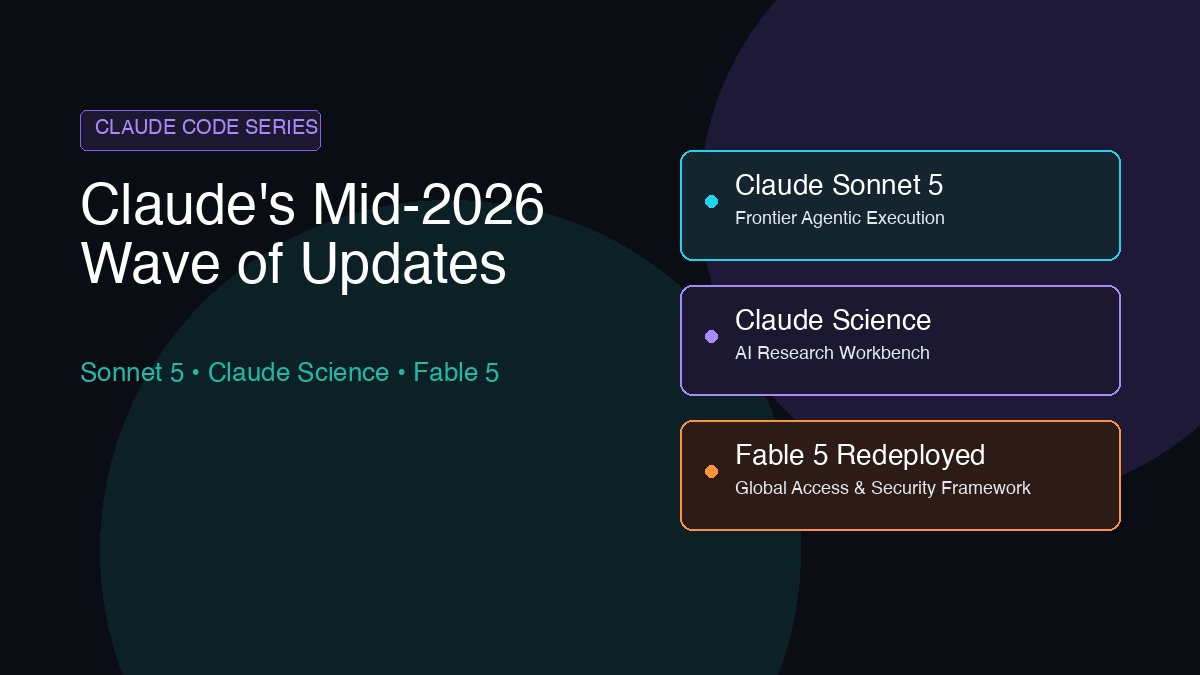
The end of June 2026 has been one of the most eventful weeks in generative AI history. Anthropic released three major announcements in rapid succession: the launch of Claude Sonnet 5, the introduction of a specialized research platform named Claude Science, and the global redeployment of Fable 5 following the lifting of short-lived export controls.
These updates signal a clear shift in how Anthropic designs and deploys frontier AI—focusing heavily on autonomous agentic execution, domain-specific scientific workbenches, and collaborative security frameworks.
In this article, we’ll summarize what these announcements mean for developers, scientists, and the future of agentic coding.
1. Claude Sonnet 5: The Agentic Leap
Claude Sonnet 5 is built to narrow the gap between the speed/affordability of the Sonnet class and the reasoning depth of the flagships. Anthropic is positioning this model as “our most agentic Sonnet yet.”
- Opus-Level Autonomy: Sonnet 5 is capable of completing multi-step planning, tool use (such as local terminals and browsers), and self-correction. Early testers reported that it regularly finishes complex workflows where previous models would halt or require human intervention.
- Flexible Effort Control: Users can adjust the model’s “effort” level to optimize the cost-to-performance curve. At medium effort, it offers substantially higher cost efficiency; at higher effort levels, it can match Opus 4.8 on benchmarks like BrowseComp and OSWorld.
- Launch Pricing: Sonnet 5 is available now with introductory pricing through August 31, 2026, set at $2.00 per million input tokens and $10.00 per million output tokens (reverting to $3/$15 after the launch period).
2. Claude Science: An AI Workbench for Researchers
In one of the first major domain-specific applications of their agentic stack, Anthropic introduced Claude Science, a tailored AI workbench designed to streamline life science workflows.
- Unified Research Interface: Instead of shifting between PubMed, Jupyter Notebooks, R sessions, and high-performance computing (HPC) terminals, Claude Science merges these tools into a single, cohesive research app.
- Reproducible Science: Every output (including figures, charts, and manuscripts) is generated alongside the exact code and environment configurations that created it, allowing other researchers to validate and reproduce findings months later.
- 3D Interactive Renderers: The platform natively supports visual rendering of 3D protein structures, genome browser tracks, and chemical structures.
- Scale on Demand: Operating locally or over SSH/Modal, coordinating agents can automatically plan compute jobs and submit them to HPC clusters or cloud GPU nodes on demand.
- Actor-Critic Multi-Agent System: A main coordinator agent utilizes a separate reviewer agent that checks calculations, verifies citations, and flags visual mismatches in data.
3. Fable 5 Redeployment & The Jailbreak Severity Framework
Following a brief suspension due to immediate US export controls on June 12, Anthropic has officially redeployed Claude Fable 5 and Claude Mythos 5 globally as of July 1, 2026.
- Improved Safety Classifiers: The suspension occurred after researchers bypassed Fable 5’s safeguards to generate a software exploit code demonstration. Anthropic worked with the government to train an improved safety classifier that blocks the borderline vulnerability exploit behavior in 99% of cases.
- A Shared Industry Bar: Recognizing that no model is completely impervious to jailbreaks, Anthropic is partnering with Amazon, Microsoft, Google, and other Glasswing partners to create a CVSS-like scoring system to grade jailbreak severity based on:
- Capability gain (advancement level relative to existing tools).
- Breadth (how many tasks the exploit works on).
- Ease of weaponization (required human prompt engineering effort).
- Discoverability (public availability of the technique).
- Deeper Government Collaboration: Anthropic is scaling up collaboration with the US Center for AI Standards and Innovation (CAISI), committing to pre-release evaluation access, rapid information sharing on novel exploits, and joint security research.
Conclusion
Whether you are building everyday applications with Sonnet 5, conducting proteomics research on Claude Science, or running background loops with Fable 5, the capabilities of terminal-based AI developers have leaped forward.
In the next post, we will explore Anthropic’s Claude Model Family: Specs, Pros, Cons, and Use Cases!