
Anthropic's Claude Model Family: Specs, Pros, Cons, and Use Cases
Compare Anthropic's Claude models—Fable 5, Opus 4.8, Sonnet 5, Haiku 4.5, and Claude Science. Learn their pros, cons, and the best use cases.
Claude Code Series: ← Anthropic’s Mid-2026 Wave: Claude Sonnet 5, Claude Science, and Fable 5 Redeployment (Previous) | Claude Code Custom Plugins: Build and Host Your Own Marketplace (Next) →
Recommended Background Reading
Before diving into this comprehensive model comparison, consider checking out our recent coverage of Anthropic’s ecosystem:
- Anthropic’s Mid-2026 Wave: Claude Sonnet 5, Claude Science, and Fable 5 Redeployment — Overview of the mid-2026 releases and model deployments.
Anthropic’s Claude model family has become one of the premier choices for software engineers and AI developers. From driving terminal-based agentic workflows to powers in-IDE autocompletion, these models excel in reasoning, code generation, and complex instruction following.
However, as the lineup has evolved with the 5-series (such as Fable 5 and Sonnet 5) and late 4-series (Opus 4.8 and Haiku 4.5), selecting the right model for the right task is critical to balancing intelligence, latency, and cost.
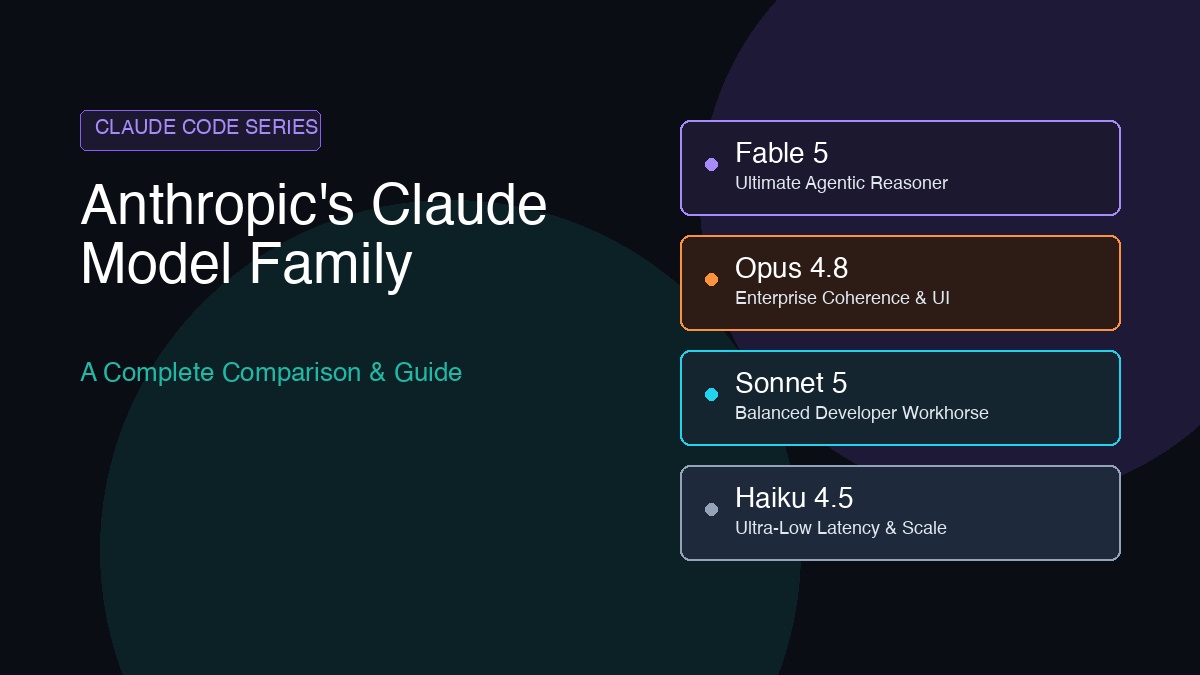
In this article, we’ll look at the current Claude family, breakdown their pros and cons, and highlight the best use cases for each model.
The Claude Lineup at a Glance
| Model | Primary Focus | Latency | Relative Cost | Best Use Case |
|---|---|---|---|---|
| Claude Fable 5 | Ultimate Agentic Reasoning | Moderate | High | Autonomous coding agents & complex planning |
| Claude Opus 4.8 | Enterprise Coherence & UI | High | Premium | Computer/Browser use & multi-step business logic |
| Claude Sonnet 5 | Balanced Workhorse | Low | Medium | Daily pair programming, inline refactoring, & CLI chat |
| Claude Haiku 4.5 | Lightning Speed & Scale | Ultra-Low | Low | Fast linting, code summaries, & high-throughput pipelines |
| Claude Science | Domain-Specific Research | Moderate | Premium | Genomics, chemical modeling, and complex academic datasets |
1. Claude Fable 5: The Agentic Powerhouse
Claude Fable 5 represents the pinnacle of Anthropic’s reasoning capabilities, specifically optimized for complex, long-running agentic tasks.
- Pros:
- Unmatched Coherence: Best-in-class multi-step planning and self-correction.
- Tool Use: Exceptional ability to call complex external tools and APIs without losing track of the main objective.
- Deep Reasoning: Excellent at debugging architectural issues across multiple files in a codebase.
- Cons:
- Latency: Slower output generation speed compared to Sonnet 5.
- Cost: Premium pricing makes it expensive for high-volume or simple conversational tasks.
- Best Use Cases:
- Autonomous Coding Agents: Use it when you want an agent to operate in a background loop (
/goalor/teamwork-previewworkflows) to refactor entire modules, run tests, and fix bugs without manual intervention. - Architectural Design: Planning new system configurations or analyzing large security audit logs.
- Autonomous Coding Agents: Use it when you want an agent to operate in a background loop (
2. Claude Opus 4.8: The Enterprise & UI Orchestrator
Claude Opus 4.8 focuses heavily on enterprise compliance, deep textual analysis, and advanced visual reasoning—especially tasks requiring browser automation and computer use.
- Pros:
- Contextual Coherence: Excellent at understanding legacy enterprise business logic.
- Advanced Computer Use: The model of choice for GUI/Browser-based agents that need to interact with visual elements, drag, and click.
- Cons:
- Speed: Slowest model in the active family.
- Cost: Highest cost per token.
- Best Use Cases:
- UI Testing & Browser Automation: Driving local browser instances to check rendering issues or perform end-to-end integration tests.
- Legacy Code Auditing: Analyzing legacy COBOL, Java, or C++ systems where nuance and full context retention are vital.
3. Claude Sonnet 5: The Developer’s Daily Workhorse
Claude Sonnet 5 is the sweet spot of the lineup. It balances incredibly high intelligence with low latency and affordable pricing.
- Pros:
- High Speed: Lightning-fast response times.
- Code Smart: Excellent at everyday coding, formatting, and standard bug fixes.
- Value: Extremely cost-efficient for interactive developer loops.
- Cons:
- Extreme Reasoning Limits: For deep, multi-hour autonomous agent tasks, Fable 5 remains more robust.
- Best Use Cases:
- Terminal Pair Programming: This is the default model for interactive shell environments like Claude Code or Antigravity CLI.
- Inline Completions: Excellent as the backend for IDE autocompletion extensions.
- Daily Refactoring: Standard feature updates, writing unit tests, and migrating styling configurations.
4. Claude Haiku 4.5: The High-Throughput Specialist
Claude Haiku 4.5 is built for extreme speed and cost-efficiency. It is designed to process massive quantities of data in sub-second times.
- Pros:
- Ultra-Low Latency: Near-instantaneous response.
- Low Cost: Extremely cheap, making it viable to scan thousands of lines of code.
- Cons:
- Reasoning Breadth: Struggles with complex, multi-file changes or deep logical debugging.
- Best Use Cases:
- Fast Code Summarization: Generating commit messages, PR descriptions, or high-level code documentation.
- Automated Linters: Running quick checks on newly written code for basic style rule violations.
- High-Volume Categorization: Sorting logs, tag generation, or preprocessing code repositories before sending it to Fable 5.
5. Claude Science: The Specialized Research Workbench
Claude Science is a domain-specific model and workbench environment designed specifically for advanced scientific, engineering, and mathematical research.
- Pros:
- Domain Optimization: Tailored specifically for computational biology, genomics, chemistry, and physics datasets.
- Visual Structure Rendering: Capable of outputting and rendering 3D chemical structures, molecular designs, and complex mathematical matrices directly within the workbench.
- Reproducible Science Loops: Engineered to enforce strict statistical validity, preventing hallucinated conclusions on numeric data.
- Cons:
- Not a Generalist: Not optimized for standard software engineering tasks, web development, or daily programming.
- Access Limits: Restricted to academic partners and specialized research organizations.
- Best Use Cases:
- Genomics & Proteomics: Analyzing protein sequences or running gene expression queries.
- Chemical Modeling: Simulating molecular structures, reaction steps, and material properties.
- Academic Data Synthesis: Aggregating, cleaning, and verifying conclusions across large batches of scientific research papers.
Which Model Should You Use?
To optimize your AI budget and coding efficiency, we recommend partitioning your tasks like this:
- For Interactive Coding & Chats: Stick with Claude Sonnet 5. The low latency keeps you in the flow state, and the intelligence is more than enough for 90% of daily programming.
- For Multi-Hour Refactors: Delegate to Claude Fable 5. Put the agent in the background to analyze log files, run test suites, and write complex implementations.
- For Pipelines & CI/CD: Use Claude Haiku 4.5. Let it generate commit messages, parse build errors, and run basic lint checks quickly and cheaply.
- For Scientific & Domain Research: Utilize Claude Science. Use its specialized workbench to parse large biological datasets and render molecular graphs.
In the next post, we will explore Claude Code Custom Plugins: Build and Host Your Own Marketplace!