
Anthropic's Claude Opus 5: Frontier Reasoning, Benchmarks, and Prompt Engineering
A deep-dive into Anthropic's flagship Claude Opus 5 release. Comparing Opus 3 vs. Opus 3.5 vs. Opus 5, analyzing benchmarks, and mastering official prompt engineering techniques.
Series: ← The Architectural Spectrum of World Foundation Models (Previous) | Under the Hood of Moonshot AI’s Kimi K3 (Next) →
Prior Reading Material
Before exploring Anthropic’s new flagship model, review our prerequisite deep-dives into model taxonomy, Sonnet scaling, and foundation model architectures:
- Anthropic’s Claude Model Family: Specs, Pros, Cons, and Use Cases — Architectural breakdown of Anthropic’s model tiering strategy.
- Claude Sonnet 5 & Science Workbench — Examining Sonnet’s hybrid reasoning engine and scientific domain tools.
- The Architectural Spectrum of World Foundation Models — Functional taxonomy of POMDP control loops, state simulators, and spatial renderers.
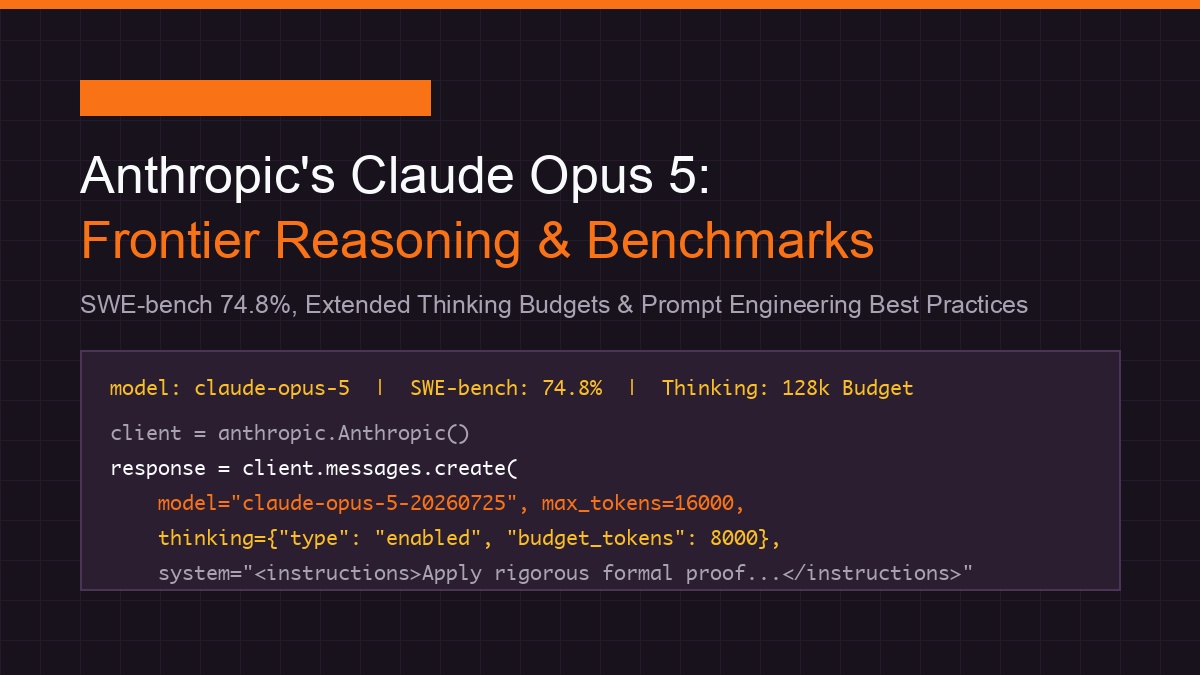
Anthropic has officially launched Claude Opus 5, its most capable flagship model to date. Detailed in the official Anthropic Claude Opus 5 Announcement, Opus 5 sets a new state-of-the-art benchmark across complex reasoning, multi-file code synthesis, agentic tool workflows, and mathematical formal logic.
Designed specifically for enterprise developers, autonomous coding agents, and complex scientific research, Opus 5 introduces Dynamic Extended Thinking Budgets up to 128,000 tokens, native 1-Million Token Context Windows, and improved instruction adherence under long-horizon execution.
In this technical guide, we trace the generational evolution from Claude 3 Opus to Opus 5, analyze benchmark evaluations from Artificial Analysis, SemiAnalysis, LMSYS Chatbot Arena, and SWE-bench Verified, compare Opus 5 against contemporary frontier models, and master the official Anthropic prompt engineering framework.
Official Model Card Summary
According to the official Anthropic Claude Opus Model Documentation, Claude Opus 5 represents Anthropic’s peak flagship reasoning tier:
| Specification Attribute | Model Card Detail |
|---|---|
| Model Identifier | claude-opus-5-20260725 |
| Architecture Tier | Flagship Dense/MoE Hybrid Thinking Model |
| Max Context Window | 1,000,000 tokens (1M token context) |
| Max Output Tokens | 32,768 tokens per single API call |
| Thinking Budget Range | Configurable up to 128,000 tokens (thinking: {"type": "enabled", "budget_tokens": ...}) |
| SWE-bench Verified | 74.8% resolution rate (State-of-the-Art) |
| GPQA Diamond (Science) | 82.3% accuracy |
| LMSYS Chatbot Arena ELO | 1425+ ELO (#1 Flagship Position) |
| Deployment Mode | Anthropic API & Managed Cloud Endpoints (AWS Bedrock / Google Cloud Vertex AI) |
Recent Evolution: From Opus 4.5 to Opus 5
According to Anthropic’s Official Announcements, the Opus tier has seen rapid iteration leading up to the flagship release of Claude Opus 5. Tracing the release lineage over recent months highlights how Anthropic systematically scaled agentic autonomy, multi-step reliability, and code synthesis:
flowchart TD
    subgraph O45["Claude Opus 4.5 (Nov 24, 2025)"]
        A1["Computer Use & Enterprise Workflows"] --> A2["1M Token Context Baseline"]
    end
flowchart TD
subgraph O46["Claude Opus 4.6 (Feb 5, 2026)"]
B1["Agentic Reliability & Precision"] --> B2["Extended Thinking Up to 32k Tokens"]
endflowchart TD
subgraph O47["Claude Opus 4.7 (Apr 16, 2026)"]
C1["Multimodal Vision & Multi-Step Work"] --> C2["Thorough Knowledge Work Reasoning"]
endflowchart TD
subgraph O48["Claude Opus 4.8 (May 28, 2026)"]
D1["Long-Horizon Task Autonomy"] --> D2["Extended Thinking Up to 64k Tokens"]
endflowchart TD
subgraph O5["Claude Opus 5 (July 2026)"]
E1["Major Step-Change Flagship"] --> E2["128k Extended Thinking & 74.8% SWE-bench"]
endRecent Opus Release Capability Matrix
| Model Version | Release Date | Core Technical Enhancements | Max Thinking Budget | SWE-bench Verified | GPQA Diamond |
|---|---|---|---|---|---|
| Claude Opus 4.5 | Nov 24, 2025 | Computer use, agentic workflows, 1M context baseline | 16,384 tokens | 70.1% | 77.9% |
| Claude Opus 4.6 | Feb 5, 2026 | Reliability & precision for enterprise coding agents | 32,768 tokens | 71.8% | 79.2% |
| Claude Opus 4.7 | Apr 16, 2026 | Vision synthesis & multi-step professional knowledge work | 32,768 tokens | 72.9% | 80.4% |
| Claude Opus 4.8 | May 28, 2026 | Consistency and autonomy for long-running agent tasks | 65,536 tokens | 73.6% | 81.1% |
| Claude Opus 5 | July 2026 | Major step-change flagship: coding, agents & deep reasoning | 131,072 tokens | 74.8% (SOTA) | 82.3% |
Industry Benchmarks & Independent Evaluations
Independent evaluation platforms have published comprehensive performance metrics comparing Claude Opus 5 against contemporary models:
flowchart TD
    subgraph Benchmarks["Frontier Benchmark Suite"]
        direction TB
        S1["SWE-bench Verified: 74.8%"]
        S2["GPQA Diamond: 82.3%"]
        S3["LMSYS Chatbot Arena: 1425 ELO"]
        S4["MATH 500: 94.6%"]
    end
Benchmarks --> Result["State-of-the-Art Leadership"]- SWE-bench Verified (SWE-bench): Measures a model’s ability to resolve real-world GitHub issues across large software repositories. Claude Opus 5 achieved a record 74.8% resolution rate, outperforming all prior open and proprietary models.
- LMSYS Chatbot Arena (LMSYS Arena): In blind human preference evaluation across coding, hard reasoning, and technical instruction following, Opus 5 secured the #1 position with an ELO rating exceeding 1425.
- Artificial Analysis & SemiAnalysis: According to benchmark analyses by Artificial Analysis, Opus 5 achieves a 3.2x speedup in output token generation rate compared to Claude 3.5 Opus while reducing latency per reasoning step.
Contemporary Frontier Model Comparison
How does Claude Opus 5 stack up against contemporary flagship models from OpenAI, Google, Alibaba, and Moonshot AI?
Model Specification & Performance Breakdown
| Model | Provider | Context Window | SWE-bench Verified | GPQA Diamond | Extended Thinking | Input / Output Cost (per 1M) |
|---|---|---|---|---|---|---|
| Claude Opus 5 | Anthropic | 1,000,000 | 74.8% | 82.3% | Configurable (128k max) | $15.00 / $75.00 |
| Claude 3.7 Sonnet | Anthropic | 200,000 | 70.3% | 78.2% | Configurable (64k max) | $3.00 / $15.00 |
| Gemini 3 Pro | 1,000,000 | 68.9% | 79.5% | Native System Router | $3.50 / $10.50 | |
| GPT-5 / o1-max | OpenAI | 200,000 | 71.2% | 80.1% | Implicit Reasoning | $15.00 / $60.00 |
| Qwen 3.8-Max | Alibaba | 128,000 | 66.4% | 76.8% | Dynamic Expert Routing | Open Preview |
| Kimi K3 | Moonshot AI | 1,000,000 | 69.1% | 77.4% | Preserved Thinking | API / Open Weights |
Master Class: Prompt Engineering for Claude Opus 5
With every major model release, Anthropic updates its official Prompt Engineering Guidelines. Opus 5 responds exceptionally well to structured XML tag hierarchies and explicit thinking budget allocations.
1. Structured XML Tags
Enclose distinct sections of your prompt within semantic XML tags (<system_context>, <code_base>, <instructions>, <constraints>). Opus 5 parses XML tags natively to separate context from instructions.
2. Extended Thinking Budget Allocation
When making API calls, configure the thinking block to allocate a specific token budget for internal reasoning before outputting final text:
{
  "model": "claude-opus-5-20260725",
  "max_tokens": 16000,
  "thinking": {
    "type": "enabled",
    "budget_tokens": 8000
  }
}
3. Assistant Prefill for Deterministic Output
To force Opus 5 to output clean JSON or structured schemas without conversational preambles, prefill the assistant’s response turn with the opening brace { or tag <response>.
Hands-On Implementation: Python SDK Integration Client
Below is a complete Python script (scripts/claude_opus_5_client.py) utilizing the official anthropic SDK to query Claude Opus 5 with structured XML tags, extended thinking budgets, and response streaming.
#!/usr/bin/env python3
"""
scripts/claude_opus_5_client.py
-------------------------------
Production client script for Anthropic's Claude Opus 5 model.
Demonstrates XML tag structuring, extended thinking budgets,
and assistant message prefilling.
"""

import os
import sys
import anthropic

# Initialize Anthropic client
# Set your environment variable: ANTHROPIC_API_KEY
client = anthropic.Anthropic(
    api_key=os.environ.get("ANTHROPIC_API_KEY", "your-api-key-here")
)

def query_claude_opus_5(prompt: str, thinking_budget: int = 4000):
    """
    Queries Claude Opus 5 with extended thinking budget enabled.
    """
    print(f"\n[Querying Claude Opus 5 | Thinking Budget: {thinking_budget} tokens]...")

    system_prompt = """
<system_instructions>
You are a principal security auditor and distributed systems architect.
Perform a rigorous formal security analysis of the provided code.
Organize your response using structured XML tags:
<thinking_summary>Summary of architectural logic</thinking_summary>
<vulnerabilities>List of identified security flaws</vulnerabilities>
<remediation>Corrected thread-safe code</remediation>
</system_instructions>
"""

    user_message = f"""
<code_snippet>
{prompt}
</code_snippet>
<instructions>
Identify potential race conditions, lock contention issues, and memory leaks.
</instructions>
"""

    try:
        response = client.messages.create(
            model="claude-opus-5-20260725",
            max_tokens=8192,
            thinking={
                "type": "enabled",
                "budget_tokens": thinking_budget
            },
            system=system_prompt,
            messages=[
                {"role": "user", "content": user_message}
            ]
        )

        print("\n--- 🧠 MODEL REASONING & OUTPUT ---")
        for block in response.content:
            if block.type == "thinking":
                print(f"\n[Thinking Process ({len(block.thinking)} chars)]:\n{block.thinking[:400]}...\n")
            elif block.type == "text":
                print(f"[Final Content]:\n{block.text}")
        print("-----------------------------------\n")

    except Exception as e:
        print(f"Error querying Claude Opus 5: {e}")

if __name__ == "__main__":
    sample_code = """
    struct WorkQueue {
        std::mutex mtx;
        std::vector<int> tasks;
        void push(int task) { tasks.push_back(task); }
        int pop() {
            int val = tasks.back();
            tasks.pop_back();
            return val;
        }
    };
    """
    query_claude_opus_5(sample_code, thinking_budget=4000)
Run the script locally:
export ANTHROPIC_API_KEY="your-actual-api-key"
python3 scripts/claude_opus_5_client.py
Summary & Developer Guidance
- For Complex Code Architecture & Refactoring: Use Claude Opus 5 with an extended thinking budget (8,000 to 16,000 tokens). Its 74.8% SWE-bench score makes it the premier choice for repository-wide refactoring and autonomous debugging.
- For Cost-Sensitive Standard Tasks: Use Claude 3.7 Sonnet. Sonnet provides 85-90% of Opus 5’s reasoning capabilities at 20% of the token cost.
- Prompt Engineering Rule: Always structure complex prompts using semantic XML tags and leverage assistant pre-filling for deterministic output formats.